Grant Tracking in CRM vs Dedicated Fund Management Software
CRMs handle grant cultivation; compliance and restricted funds demand their own software.
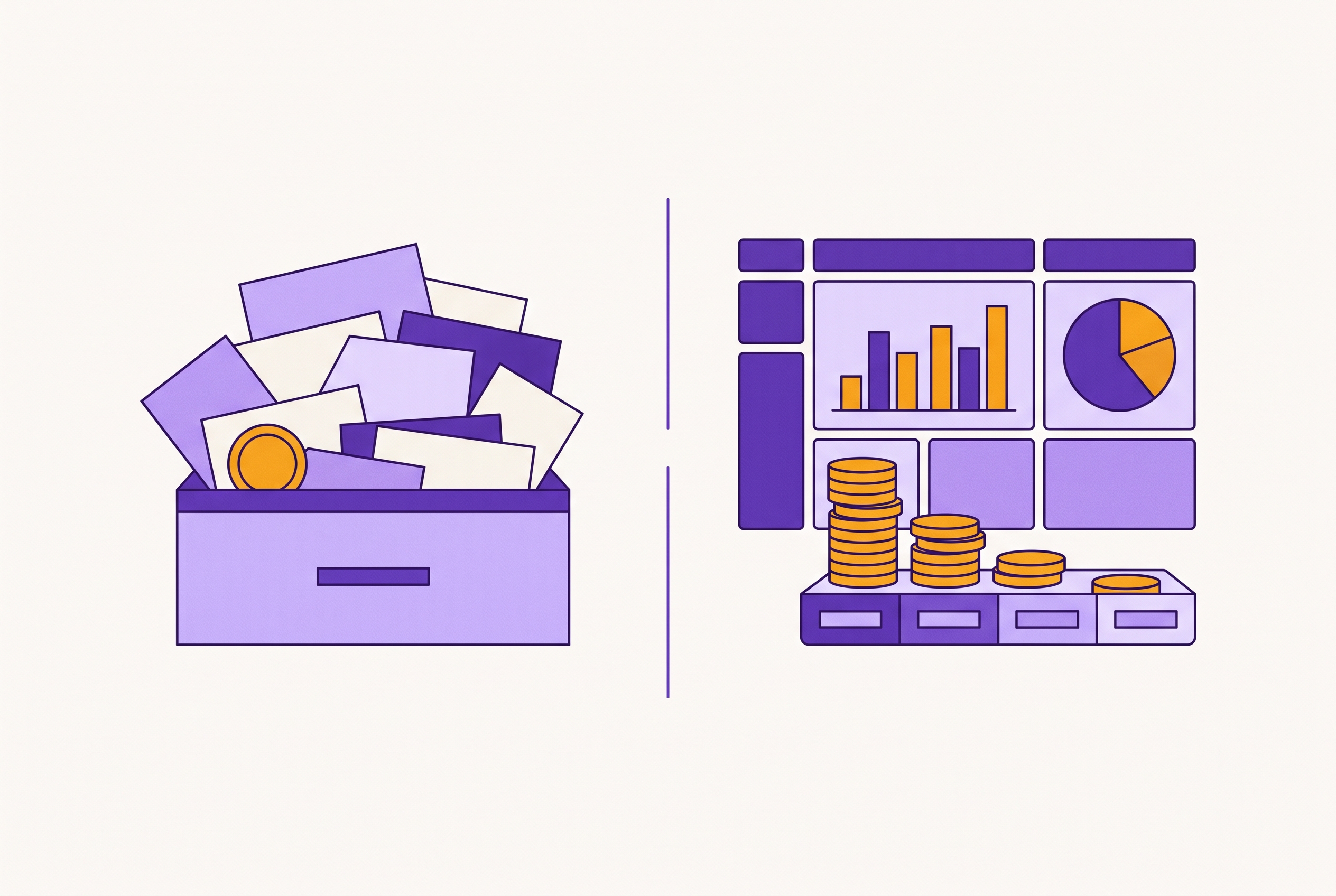
A leader may frame it as, “Can our CRM handle grants?” but that single-sounding question actually contains two separate tasks. Before funding is awarded, teams cultivate relationships and manage the pipeline, while afterward they handle compliance, track restricted funds, and stay audit-ready. Each side runs on its own rules, cadence, and technology. That split points a nonprofit toward the right choice.
Zeffy's 2026 guide divides the market into two tool categories: grantmaker systems and nonprofit tracking solutions, each built for separate audiences with separate needs. This does not reflect an incomplete tool. It is structural.
Securing grants depends on relationships: locating funders, nurturing those ties, monitoring submission phases, and organizing draft proposals. Potential funding opportunities flow into a tracking system, advance through defined steps, and ultimately succeed or exit the process. The pipeline metaphor behind CRMs fits this work. Each connection moves inward, advances step by step, and turns into a win. That is how cultivation works.
After an award, the work becomes compliance work. It involves monitoring restricted balances, tying spending back to the award budget, keeping reports on schedule, and maintaining records ready for audit. At this point, pipeline logic does not apply, and nothing converts. The funds are already in hand, bound by requirements that must be met exactly. The metaphor falls apart.
To handle restricted funds, nonprofits typically rely on three separate platforms: discovery software, pipeline tracking, plus a CRM or accounting package. The true difficulty lies in ensuring smooth transitions among those three platforms rather than merging them together. Acknowledging these as two distinct tasks helps organizations select appropriate software for both.
What CRMs are actually built to do, and where they stop
CRMs are built around managing supporter connections and the flow of fundraising work. For nonprofits, that includes following donors and supporters over time, recording prior interactions, running outreach by email, coordinating events, sending thanks for gifts, and tracking each opportunity’s stage. Those are real strengths. When a CRM keeps a long view of a donor’s record, giving behavior, and involvement, it is serving its intended purpose effectively.
Such strengths make CRMs a natural asset when nurturing grants. Program officers at foundations represent relational ties, and past interactions with funders carry weight. Monitoring a potential donor's progress through the development stages aligns perfectly with how these systems operate.
Insightly's nonprofit CRM write-up points out that these platforms mostly stick to gift tracking and fundraising, leaving aside things like running programs, coordinating volunteers, and keeping tabs on services. The grant pipeline tools they offer tend to be surface-level too. They're built for one main job, and pushing them past it takes them out of their lane.
CRMs leave clear grant-management gaps: they do not track restricted fund balances natively, connect spending records to award budgets, or manage reporting due dates at the level compliance requires. CRMs cannot trace how funding choices were made, since they record relationship history rather than decision history. Foundations running grantmaking programs also miss out on portals for applicants and tools for reviewers to assign scores. All these shortcomings stem from one design reality: CRMs follow relationship pipelines, a structure ill-suited to compliance tasks.
This does not fault the category. It simply explains the category’s purpose. The problem begins when a CRM is expected to cover tasks outside its design, leaving teams to fall back on spreadsheets, reconcile numbers by hand, and keep the finance director late ahead of every reporting cutoff.
What post-award compliance actually requires from software
Compliance obligations following a grant award create particular operational demands extending past mere record-keeping. Restricted funds require careful separation and detailed monitoring, since program-specific money must stay apart from general operating resources. The system must track spending linked to each grant and the cost categories permitted by individual funders. Recognizing Grant revenue follows different rules than how typical gifts are booked, so the platform must reflect that. Deadlines for reporting must be tracked per funder rather than through one shared schedule. To satisfy auditors, the system must document every authorization, outlay, and its supporting proof.
Mistakes here hit the organization quickly and in dollars. When restricted funds are tracked poorly, the result can be audit failures, inaccurate net-asset reporting, repayment demands, a suspended award, and ineligibility for future funding. The danger is real. It shows up when award dollars blur into operating cash or a cost cannot be tied back to the grant that funded it. In Zeffy's guide, the often-overlooked post-award task is keeping restricted grants separated and traceable. Real work starts after the award is won and before closeout, precisely where generic tracking tools are weakest.
Most software completely overlooks the most fundamental requirement. To work, purchasing workflows must have spend controls and fund accounting rules built directly into them. Safeguarding restricted dollars must happen prior to any disbursement rather than during later reviews. Neither CRMs nor the majority of grant trackers satisfy this requirement unless they incorporate a dedicated fund accounting component. Such tools must intervene right after an order is approved but before funds transfer, applying those limits when they count. Falling short turns oversight into a retroactive matching task, the exact phase where mistakes remain hidden until an auditor uncovers them.
What dedicated grant management software handles that CRMs don't
Grant management software is built to follow the funding lifecycle, not the relationship pipeline. Because of that orientation, these tools handle post-award obligations natively, while CRMs generally need extensive customization to do the same. A CRM asks, “what is our relationship with this contact?” A grant tool asks, “what stage is this award in, and what does it require right now?”?
Those core jobs are precisely what specialized software manages out of the box, reflecting that focus. Pipeline tracking moves a grant from initial research and writing through submission to final award or rejection. Sponsors trigger LOI, full proposal, and reporting reminders through deadline management. Document and answer libraries store reusable boilerplate, past proposals, plus supporting attachments sorted per award. Restricted-fund tracking logs spending, while funder reporting assembles the required submissions. Audit trails on funding decisions reveal each reviewer, every approval granted, and all attached stipulations.
Grantmaking organizations face a further layer of complexity. Foundations must manage applications, score reviews while flagging conflicts of interest, schedule payments, and monitor grantees. CRMs can only come close to this workflow after heavy customization, since the core task is managing decisions rather than relationships. When a foundation evaluates applications, it is not cultivating prospects. It is administering formal reviews with oversight embedded throughout.
Dedicated grant tools picked up AI before CRMs did. Grant-focused AI today spans finding suitable funders, screening for eligibility, drafting proposals that build on earlier submissions, and reporting after awards are made. General nonprofit CRMs have not matched this depth, because these features depend on data models built around grants, which CRMs lack.
This is where integration matters. Specialized grant platforms do not function as complete operating systems. Such platforms typically depend on separate CRM software for managing donors plus dedicated tools to handle fund accounting. The real value lies in seamless data transfers rather than total system replacement. Such software succeeds by delivering accurate financial information to the ledger. Attempting to serve as the ledger instead means neither task gets handled competently.
Foundant’s GrantHub served many organizations as a tracker built for grantees. With service ending January 31, 2026, Foundant gave users no choice but to move to another platform first. For a lot of nonprofit teams, the closure forced a long-delayed decision: what platform best matches today’s grant work? As many organizations reconsider their software choices, the platform comparison that follows is especially timely now.
Potential funding opportunities flow into a tracking system, advance through defined steps, and ultimately succeed or exit the process.
How the leading platforms compare for nonprofit grantees
No platform manages every stage of a grant on its own. Each tool excels in different areas while forcing teams to source missing capabilities elsewhere. The following analysis measures every option against the criteria outlined earlier.
Phantom Farm best serves nonprofits looking to manage grant tracking and fund accounting together. By tying grants to the accounting ledger, it lets teams view restricted fund balances, supporting spend records, and reports for funders without reconciling them elsewhere. This is the specific weakness outlined earlier, and Phantom Farm is built to address it. It fits teams whose toughest work begins after awards are made: keeping restricted funds separate, staying audit-ready, and handling funder reports at scale. Its greatest value shows up when finance and development can rely on one shared dataset instead of passing exports back and forth.
Instrumentl works well for organizations that want discovery-through-management workflows in one place. It brings together grant discovery, AI-assisted proposal drafting, application tracking, and post-award budget tracking on a single platform. Post-award budget tracking sits behind the Full Lifecycle plan rather than every tier. Organizations using Salesforce, Raiser's Edge NXT, or Virtuous CRM can link Instrumentl to their existing setup. Its post-award controls are less extensive than platforms with built-in fund accounting, and teams still need a separate accounting system to track restricted balances in the general ledger. Because Instrumentl lacks a built-in donor CRM, teams must handle donor relationship management in another system. If the main requirement is purpose-built grantseeker tracking, Instrumentl comes closest to replacing GrantHub’s functionality.
Bloomerang fits organizations that already use it for donor management and need one place to monitor grant opportunities. Grant tracking sits inside its broader donor-management CRM, not in a separate compliance platform. It lacks restricted-balance tracking, full compliance-level scheduling for grant reports, and award-period spending report generation. Teams overseeing active awards should use a second tool to handle compliance after award. It works best for low grant volume when teams mainly need one system for both grant and donor records.
Agentforce Nonprofit gives Salesforce the power to handle grant compliance, but configuring it is expensive. NPSP still gets support, just no new features. Nonprofit Cloud became Agentforce Nonprofit in October 2025, marking the platform's current development direction. Neither path handles grant management out of the box, so teams must build their own objects and workflows or buy external apps. Larger nonprofits with in-house technical teams or funds for ongoing consultant support are the ideal candidates. The license price is where spending starts, not where it ends.
How to match the right tool to your organization's actual situation
Choose software by first finding where grant workflows are breaking down, rather than starting with feature lists or cost. Even when two organizations share a budget and mission, each may require a different tool because its failure point is different. A clear diagnosis matters more than a side-by-side table.
Grant volume differentiates organizations more than most expect. Having under five active grants with straightforward funder demands represents one scenario. Managing ten plus grants with distinct outcome measures and varied timelines is a completely different matter. What succeeds at a smaller volume does not merely slow down when the volume grows. It breaks down.
Compliance obligations raise the standard for being audit ready. The evidence the software must produce shifts when federal awards, pass-through funds, or multi-year restricted grants are involved. In each case, the documentation bar rises, and software that falls short will break down at the audit moment.
Start with where the breakdown is now. Missed deadlines and opportunities signal trouble before the award. Trouble tracking restricted fund balances or generating funder reports through manual reconciliation signals a problem after the award. These point toward different solutions.
The technology already in place limits what is feasible. An agency's existing CRM or irreplaceable accounting platform dictates whether the grant software must connect to those systems or function as the primary hub. Choosing Salesforce means securing either in-house expertise or funding for outside consultants. Purpose-built platforms demand minimal setup yet still require someone to manage the data.
Use the profiles below to diagnose needs rather than as instructions to follow. For an organization managing under five live grants and mainly needing to see its pipeline and monitor due dates, a simple grant tracker or CRM configured for grant opportunities will likely be enough. At that size, linking the system to fund accounting can wait. As nonprofits move into mid-size operations, expanding grants, restricted dollars from several funders, and disconnected development and finance workflows create compliance risk after funds are awarded. Phantom Farm's positioning is most relevant when the solution ties grant oversight straight into fund accounting.
An organization built mainly on donor relationships with few grants can track them inside its current CRM, like Bloomerang, accepting limited compliance depth. Such an approach makes sense when the volume of grant activity remains minimal. Teams currently using GrantHub need to move before its shutdown, and Instrumentl offers the nearest equivalent for tracking from a grantee perspective. Bigger nonprofits facing intricate, enterprise-level demands and holding a technical budget might consider Salesforce Agentforce Nonprofit workable, yet only once they fully cost out setup, tailoring, and data transfer rather than relying on the listed subscription fee.
Start with the integration test now. First, identify today’s restricted fund data systems and see if the tool under consideration can exchange information with them. If the tool cannot do that, the compliance problem remains at the connection point. That single test brings the decision into focus more quickly than comparing features by making the organization state what is actually limiting the choice. Pick the option that fits the organization’s real grant-compliance duties after an award is made.
Sources
- Post-Award Grants Management Software
Informed the article's discussion of post-award compliance requirements, including restricted fund separation, spending controls, and audit documentation demands.