What Nonprofit CRMs Handle That Sales CRMs Can't
Nonprofit CRMs track donor relationships and recurring gifts that sales software cannot support.
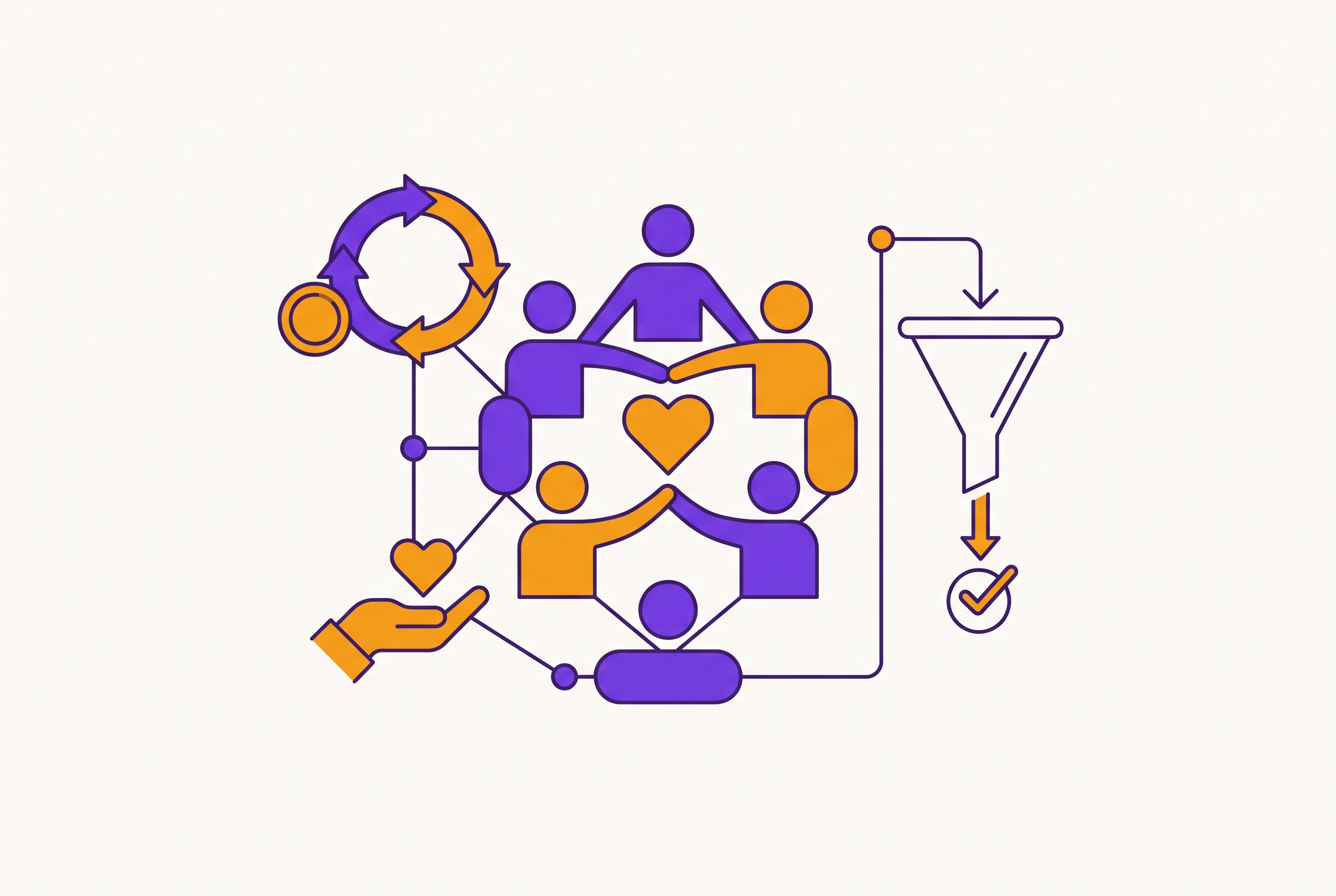
Sales pipelines by themselves fail to track the donor relationships, recurring gift patterns, and stewardship duties that nonprofit CRMs are designed to handle. Smaller organizations trying to adapt sales software must reconstruct its logic for dependable daily use, whereas dedicated platforms arrive with those foundations already built.
Why a sales CRM's core logic makes it the wrong foundation for nonprofit work
Sales software of the CRM kind is built to lead somewhere: the close. A nonprofit relationship has no matching endpoint. In sales, staged pipelines, dollar figures, and likelihoods let teams steer a deal toward a close, while metrics like conversion, pace, and per-rep earnings reveal how smoothly the whole machinery runs. A gift, by contrast, invites thanks, deeper involvement, and ongoing backing.
This distinction reshapes what the system needs to organize. For nonprofits, success hinges on keeping supporters engaged through sustained gifts, long-term value, and regular stewardship, none of which a pipeline field captures well. The transaction still matters, but it is part of a broader relationship. Relabeling a deal as a “donation” does not alter that logic.
What constituent relationships actually look like inside a nonprofit CRM
One person can concurrently hold roles in giving, governance, volunteering, program participation, and major gift cultivation. Every role brings a distinct backstory and set of commitments. Long-term support may sit alongside board duties, recorded volunteer time, and current cultivation. The record needs to track every role, so their full relationship is not reduced to the current transaction.
The relationship network also goes past individual supporters. Each corporate sponsor, donor-advised fund, grant-making foundation, peer-to-peer fundraising participant, and event attendee requires distinct stewardship. A nonprofit CRM links each of those relationships to the constituent record, including giving, email engagement, event participation, calls, finished tasks, and conversations.
Keeping that context means clean records and connected tools for giving, events, and email. Every donation, whether via check, giving page, Facebook fundraiser, or peer-driven effort, must tie back to one constituent record. Without that, the platform fails to display the multi-level connections it was built to maintain.
Gift attribution, soft credits, and tax receipting — the first place a sales CRM breaks
Routine processing is where the mismatch in gift attribution becomes visible. Partners who donate together ought to be credited separately in their own records. For contributions channeled via a donor-advised fund, the fund takes the hard credit and the recommending donor takes a soft credit. When an employer matches a gift, credit the individual’s giving history with that full value to support stewardship, despite the company having supplied the check.
These distinctions matter beyond the way a record appears. Cumulative giving influences major-gift identification, recognition-society thresholds, and stewardship-tier assignments. Incorrect attribution feeds directly into decisions about which relationships to pursue. No general-purpose sales CRM offers native support for soft credits, while bespoke tracking and labor-intensive substitutions leave the process fragile and dependent on staff.
For year-end receipts, the IRS-required language is nonnegotiable, while hand-building them off sales deal records quickly breaks down. A nonprofit CRM can take gift records and turn them into compliant receipts ready to send. The same gift has to be treated one way for attribution and another for receipting, so one amount cannot carry both views.
Recurring gift management and the donor retention problem it exists to solve
Recurring giving turns retention into a system problem and also a relationship practice. Repeat donors tend to stay active, and their regular gifts make income easier to forecast than one-off giving can. Their engagement can last for years. If few first-time donors come back, spending to acquire more without machinery to keep them quickly undermines the finances.
Card-updater logic refreshes old or newly issued card details so donations are not interrupted. When a charge fails, dunning schedules follow-up attempts and donor messages early enough to avoid losing the supporter. Upgrade suggestions draw on prior donations and interaction patterns to identify supporters suited for a higher monthly gift, while risk indicators catch waning involvement before cancellation.
The payment cycle captures just one aspect of the donor relationship. Sales tools, where they exist, treat renewals as transactions instead of representing the ongoing stewardship that sustains donor engagement between payments. Nonprofits also need analysis that spots Last Year But Not This Year (LYBUNT) and Some Year But Not This Year (SYBUNT) donors. Native data models in a sales CRM do not support this kind of standard retention reporting.
Grant management as a revenue stream with no equivalent in a deal pipeline
Skipping a grant report creates a compliance breach. Even with solid donor ties, an organization may face audit trouble when it falls short on grant obligations. Grant revenue should be managed through a system for tracking due dates, limits on use, and report ownership. Getting the award does not finish the work.
That structure organizes each funder record around its preliminary contacts, funding requests, updates, and continuation filings. Submission records capture the package, recipient, submission date, and relevant program priority. Awards remain tied to the appropriate restricted fund designation and are not closed out before every reporting requirement is met. Several teams share the effort: program staff track results, finance handles fund reconciliation, and development completes the reports.
The funder relationship needs to stay in view across all of this work. Foundation contacts turn over, priorities evolve, and stewardship continues after each application. When grant activity lives alongside donor records, teams retain that context and can still see revenue by stream and assess grant dependency. Using a separate spreadsheet or project tool cuts the duty loose from the relationship that makes it manageable.
This distinction reshapes what the system needs to organize.
What volunteer and program management add to the constituent record
Tracking RSVPs, tasks, logged hours, and volunteer shifts reveals dedication that donation amounts alone cannot capture. Someone serving for years without donating might still represent a significant funding opportunity that purely monetary reviews overlook. Participating in initiatives enriches this record, since those receiving help may eventually contribute funds or champion the cause. Connecting program outcomes to supporter profiles hands staff the data they need for grant reports.
CRM coverage for nonprofits still varies beyond fundraising. Program execution, volunteer management, and monitoring services fall outside donor management alone. Insightly bridges this gap by converting deals into projects, transferring completed donations along with their associated information to program delivery staff. This eliminates duplicate data entry and preserves the connection between donations and their funded activities, proving valuable for nonprofits overseeing the initiatives they fund.
The record grows more complex when other support types are considered. Contributions like in-kind gifts, dues, ticket sales, and advocacy efforts each involve distinct fiscal and stewardship obligations that no single transaction figure can reflect. A supporter's profile needs to capture both their specific input and the way it ties them to the institution.
How stewardship workflows differ from sales follow-up sequences
Sales follow-up guides a potential buyer toward closing. Stewardship is about making the relationship stronger over time. Donors feel that difference through each message an organization sends. If gratitude takes three weeks to reach the donor, stewardship has already fallen short, whatever its pipeline stage. The timing of the gift should drive the timing of the thanks, and the personal touch should reflect past giving, engagement, and the age of the relationship.
That distinction governs what happens after the acknowledgment as well. Renewal reminders track when each donor’s gift anniversary arrives, and impact reports show what the gift achieved instead of letting the finished transaction close the sequence. Inconsistent thank-yous are the reason donors frequently give for stopping, which makes a failure to acknowledge gifts at every level a retention liability.
Moves management follows the relationship path from first introduction to cultivation, solicitation, and post-gift care. Appeal segmentation also weighs past donations, reactivation status, donor potential, issue affinity, and preferred outreach channel. Those needs exceed what sales CRMs typically handle through contact filtering.
The real cost of adapting a sales CRM — Salesforce as the instructive case
Salesforce shows the cost of adaptation clearly. Agentforce Nonprofit is its nonprofit offering, known as Nonprofit Cloud until a December 2, 2025 renaming. It spans fundraising, grantmaking, programs, and volunteer work, with nonprofit-specific AI agents included. It is not simply a repackaged commercial platform wearing a charity gloss.
Someone has to model the data, set up objects and fields, design the page layouts, put automations in place, produce dashboards plus reports, and load constituent data. Through certified implementation partners, a standard implementation runs most nonprofits a five-figure investment. Eligible nonprofits get licenses for free, but those licenses don't include implementation.
That dependency stays in place as organizational needs shift. Sustaining those configurations demands either a staff member holding the Salesforce-certified administrator credential or ongoing consultant fees. Only the largest organizations, whose interdepartmental demands outstrip what a specialized donor CRM offers, can justify that expense. Yet for mid-sized and growing nonprofits, the costs of tailoring and maintaining the platform can postpone benefits that specialized tools deliver immediately.
What purpose-built nonprofit CRMs are doing now that widens the gap further
Modern CRMs designed for nonprofits are moving past simple records through predictive analytics paired with responsive fundraising automation. They now stand out not just by tracking nonprofit relationships but by helping teams act on them. What once demanded enterprise wealth analysis or tailored Salesforce builds is now being built into purpose-built nonprofit CRMs. As these tools broaden, sales software is left trying to match them.
Virtuous labels its approach “responsive fundraising.” The platform's predictive analytics recommend how large a gift to ask for, its social profile enrichment draws on public data sources, and its marketing tools react to signals in how donors behave. What matters is that these capabilities tie back to the donor relationship the system already holds. This is not generic automation bolted onto a contact database.
Enterprise platforms are advancing their nonprofit capabilities too. So the distinction is not who can get the intelligence, but the effort needed to actually use it. As expectations for such tools in sector-specific systems grow, most organizations will see little point in adapting an enterprise product merely to gain them.
Where the “just use a sales CRM” approach still has a defensible case — and where it does not
Adaptation becomes most defensible when a CRM designed for nonprofits can no longer support how complex the operation has become. In large hospital networks, grateful patient programs may have to tie clinical records to fundraising data. Advancement teams at universities may oversee thousands of major-gift prospects, using detailed guidelines to allocate ownership and draw territories. Advocacy groups may also need systems that monitor federal compliance while supporting constituent action tools.
If Salesforce administration is already staffed for work outside fundraising, adding the nonprofit layer costs less at the margin. Smaller but expanding nonprofits, however, may have an immediate need for soft-credit tracking, gift receipts, donor-retention reporting, and recurring-gift workflows. Recreating those capabilities means taking on expense before the work gets easier. If no technical staff are available and the development director carries day-to-day use, the team may end up relying on outside configuration more than it can sustain.
One boundary holds no matter which CRM is picked. Donor platforms such as Bloomerang, Neon CRM, DonorPerfect, Givebutter, and Little Green Light manage supporters and contributions. Meeting FASB ASC 958 rules and handling restricted funds call for a different application, usually QuickBooks or a platform built for nonprofit bookkeeping. Logging a restricted gift inside the CRM is no substitute for that bookkeeping role.
So for smaller nonprofits, the real question is which dedicated CRM matches their scale, revenue approach, and service requirements. Larger institutions can still justify custom builds once their demands outgrow standard options. But organizations shouldn’t automatically rely on it just to handle everyday operational essentials.