ActiveCampaign Review for Marketing-Driven Sales Teams
Automation builder and CRM pairing makes it worth the cost jump to Plus and beyond.
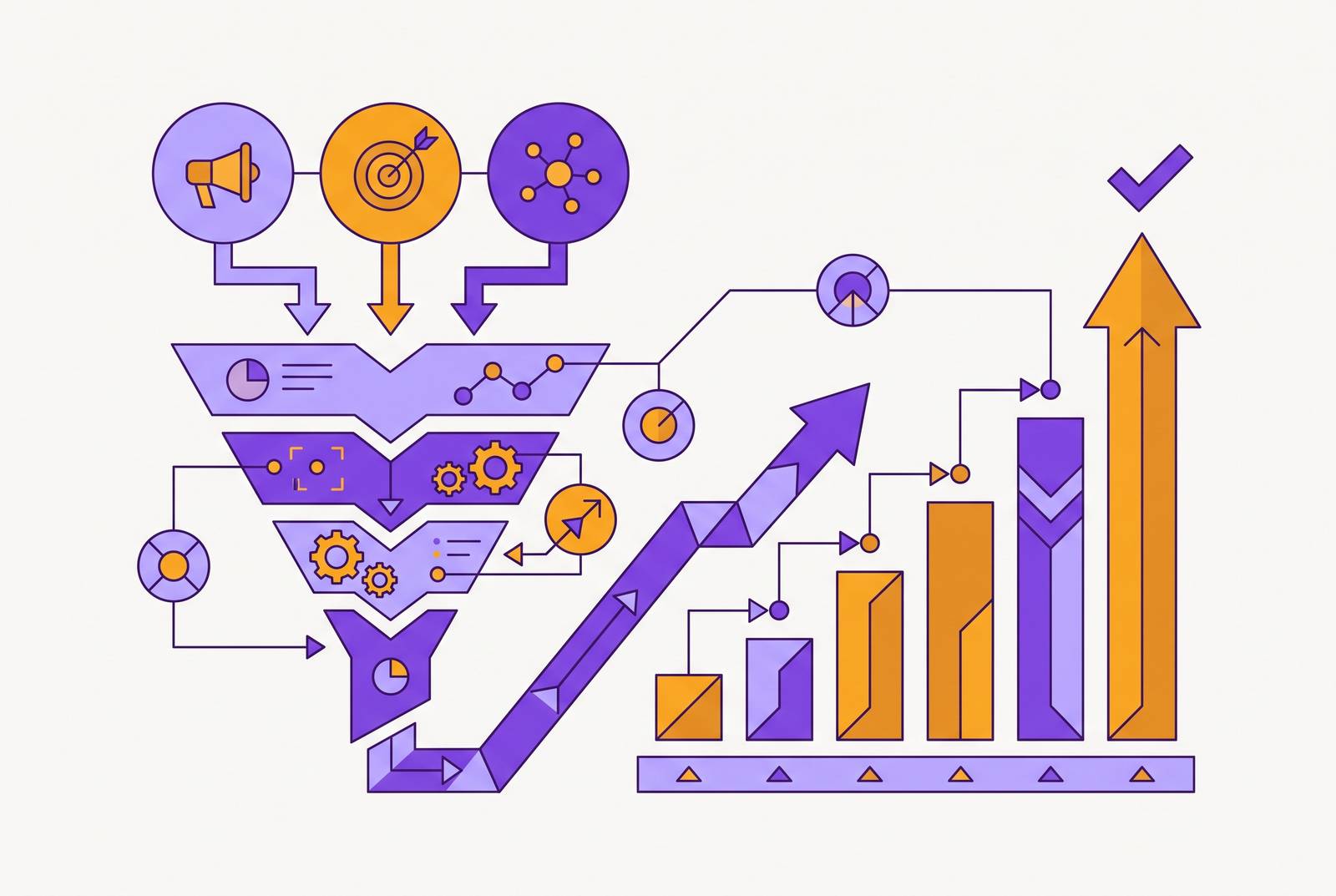
Marketing-driven sales teams pick the platform for ActiveCampaign's automation builder, yet that same tool often ends up on a tier where it hardly functions. The firm, founded in Chicago in 2003, bet on one core belief: sales and email flows should take care of themselves once a user picks the steps. Today it counts over 180,000 businesses across 170 countries as customers, with a substantial sum raised and a 2021 round that put its worth above $3 billion. Its reach places it between Mailchimp and the pair of HubSpot and Marketo: lower-cost with a focus on automation, but with fewer CRM and reporting features compared to some enterprise tools. This piece looks at how the automation stacks up against the rest of the tools.
The automation builder, the feature that defines the platform's value
Longtime customers explaining why they stick with ActiveCampaign return to one place: the automation builder. People across the platform's user community name this tool first when explaining their retention, and you see why the moment you check what it can do. With more than 135 triggers and 900 pre-built options, a team can create automations tied to customer actions, site activity, messages, and pipeline updates without technical help.
What makes it different from basic email tools is split-testing automation elements, not just a subject line or button color. What sets it apart is split-testing full automation paths rather than just a subject line or button color. A team can compare both complete nurture sequences and have the results choose the better path, a structurally distinct optimization from trying one email alone. When a sales team needs marketing to get people ready before anyone calls, this proves the whole flow does its job rather than leaving them guessing.
On Starter, though, that matters little. Automations there cap at 5 steps, so the builder is more a sample of the platform’s power rather than a tool for serious work. The real starting point here is Plus, priced at $49 monthly. Those evaluating ActiveCampaign mainly for automation should view Starter as a sample tier rather than a workable option.
How the CRM functions within a sales workflow driven by marketing
Starter includes a marketing CRM, but most sales teams get the tools they rely on, Sales Engagement and Pipelines, only through an add-on with Plus or higher. This matters. For a sales group led by marketing, the CRM joins what the software creates with a salesperson's next step, and choosing the bad plan leaves that link stuck.
When it does the job, it nails it. The deals tool covers pipeline, notes, booking, and messaging contacts, and links to automation so a move along the pipeline pushes work forward without anyone reaching for a spreadsheet. It uses engagement and what people do, so marketing gives sales contacts who've acted interested, not someone from the webinar list. Starting at Pro, the Predictive Win Probability tool provides an AI-generated estimate for each deal using its attributes and how comparable ones ended before, so reps can prioritize follow-up rather than just moving down the pipeline.
Marketing and deals stay linked on their own, and competitors can't match that without middleware. But it only goes so far. Some users report that the CRM may not fully support complex sales workflows. It can't step in for Salesforce, and that wasn't the goal. Advanced features like forecasting and territory planning are not part of the platform.
For any marketing-driven sales team, ActiveCampaign's CRM covers pipeline visibility and prioritization, plus structured follow-up, using what marketing automation already holds on someone. If the sales org requires forecasting or territorial logic managed by a dedicated enterprise CRM, allocate funds for an additional solution and the integration effort of maintaining parallel systems.
Active Intelligence and AI capabilities: their functions, the tier unlocks granting access, plus any supervision still required.
Active Intelligence arrived in May 2025, starting out on Pro and Enterprise accounts only. In October 2025, it reached every admin account across all tiers, a change more important than it seems: any earlier assessment covers a narrower version than the one available today.
Everything here squarely serves the handoff between marketing and sales. Segments finds valuable customer groups in behavior records without someone setting rules themselves. The Automations tool generates a complete multi-step nurture sequence from one prompt, which speeds up setup for a team already clear on its goal, but someone should still review the logic before launch, because no AI-built workflow is safe to leave unsupervised at the start. The AI Campaign Builder creates subject, preheaders, email text, CTAs, and pictures from one prompt, while AI Brand Kit can take brand materials from a URL to stay on-style.
Predictive Sending schedules each email around a contact's habits rather than one fixed moment, and ActiveCampaign claims better results, though outside stats mix up open-rate and click-through gains based on where they come from, so before citing an exact value, check which metric that claim is actually repeating. AI Performance Intelligence works all the time behind the scenes, measuring campaign and automation performance using platform-wide signals.
Structurally, the MCP Server matters more because it gives AI tools like Claude, ChatGPT, and Cursor access to an ActiveCampaign account for handling contacts, starting automations, and reading campaign stats without loading ActiveCampaign. A dedicated Claude connector arrived in November 2025. A team already using its AI tool for regular tasks can handle ActiveCampaign workflows and data without moving between apps. It frames the platform as the foundation for agentic marketing, not just somewhere to put campaigns together, and the line between what ActiveCampaign handles on its own and what a team can build on top of it through these links matters. The same qualifier fits here: Active Intelligence gives a starting point, and someone still has to review it.
Pricing tiers, what each one unlocks, and the contact-billing update that shapes actual spend
The tiers are priced at 1,000 contacts with yearly billing. Starter starts at $15 monthly and covers email marketing and one user, with limited automation steps. At $49 monthly, Plus lifts the five-action limit and includes AI writing tools and a CRM upgrade, so sales crews should pick it over Starter. Pro costs $79 monthly and adds predictive sending, more detailed analytics, attribution reporting, plus omnichannel automation and 3 user accounts. Enterprise costs $145 monthly for enhanced safety, regulatory tooling, top-tier integrations, dedicated help, and five user accounts, with custom pricing when a list gets big.
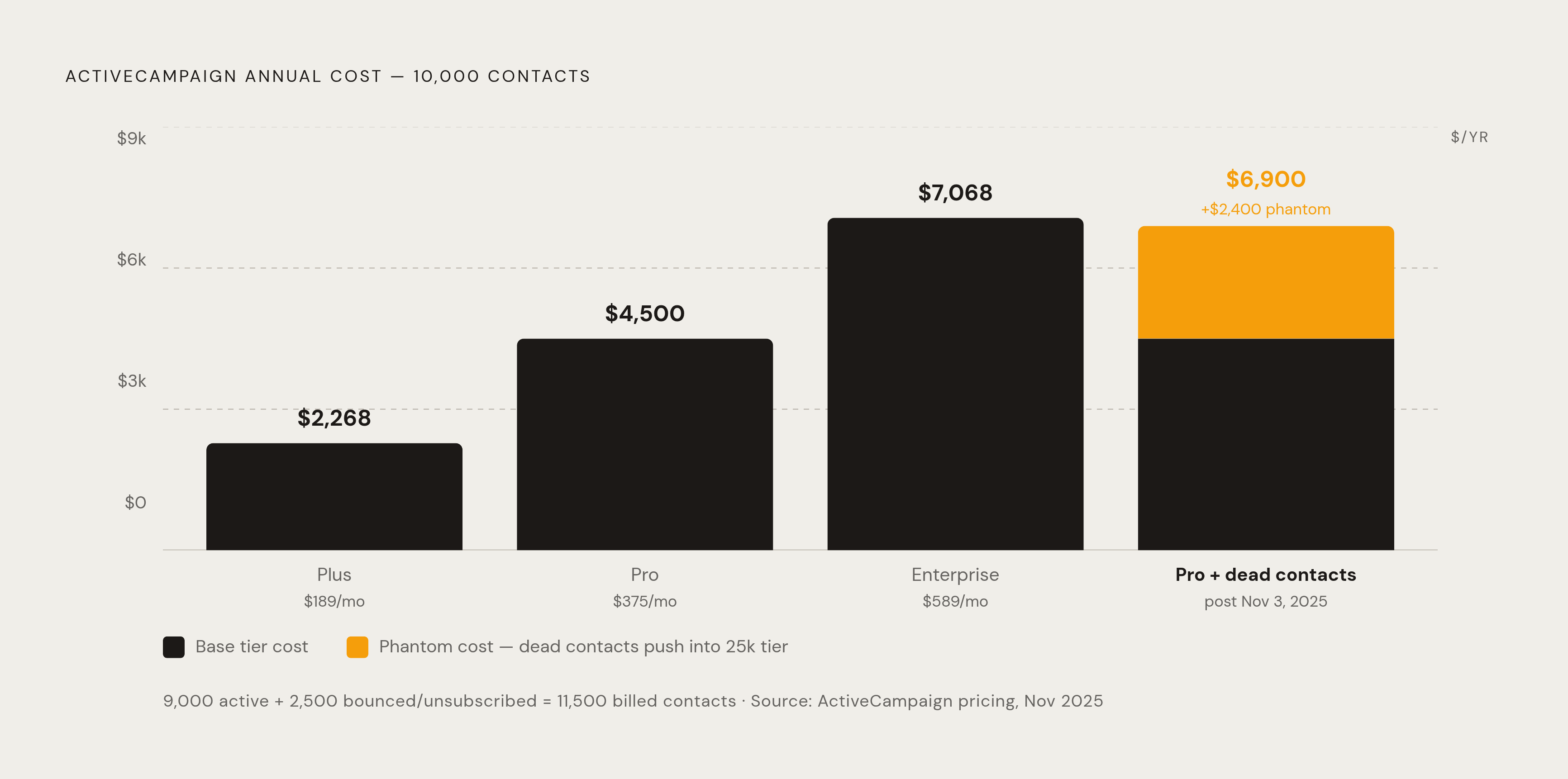
Pricing climbs a lot as the list grows. With 10,000 contacts, Plus costs $189, Pro costs $375, and Enterprise costs $589. That's why a billing update from 2025 needs careful review before signing up.
Accounts opened from November 3, 2025 onward are billed for every person in the account, even those that are bounced, unsubscribed, or unconfirmed. Accounts created earlier still get active-only billing through the clause. Picture a list holding 9,000 active contacts plus 2,500 dead addresses: the 11,500 total pushes that account beyond the 10,000-contact tier into the 25,000-contact tier, tacking up to $2,400 onto the annual bill for contacts no one can email.
The straightforward answer comes before cleanup: remove long-dead non-engagers, unsubscribes, and bounces from a list before it touches ActiveCampaign, because the billing baseline starts when those contacts arrive. The archive is only a partial fix, and it has rules too: a cap on contacts archived each month, twelve months before deletion, and 30 days to retrieve someone pulled out. Mailchimp has long billed for unsubscribed contacts, so ActiveCampaign's approach is not unprecedented. But it surrendered that edge against Mailchimp, so any team budgeting around the platform must build list hygiene into cost-control.
For a sales team focused on marketing, Plus is the practical minimum. Pro earns its cost when attribution reporting and predictive sending help the team prove marketing's role in revenue. Starter doesn't really fit this use case, no matter what the sticker says.
What getting up to speed adds to the fee
Outside sources agree on the same span: 2 to 4 weeks at least before a group knows the core tools, and additional time before users can create complex workflows effectively. EmailToolTester says a team that just wants a newsletter or basic drip campaign is wasting money on features it won't use.
Deliverability stays strong once a list is properly prepared, above the about 83% industry rate for inbox delivery. But that figure assumes authentication, list hygiene done right, and a completed warm-up, all of which drag out onboarding instead of running on their own when an account first goes live.
Certain teams absorb that curve with little trouble. One is a team migrating from a simpler platform with its workflow chosen, ready to translate it into the logic of ActiveCampaign. The second kind of team has one member learn the tool and try things out before sharing it company-wide. Teams that bypass it and put logins in every marketer's hands often get little value from the platform for a long time.
How marketing-sales teams track performance and results
Reporting covers plenty, from link heatmaps and geo-tracking to site views, plus automation performance alongside campaign metrics, with revenue attribution shown through customizable dashboards offering real-time numbers. On top tiers, order data plus revenue attribution gets more detail via Shopify, WooCommerce, BigCommerce, and Square integrations, and matters mostly for ecommerce-adjacent sales teams, not a B2B pipeline with extended sales cycles.
theMarketingAgency rated the analytics highly, and that metric-level detail justifies it. Visualization starts to look thin here, though: the pictures are simple, performance slows on bigger databases, and no part can take the place of a dedicated BI tool when a team has to make custom dashboards for executives.
When aligning marketing and sales, the sharper issue lives in the tier layout. Revenue attribution, reporting that proves marketing's impact on deals, is only available with Pro or higher. On Plus, a team sees campaign metrics like opens, clicks, and conversions, but needs upgrading to tie them to revenue. For a team proving marketing's worth to the CFO, this isn't a cosmetic limitation.
What multi-brand teams and agencies should check before picking ActiveCampaign
An ActiveCampaign account is designed for a single company, not multiple ones. Agencies with several customers on basic accounts have to keep track of different logins, keep duplicating templates for each one, and can't do much when something spans accounts, a problem third-party reviews often bring up about how they use the platform.
ActiveCampaign offers ActiveCampaign HQ (ACHQ) as a dedicated solution for this specific challenge. There's a a one-time setup fee, and the ongoing cost only gets shared during a sales conversation instead of appearing on a public price list. The fee buys 90-day onboarding with hands-on coaching, help from a dedicated Customer Success Manager, and no-cost transfer of current email contacts, documents, templates, landing pages, and automations. After setup, it allows a company to bring in and reuse brand assets, designs, and copy in each customer workspace instead of making the same message again.
ACHQ is designed for agencies managing multiple client accounts. Against the platform's more than 180,000 customers, ACHQ is a focused, higher-touch tool for agencies that can make setup pay off, not something most users will use.
Beyond ACHQ, the partner track includes recurring revenue, custom billing, white-labeling, and a dashboard for tracking customers, with rewards scaling alongside the revenue a company manages. Agencies can sell ActiveCampaign below list price or pass along leads for a cut. They rebuilt the Partner Portal in 2025 because agencies asked for it, folding Active Intelligence into the mix and upgrading tools for client visibility, which shows this part of the operation gets actual money rather than being an afterthought.