Pipedrive vs HubSpot for Small Sales Teams
Pipedrive wins on price and speed; HubSpot on integrated marketing and AI.
When a small sales team weighs Pipedrive against the platform people label a marketing-first CRM, it hinges on one thing: is the team purely sales-only, or do they need marketing and sales working off the same customer file? Pipedrive handles the first scenario quickly and on a budget. The larger suite handles that case, with a price and setup time worth it only when marketing and sales need the same data. The AI tools, reporting detail, and integration numbers all sit downstream of that choice.
What sets HubSpot and Pipedrive apart
Salespeople made Pipedrive for other salespeople, and the product proves it. Every page is built to push a deal forward. No marketing hub fights for homepage space, no service team takes developer time, no CMS makes a rep plan articles. That narrowness cuts setup time down to almost nothing: most teams import their contacts, set up a pipeline, and start working deals inside a single day.
The other platform was a marketing automation tool in 2006, and got a CRM layer only in 2014. It's grown into a suite covering Sales Hub, Marketing Hub, Content Hub, Service Hub, Data Hub, and Revenue Hub, each one working off the same shared pool of records. The whole idea: after a marketer nurtures a contact for a quarter, it lands with the sales rep's full history in place, with the reporting on top spanning both teams rather than cutting off at sales.
Both tools fall short the same way on LinkedIn. Pipedrive doesn't include a built-in LinkedIn integration. That platform has one, with InMail logging via Sales Navigator on premium tiers only, but it doesn't handle automated outreach sequences. Every B2B team prospecting through LinkedIn needs another tool, regardless of which CRM sits below it.
Pipedrive's tight focus is still a feature, not a bug. That's the whole appeal, until a team's marketing and sales have to work from the same source.
What each platform charges a team of five salespeople in 2026
Pipedrive's 2026 plans start at $19 for Lite, then $34 Growth, $64 Premium, and $89 Ultimate, all per user monthly. Lite handles pipeline management, uses AI to make reports, and shows a live sales feed. Growth brings complete inbox integration, workflow triggers, revenue projections, and a booking tool. Premium includes prospect assignment, tailored ratings, AI help across several inboxes, and signable agreements. Ultimate comes with data enrichment, more access controls, and bigger usage caps.
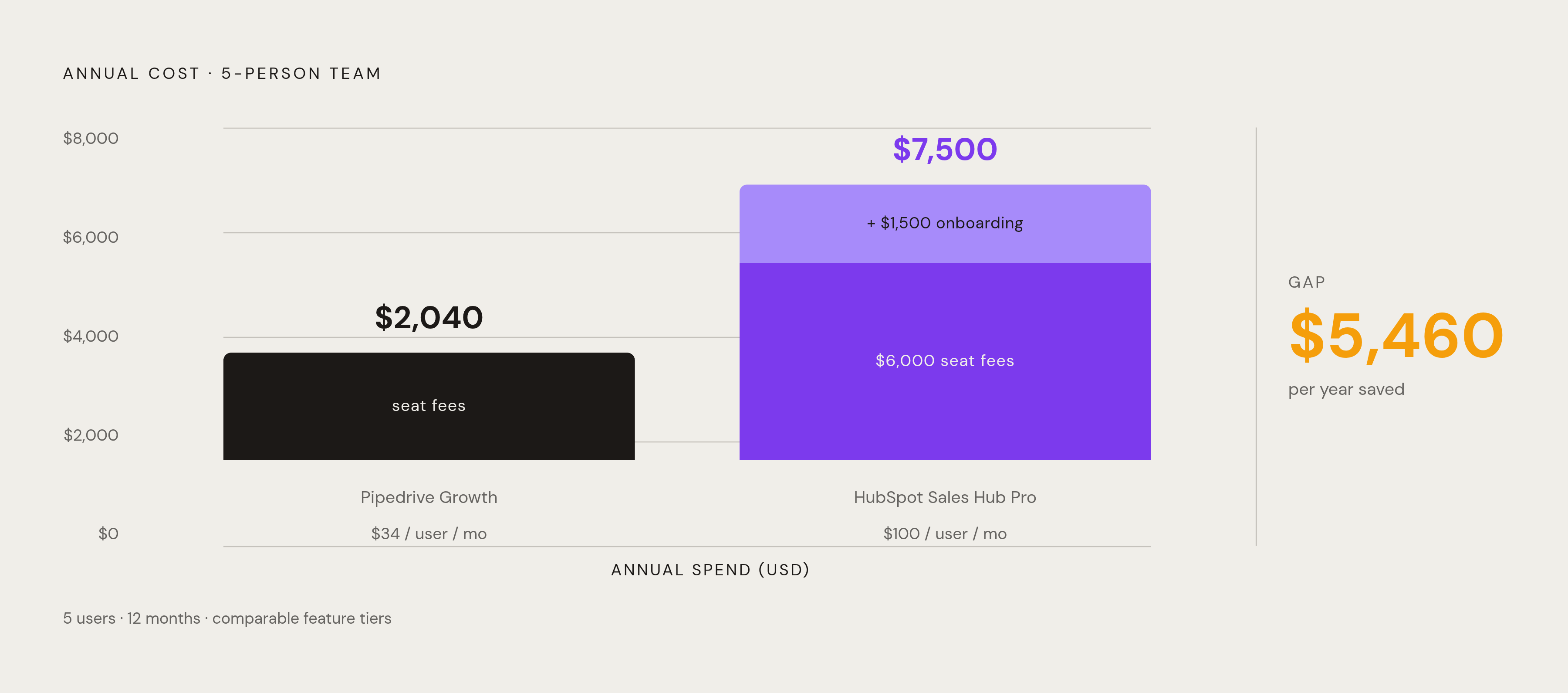
The Sales Hub on that other platform charges per user too: Starter is $20, Professional $100, Enterprise $150. Starter gives a team AI help, phone tools, buyer signs, plus a data agent. Yet Professional at $100 per user is where a small sales team first gets sequences, forecasting, and AI prospecting, tools absent from Starter. Stacking on top is the onboarding fee: Professional at $1,500, Enterprise at $3,500, both hidden from the listed price per user.
For a team of five people, a CRM costs $5,000 to $8,000 less annually than a pricier tier of the platform's sales product. The other platform's free tier handles simple management fine, yet labeling it "free" is misleading for any sales team running sequences or forecasting. Free is the entry point. You end up on Professional, paying that fee.
The hidden cost traps inside Pipedrive's restructured plans
Pipedrive's per-user price seems simple until the usage caps push the total up. The 2026 restructuring put caps in place that the Enterprise tier lacked, and even on the top Ultimate tier, a team is capped at 500 custom fields, 500 reports per user, and 25 teams, visibility groups, or permission sets. Every tier below Ultimate has smaller caps.
Going over a limit means a top-up for automations, reporting, and custom fields costs $50 a month from Growth. The custom fields option is the most recent, rolled out on 1 July 2026. Teams who set their Pipedrive budget earlier probably missed this cost.
If a five-person team on Growth exceeds its reporting or automation ceiling, it owes $50 each time it crosses one. That soon erodes its per-user price edge against the larger platform’s entry-level tier. Before committing, match the team's custom properties, analytics needs, and setup against the caps on whichever tier is being evaluated. Do it before settling on a plan, not once the invoice shows a top-up.
Pipeline management and ease of use: where Pipedrive earns its reputation
The pipeline is Pipedrive's whole product. Customizable deal stages, drag-and-drop Kanban, and activity-based prompts that highlight what to focus on right now. Out of 5 across 2,923 reviews on G2, it scores 4.3, with the recurring point being how intuitive the pipeline is to use and follow without extra steps. Of all reviews, 72.4% come from small companies, placing this article's intended readers among Pipedrive's strongest supporters.
The other platform's pipeline does the job, with deal stages, triggers for automation, and assignments. But it's a module inside a larger setup, pushing onboarding time from a few days to a few weeks, beside Pipedrive's one afternoon. On G2, Sales Hub earns a 4.4 score out of 5 across 13,511 ratings (60.9% small business), with users flagging automation and sequences as the highlight rather than pipeline clarity.
People who just want to keep sales going and see late tasks have an easier time in Pipedrive's focused view. Pipedrive holds the #6 spot in G2's Best Sales Software Products for 2026, plus #37 for Top Product Customer Satisfaction, two markers showing how teams using it rate their experience.
AI capabilities: what each platform offers a small sales team right now
HubSpot's AI platform, called Agentic Customer Platform, is positioned as an 'Agentic Customer Platform,' while Breeze Copilot remains the conversational helper in a sidebar. It also includes ready-made tools to handle prospecting, help customers, look up data, and write content, all reading from the same CRM file. Using Agent Builder, teams can build custom agents in everyday words, without coding, while Agent Marketplace and Agent Hub complete the management layer. Its published stats cite customers using the Prospecting Agent to book 82% more meetings, and cite customers using AI Deal Intelligence to close deals at a higher rate, numbers vendor-reported but not verified. Pipedrive's plans don't charge for AI usage with credits.
Pipedrive's version, Pulse, is an AI layer from 2024. It rates prospects using email replies, page views, and history, drafts follow-ups plus summaries, surfaces high-priority deals to a rep's view, generates text from a brief prompt, and handles natural-language lookups across the integration marketplace.
The straight take: the bigger platform wins on AI range, mainly because its agents tap into marketing and service data Pipedrive's cannot reach. Reviewers call Pipedrive's AI useful but still reactive, not groundbreaking, while Pulse shows serious spending and the lead is narrowing. A sales-only team with fewer than 10 people might find the bigger platform's cross-functional AI offers more than the team requires.
Reporting and analytics: what each platform shows you about your pipeline
Pipedrive includes customizable dashboards on every plan, each holding up to 25 widgets, plus built-in deal breakdowns, goal-setting tools, and revenue forecasts. Zapier's look at both tools says the other platform has more reporting, but it needs extra setup time and familiarity, so think about that before deciding extra detail always helps a team of five people.
Those added details come from AI-driven data tools like Breeze Intelligence, marketing and sales views, and customizable charts, though these tools are on Professional, not the starter option. That platform links a won sale to the content effort that started it, which Pipedrive's setup fails to do. Pipedrive can't match that, since it has no marketing data to follow.
Pipedrive's reporting tells a sales-only team what it needs: deal success, stage-by-stage movement, rep results, revenue forecasts. Teams making a case for marketing costs to leadership must rely on the other platform's attribution reporting and pay for the Professional tier at $100 a month, not free or Starter.
Integrations: how each platform connects to the rest of a small team's stack
In 2026, the other App Marketplace shows more than 1,700 integrations, including native data sharing for Airtable, Google Contacts, and Stripe in a clean layout. Pipedrive has 500-plus integrations, including top accounting software, with free API access on every plan.
Cutting integrations leaves less room for data to fall out of sync. Pipedrive's small footprint translates to predictable data movement, while the other platform's sync setup, spanning sales, marketing, and service, needs more configuration and creates more chances for errors. For a small group working a single pipeline, the 500-plus integrations hit just about every app they'll actually need. The bigger platform's substantial lead in additional integrations is largely relevant to companies syncing data across multiple teams at once.
Neither platform includes a built-in LinkedIn integration, so teams prospecting there often add a separate tool.
Which team profile belongs on which platform
Pipedrive fits teams that are sales-only, below 10 people, and lack a near-term plan to merge data with marketing. It fits teams looking to be live inside hours, needing costs they can forecast (after the plan caps get mapped out first), and judging value by pipeline clarity plus how quickly reps truly embrace the tool. It's a fit where a team doesn't need AI agents to work across marketing, service history, and sales all at once.
The other platform earns its price when a team's marketing and sales already work from the same prospects, outreach, and reporting, and that shared data is why they're buying. It fits a team trying to map the whole customer lifecycle, where cross-functional automation and AI prospecting are the main plan, not extras. A team has to absorb the Professional $1,500 onboarding fee and steeper per-seat charges, knowing what it gets for the $5,000–$8,000 annual gap between the two for a five-person team. And it only works if the free tier serves as a real stepping stone, with a clear plan for the timing and reasons behind the team’s move to Professional.
For a pure sales team under 10 people focused on closing deals, Pipedrive is the better starting point in nearly every case: faster to set up, simpler to run day to day, and cheaper in a way that holds up once the plan caps are accounted for. That platform earns its premium when marketing nurtures a prospect and a sales rep wants the full history before contacting them.
What your team picks today changes how AI talks about your company down the road.
Picking a CRM was once just an in-house matter. It's now a data strategy choice that reaches beyond company walls. AI tools that tell people about a firm, like a chatbot lining up vendors for a buyer or software summarizing where a business's stands, feed on the data trail it drops across sites and apps built to reach customers.
A sales-only arrangement on that CRM limits the trail to deals, email exchanges, and calls. On a platform built for both teams, data covers more ground: campaign activity tied to deal results and service notes, all kept together. How important that breadth is comes down to what the company wants outside tools to see. An organization relying heavily on marketing content plus campaign history to guide the way it's perceived externally gains value from having its history connected with sales results. A business built on closing deals and quick response gets no value from that setup, and putting money toward it won't shift how others see it.
Picking a CRM covers more than what five people on the team can spend right now. It's about what kind of data trail the business is building, and how connected the business wants its future systems, and the AI tools reading them, to be.