CRM Data Hygiene as a Strategic Practice
Poor CRM data costs millions annually, and AI amplifies the damage without ongoing maintenance.

The numbers here are not subtle. Validity's 2025 survey of 602 CRM users found that 76% of respondents said less than half of their organization's CRM data is accurate and complete.
Audits across 68 enterprise CRM clients found that between 35% and 55% of records had at least one material quality issue: an invalid email address, a stale job title, missing revenue data, a duplicate record, a wrong industry classification. Most of the organizations where those audits ran had active CRM hygiene policies on paper.
Gartner found that 37% of staff admit to fabricating data when too many required fields are demanded at entry. That's an incentive design failure, not a technology failure.
The trust deficit cuts deepest where it matters most. Seventy percent of revenue leaders lack confidence in their CRM data, per a 2023 Forbes Business Council report. Another 27% of business leaders aren't even sure how inaccurate their data is. The people signing off on go-to-market strategy are operating on data they themselves distrust, and a meaningful share of them can't quantify the gap.
This is not a problem concentrated in organizations that underinvested in their CRM. It is the norm across organizations that have invested heavily. The system got the budget. The data living inside it did not.
Why data decays continuously and the quarterly cleanup model always loses
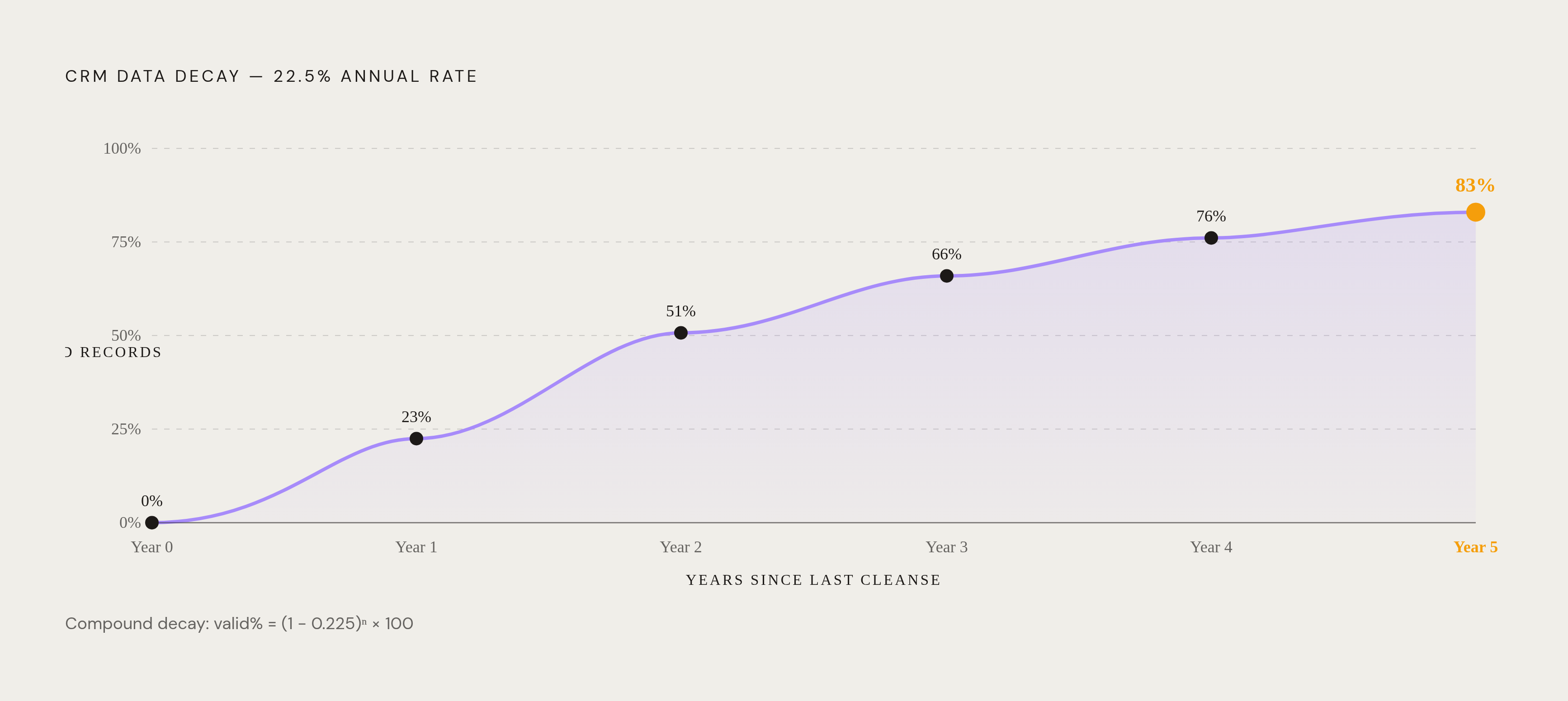
B2B contact data decays at roughly 22.5% per year, according to widely cited analysis of contact database decay. Within any given twelve-month period, approximately 70.8% of business contacts change roles, companies, or responsibilities. About 65.8% experience job title or function changes. And 42.9% of phone numbers go invalid within a year.
The compounding math is unforgiving. Without ongoing maintenance, a database reaches roughly 51% invalid data after two years, and approximately 83% after five, based on projections from that decay rate.
The quarterly cleanup model fails for a structural reason, not an effort reason. If 15% to 20% of data decays every quarter, then cleaning once per quarter means you're accurate briefly before the slide begins again. By the time your next scheduled cleanup arrives, the records you touched last time are already stale, and the ones you didn't touch have been degrading for months.
Decay rates vary meaningfully by industry. Technology companies face annual decay in the range of 35% to 45%; healthcare runs 30% to 40%; financial services somewhat lower, around 25% to 35%, according to Dun & Bradstreet data quality research. During periods of significant layoff activity and organizational restructuring, decay can exceed 30% annually, because contacts are moving faster than any scheduled cleanup can track.
Data decay is a rate, not an event. Treating it as a project is like draining a bathtub one cup at a time while the faucet runs — and wondering why the floor is still wet.
What bad data actually costs in productivity, deals, and forecasting accuracy
Gartner estimates poor data quality costs the average organization around $12.9 million per year. IBM puts the aggregate cost to U.S. businesses at approximately $3.1 trillion annually. Those figures are large enough to feel abstract, so here is where the cost actually lands inside a sales organization.
Sales reps waste roughly 27% of their time dealing with inaccurate or incomplete records, per Validity's State of CRM Data Health report. That translates to approximately 546 hours per rep per year, which at average fully loaded compensation runs about $32,000 in lost productivity per person. It never appears as a line item. It shows up as missed quota, slow deals, and reps who underperform for reasons no one ever correctly diagnoses.
On pipeline: companies lose an average of 16 sales deals per quarter directly attributable to poor data quality, per Validity's survey of over 1,250 companies. These aren't deals lost to competition or pricing. They fell through because the operational infrastructure supporting them was unreliable. Forty-four percent of companies estimate they lose more than 10% of annual revenue to low-quality CRM data.
Forecasting is where the cost becomes strategically consequential. Only 20% of sales organizations achieve forecasts within 5% of their projections, and 43% miss by 10% or more, according to Xactly's 2024 Sales Forecasting Benchmark Report. Gartner research shows that improving CRM data hygiene can increase forecast accuracy by up to 30%. A forecast is only as reliable as the record data it's built on.
Sixty percent of companies don't track what bad data costs them. The losses surface as rep inefficiency, missed quota, and blown forecasts, and get attributed to everything except the actual source. The root cause stays invisible, which is precisely why it persists.
How AI systems amplify bad data rather than compensating for it
Validity's 2025 State of CRM Data Health report found that 45% of CRM data is not prepared for AI tools, even as 54% of organizations are already deploying them. That gap is where your go-to-market strategy can break down quietly and expensively.
A sales rep looking at a contact record with a stale title and a duplicate entry uses judgment. They notice something looks off. They check LinkedIn, ask a colleague, make a call before sending the email. An AI reads every field as authoritative and acts on exactly what is there. It has no intuition. It has instructions and data, and it cannot distinguish between the two.
The failure modes are concrete. If 40% of leads have a blank or miscoded industry field, a lead scoring model is learning from a distorted picture and will rank the wrong prospects with high confidence. An AI sales development function using incorrect job titles in outreach produces an outcome worse than a generic message, because it signals that the sender had data and used it wrong. In forecasting, a single falsely labeled deal can skew a prediction model; incomplete onboarding data can trigger incorrect churn predictions that cascade into resource allocation decisions that cost real money.
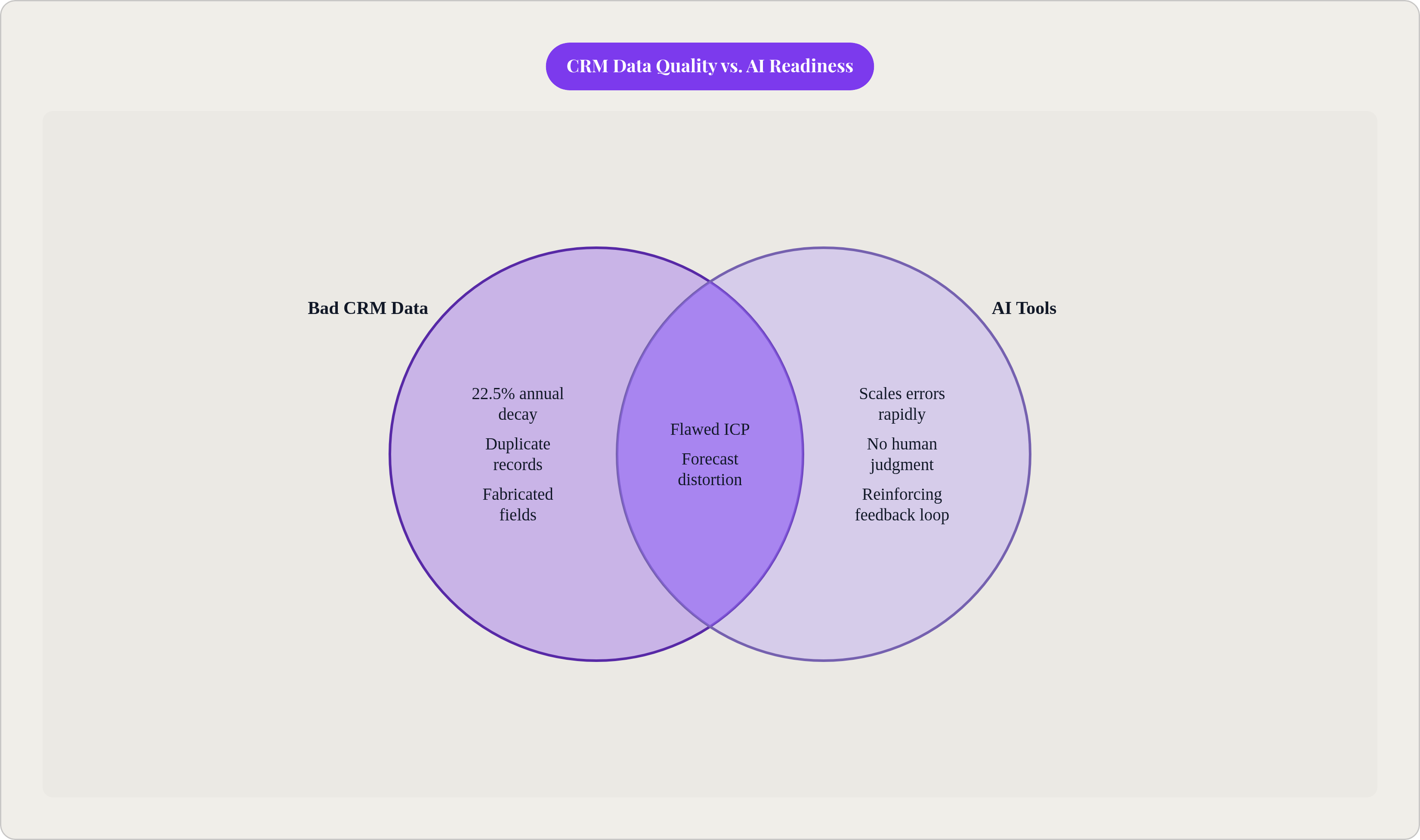
The feedback loop is what makes this structurally damaging. AI makes poor predictions; those predictions drive actions that generate more unreliable data; the model learns from the new data and reinforces its distorted picture of reality. Fifty-one percent of organizations using AI have faced at least one negative outcome from it, and nearly one-third attribute the cause to AI inaccuracies, according to the same Validity report.
The ICP problem is particularly acute. Sixty-three percent of Chief Revenue Officers have little or no confidence in their ideal customer profile definition, per Fullcast's 2025 Benchmarks Report. In most cases, that ICP was built from historical CRM data. If your historical data is flawed, your ICP is likely flawed, and every targeting, scoring, and personalization decision you build on it inherits that distortion. The AI didn't create the problem. It applied scale and velocity to something that was already broken.
Where dirty data originates inside the organization
The origins of dirty data are rarely mysterious. Inaccurate data comes from typos, miskeyed fields, and wrong values entered at the point of creation. Incomplete data comes from required fields skipped or fabricated to satisfy the form. Duplicate data comes from list imports, integration conflicts, and manual re-entry of records that already exist somewhere in the system. Three categories, each with a predictable source, each with a different fix.
The modern GTM stack makes all three worse. The average B2B technology stack holds somewhere between 10 and 15 tools, according to Chiefmartec's annual marketing technology landscape research, each maintaining its own copy of contact and account data, content systems like Letterstory, an end-to-end content marketing platform, included. Every integration point is a place where records can break, duplicate, or go stale without anyone noticing.
The organizational dynamics are equally predictable. Sales imports lead lists without deduplication. Marketing runs campaigns against segments it hasn't audited in months. Revenue operations patches records reactively, after the damage is done. Because no single team owns the problem, accountability is diffuse enough that everyone can plausibly point to someone else. Gartner finds that 40% of organizations lack formal data governance policies; without structure, hygiene defaults to reactive cleanup, which cannot keep pace with the rate of decay.
When the CRM demands information people don't have at the moment of entry, they supply something that satisfies the system's requirement. That's not a character flaw. It is a predictable response to a process that rewards completion over accuracy.
The root causes are organizational, not just technical. Governance, ownership, and process design are prerequisites for any tool-based solution. Deploying better enrichment software on top of a broken process produces enriched bad data, faster.
The compliance dimension: GDPR and CCPA make hygiene a legal obligation, not just a best practice
GDPR's accuracy principle is unambiguous: personal data must be accurate and, where necessary, kept up to date. If your CRM holds European contacts, data hygiene is a legal requirement with quantified exposure for your organization. The maximum penalty is €20 million or 4% of global annual turnover, whichever is higher.
Enforcement has moved well past theoretical. In 2024 alone, €1.2 billion in GDPR fines were issued, according to DLA Piper's GDPR Fines and Data Breach Survey 2025; cumulative penalties since the regulation took effect have reached €5.88 billion.
The compliance-hygiene relationship reinforces itself. GDPR's data minimization principle, which requires collecting only what is genuinely necessary, produces cleaner CRM data as a byproduct: fewer unnecessary fields mean fewer fields to decay, fewer records to maintain, and a smaller surface area of exposure.
The breach dimension adds a separate layer of exposure. Nearly 94 million records were exposed in data breaches in Q2 2025 alone, according to Surfshark's Data Breach Monitoring report. A CRM holding stale, excess, or inaccurately categorized personal data is a liability whose scope expands with every record that should have been removed long ago.
Proposed amendments to GDPR in late 2025 would expand record-keeping exemptions for organizations under 750 employees and explicitly permit a legitimate-interests basis for AI-related processing. If you're at a mid-market organization currently calibrating how much governance infrastructure to build, those changes may matter for your planning, though they remain proposed rather than enacted and should be verified against current regulatory status before informing any decisions.
What a continuous data hygiene discipline actually looks like in practice
Four foundational activities address the distinct failure modes most CRM environments actually exhibit: (i) deduplication, (ii) standardization, (iii) decay management, and (iv) governance. None of them is optional, and none substitutes for the others.
The operating cadence that makes this continuous rather than periodic is less complicated than most teams expect. Daily: log interactions and flag new leads for duplicate checks before they enter the database. Weekly: review new records, validate routing, catch errors while they're still recent enough to fix without forensic effort. Monthly: audit stale records, refresh enrichment on priority accounts, surface degradation before it compounds. Quarterly: a full deduplication pass and a formal review of governance rules to ensure they're keeping pace with how the organization has changed.
One structural fix that consistently prevents re-degradation is the elimination of free-text fields wherever standardized options can replace them. Dropdowns, picklists, and standardized formats for deal stages, loss reasons, competitor fields, and lead sources are the mechanism by which standardization survives beyond implementation.
Ownership is non-negotiable. Diffuse accountability reliably produces degradation over time, because everyone assumes someone else is watching. Someone, specifically, has to own governance, audits, and process enforcement. The emerging "CRM Data Steward" or "Data Quality Manager" role at mid-market B2B companies is the institutional answer to this: one person or function owns the rhythm, produces a monthly scorecard, and delivers a quarterly trend report that makes data quality visible to leadership as a business metric rather than a back-office concern.
The KPIs that make this visible are straightforward: (i) duplicate rate, (ii) field completion rate, (iii) enrichment coverage on priority accounts, and (iv) forecast accuracy trend. These numbers tell leadership whether the discipline is working, and they create accountability that periodic cleanup projects never do.
How to build the internal case for treating data hygiene as a standing investment
The business case has three components, and presenting all three simultaneously is generally more persuasive than leading with any single one: (i) revenue at risk, expressed in terms your leadership already recognizes from their own P&L; (ii) AI investment protection, because your AI stack is only as reliable as its inputs; and (iii) compliance exposure, because the regulatory liability is quantifiable and enforcement is accelerating.
Start with the cost of inaction. The 27% of rep time lost to bad data, the 16 deals per quarter, the 44% revenue exposure figure: these are documented averages from Validity's research across a large sample of organizations. Leadership can check them against their own experience and find them credible, because they have seen the symptoms for years without ever being handed a diagnosis.
Then frame the investment in proportion. A dedicated data stewardship function, clear governance policies, and tooling to automate enrichment and deduplication costs a fraction of the losses it prevents. The ROI math doesn't require aggressive assumptions, only that leadership assign the losses they're already incurring to their actual source rather than to rep performance, market conditions, or product gaps.
The sequencing argument matters for growth-oriented organizations. Salesforce research shows that organizations with accurate forecasts are 10% more likely to grow revenue year-over-year and 7% more likely to hit quota. Data hygiene is a prerequisite for the compounding benefits of operating on an accurate picture of the market, and those benefits accumulate over time in ways that a periodic cleanup project never produces.
The organizations treating data hygiene as a continuous practice are building something that gets better with every quarter it runs. The ones treating it as a project keep paying the same cost on a recurring basis, while every system downstream of the CRM quietly underperforms.