CRM Strategy for Customer Retention and Expansion
Most CRM failures stem from poor data quality and lack of strategy, not bad software.
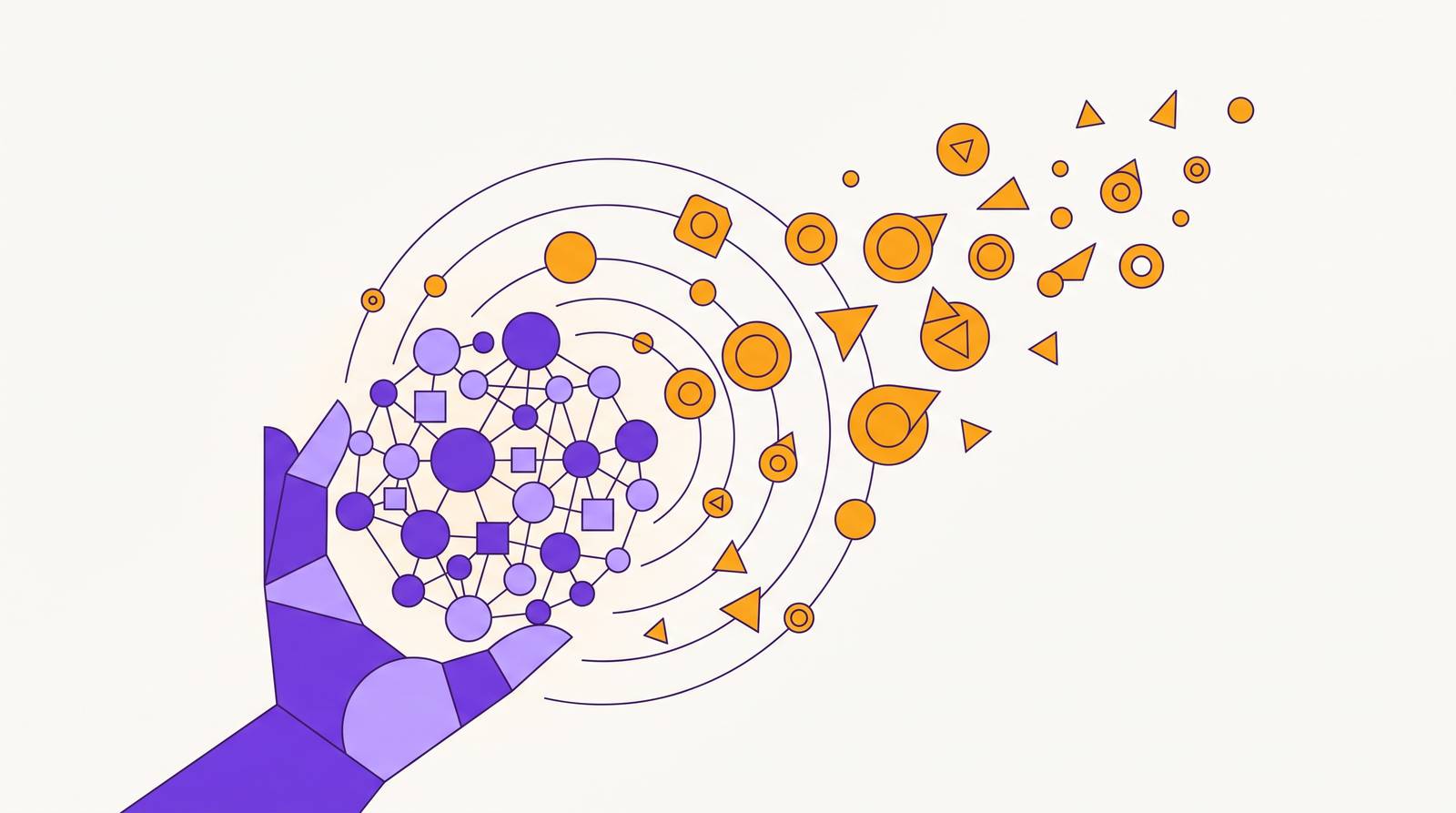
The failure mode is common and surprisingly easy to miss from the inside. A CRM fills up with contacts, deal stages advance, calls get logged. The system looks alive. But if the data isn't organized around customer lifecycle stages, if no one has defined what a healthy account looks like versus a drifting one, if the platform surfaces no signals and triggers no actions, then you have a very expensive address book. That's the operational reality in most organizations.
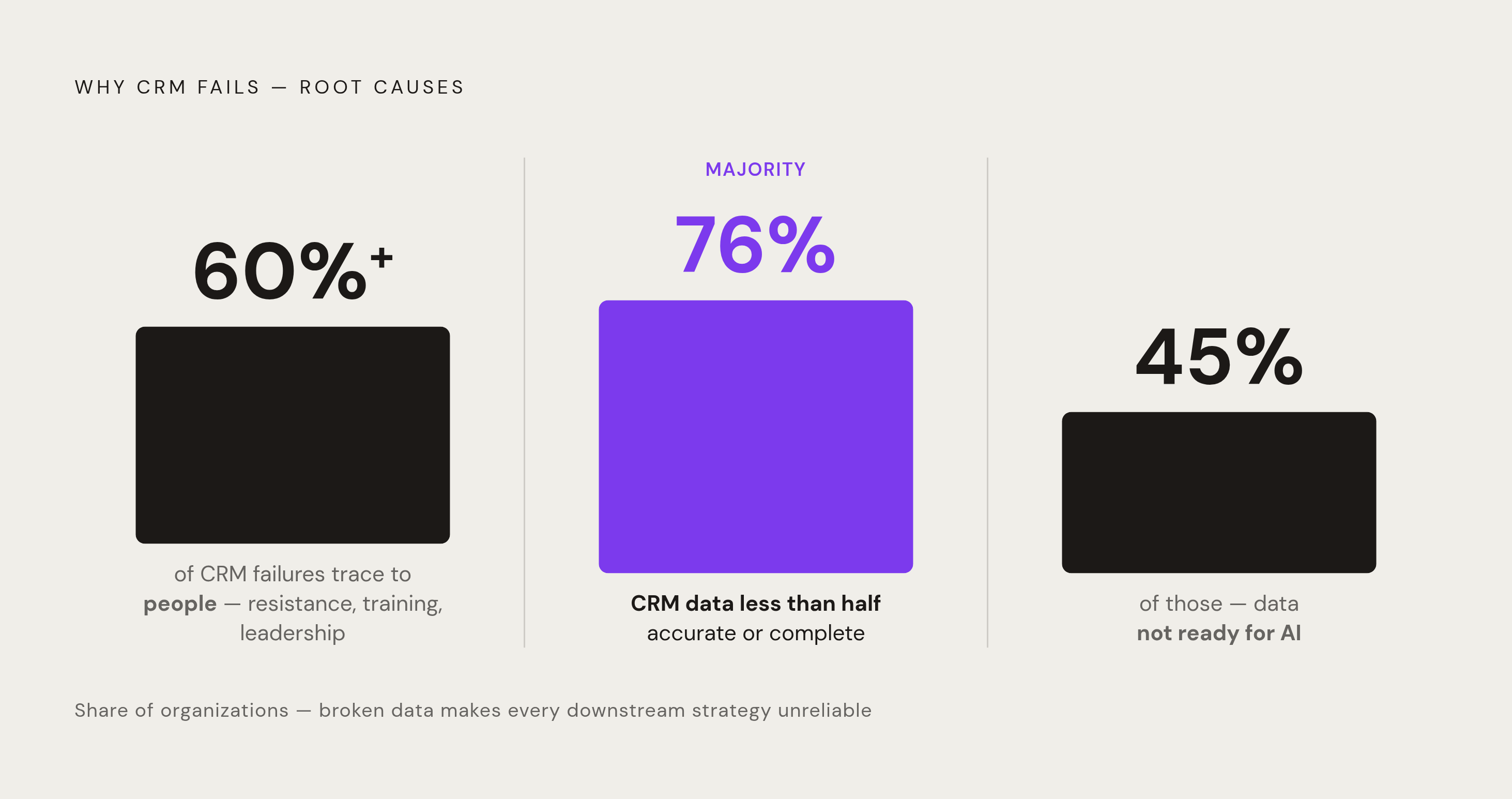
The adoption numbers are worth sitting with. More than sixty percent of CRM failures trace to people-related challenges: resistance to change, inadequate training, lack of executive commitment. Not bad software. Validity's 2025 study of over six hundred respondents across the U.S., U.K., and Australia found that seventy-six percent of organizations are working with CRM data that is less than half accurate and complete, and forty-five percent of those same organizations say their data isn't prepared for AI use. These are strategy and discipline problems. The technology is, largely, fine.
An active CRM strategy looks structurally different from a passive one. Data is organized around customer lifecycle stages, not just deal stages. Segments are defined by behavior, health, and growth potential, not firmographics alone. The platform surfaces signals: engagement drops, usage milestones, support ticket clusters, pricing page visits. And teams act on those signals systematically, not reactively, not when someone happens to remember to check the account.
The prerequisite for all of it is data quality, and this is where I've watched implementations crater more than anywhere else. Clean, complete, current data is not something you address after your system is live. Ninety percent of organizations recognize CRM data as the cornerstone of their operations, per that same Validity research. You cannot build accurate health scores on inaccurate inputs. You cannot segment meaningfully on stale fields. The data hygiene conversation belongs at the beginning of the implementation, not as a remediation project six months in when the health scores are returning nonsense — garbage in, garbage out, no matter how sophisticated the system sitting on top of it.
Segmenting the Existing Customer Base So Every Account Gets the Right Strategy
Generic retention campaigns don't just underperform. They accelerate churn. A one-size outreach sequence tells a high-value, deeply embedded account the same thing it tells a dormant, low-margin one, and that isn't neutral. It signals to both accounts that you don't know them. Customers notice. Research consistently shows that a meaningful share of customers leave brands specifically because of impersonal engagement, and the majority say being treated like a person rather than a number materially influences their loyalty.
The segmentation dimensions that actually drive retention and expansion decisions are behavioral, lifecycle, value-based, and growth-oriented. Behavioral segmentation captures purchase frequency, product usage depth, feature adoption, and support volume. A customer using thirty percent of your platform's capacity needs a fundamentally different conversation than one operating at ninety percent — those are not variations on the same account situation, they're different problems entirely, like comparing a car idling in a driveway to one running hot on the highway. Lifecycle stage tells you where an account is in its relationship arc: onboarding, active, at-risk, dormant, or ready to expand. Value tier accounts for revenue contribution, margin, and strategic importance, because not every account warrants the same investment of CSM time or executive attention. Growth potential maps the whitespace: products not yet purchased, seats not yet filled, use cases not yet activated.
Inside the CRM, this means custom fields and tags for lifecycle stage, health score, and expansion flags. It means dynamic lists that update automatically as account behavior changes, because static segments go stale within weeks. The platform should be able to surface, for example, which customers in a specific segment have purchased a particular add-on, enabling targeted campaigns with meaningfully higher conversion rates than generic sends.
One practical guardrail worth naming: the goal is actionable segments, not a taxonomy exercise. A team can operate effectively on five well-defined segments. Fifty segments become an analytical artifact that no one actually uses. I've seen that mistake made more than once, usually by someone who spent three months building a beautiful segmentation model that collapsed under its own complexity the moment it had to live inside a real sales or CS workflow.
Reading Lifecycle Signals to Intervene Before Customers Disengage
By the time a customer is visibly disengaged, recovery is expensive and uncertain. Declining login frequency or product usage is a leading indicator of churn, not a lagging one. Support ticket spikes, particularly unresolved or escalating ones, signal friction before it converts to dissatisfaction. A drop in email engagement from a previously active account is a behavioral flag. A contract renewal window approaching without any proactive contact logged in the account record is a process failure waiting to become a revenue event.
There's a specific dynamic worth understanding here. A single negative experience has disproportionate staying power. Research on customer experience recovery consistently shows it takes a significant accumulation of positive interactions to neutralize the damage from one bad one, and a meaningful share of customers reduce spending or disengage entirely after a poor experience. The implication is asymmetric in a way that most teams don't fully internalize: the cost of missing an early signal is substantially higher than the cost of acting on a false one. Erring toward early contact is almost always the right call.
Eighty-three percent of sales leaders start contract renewal discussions early specifically to reduce churn, according to a 2025 survey of over one hundred thirty thousand U.S. sales leaders by The Sales Collective. That discipline is measurable and repeatable, and it starts with the CRM surfacing the signal in time to act.
The setup required to support early intervention isn't complex, but it does require intentional configuration. Automated alerts when an account's health score drops below a defined threshold. Task creation for the account owner when no meaningful activity is logged within a set window. Trigger-based outreach sequences that initiate contact when usage drops, not because it's the third Tuesday of the quarter.
Omnichannel consistency matters here in a practical, not abstract, way. If your email data lives in one place, support tickets in another, and call logs somewhere else, a customer can slip through gaps that look fine in isolation but represent a deteriorating relationship in aggregate. Your CRM needs to unify those inputs so no signal goes unread because it arrived through a channel that feeds a different system.
Building an Account Health Scoring Model That Prioritizes Where Teams Focus
A health score exists to triage team attention, not to grade customers. Teams without a health model default to loudest-voice prioritization: the customer who complains most gets the most resources, regardless of strategic importance. The scoring model replaces that reactive allocation with a structured one, and the difference in how a CS team operates under each mode is significant — like the difference between a fire department that inspects buildings on a schedule and one that only shows up when something is already burning.
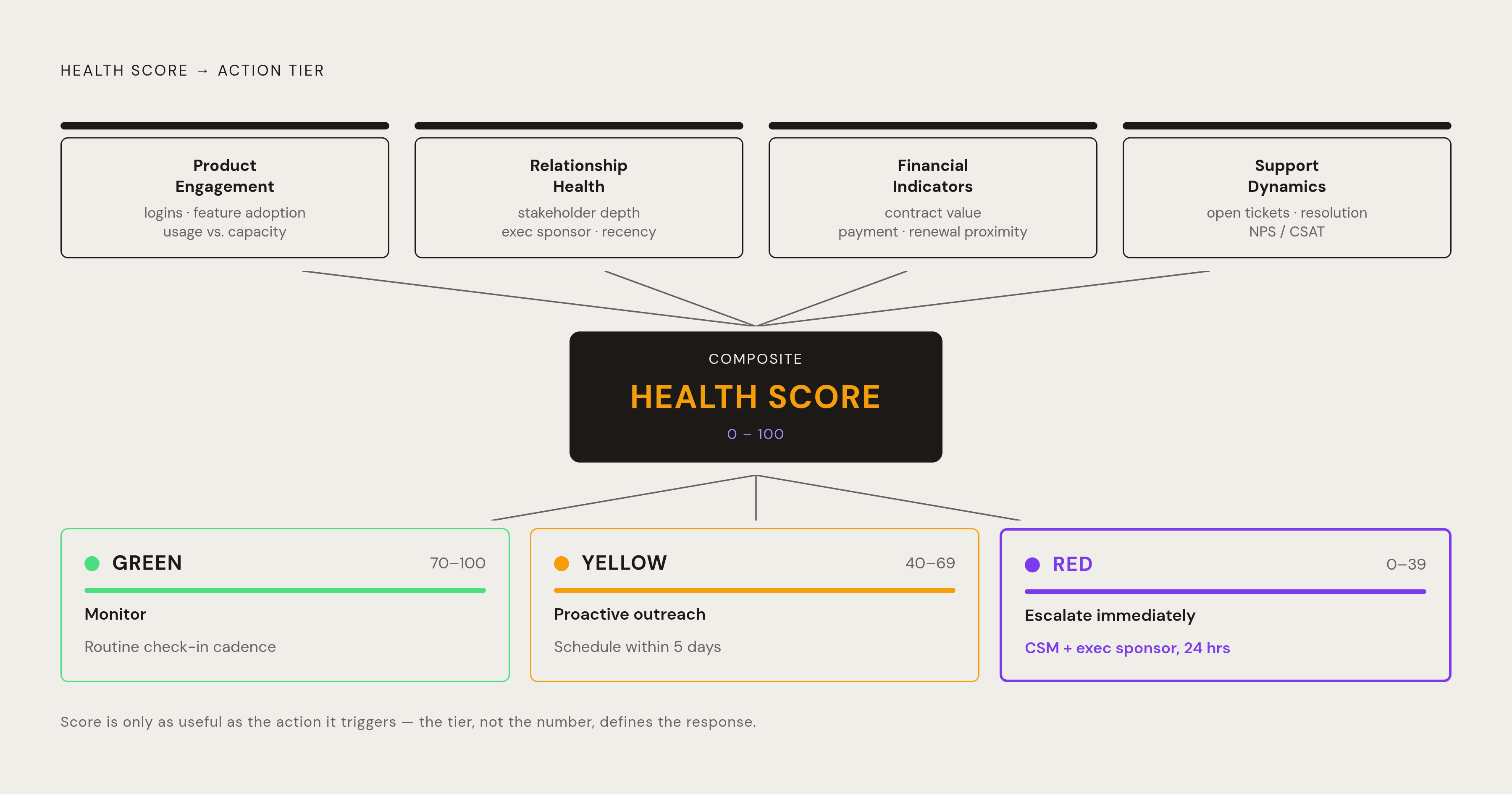
The components of a practical health score span four categories. Product engagement: logins, feature adoption, usage against capacity limits. Relationship health: stakeholder engagement depth, executive sponsor presence, recency of a meaningful touchpoint. Financial indicators: contract value, payment history, renewal proximity. Support dynamics: open ticket count, time-to-resolution trends, NPS or CSAT signals. Expansion indicators sit alongside these, capturing whitespace products, usage approaching tier limits, and engagement with premium-feature content.
Weighting those components is where your model becomes specific to your business. Start with a hypothesis about what actually predicts churn in your customer base, then validate it over time with cohort data. A customer with high product engagement but a long-standing unresolved support ticket behaves differently than one with low engagement and no support history at all; the weights should reflect what your data has actually shown, not what feels intuitively right. That validation step is the one most teams skip, which is why they end up with a health score that looks rigorous but doesn't actually predict anything.
Operationalization matters as much as the model itself. Surface the score on the account record so reps and CSMs see it without hunting for it. Tie scores to action thresholds: green means monitor, yellow means schedule proactive outreach, red means escalate immediately. Real-time dashboards tracking usage, support trends, and feature adoption let teams act on emerging signals rather than retrospective ones. A score that lives only in a spreadsheet someone opens monthly is not a strategy.
Turning Account Health Data into a Systematic Expansion Playbook
Calendar-based expansion has always been structurally flawed. Quarterly business reviews and annual upsell conversations are predictable for the seller, which means they're often mistimed for the buyer. The customer who hit eighty percent of their storage limit six weeks before their QBR needed that conversation six weeks ago. The one approaching the same meeting with capacity to spare is not a compelling upsell candidate today, regardless of how well the meeting goes.
Trigger-based expansion shifts the logic entirely. Usage approaching a capacity threshold signals upsell readiness at peak interest. A customer regularly working around limits to access premium functionality signals tier upgrade timing. Engagement with advanced-feature documentation signals curiosity that a well-timed conversation can convert. The offer hasn't changed. The moment has. That timing shift alone moves conversion rates in a direction no amount of pitch refinement can replicate, and it's the reason the same product team can look like heroes one quarter and mediocre the next depending entirely on when they're showing up.
The specific expansion motion matters as much as the timing. Upsell works when usage is pressing against current limits; the customer already understands the value, and more of it is a natural ask. Cross-sell within a category converts well because the adjacent product addresses a use case the customer already has context for. Platform cross-sell, introducing a new product category and engaging a new internal stakeholder, requires a longer nurture sequence, and conversion rates reflect that added complexity.
Customers using multiple products or advanced features are more deeply embedded and substantively less likely to churn. Expansion is not a revenue play layered on top of a retention strategy. It is the retention strategy. McKinsey research on customer satisfaction points to meaningful cross-sell rate increases among customers reporting both satisfaction and strong advocacy. The health score you built for churn prevention is also a reliable proxy for cross-sell readiness; these aren't separate systems doing separate jobs.
Sales and customer success alignment is the operational requirement that makes this work for you. Your sales team knows how to close. Your customer success team knows the account. Expansion requires both disciplines, and your CRM is the shared record that makes handoffs between them legible. Seventy-three percent of sales leaders use shared CRM tools specifically to align sales and customer success and reduce churn, per The Sales Collective's 2025 research.
Where AI-Powered CRM Features Genuinely Change Retention and Expansion Outcomes
Start with the data reality, because it's the precondition everything else depends on. Seventy-six percent of organizations have less than half of their CRM data accurate and complete, and forty-five percent say their data isn't ready for AI use, per Validity's 2025 research. You cannot shortcut that problem. AI features require a data quality investment first, full stop.
Where AI adds genuine lift, in a retention and expansion context, is in pattern recognition at a scale and speed that manual review cannot replicate. Churn prediction models trained on historical behavioral data flag at-risk accounts earlier than any CSM can, acting on weak signals before they become visible disengagement. Buying signal detection analyzes browsing behavior, email engagement, and feature activity, surfacing accounts showing expansion interest through pricing page visits, product guide downloads, or premium-feature engagement. These aren't signals a human reviewer misses out of carelessness. They're signals a human reviewer misses because there are hundreds of accounts and twenty-four hours in a day.
Personalization at scale is where the revenue impact becomes measurable. Personalized email campaigns built on CRM behavioral data consistently outperform generic ones on click-through rates. AI-assisted service tools compress response times in ways that maintain continuity between human touchpoints. Firms using AI capabilities are substantially more likely to exceed sales goals, and the evidence across multiple research sources points consistently in the same direction: AI-enhanced personalization improves repeat sales and retention metrics.
That correlation deserves honest context, though. The firms leading AI adoption were, in most cases, already more disciplined about CRM strategy before AI entered the picture. AI didn't make them rigorous. It amplified rigor that already existed. Feed a well-structured CRM to an AI layer and you get meaningfully better outcomes. Feed a passive contact database to one and you get faster noise — which is a more expensive version of the problem you already had. The AI is only as smart as the data it's fed, which means the most artificial thing about artificial intelligence, in practice, is the assumption that it can substitute for the real work of getting your data right.
The Organizational Conditions That Determine Whether a CRM Retention Strategy Actually Runs
More than half of CRM implementations fail to achieve their planned objectives, and over sixty percent of those failures trace to people-related challenges: resistance to change, inadequate training, absence of executive commitment. The technology is not the problem. The organizational conditions that determine whether anyone uses it correctly are where implementations succeed or quietly collapse.
Three conditions separate implementations that run from the ones that stall.
Data Hygiene as an Ongoing Practice
Ninety percent of organizations recognize CRM data as the cornerstone of operations, per Validity's 2025 research. Recognition without maintenance creates a false foundation. The import event brings in clean data. Within six months, contacts have changed roles, companies have been acquired, and product usage fields haven't been updated since onboarding.
Assign ownership of data quality not as a launch-phase responsibility but as a permanent operational role within your organization. Someone's job should be to keep your data current, not just to make it accurate once. The distinction between those two framings is the difference between a functioning intelligence system and an increasingly unreliable one that everyone quietly stops trusting, which is how you end up with CSMs managing their own spreadsheets alongside the CRM because they've learned not to rely on it.
Cross-Functional Alignment on What the CRM Is For
Your sales, customer success, and marketing teams need shared definitions before the platform does anything useful. What constitutes each lifecycle stage? What triggers an escalation from yellow to red? What counts as an expansion signal versus a routine support interaction? When those definitions differ across your teams, your CRM can become three separate systems that happen to share a login. When they're aligned, it becomes the single source of truth that makes coordinated action possible. The alignment conversation feels administrative. It is actually foundational, and teams that skip it spend years working around a system that never quite captures what any of them actually needs.
Executive Visibility That Makes CRM Data Consequential
Retention and expansion metrics surfaced in leadership reviews signal that this strategy is measured, not optional. That signal changes organizational behavior in ways that no amount of internal advocacy from individual contributors can. Bain and Company research shows that increasing customer retention by five percent can boost profits by twenty-five to ninety-five percent. Making that number visible in the reporting structure that leadership actually reviews changes how the entire organization relates to the CRM and the data inside it.
The constraint, consistently, is not technology. It's whether your segmentation frameworks, lifecycle signal architecture, health scoring model, and expansion playbooks are built and maintained with enough discipline for the system to act on them coherently. Organizations that get that structure right can extract compounding value from their existing customer base. Those that don't often end up funding a more expensive acquisition motion to replace revenue that was always there to retain.