Customer Segmentation Models Inside CRM Platforms
Behavioral data beats demographics alone for predicting what customers will do next.
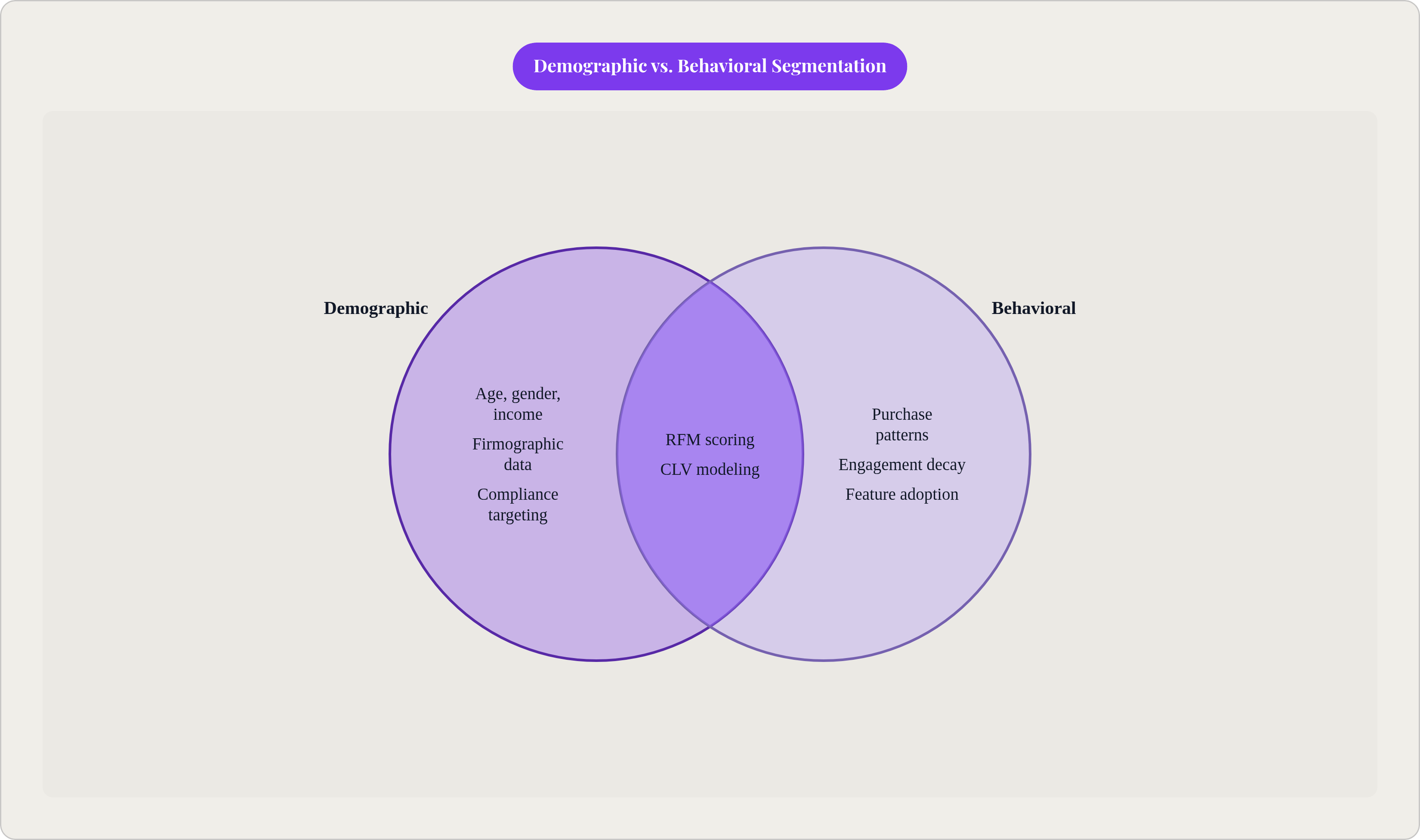
Demographic segmentation groups contacts by stable personal attributes: age, gender, income, education, occupation, family size. In B2B contexts, firmographic segmentation covers the structural equivalent: company size, industry, revenue, geography, headcount. This data typically arrives at acquisition through intake forms, enrichment tools, and imported lists. Most CRMs surface it by default, which is exactly why it's where most teams start, and exactly why most teams stay there far longer than they should.
Where it earns its keep: initial list filtering, broad campaign targeting, ad audience construction, compliance-sensitive segmentation for age-gated products or jurisdiction-specific regulatory requirements. If you're running a top-of-funnel awareness campaign against a cold list, demographic filters are often the only tool you have. That's a legitimate constraint, not a strategic choice.
The problem is what demographics can't tell you. Two contacts sharing the same age bracket and income tier can exhibit completely different purchase behavior, brand affinity, and product usage patterns. Demographic data describes composition. It does not predict response. I've watched teams spend real budget sending technically accurate campaigns to practically useless segments, because they built on who the customer was rather than what the customer wanted. The profile was right. The person was somewhere else entirely. Demographics are the map, not the territory — and too many teams mistake having a map for knowing where their customers actually are.
Demographics don't become obsolete once behavioral data accumulates. They become more precise, providing the interpretive context that makes behavioral signals legible. That's the evolution most teams miss: they treat this as a starting layer to graduate past, rather than a permanent foundation to build on.
Behavioral segmentation: what customers do, not who they are
Behavioral segmentation groups contacts by what they actually do: purchase patterns, website activity, email engagement, app usage, feature adoption, session duration. The data feeding this inside a CRM comes from web tracking pixels, email open and click logs, in-app event streams, support ticket history, and product usage telemetry. The segmentation is only as good as the tracking infrastructure behind it. Your contact records alone don't produce behavioral segments. Connected data pipelines do.
What behavioral data surfaces that demographics cannot is intent. A high-frequency browser who hasn't purchased is a conversion candidate. An email clicker who never visits the site is signaling interest without commitment, a different problem requiring a different message. A power user of one specific product feature is a natural candidate for an upsell to a higher service tier. A contact whose engagement has decayed over 60 days is showing you an early churn signal, but only if you're tracking the decay in the first place. These aren't abstract archetypes. They're segments you can build and act on inside most mature CRM platforms today, provided your data infrastructure is actually connected.
Psychographic segmentation belongs in this conversation as a related but distinct layer. It groups contacts by values, motivations, and interests, addressing why people buy rather than cataloguing what they've done. It's harder to collect at scale, requiring survey data or social listening infrastructure, and many teams skip it entirely. When that data does exist, it compounds with behavioral signals in ways that are hard to replicate otherwise. A contact who is both behaviorally engaged and psychographically aligned with a brand's values represents a categorically different relationship than engagement alone suggests, and the messaging should reflect that difference.
Behavioral segmentation is retrospective. It shows what customers have done. The next model takes that historical record and builds a structured scoring system on top of it.
RFM segmentation: turning transaction history into an actionable retention map
RFM stands for Recency, Frequency, and Monetary value. Each customer gets scored on all three dimensions: how recently they purchased, how often, and how much they've spent in total. Combinations of those scores produce distinct segments with distinct strategic implications, broadly grouped into most valuable customers, most growable customers, migrators, and below-zero customers. The segment names point directly to the campaign logic.
What makes RFM operationally valuable is its accessibility. It requires no machine learning, no data science function, no advanced platform configuration. It's computable from standard order history and natively embedded in several major marketing automation and CRM platforms. If your team lacks dedicated analytical resources, you can implement it quickly and start making materially better decisions with data you already have.
Here's the asymmetry that teams consistently miss: win-back ROI is not uniform across low-recency segments. A lapsed high-frequency buyer and a one-time buyer share identical recency scores but warrant entirely different offers, messaging frameworks, and spend thresholds. Treating them identically because they occupy the same RFM bucket quietly dilutes campaign performance in ways that are genuinely difficult to diagnose. One of them is a high-probability win-back with meaningful lifetime value on the other side of reactivation. The other is a sunk cost you're about to deepen. RFM is a blunt instrument that rewards the teams sharp enough to read between its lines.
For teams whose transaction data supports additional complexity, extended RFM models incorporating dimensions like campaign responsiveness, basket depth, and order interval variability can add meaningful fidelity. The implementation burden rises proportionally.
RFM is generally the right starting point if your team lacks a data science function, if you're running an ecommerce or subscription business with clean transaction logs, or if speed matters. Its limit is that it looks backward. A customer who scored well six months ago but is quietly disengaging looks perfectly fine inside an RFM model until churn has already happened. That gap is what predictive models are built to close.
Predictive segmentation: moving from what customers did to what they will do
Predictive segmentation applies machine learning trained on historical CRM data to forecast future customer behavior. The methods most commonly deployed include logistic regression, random forest, XGBoost, and LightGBM. Three applications do the most practical work inside CRM environments: churn prediction, customer lifetime value scoring, and propensity modeling for next-best action.
The performance gap between behavioral and static data in churn modeling is substantial. Models built on engineered behavioral features, things like rate of change in engagement, time elapsed between support contacts, shifts in product usage, consistently outperform those built on static attributes alone. Those variables only exist if your tracking infrastructure is consistently capturing them. If it isn't, your churn model is operating on an incomplete picture, and the platform won't surface that limitation on its own.
The operative mechanism in CLV modeling is reallocation: directing retention spend proportionally toward predicted value before the outcome resolves. When CLV and churn projections are integrated directly into CRM workflows, retention campaigns against high-risk accounts can be automated ahead of the inflection point, rather than triggered after the damage is already visible. That timing difference is where the actual ROI lives.
Salesforce Einstein, HubSpot Breeze, and comparable embedded tools are actively lowering the technical bar for teams without in-house modeling capacity. Worth being direct about what that does and doesn't solve: a simplified interface built on degraded data still produces unreliable outputs. The market is moving toward embedded intelligence. What embedded intelligence won't do is fix a data hygiene problem you haven't addressed.
CLV-based and lifecycle segmentation: organizing the customer base by value and tenure
Value-based segmentation ranks customers by actual or predicted economic contribution, typically organized into tiers that determine service level, offer generosity, and the intensity of retention investment. Its most useful function is budget allocation: knowing which segment to protect aggressively versus which to let attrite without significant spend.
A documented limitation of pure value segmentation is that it ignores non-monetary contribution. A low-spend customer who consistently generates referrals, leaves detailed reviews, or advocates publicly for the brand occupies the wrong tier under a spend-only model. The influence those customers carry has real economic value that doesn't register in transaction data. If you run value segmentation in isolation, you can systematically underinvest in some commercially significant relationships, and your P&L won't show you where the error is.
Lifecycle segmentation groups customers by tenure and relationship stage. New customers in the onboarding phase need education and early activation content. Active mid-tenure customers are candidates for cross-sell and relationship deepening. Long-term loyalists warrant VIP treatment and referral programs. Lapsing customers need win-back intervention before full churn completes.
Lifecycle stage changes the message even when the value tier is identical. A high-value customer in month two needs different communication, different content, and different offers than a high-value customer in year four. The value is the same. The relationship dynamic is not. Combining value and lifecycle produces a matrix, and that matrix drives more precise playbooks than either dimension alone. "High-value customer" without tenure context is still a blunt instrument.
Cluster analysis and dynamic segmentation: when the data defines the groups, not the marketer
Cluster analysis and dynamic segmentation let the data define the customer groups rather than the marketer, surfacing emergent behavioral patterns that no predefined model is designed to find. Cluster analysis, using methods like K-means, K-medoids, and fuzzy C-means, groups customers by similarity across multiple signals simultaneously, without the marketer defining the groups in advance. The algorithm finds the structure. The team interprets and names what emerges. That inversion can be either liberating or disorienting depending on your team's analytical maturity, and it's worth settling that question honestly before you commit to the method.
What clusters surface that predefined models miss is emergent behavioral coherence across dimensions that don't obviously relate to one another. One cluster will contain frequent, promotion-responsive buyers who share no demographic characteristics whatsoever. Another will contain low-frequency, high-monetary-value customers who consistently respond to early access offers rather than discount incentives. Those patterns don't emerge from demographic or RFM segmentation because neither model is designed to find them. They require a method that looks across all the dimensions at once, without a predetermined hypothesis about what matters.
Dynamic segmentation extends the logic across time. As new behavioral data enters the CRM, the algorithm updates segment membership automatically. A customer who begins purchasing more frequently shifts clusters without requiring manual reclassification. Natural language processing adds a further layer by analyzing sentiment from support tickets, social posts, and survey responses, sometimes catching the transition from satisfied customer to quietly frustrated one before it registers in behavioral metrics at all.
Clusters require interpretation, and that's not a peripheral consideration. The algorithm produces groupings, not campaign briefs. Someone on the team must translate cluster characteristics into segment names, strategic rationales, and executable playbooks. This step is consistently underestimated, particularly if you've invested in the tooling and then discovered you lacked the analytical bandwidth to do anything useful with the output. Cluster analysis is also the wrong tool for small databases, early-stage CRM implementations, and teams that need actionable segments within weeks. Applied prematurely, it produces confusion, not clarity. The method earns its complexity when the customer base is large and diverse, the data infrastructure is mature, and analytical support exists to do the interpretive work.
How to choose the right model given your data maturity and campaign goal
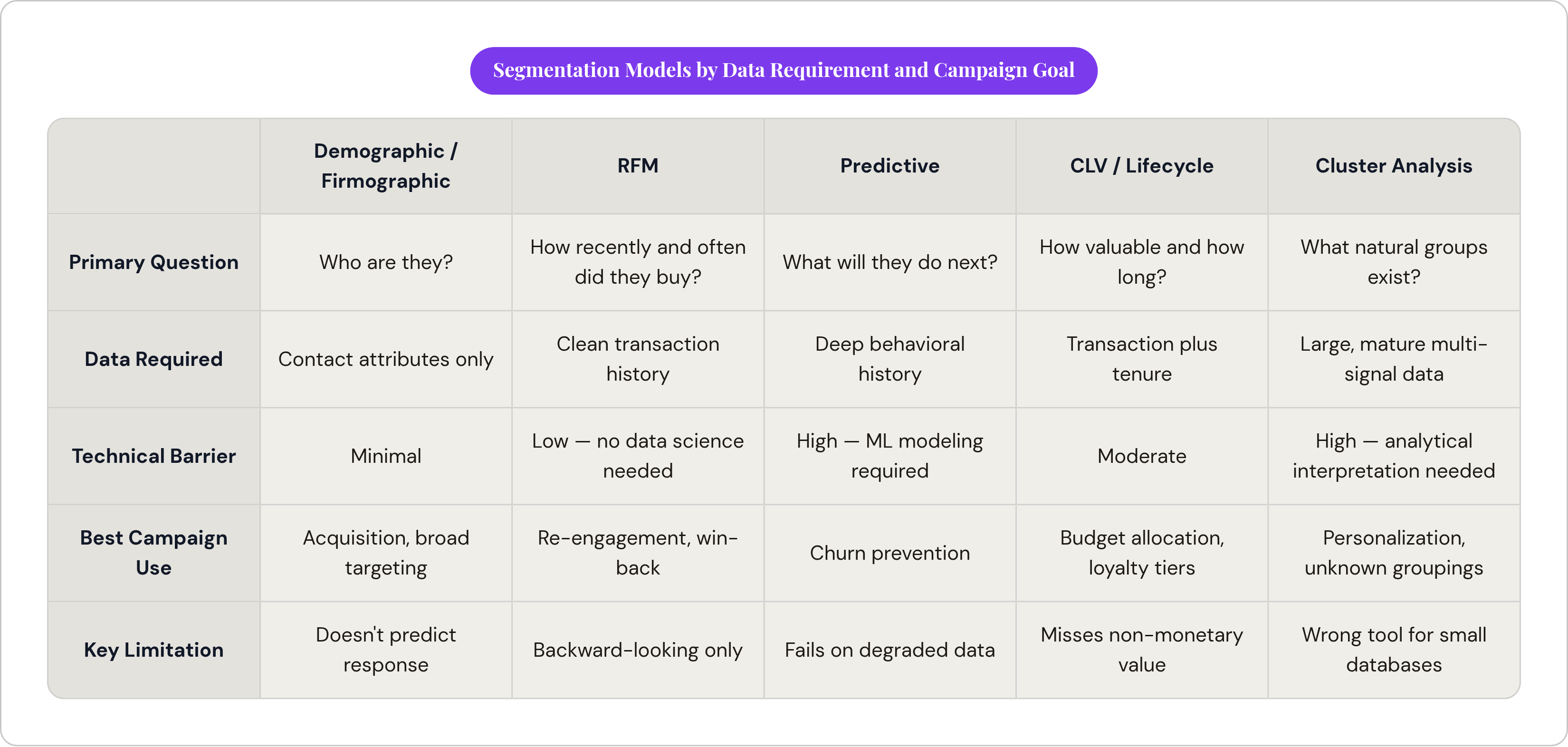
The choice is never which model is theoretically superior. It's which layer you can actually build right now, with the data you have, against the goal you're optimizing for.
The first decision axis is data maturity. If your CRM contains contact records without behavioral or transaction history, demographic and firmographic segmentation is the only viable starting point. When transaction history becomes available, RFM is implementable without a data science function and without significant platform configuration. As behavioral tracking matures and historical depth accumulates, predictive models and cluster analysis move from aspirational to deployable. The sequence is real. Skipping steps doesn't accelerate anything; it creates structural debt that's expensive to unwind later.
The second axis is campaign goal. Acquisition and broad targeting favor demographic and firmographic filters. Re-engagement and win-back campaigns hinge on the recency dimension of RFM. Churn prevention requires predictive scoring, because RFM alone won't surface at-risk customers until the damage is done. Budget allocation across the customer base calls for CLV and lifecycle tiers. Personalization at scale, particularly when natural groupings in the data are unknown, calls for cluster analysis.
Mature teams run all of these models simultaneously because they're solving different problems at the same time. RFM defines retention tiers. Predictive scores flag at-risk accounts within those tiers. Behavioral segments drive the messaging variant within each campaign. The models build on each other rather than compete for the same territory.
The most pervasive mistake is treating segmentation as a one-time configuration. Dynamic segments require functioning data pipelines, regular audits of segment logic, and willingness to revise definitions as customer behavior evolves. If you configure segments once and leave them alone, you're often operating, within 12 months, on a portrait of who your customers were rather than who they currently are. That's a discipline failure, and it tends to show up in campaign performance long before you think to check the segments.
If you're building from scratch: clean and standardize your contact and transaction data first. Build RFM segments as the first actionable layer. Add behavioral tracking and overlay engagement signals onto those RFM segments. Introduce predictive scoring once sufficient historical depth exists to train reliable models. Each step makes the next one possible. If you attempt to start with cluster analysis or predictive scoring on a thin data foundation, you can spend months arriving at results you can't trust.