What a CRM Strategy Actually Includes
Most CRM implementations fail because companies choose software before defining strategy.

A CRM strategy is a company's action plan for acquiring, nurturing, and retaining customers. It defines the business objectives the company is working toward, the processes required to reach them, and the metrics that will tell you if you're getting anywhere. Everything else follows from that. The execution is hard, but the concept is not complicated.
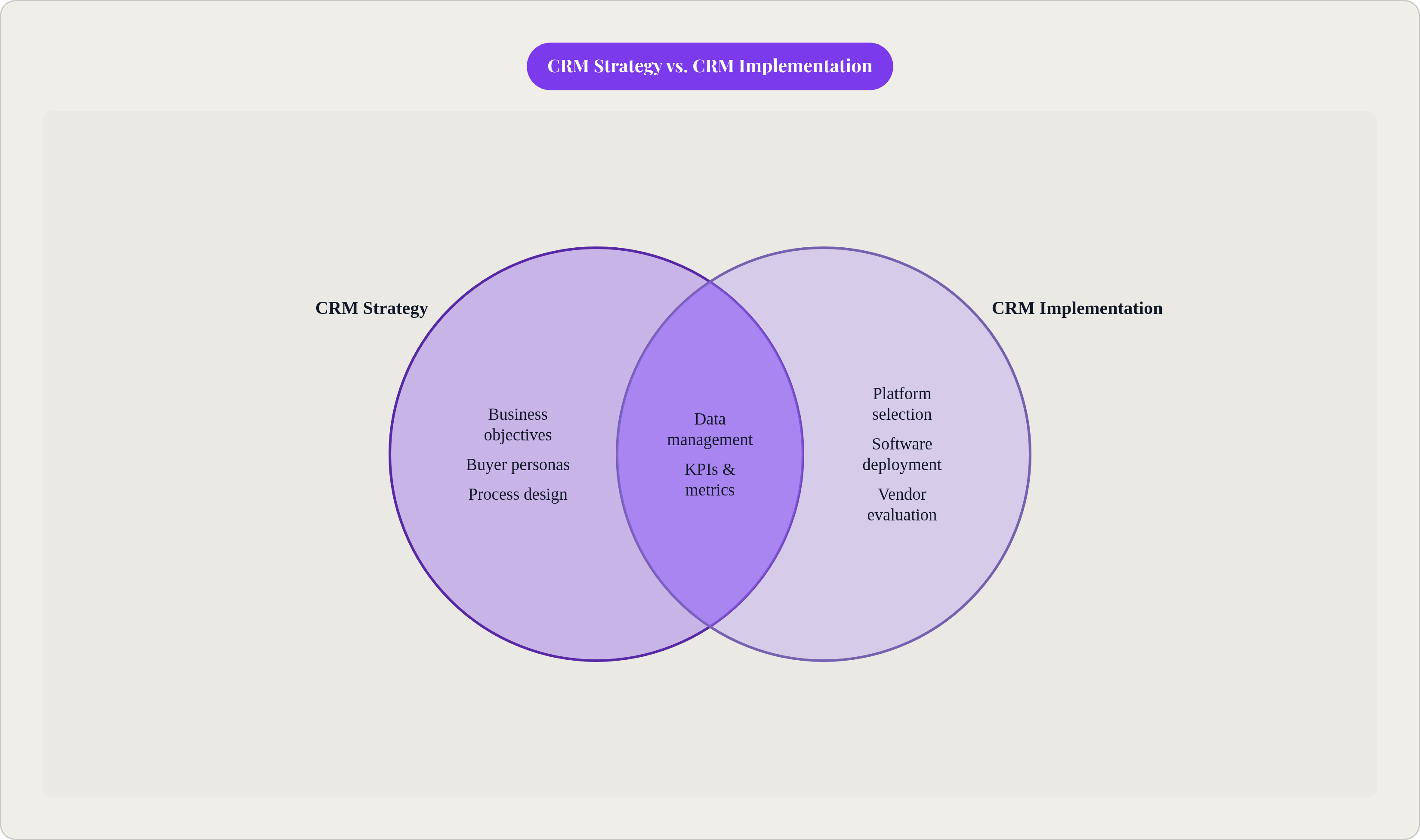
Here is where most companies go wrong: they conflate the strategy with the software. A CRM strategy is the design of the processes and workflows that shape how customers experience your company. A CRM implementation is the selection and deployment of software that supports those processes. One comes before the other, and the order is not interchangeable — like building a house by choosing the curtains before you've poured the foundation.
Gartner and Forrester have each put CRM failure rates somewhere between 47 and 70 percent. That range is not a rounding error; it reflects how consistently organizations reverse the sequence, buying the tool first and hoping a strategy materializes around it. It rarely does. No platform, regardless of its feature set or how impressive its AI roadmap sounds in a demo, can substitute for a clear understanding of what the business is actually trying to accomplish. The system performs exactly as well as the thinking behind it.
What a CRM strategy is not: an IT project, a vendor evaluation checklist, or something you can retrofit after the contract is already signed. Companies attempt the retrofit constantly. The failure statistics are where those attempts accumulate.
Starting with Business Objectives, Not Software Capabilities
The question every CRM strategy has to start with is unglamorous: what business outcome are we actually trying to achieve? Not "what does this platform support?" and not "what does the vendor recommend?" Those are someone else's questions. This one belongs to the business, and it has to be answered before any process or technology decision gets made.
Gartner identifies two absences as the most reliable predictors of a failed CRM initiative: unmeasurable objectives and missing executive sponsorship. Both are avoidable. Both show up in most failures anyway, which tells you something about how seriously organizations take the strategic groundwork before the demos start.
Well-defined objectives have specificity. Reducing customer churn by a defined percentage within twelve months is an objective. Improving lead-to-close conversion rate is an objective. Increasing customer lifetime value across a specific segment is an objective. "Getting better at customer relationships" is a sentiment, not a target, and it will not support accountability when results fall short. There is a difference between aspiration and direction — one points somewhere, and one just waves.
Objectives also force a structural question that gets deferred too often: which departments own this strategy? Is it a sales initiative, a marketing initiative, a customer service initiative, some combination? That answer shapes every subsequent decision about process design and, eventually, about tooling. Without clear objectives, there is no coherent answer, and without a coherent answer, the strategy splinters before it is ever executed. You end up with three departments running three different interpretations of the same initiative, and wondering why adoption is low.
Building Buyer Personas and Segmenting the Customer Base
Buyer personas are not marketing decoration. In CRM strategy, they function as operational inputs. They determine how the customer journey gets mapped and how communications get structured across every stage of the relationship, which makes their quality consequential, not cosmetic.
A persona is a profile of an ideal customer built from actual data: purchase history, behavioral signals, support interactions, demographic attributes. It is a pattern extracted from real customer behavior, used to inform real decisions. When persona development drifts from data into assumption, its operational usefulness declines in proportion to how much the assumptions diverge from the reality of who your customers actually are.
Customer segmentation is what operationalizes those personas. It groups customers by shared characteristics so that each group can be reached with relevant, differentiated communications rather than undifferentiated broadcasts. McKinsey research found that 71 percent of consumers expect personalized interactions and 76 percent report frustration when that personalization is absent. The expectation is now baseline, and segmentation is how you meet it systematically rather than by accident.
Common segmentation variables include purchase frequency and value, stage in the customer lifecycle, channel preference, and for B2B organizations, industry or company size. The variables that matter in any specific situation depend on the objectives defined in the previous step. Segmentation done without a destination in mind produces categories that look analytically satisfying and drive no useful action.
Mapping the Customer Journey as a Strategic Document
A customer journey map visualizes every step a customer takes when interacting with the brand, from first awareness through purchase through retention. More importantly, it identifies where the relationship is most likely to break down. Think of it as a diagnostic instrument — the organizational equivalent of a doctor's chart, one that only helps if the readings are accurate. Done properly, it reveals gaps, friction points, and handoff failures in granular, actionable terms rather than the vague "we need to improve the experience" conclusions that strategic exercises too often produce.
Aberdeen Group research found that companies mapping their customer journeys report lower costs, improved sales performance, and higher profitability compared to those that do not. The map pays for the effort.
What the map must capture: every touchpoint a customer has with the business across all channels; who inside the organization owns each touchpoint; where friction or drop-off is most likely to occur; and what data needs to be captured at each stage. Ownership is the part most maps omit, and it is the part that matters most in practice. A touchpoint without a named internal owner is a touchpoint no one manages. The customer's experience at that moment becomes entirely dependent on whoever happens to be available and paying attention that day.
The map is also not a static artifact. Buyer behavior shifts, and a map built in a different market environment is describing a journey that no longer exists. Reviewing and updating it at least every six months is reasonable maintenance, not excessive caution.
The journey map becomes the blueprint for what comes next: the process design the strategy actually runs on.
Designing the Cross-Departmental Processes the Strategy Runs On
A CRM strategy must define how sales, marketing, customer service, and technical support interact, not just within each team, but precisely at the handoffs between them. Those handoffs are where the customer experience either holds together or fractures. Most organizations know this in the abstract and underinvest in the specifics anyway.
Information silos are the structural problem. When teams operate on different data, or different definitions of what a customer even is, the experience the customer receives becomes inconsistent in ways that erode trust faster than almost any product or pricing failure could. Process design addresses this by establishing shared rules for how information moves across the organization. Not aspirational values about collaboration; actual rules about actual information.
The questions process design must answer are operational. What triggers a lead handoff from marketing to sales, and what information must accompany it? Who owns a customer record after the sale closes? How does a support interaction get fed back into marketing segmentation? These decisions determine whether a unified customer view is achievable in practice, as opposed to in the slide deck presented to leadership.
Automation belongs here as a process decision, not a software feature. Salesforce's State of Sales report found that 61 percent of sales leaders had already automated their CRM workflows as of 2023, applying automation to lead nurturing, customer engagement, and campaign reporting, among other functions. Applied to a well-designed process, automation scales efficiency. Applied to a broken one, it scales the breakage faster and more consistently than any human team could manage — like automating a leaky pipe instead of fixing it.
Change management and training are part of this component. People and process failures, not technology failures, are why most CRM strategies collapse. Treating training as an implementation detail, something to schedule after go-live when everyone is already exhausted and behind, undermines everything built before it.
Data Management as a Strategic Requirement, Not an Operational Detail
The accuracy and completeness of customer data determines how well every other component of the strategy performs. Personas are only as reliable as the data they are built from. Journey maps only reveal real friction if the behavioral data feeding them is clean. Measurement only reflects reality if what is being measured is accurate. Bad data does not announce itself; it just quietly degrades every output downstream — like a crack in a dam that nobody notices until the flood.
A 2023 Gartner report found that 60 percent of CRM implementations fail specifically because of poor data quality. That number is high enough that it should be treated as a structural risk, not an edge case.
Data management as a strategic decision means defining explicitly: what data is collected at each touchpoint and by whom; how often the database is audited and cleansed; what constitutes a complete customer record across the organization; and how privacy and compliance requirements are built into collection protocols from the start. Layering compliance on afterward is significantly more painful than designing for it initially, and the regulatory environment is not becoming more forgiving.
The AI dimension is worth naming directly. AI-assisted workflows produce outputs only as reliable as the data they operate on. Poor data fed into an AI-assisted workflow produces poor outputs at higher velocity and at greater scale. The data management protocol is a deliverable of the strategy, not something to delegate to the software vendor during implementation. Vendors will rarely flag this problem; it is not in their interest to do so before the contract is signed.
Choosing Technology Only After the Strategy Defines What It Needs to Do
The CRM software market was valued at $73.40 billion in 2024 and is projected to reach $163.16 billion by 2030, according to Grand View Research. That scale generates an enormous amount of noise: vendor pitches, analyst rankings, peer recommendations, conference sessions, all of which are easier to act on than a strategy document that requires actual decisions. The noise is not malicious; it is just louder than the work.
Platform selection before the strategy is defined causes the process to conform to the software rather than the software to support the process. Teams spend months trying to make their operations fit a tool's constraints, and the strategy never quite materializes because the structure it was supposed to run on was built in the wrong order.
Before evaluating any platform, the strategy should specify which departments will use the system and for what specific workflows; what integrations are non-negotiable, such as email, ERP, and marketing automation; what volume and type of customer data the system must handle; and what the measurement and reporting requirements are. Those specifications are the requirements. The platform's job is to meet them, not define them.
AI capabilities are now a meaningful selection variable. As of 2024, 65 percent of businesses have adopted CRM systems with generative AI features, per Freshworks research, and businesses using those features are 83 percent more likely to exceed their sales goals according to the same report. A counterweight worth noting: a 2024 Gartner survey found that 64 percent of customers prefer that companies avoid using AI in customer service interactions, which makes human-feeling design a genuine product requirement rather than a nice-to-have. Agentic AI, systems capable of acting on goals independently rather than responding to prompts, is an emerging capability worth understanding at the strategy stage even if deployment is not immediately planned. The companies that evaluate it now will be less surprised later.
The company will live with its platform choice longer than it expects. Future fit matters at least as much as current fit.
The Metrics That Tell You Whether the Strategy Is Working
KPIs must be selected based on the business objectives defined at the beginning of this process. Borrowing from a generic dashboard or copying a competitor's quarterly review produces targets that have nothing to do with what the business is actually trying to accomplish. Measuring the wrong things with precision yields precise information about the wrong things.
Core metrics appearing across most CRM measurement frameworks include customer lifetime value, customer acquisition cost, churn rate, sales conversion rate, lead response time, and customer satisfaction score. Which of those are primary depends entirely on the objectives, and that dependency is why the sequencing of this entire process matters. The metrics flow from the objectives; they cannot be selected independently of them.
Salesforce's customer impact research gives a useful benchmark for what well-executed CRM strategy can produce: a 29 percent increase in sales, a 34 percent increase in sales productivity, and a 42 percent improvement in sales forecast accuracy. Those outcomes do not emerge from the software. They emerge from the measurement framework that creates the feedback loop allowing continuous adjustment.
Measurement tells you where processes need correction, where data quality is degrading, where customer segments are shifting in ways the original strategy did not anticipate. The strategy is not a document you file after launch. It is a living system, and measurement is the mechanism that keeps it calibrated against what is actually happening, rather than what was projected to happen twelve months ago.