CRM Marketing Strategy for Lead Nurture Programs
Your CRM's segmentation and scoring determine whether nurturing generates ROI or wastes resources.
Lead nurturing is not email drips. It is the sustained, systematic process of building a relationship with a prospect across time and multiple touchpoints, moving them from initial awareness toward genuine sales readiness. That process takes longer than most teams want to admit, and it requires more deliberate architecture than most teams actually build.
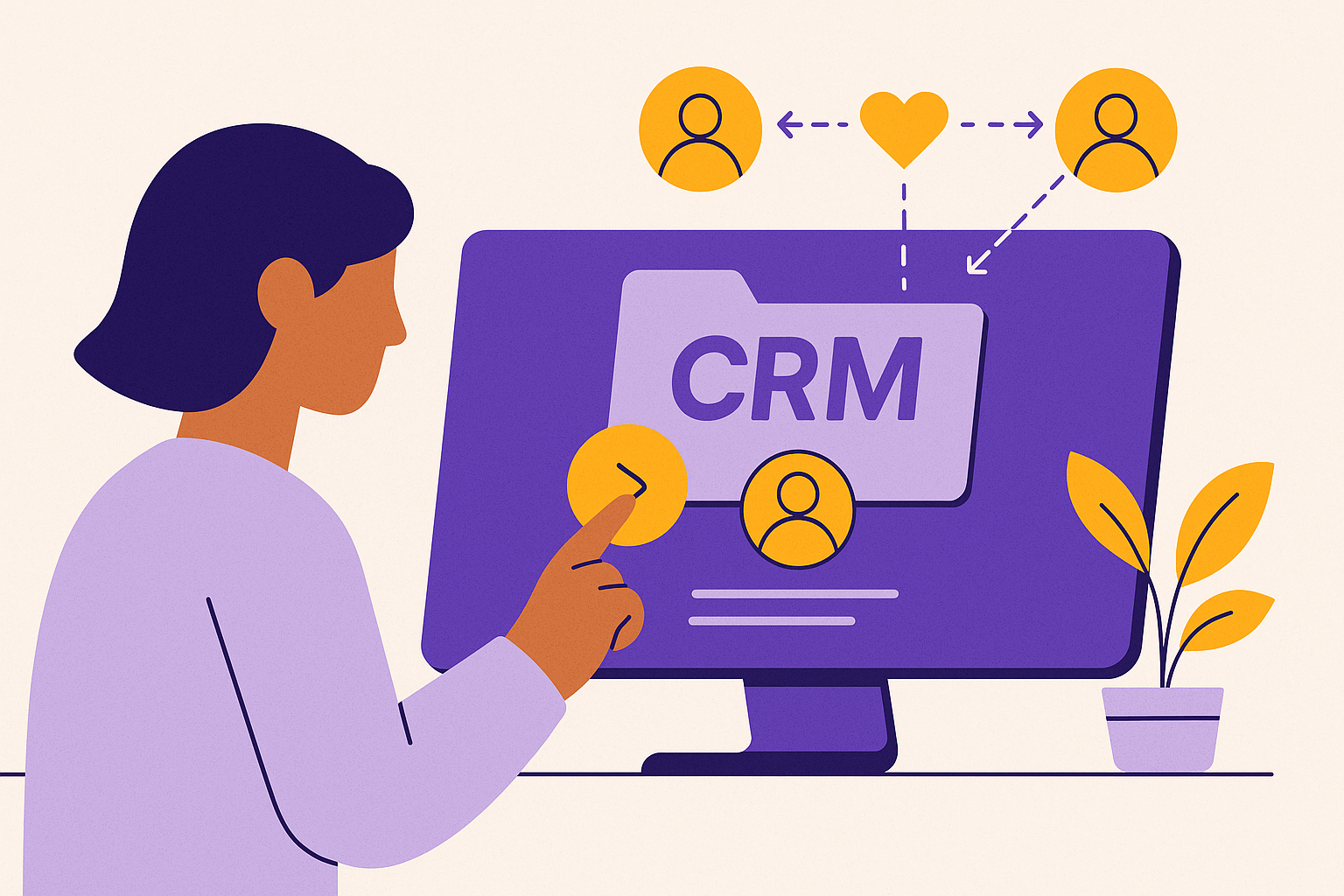
The CRM sits at the center of this because it holds the unified contact record. That record is what makes personalized, behavior-triggered communication possible across channels and across teams. Without it, sales and marketing are operating on different assumptions about the same person, and you feel that misalignment acutely when a rep calls someone marketing has already closed, or worse, has already alienated.
Here is what most CRM databases actually look like in practice: a flat list of contacts with wildly different levels of intent and fit. Someone who downloaded one white paper eighteen months ago sits next to a webinar regular who attends every quarter, a student who filled out a gated form for a class project, and a competitor doing reconnaissance. They look identical in a raw export. That is the problem lead nurturing exists to solve, and the CRM is the instrument that captures and acts on the signal buried inside that noise.
One distinction worth establishing before going further, because conflating these leads to configuration decisions you will regret: the CRM handles data storage, segmentation logic, scoring, workflow triggers, and sales handoffs. The surrounding toolset handles email send infrastructure, advertising platforms, and landing pages. Those are different systems. Treating them as one creates compounding errors that are surprisingly difficult to diagnose once they've been running quietly for a few months.
The Business Case for Doing This Properly, in Numbers
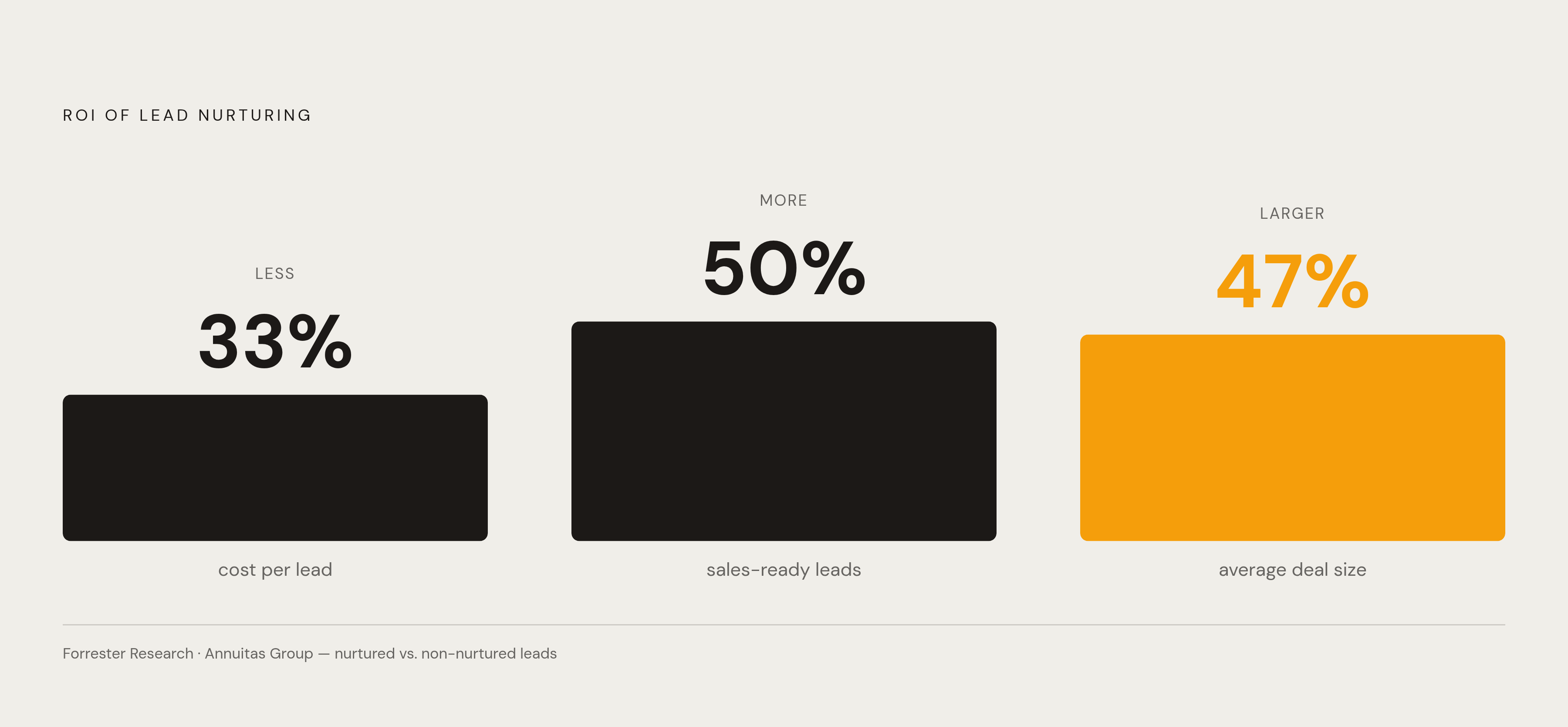
The efficiency argument is more compelling than the volume argument, and it is the one you should lead with if you are managing a constrained budget. Companies that nurture leads generate 50% more sales-ready leads at 33% lower cost per lead, according to Forrester Research, and nurtured prospects make purchases 47% larger than their non-nurtured counterparts, according to the Annuitas Group. The sales cycle shortens. The average deal size increases. Both move in the right direction simultaneously, which almost never happens when you optimize for only one.
The ROI case for CRM investment specifically is not subtle. Nucleus Research has reported an average return of $8.71 for every dollar spent on CRM. That framing reorients the configuration work entirely: getting the system right is one of the higher-return activities available to a marketing team, not a cost center or an IT obligation.
The counterweight is this: most B2B organizations are running programs they cannot evaluate. They do not track ROI on lead generation, which means they have no mechanism to identify what is working and no basis for improving what is not. That is a structural problem, and it originates in how the CRM is configured, or more accurately, in how it fails to be configured properly.
Segmentation: How to Divide a Contact Database So Nurture Logic Can Operate on It
Segmentation is where nurture strategy either becomes operational or stays aspirational. The approach that consistently outperforms in B2B contexts is behavior- and interest-based segmentation, meaning you are sorting not just by company size and job title but by what contacts actually do when they interact with your content.
Two axes need to be configured inside the CRM. The first is firmographic and demographic: industry, company size, role, position in the buying committee. This determines which content track a contact enters. The second is behavioral: email engagement, specific pages visited, content downloaded, event attendance. This determines urgency and next action. You need both, and they have to update in real time.
That last part is where most implementations fail. Segmentation is not a one-time import exercise. Static lists go stale fast. CRM data degrades at approximately 30% per year, which means a list you built last January is already substantially less accurate than when you built it. I have seen teams spend six figures on a campaign and realize three weeks in that a significant portion of the list had changed roles, companies, or both. It is an avoidable problem. Build dynamic segments so contacts move automatically as their attributes change. Tag ICP fit at the point of entry so you are not burning nurture resources on contacts who will never convert.
And establish a holding segment for contacts that lack sufficient behavioral data to route correctly. This one gets skipped constantly. Contacts land in the wrong track, receive irrelevant content, disengage, and the team blames the content rather than the routing logic.
The ordering of B2B segmentation follows a logical hierarchy in practice: by account first, then by industry, then by customer status, then by response or area of interest, then by funnel stage. That is a reasonable starting configuration and a useful benchmark if you are building from scratch.
Lead Scoring: Giving the CRM a Mechanism to Act on What Segmentation Reveals
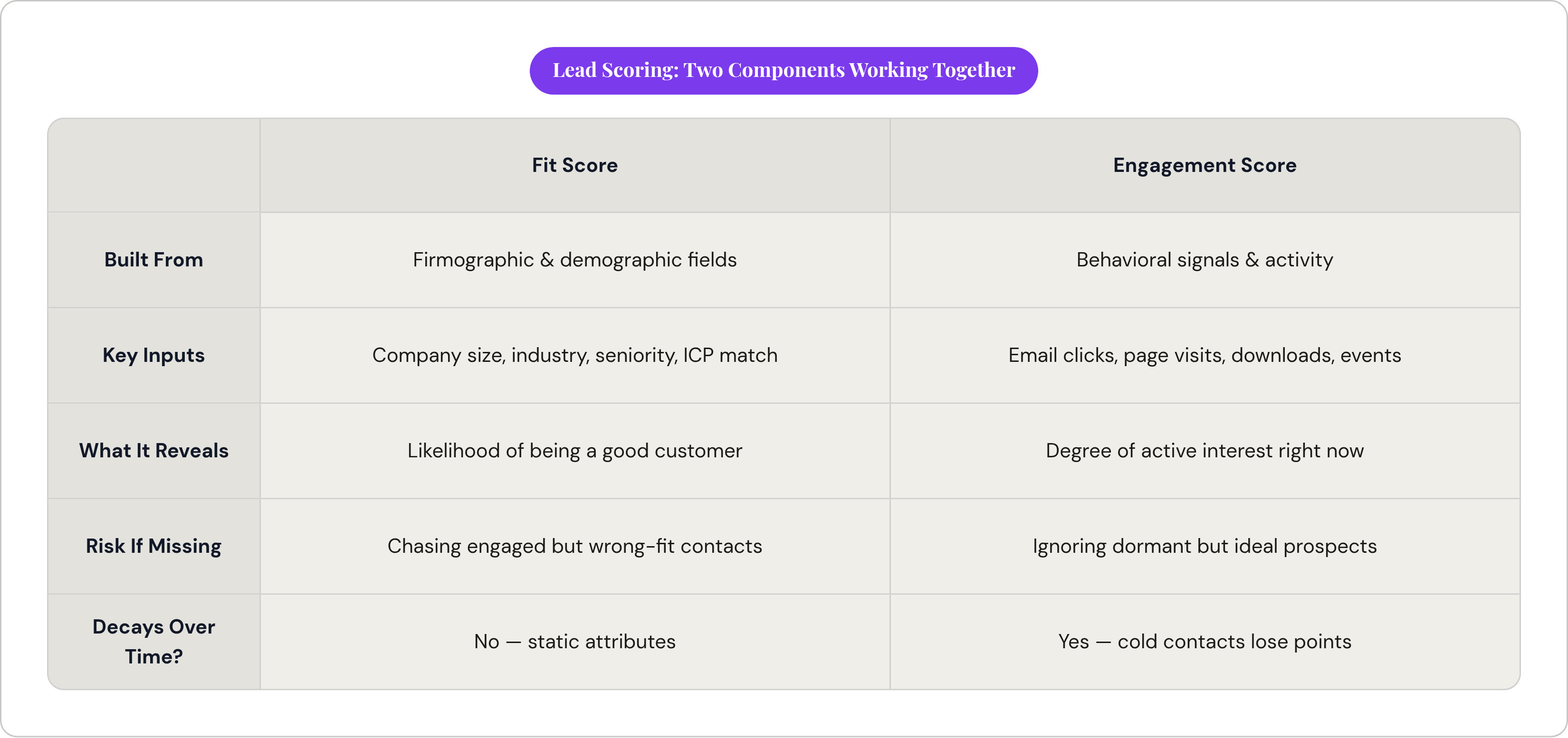
Segmentation tells you who someone is and what they have done. Lead scoring tells you what to do next. Without it, every form fill gets treated as roughly equivalent, which wastes finite sales attention on the wrong people while genuinely ready prospects sit unworked in the queue.
A scoring model has two components that must run in parallel. The first is a fit score, built on static firmographic and demographic fields: company size, industry, seniority, ICP match. The second is an engagement score, built on behavioral signals: email opens, clicks, page visits, content downloads, event attendance, time on site. A high-fit contact with no engagement is a dormant opportunity. A highly engaged contact with poor fit is noise. Both need to be in the model, weighted separately, so the combined picture reflects actual sales readiness rather than either dimension alone.
From those two scores, you need defined thresholds: (i) at what combined score does a contact enter an accelerated nurture track, and (ii) at what score does a contact become an MQL and get handed to your sales team. You also need decay rules. Contacts who go cold should lose points over time. Failing to build score decay into the model means the queue fills with stale high-scorers who have been inactive for months, and your sales team learns to distrust the model. Once that trust is gone, getting it back requires an organizational conversation that nobody wants to have and that usually happens after several quarters of friction.
Scoring also resolves a recurring political tension between marketing and sales. A documented, data-based handoff protocol is far more defensible than a subjective judgment call. If a salesperson disputes an MQL, you can show the score, the signals that produced it, and the threshold logic. That is a conversation, not an argument.
One thing that gets skipped too often: scoring requires recalibration. If high-scoring leads are consistently failing to convert, the point allocations are wrong. Analyze actual conversion data regularly and adjust the model against what reality is telling you. The model is a hypothesis, not a verdict.
Content Triggers: Connecting CRM Signals to the Right Message at the Right Moment
B2B buyers consume an average of 11.4 pieces of content before choosing a vendor, according to Forrester Research. The nurture program must deliver that content progressively, not randomly and not repetitively. Random is what happens without a trigger model. Repetitive is what happens when the CRM is not storing consumption history.
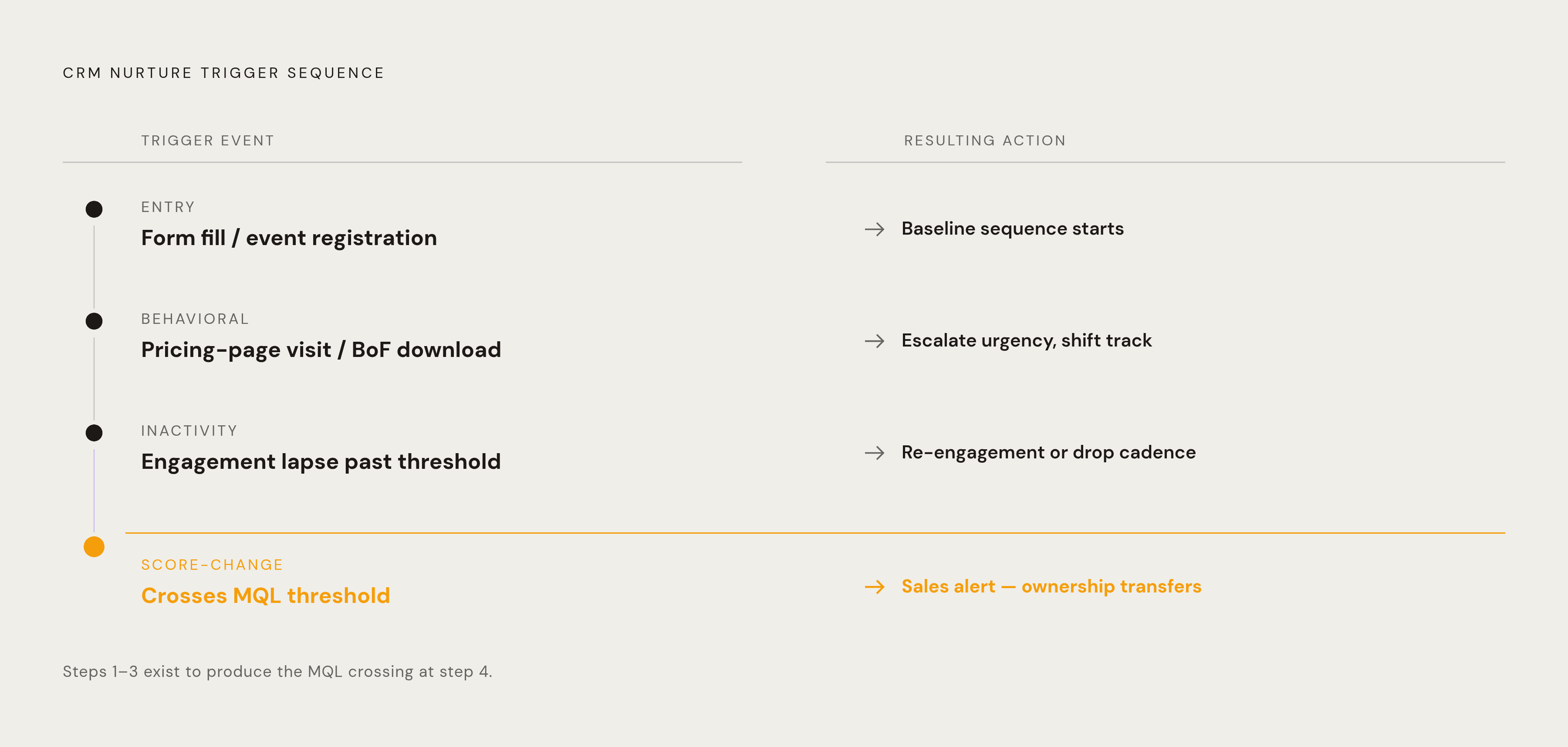
A trigger-based model maps CRM events to content responses. A trigger-based model generally includes four types: (i) entry triggers (a first form fill, an event registration) that start a baseline sequence for the contact's segment; (ii) behavioral triggers (a pricing-page visit, a bottom-of-funnel download, a product webinar) that escalate urgency or move the contact to a different track entirely; (iii) inactivity triggers that fire a re-engagement sequence or shift the contact to a lower-cadence track when engagement lapses past a defined threshold; and (iv) score-change triggers that, when a contact crosses your MQL threshold, initiate a sales alert and handoff workflow.
Content maps to funnel stage in a straightforward way. Early stage: educational content addressing the problem category, research, explainers, benchmark reports. Middle stage: evaluative content, comparisons, case studies, ROI frameworks, webinars. Late stage: decision-enabling content, demos, trials, customer proof, pricing discussions. Platforms like Letterstory, an end-to-end content automation platform, handle the production side of that mapping by curating topics and drafting assets by stage.
Personalization is the quality layer on top of all of this. Personalized emails produce 26% higher open rates, according to Campaign Monitor, and McKinsey and Company has reported revenue lifts of 10 to 15% attributable to personalization. Generic trigger emails underperform even when the timing is correct. The cost of poor personalization is not just lower engagement; it is attrition from the program entirely, and you usually cannot see it happening because the contacts simply stop engaging rather than unsubscribing.
The CRM configuration point most programs overlook: the system should store which content a contact has already received and consumed. Resending the same asset to someone who already downloaded it signals inattention. That erosion of trust is subtle, cumulative, and entirely preventable.
Cadence and Channel Mix: How Many Touches, Across Which Channels, and When
A three-email drip sequence is structurally insufficient for B2B nurture. It takes an average of six to eight marketing-driven touches to generate a viable sales lead, according to Salesforce research. The gap between a minimal drip and that threshold is where most programs quietly fail without understanding why.
Speed matters more than most teams account for. Companies that contacted prospects within one hour of receiving a query were nearly seven times more likely to have a meaningful conversation with a key decision-maker, according to research published in the Harvard Business Review. Your initial response time and nurture cadence need to be designed together, not separately.
Email remains the anchor channel. Roughly 64% of marketers use email as their primary nurture vehicle, and nurture emails generate click-through rates four to ten times higher than general broadcast sends. But that performance premium depends entirely on relevance, not volume. Approximately 16% of legitimate marketing emails never reach the inbox, according to Validity's 2023 Email Deliverability Benchmark Report. Volume is not a substitute for precision.
Multi-channel is not optional in B2B. No single channel reaches the full addressable audience, and a contact's score in the CRM should reflect total engagement across all channels, not just email activity. LinkedIn retargeting works well for awareness-stage contacts. Direct outreach from a sales rep is appropriate at late stage. Phone contact for high-intent triggers accelerates a conversation that email alone cannot close.
A few cadence principles worth encoding into your workflow logic: front-load the sequence early, then taper as engagement drops, rather than maintaining uniform frequency throughout. Let behavioral signals accelerate or decelerate touches. A contact who clicks three emails in a week is telling you something; one who ignores four consecutive sends needs a pause, not a fifth email. And build explicit exit criteria into every workflow. When a contact crosses into sales territory or opts out of a sequence, the CRM must stop sending, because uncoordinated marketing sends after a sales handoff damage exactly the relationship the rep is trying to build.
Automation: Where CRM-Driven Nurture Becomes Operationally Scalable
The performance differential between automated and non-automated nurture is not marginal. Automated emails account for approximately 2% of total email volume but generate around 31% of email-driven orders, according to Epsilon. The mechanism producing that gap is behavioral targeting at scale, which is only possible when the underlying CRM logic is properly configured.
In a well-configured CRM, automation handles trigger-based sequence enrollment when contacts hit defined thresholds, dynamic content substitution based on segment and stage, score updates as new behavioral data accumulates, sales alerts and task creation when the MQL threshold is crossed, and re-engagement workflows for dormant contacts. McKinsey and Company has reported that automation reclaims meaningful time per employee per week and measurably shortens sales cycles.
The critical caveat: automation built on top of a poorly adopted CRM does not fix the adoption problem. It scales the consequences. I have watched teams deploy sophisticated automation on corrupted data and then spend months debugging outputs rather than building pipeline. The data feeding the system must be reliable for the outputs to be useful. That is a discipline problem, not a technology limitation.
Automation is no longer a competitive differentiator. It is baseline. The majority of sales organizations have already automated their CRM, with lead nurturing as the primary beneficiary, according to Salesforce's State of Sales report. What separates programs that produce results from programs that merely run is the quality of the nurture logic being automated.
Where AI Fits Into a CRM Nurture System in 2025 (and What It Still Can't Do)
Nearly two-thirds of businesses now use CRM systems with generative AI capabilities, according to Salesforce's State of CRM report, and organizations using AI are more likely to exceed their sales goals, according to the same report. That correlation is real, but it reflects sophisticated teams adopting AI on top of already-functional systems. AI is not a corrective for broken nurture architecture. It is an accelerant, which means it accelerates whatever is already there, good or bad.
What AI is doing well in 2025 is specific, and worth understanding in terms of three practical gains: (i) AI-powered segmentation has moved beyond firmographics to include psychographic and behavioral clustering, meaning contacts are grouped by how they respond and engage rather than just by job title and industry; (ii) predictive lead scoring replaces static point allocation with continuously updated models, which can close the recalibration gap that manual scoring often leaves open; and (iii) AI-driven tools have improved A/B testing velocity significantly, so what previously required months of manual analysis can now happen continuously in the background.
Real-world results are beginning to accumulate. Some enterprises integrating AI-powered nurturing have reported improved deal closure rates and meaningful time reclaimed for sales reps. Some SaaS organizations using predictive nurturing have reported increases in qualified meetings. These are early indicators drawn from a limited set of published case studies, not guarantees, but the directional consistency is worth monitoring.
What AI does not solve is this: if your segmentation logic is wrong, your scoring thresholds are arbitrary, and your content is mapped poorly to funnel stage, AI will optimize and accelerate those flawed processes efficiently. The prerequisite for AI delivering on its potential in a CRM nurture system is that the foundational architecture — the deliberate segmentation, the calibrated scoring, the trigger logic, the content mapping — is built correctly first.