CRM Vendor AI Roadmaps Compared
Choosing a CRM vendor now means choosing an AI architecture, not just comparing features.
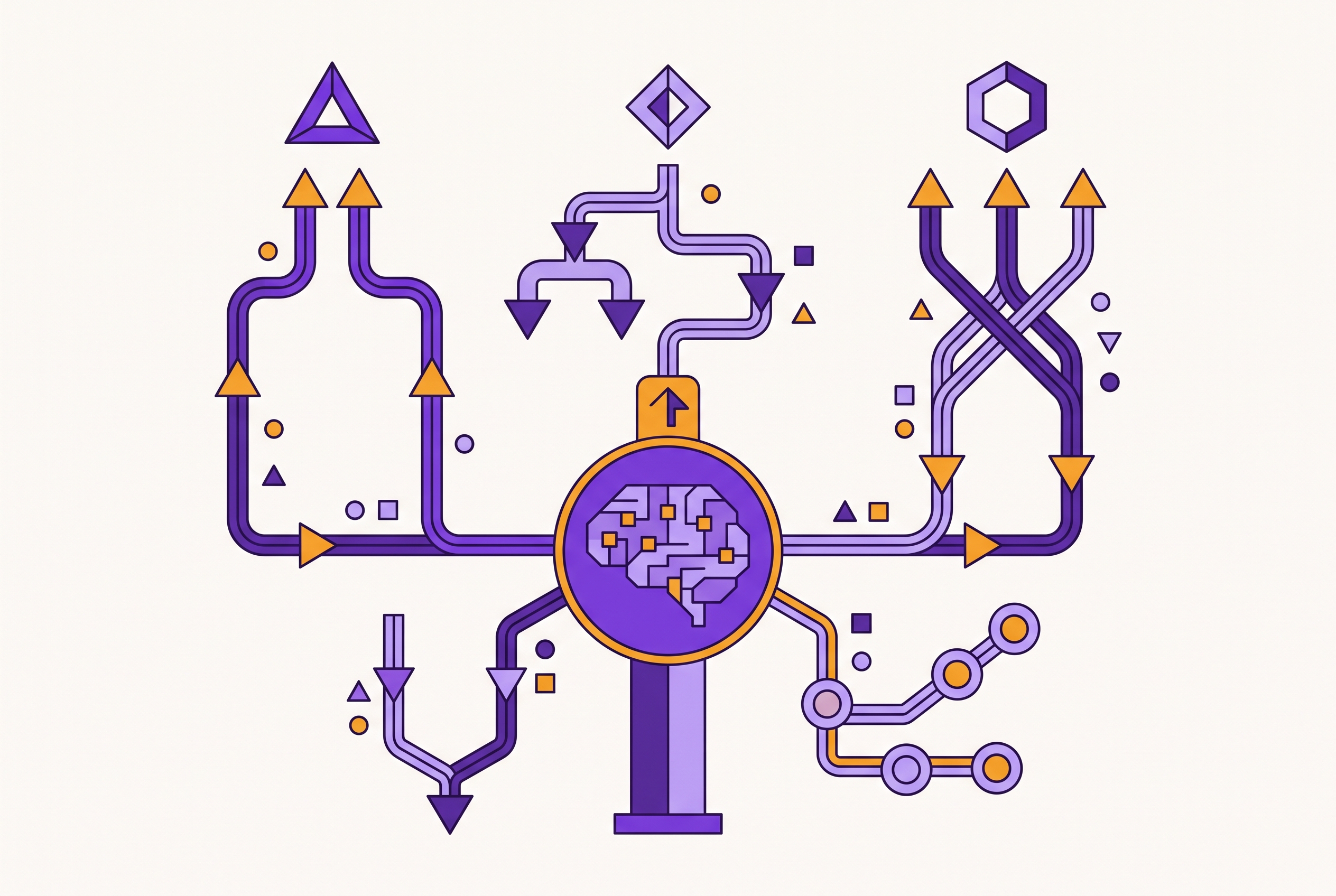
Every CRM vendor is now making a specific, structural bet on how AI should work inside sales and marketing software, and picking a vendor has quietly become the same decision as picking an AI architecture. Most buyers still treat it like a feature comparison, and that's the mistake this piece is trying to talk you out of.
Adoption tells a messier story than the market-sizing decks suggest. A 2025 State of Sales survey of more than 1,000 sales professionals found only 8% of reps say they're not using AI at all. But poor data quality remains a widely cited barrier to generative AI adoption inside enterprise organizations, which means a lot of reps are clicking the AI button before their underlying records are clean enough to make that button worth clicking. That gap between using AI and getting value from it runs through everything below, and it's the reason a vendor with a flashier roadmap can still lose to a boring one with cleaner data.
The point here is to say plainly: most buyers are optimizing for the wrong variable. They're comparing feature lists when they should be comparing whether their own data and team structure can support the architecture they're about to buy into. Get that match wrong, and the vendor doesn't just underwhelm; it locks a team into a roadmap built for someone else's problems.
The architectural bets that separate these roadmaps before you look at any feature list
Three questions matter more than any feature comparison, and they're worth settling before anyone opens a product demo.
Does the AI act, or does it advise? Some vendors are building agents that execute tasks on their own; others are building copilots that surface a recommendation and wait for a human to click approve. Is the AI sitting on a unified customer data platform built for this purpose, or bolted onto record structures that already existed for other reasons? And does the vendor's AI advantage require buying deeper into that vendor's own stack, or does it work reasonably well against third-party tools already in place?
Gartner projects that 40% of enterprise applications will include task-specific AI agents by the end of 2026, up from under 5% in 2025. That's a market flipping from agents-as-demo-feature to agents-as-baseline in about twelve months, which means the autonomy question is about to stop being a differentiator and start being table stakes for anyone still in the game.
Here's the position worth stating outright: full autonomy is the wrong default for most teams evaluating this market right now. The technology can do it, but most sales orgs don't have the data hygiene or the admin headcount to govern an agent that acts without a human checking its work. A large enterprise with a dedicated ops and IT team might genuinely want autonomous agents on a proprietary data layer, while a mid-market revenue team running lean, without anyone on staff to build agent infrastructure from scratch, needs something closer to a copilot that slots into the workflow reps already use. Keep these three questions in mind through the vendor sections below; they're the scorecard everything else gets measured against.
Salesforce: an autonomous-agent bet at enterprise scale, still in early adoption
Salesforce has rebuilt its entire product identity around one idea: agents that act rather than advise, with Agentforce, Data Cloud (folded into the Agentforce platform), and what used to be the Einstein 1 Platform now running as a single agentic model instead of separate modules bolted together.
In practice, Agentforce builds task-focused agents that do repeatable work without waiting on a human for every step: updating records, drafting responses, kicking off workflows. The Atlas Reasoning Engine handles the multi-step logic inside those agents, and Data Cloud (now Data 360) supplies the real-time customer profile they draw from, a dataset that's crossed 50 trillion records and more than doubled year over year.
The revenue numbers look strong on paper. Agentforce ARR hit roughly $800 million by the end of fiscal Q4 2026, up 169% year over year, but Stifel analysis puts actual Agentforce adoption at around 5.3% of Salesforce's customer base, meaning fewer than one in ten of the company's 150,000-plus customers has even signed a deal for it. That gap points to unclear pricing, messy customer org data, and thin enablement resources colliding with a product that demanded all three be solved first.
The pricing history makes that point on its own. Salesforce has run through three different Agentforce pricing models in under two years: $2 per conversation, then $0.10 per action through Flex Credits, then per-user licenses starting around $125 a month under the Agentic Enterprise License Agreement. A company doesn't burn through three pricing models in two years because it's casually testing the market; it does that because it hasn't found the number that matches how enterprise budgets actually get approved for agent work, and buyers across the market are increasingly demanding disciplined economics before they sign.
The 2026 roadmap keeps pushing further into what Salesforce itself calls "agents all the way down": Setup powered by Agentforce for admins, Agentforce for Security, more agent surface area across the platform. For a buyer, the read is straightforward: this architecture is the most ambitious of the group and the most demanding, and it rewards organizations with clean data, admin capacity to spare, and enterprise-scale budgets while punishing everyone else. Worth noting: IDC's Agent Build and Deploy category shows Salesforce jumping from 6.9% to 17.5% share between 2024 and 2025, the largest single-year gain tracked in that category. The market is pricing in the bet even though most customers haven't turned it on yet, which tells you something about where the smart money thinks this goes, not about where the average customer actually stands today.
Microsoft Dynamics 365: AI embedded across a stack most enterprises already own
Microsoft's core advantage is ecosystem depth: Dynamics 365's value compounds directly with any investment an organization has already made in Azure, Microsoft 365, and Power Platform. Those products increasingly behave like one continuous surface rather than separate tools with separate logins, and that's the whole pitch in a sentence.
Inside Dynamics 365 Sales, Copilot is positioned to support sellers with insights and workflow automation inside the tools reps already use. Copilot Studio extends further into contact center scenarios as part of the broader Dynamics 365 AI surface area.
What sets Microsoft apart procedurally is how predictable the release cadence is. Dynamics 365 follows a structured, predictable release cadence, with new features made available for testing before they go live everywhere. As of September 2026, Microsoft folded Dynamics 365, Power Platform, and Dataverse roadmap content into one unified "AI at Work" roadmap, a single place to track what's coming across the whole business applications portfolio. For enterprise IT and procurement teams planning budgets and training cycles months ahead, that predictability carries real weight, often more than any single feature announcement Microsoft makes in a given quarter.
Globally, Dynamics 365 holds a smaller share of the CRM market than Salesforce's overall footprint. The real question is whether an organization already lives inside Teams, Azure, and Microsoft 365. If it does, the Dynamics AI roadmap compounds an investment that's already been made instead of asking for a new one, and the switching-cost math favors staying put almost automatically. Outside that ecosystem, most of that advantage evaporates, and Dynamics has to win purely on merit against tools built from scratch as CRMs.
They're comparing feature lists when they should be comparing whether their own data and team structure can support the architecture they're about to buy into.
HubSpot: AI designed around the hybrid human-AI team, not the autonomous pipeline
HubSpot's bet runs in the opposite direction from Salesforce's. HubSpot frames the future as hybrid human-AI teams: people working alongside systems, with the human staying in the loop on anything that requires actual judgment rather than pattern-matching.
Breeze AI is the product expression of that idea. The Breeze Customer Agent is designed to handle prospect interactions and take action inside HubSpot records without a rep manually logging each step. HubSpot has maintained a rapid pace of iteration across the whole platform, with major spotlight releases rolling out updates across its core product areas. HubSpot's data unification features treat clean, usable data as a core product feature rather than homework the customer has to finish before the AI becomes useful.
That framing shows up directly in the interface: AI features are built to sit alongside a rep's existing workflow, handling research, first drafts, and data cleanup, while leaving judgment calls to the person. That lines up with where most mid-market teams actually sit today: in the same 2025 State of Sales survey, 84% of reps said AI saves them time, 83% said it personalizes their outreach, and 82% said it surfaces better data insight. Those are copilot outcomes, a meaningfully different emphasis from Salesforce's execution-first model.
For a buyer, HubSpot's pitch is speed to value without standing up agent infrastructure first. The tradeoff is real: less autonomous depth than Agentforce, but a much shorter runway to seeing anything actually work. The Data Hub decision is worth flagging on its own, because it's a direct architectural answer to the exact barrier Gartner identified, poor data quality blocking generative AI adoption, built into the base platform instead of requiring a separate CDP purchase and a multi-month integration project before anything gets useful.
Zoho: Zia and an AI-everywhere strategy built for cost-sensitive and global markets
Zoho's AI strategy runs through Zia, an assistant embedded across Zoho CRM and the wider Zoho One suite, priced and positioned as part of that broader suite rather than as a standalone agent product with its own tier and marketing page.
Zia is embedded across Zoho CRM and the wider Zoho One suite, offering predictive and analytical capabilities designed to surface insights and automate routine data tasks as part of the normal daily flow. Zia is designed to make CRM insights more accessible to reps without requiring them to navigate complex menu structures.
The strategic logic here differs from Salesforce's or Microsoft's, and it's worth saying which approach actually fits which buyer instead of hedging. Zoho spreads AI capability across a wide product surface, keeps the price accessible, and competes on total cost of ownership rather than raw depth. Anyone evaluating Zoho should ask directly: is Zia's breadth enough for the job at hand, or will the org eventually need the deeper autonomous agent infrastructure Salesforce and Microsoft are racing to build, at which point the cheaper option today gets expensive later?
Zoho's strongest ground tends to be exactly where the top-tier vendors are overbuilt for what a team actually needs: smaller sales organizations, international markets, and companies running several business functions inside one Zoho One subscription instead of stitching together five separate vendor contracts. There's no single splashy adoption number here the way there is with Salesforce's ARR figures; the qualitative picture is a large, established global install base concentrated in SMB and mid-market accounts, which is a less exciting story but a more stable one.
Where the roadmaps diverge on data architecture, the question beneath all the AI claims
Every AI layer described above is only as good as the data underneath it. That's the actual constraint deciding whether any of this works once it leaves the demo environment. Gartner's finding that poor data quality is the top barrier to enterprise generative AI adoption turns the data layer into the first thing to check before believing any vendor's roadmap slide, full stop.
Each vendor handles that problem differently, and the differences aren't cosmetic. Salesforce's Data 360 (formerly Data Cloud) is a proprietary customer data platform built to unify records at serious scale, having already crossed 50 trillion records, but getting an organization's own data into that state takes real migration work and governance discipline up front, and it rewards full commitment while punishing half-measures badly. Microsoft's data architecture benefits from deep integration across its own ecosystem; because many large organizations already have data sitting somewhere in that ecosystem, the migration lift tends to be smaller by default. The hybrid-team vendor's data unification approach answers the readiness problem directly, building data consolidation into the base product so teams starting from scattered spreadsheets and half-synced tools have less prerequisite work before AI features start paying off. Zoho's AI runs on data already inside the Zoho suite, which works well for organizations living mostly inside that suite and considerably less well for anyone with data spread across a pile of outside systems that never got integrated.
Here's the trap worth naming directly: using an AI feature and getting real value out of it are not the same outcome, and most of the market is currently confusing the two. A modest AI feature running on clean data will beat a flashier one running on a database full of duplicate contacts and half-filled fields, every time, and no vendor's roadmap slide will tell a buyer which situation they're actually in. Checking data maturity before getting impressed by a demo isn't optional due diligence; it's the due diligence that predicts whether any of this works six months in.
How to read these roadmaps against your actual go-to-market motion
None of this settles into a simple ranking, and that's the point worth sitting with rather than resolving too neatly. Salesforce's Agentforce bet makes sense for an organization with the budget, the admin headcount, and the data discipline to feed a proprietary CDP. Without those three things in place, the pricing churn and the low adoption numbers described above stop looking like early-stage jitters and start looking like a preview of what's coming for that org specifically. Microsoft's advantage barely needs evaluating on its own merits if an organization already lives inside Teams and Azure, because the switching-cost argument does most of the work automatically; outside that ecosystem, Dynamics 365 has to compete purely on feature merit against products built solely as CRMs, and that's a harder fight.
The hybrid-team framing offered by one of these vendors fits organizations that want AI improving the day-to-day work of the reps already on staff, rather than an agent standing in for a rep who isn't there. Zoho fits organizations for whom the top three vendors' capabilities are simply more than the job requires, where cost per seat and breadth of embedded features matter more than how autonomous the agent gets.
The one move that applies across every vendor here: check the state of the underlying data before trusting the roadmap slide, not after. A vendor's AI story describes what its architecture can do once the data underneath is ready to support it, and Gartner's research points to that gap, not the sophistication of any given model, as where most enterprise AI adoption actually stalls. Match the architecture to the org's actual data maturity, team structure, and go-to-market motion, and the decision gets a lot less complicated than the marketing pages make it look.
Sources
- https://getperspective.ai/blog/salesforce-ai-customer-research-crm-leader-conversational-discovery-2026
Provided the figure of 50 trillion records in Salesforce's Data Cloud, cited in the Salesforce section.