Agentic CRM Workflows and Autonomous Deal Actions
AI agents now execute sales tasks autonomously instead of waiting for reps to manually log and act.
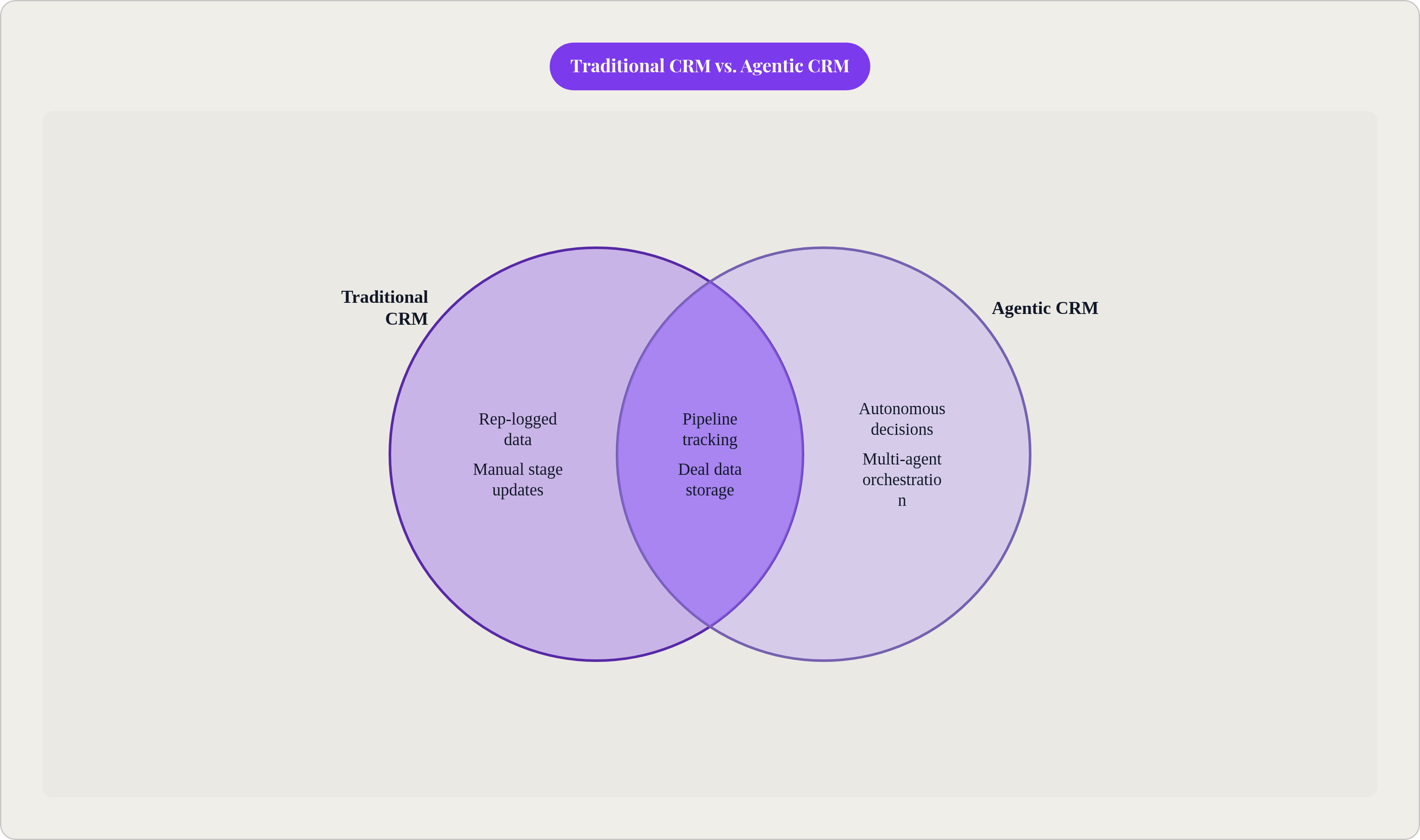
Agentic CRM is the shift from software that stores your deal data to software that acts on it. A traditional CRM waits: a rep logs a call, updates a stage, decides who gets the next email. An agentic CRM watches the same signals and does those things itself, without anyone touching a keyboard. That's the whole shift, and everything below is an attempt to help you figure out how real it actually is, versus how real the vendors need you to believe it is.
Four things separate an agentic system from the pipeline dashboard you've been staring at since 2019. It makes real operational decisions instead of surfacing a suggestion and waiting for permission. It chases an actual goal across a chain of steps rather than firing off one canned response. It adjusts based on what happened last week instead of running a rule someone wrote two years ago and forgot about. And it splits complex work across multiple agents the way a sales support team divides labor, rather than relying on one script trying to be everything to everyone.
Microsoft calls this the move "from systems of record to systems of action." A system of record logs what happened after the fact. A system of action notices something's missing, goes and finds it, files it, and only bothers you if something's actually wrong. Old CRM waits for the rep to log the call, maybe Tuesday, maybe never. Agentic CRM logs it the second the call ends, scores the deal against the last dozen calls that looked like it, updates the stage, and queues a follow-up, all inside a few seconds. You don't need a productivity study to see why that changes the math.
How fast adoption is actually moving
Gartner projects that 40% of enterprise applications will have task-specific AI agents built in by the end of 2026, up from under 5% in 2025. That's the kind of curve that makes procurement teams nervous and makes vendors insufferable at conferences.
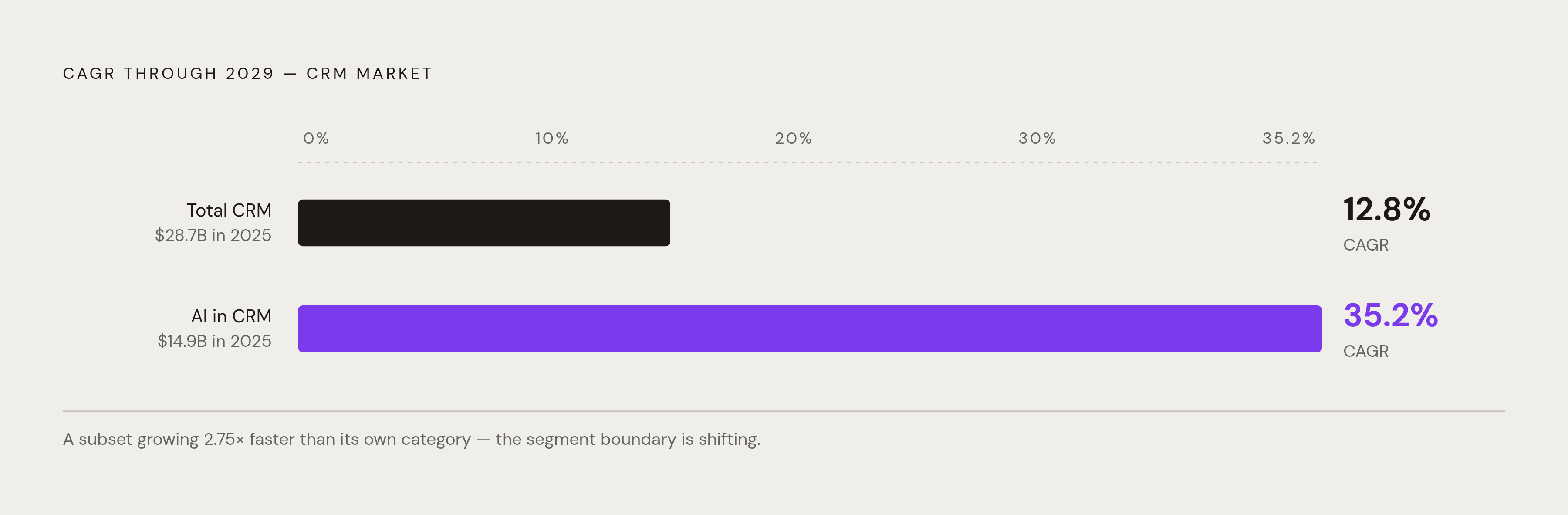
The dollar figures underneath tell the same story from a different angle. Gartner's Forecast Analysis from October 2025 puts the CRM sales software segment at $28.7 billion for 2025, growing at a 12.8% compound annual rate through 2029, a perfectly respectable, perfectly boring growth line. The AI-in-CRM slice inside that market is a different animal entirely: $14.9 billion in 2025, growing at 35.2% annually, nearly three times the pace of the category surrounding it. I had to check that math twice before believing it, because a subset outgrowing its own market three-to-one this early usually means the category boundary itself is about to get redrawn.
Practitioner intent lines up with the money. Ninety-three percent of IT leaders say they plan to deploy autonomous agents within two years, and 87% already list AI as a top CRM priority. These are numbers from people who already decided and are just sorting out the rollout calendar.
And the platforms have receipts to match. Salesforce Agentforce runs at $540 million in annual recurring revenue. HubSpot Breeze serves more than 279,000 customers. Whatever gap exists between companies running agentic workflows now and companies still debating it in a committee meeting, that gap is widening fast, and "we'll revisit this next year" is turning into the more expensive option by the month.
Where the time savings actually come from
Sales teams spend up to 60% of their time on administrative work, per a 2025 Gartner report. Sit with that for a second: more than half the working day gone to tasks that have nothing to do with selling. If you've ever wondered why quota attainment keeps sliding even as headcount grows, that's a reasonable place to start digging.
CRM data entry alone eats roughly four hours a week per rep. Multiply that across a fifty-person floor and you've quietly built yourself an extra employee whose entire job is retyping information that already exists somewhere else in the system, an email, a calendar invite, or a call transcript nobody read twice.
Agentic capture is what removes that tax. AI-powered systems now catch 90% of seller-buyer interactions without anyone typing a word, and teams running automated data entry save over 200 hours per person, per year. Other measurements arrive at the same place from different directions: (i) AI-assisted research saves around 1.5 hours a week; (ii) 64% of reps report saving one to five hours weekly through automation; and (iii) one analysis concludes AI could roughly double a rep's active selling time. Multiple methodologies landing near the same conclusion is the kind of convergence that's hard to wave away as vendor noise.
Recovered time is not the same thing as productive time, though, and that distinction is where most of the excitement quietly runs out of road. Microsoft's internal research found that 66% of AI users say the tools free them up for higher-value work, and 58% say they're producing work they couldn't have pulled off a year ago. That's the actual payoff: what fills those hours once the data entry disappears. A rep who gets three hours back and spends it scrolling LinkedIn hasn't gained anything measurable. Time saved is a number. Time spent well is a result, and the two rarely arrive together on their own.
The autonomous deal actions that actually run in a live pipeline
Follow a deal from first contact to signature and you'll find an agent sitting at nearly every point where a rep used to be the bottleneck.
Start with qualification. More than 65% of enterprise sales teams now run AI-driven agents for prospecting and qualification, according to a 2025 Gartner report. What separates this from the lead-scoring tools of a decade back is the breadth of signal: email engagement, how many stakeholders are actually on the thread, competitive mentions dropped mid-call, whether a supposed Q3 close date has quietly drifted to Q1. Agents track dozens of these threads simultaneously instead of asking a rep to eyeball a spreadsheet at 6pm, and behavioral scoring built this way predicts outcomes two to three times more accurately than manual guesswork.
Pipeline management works the same principle, just further downstream. An agent notices a quote sitting unanswered for six days, a deal gone quiet, a support ticket with the word "refund" buried in it, and acts on the pattern without waiting to be asked. Stage updates fire. Follow-up tasks queue. Content nudges go out, all against rules set well in advance.
Forecasting is maybe the starkest before-and-after on this whole list. Judgment-based forecasting, the kind built on stage probabilities and a rep's gut, can land around 50% accuracy on a good day, barely better than a coin flip. AI forecasting reads what people actually did instead: how often someone opened an email, how fast they replied, whether the proposal document got a second look, whether a new name showed up uninvited on the call. Companies running AI-powered forecasting this way have reported accuracy as high as 95%, the difference between planning a quarter and guessing at one and hoping.
Follow-up timing is smaller but it adds up fast. An agent deciding when to send a nudge weighs engagement history, time zone, industry norms, deal stage, and everything else already queued, all inside a fraction of a second. On the copy itself, AI-drafted outreach has been credited with an average 28% lift in cold-email response rates, according to LinkedIn.
Then there's the part nobody puts on a highlight reel but everyone in legal quietly obsesses over: compliance. Agents log call-recording consent automatically and fire opt-out triggers straight into CRM suppression fields the moment a prospect says "unsubscribe," no human step in between. Coffee.ai's analysis found this cuts documentation time from 45–60 minutes a day down to 5–10. It's the kind of number that never makes a keynote slide, and it might still be the most consequential item on this entire list.
A system of action notices something's missing, goes and finds it, files it, and only bothers you if something's actually wrong.
The architecture underneath autonomous CRM actions
None of the above works without four pieces underneath: (i) a model that ingests live data, (ii) an orchestration engine, (iii) connectors into every other system the data actually lives in, and (iv) something tracking state across steps. Pull any one of those out and you're back to a chatbot answering questions, not an agent doing work.
Accordion's analysis found this architecture cuts manual sales admin workload substantially versus reps entering everything by hand. That's a wide range, and the width itself is the tell: how well the pieces are wired together decides which end of that range you land on, a point worth carrying into the governance section further down.
Orchestration is the concept doing the heavy lifting. An agent doesn't run one command and stop; it holds a goal, breaks it into sub-tasks, picks a tool for each one, checks progress against the goal, loops back if something didn't land, and keeps going until the job's done or it hits a decision that needs a human's signature. Multiple agents often split the work by domain, one handling qualification, another enrichment, another outreach, another compliance, passing context between them the way a small team divides responsibilities without needing a meeting about it.
Retrieval-augmented generation, RAG for short, is what keeps this grounded instead of generic. Agents pull actual CRM records, actual email threads, actual call transcripts into their reasoning, so the follow-up email an agent drafts references what really happened on the call rather than a guess at what usually happens on calls like it.
Which raises the obvious catch, and it's the one that took the longest to sit right with me while working through this: these systems amplify whatever's already sitting in the CRM. Clean, structured data produces reliable autonomous action. Fragmented, inconsistent data produces confident autonomous mistakes, at scale, faster than any human could have made them alone. Sit with that one before the vendor tour below, because it applies to every platform on the list without exception.
How the major platforms have built this out
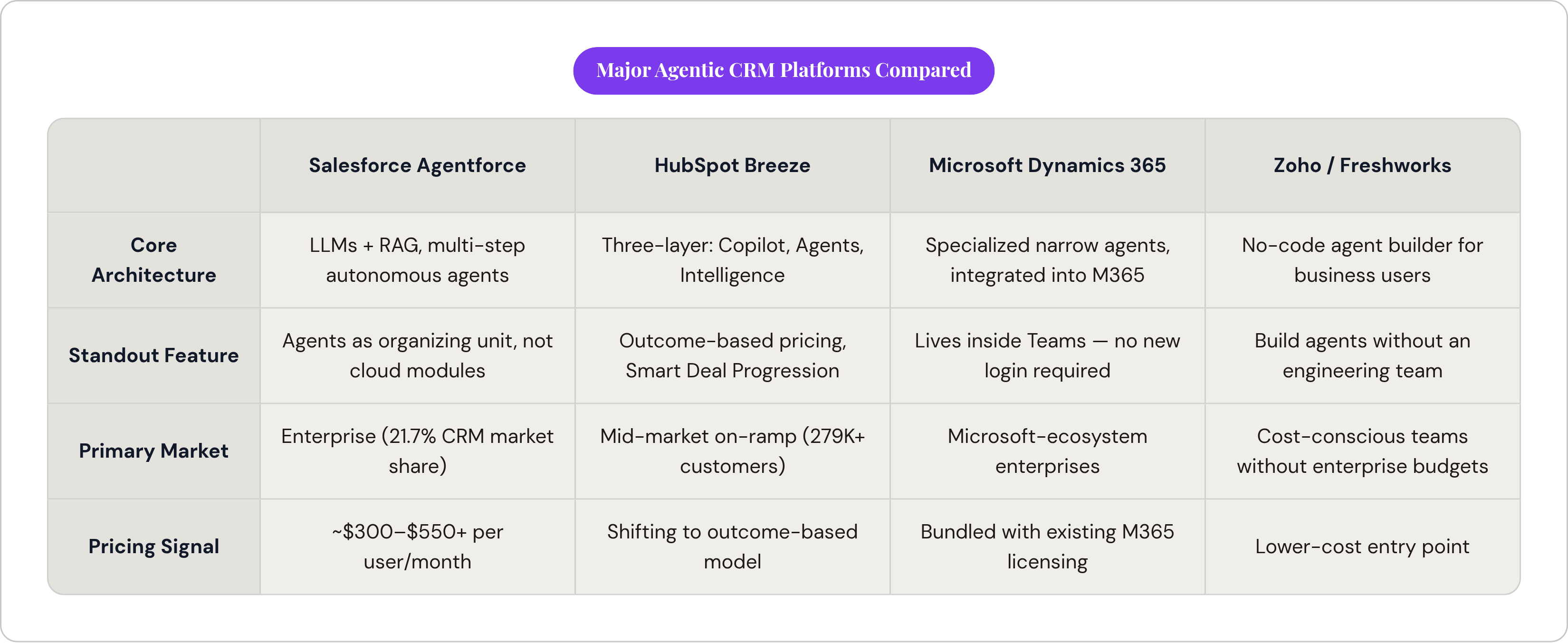
Salesforce has been building toward this for a decade, across three distinct waves: predictive AI with Einstein, generative AI with Einstein GPT, and agentic AI with Agentforce. The engine underneath combines language models and RAG to run multi-step actions without pausing for approval at every turn. Telling detail: agents are the organizing unit now, not the cloud modules Salesforce used to sell by name. Agentforce sits at $540 million ARR, and Salesforce holds the largest CRM market share at 21.7%, per IDC data. Pricing starts around $300 per user per month and climbs past $550 for the full Agentforce edition, positioning it squarely as an enterprise-grade offering.
HubSpot's Breeze splits into three layers: Breeze Copilot, the conversational assistant living inside the platform, Breeze Agents, which run full autonomous workflows end to end, and Breeze Intelligence, handling data enrichment and buyer intent signals. Recent updates added a feature called Smart Deal Progression and a range of supporting improvements stacked on top. HubSpot's pricing model has shifted toward outcome-based structures rather than the per-seat model most competitors still run, a meaningfully different bet on where the value actually lives. With 279,000-plus customers, HubSpot is positioning itself as the on-ramp for mid-market teams not ready to sign an enterprise-scale contract.
Microsoft's Dynamics 365 deploys a set of specialized agents covering sales qualification, opportunity management, data enrichment, and research, each one narrow, together adding up to what Microsoft frames as extra support capacity for every rep. Because it's wired tightly into Microsoft 365 and Teams, these agents show up inside tools reps already have open instead of demanding a new login and a new mental context switch. Microsoft's ambitions run past sales entirely too, into finance and operations, expense entry, supplier outreach, reconciliations, the same agentic logic applied company-wide instead of department by department.
Zoho and Freshworks deserve a mention for a different reason. Zoho's Zia Agent Studio and Freshworks run comparable platforms that let a business user build an agent without needing an engineering team on standby. That matters most for companies chasing agentic workflows without an enterprise platform's price tag attached.
One more piece worth naming, because it's easy to skip: agents don't invent nurture sequences and follow-up copy out of thin air, they deploy assets someone already built. The upstream content, the sequences, the nurture copy, the templates, still needs a strategy and a human hand behind it. The platforms connecting content production directly to deployment logic are the ones actually closing the loop between what marketing writes and what sales sends.
What changes for the sales rep working alongside these agents
The rep's job moves from data steward to decision reviewer. Less time typing updates into fields nobody reads twice, more time on calls that actually need a human: reading a room, negotiating terms, figuring out who the real champion is inside a buying committee, judgment work no agent replicates yet.
Sales teams using AI reported revenue growth at an 83% rate, compared with 66% for teams not using it. That gap is real, but it comes with a string attached: it only shows up for reps who actually engage with what the agent surfaces, rather than ignoring the flag and doing what they were always going to do anyway.
"Human in the loop" isn't a default setting. It's a decision someone has to make on purpose, deliberately, in advance. Which actions run fully on autopilot? Which ones need a human to click approve first? Which ones does the agent only get to suggest? Get that sequencing wrong, and you either drown reps in approval requests or let an agent send something to a VP that badly needed a second pair of eyes first.
There's a trust problem tucked in here too. A rep who doesn't understand why an agent scored a deal lower than expected is going to override that score on gut feeling, and the gut feeling is often wrong, or at best no more right than the machine's. Teaching a rep how the agent reasons matters as much as flipping the agent on in the first place.
Pipeline reviews change shape as a result. Instead of a rep reading numbers off a screen because the data's finally current on its own, the meeting shifts toward arguing over the flags the agent raised and deciding which exceptions are worth making. The most valuable rep in this setup isn't the fastest typist anymore. It's the one who reads what the agent's telling them clearly and adds the judgment call the agent still can't make.
Governance, data quality, and the limits of autonomous action
Everything said above about clean data cuts both ways, and it's worth restating plainly here: structured, accurate CRM records produce reliable autonomous action, and messy, inconsistent ones produce errors that compound instead of staying isolated to one bad record somewhere.
Identity and permissions raise a question most companies haven't fully worked out. An agent acting on a rep's behalf needs its own access controls, distinct from the rep's own login, and figuring out how to govern that is becoming its own discipline, separate from ordinary user account management entirely.
Compliance actions make the stakes concrete fast. When an agent writes a consent record or fires an opt-out into a suppression field, that write carries legal weight, not just operational tidiness. Get it wrong, and the fallout is a compliance problem with a paper trail attached to it.
Autonomy runs on a spectrum, not a single switch. At one end, full autonomy: the agent executes and logs, no review needed, fine for high-volume, low-risk work like routine data entry or a stage update. In the middle, human confirmation: the agent proposes and a rep or manager signs off before it fires, the right setting for outreach to a senior stakeholder or a stage change carrying contract implications. At the far end, recommendation only: the agent surfaces what it sees, a human decides and acts, which is where forecasting inputs and major account strategy belong and probably should stay for a while.
That 60% to 80% admin reduction cited earlier assumes the architecture underneath is actually configured well. Bolt an agent onto a CRM full of duplicate records and half-filled fields and that number won't show up; the mess just gets automated faster than before. Before you turn any of this on, audit three things plainly: (i) how complete your data actually is, (ii) whether fields are standardized across your teams, and (iii) whether the integrations between your CRM and everything touching it are reliable, not just connected on paper somewhere in a settings page nobody's opened in a year.
What sales and marketing leaders need to decide before deploying agentic workflows
The real question is which actions you're ready to hand over right now, and which ones you're not yet, a sequencing decision rather than an up-or-down vote at a board meeting.
Start with the highest-volume, lowest-judgment work: (i) data capture, (ii) routine stage updates, and (iii) compliance logging. These carry the fastest payoff and the least downside if something goes slightly sideways, which makes them the obvious place to build confidence before handing over anything carrying real judgment.
Content quality matters just as much as the automation wrapped around it, maybe more. An agent deploying a nurture sequence or a follow-up email runs that copy at scale, so a mediocre template doesn't just underperform once, it underperforms across every single deal the agent touches with it. What an agent sends reflects on the brand exactly as much as what a person sends, arguably more, since it's happening thousands of times without anyone double-checking each one along the way. The strongest agentic outreach programs are still built on content a person thought through carefully beforehand; the agent's job is deployment, not authorship. Get that division of labor backwards, and the result is a faster way to send noise rather than a genuine agentic workflow.
Sources
- https://www.microsoft.com/en-us/dynamics-365/blog/business-leader/2026/06/25/agentic-crm-in-the-flow-of-work-how-ai-is-transforming-sales-and-rebuilding-customer-trust/
Provided the framing of CRM shifting from 'systems of record to systems of action,' which is directly quoted in the article.