Generative AI for CRM Email and Follow-Up Drafts
Generative AI in CRM works only when it has real customer data to draw from.
Old-school email automation in CRM tools runs on rules. You set up a sequence, the system fires pre-written emails on a schedule, and nothing about the content changes unless a human opens the template and edits it by hand.
Generative AI builds new text from context, pulling nothing off a shelf. That's a different category of tool entirely, and the distinction is worth being precise about, because "AI in CRM" has meant three or four different things depending on when you bought the software.
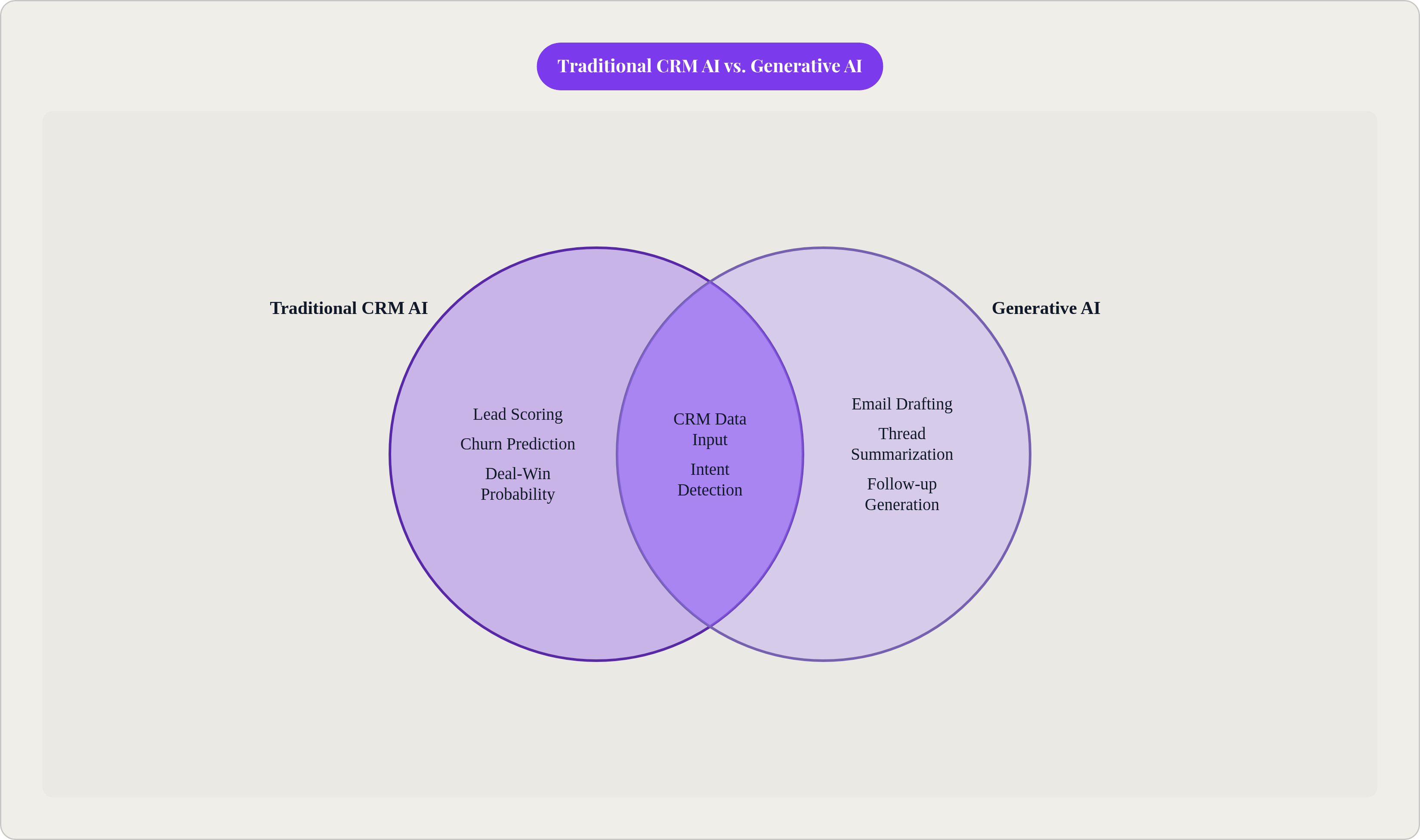
Traditional CRM AI is predictive, covering things like lead scoring, churn prediction, and deal-win probability, all of it analyzing existing data to forecast an outcome. Generative AI creates content instead: email drafts, follow-up messages, call summaries, proposal language. One forecasts an outcome; the other produces the content itself.
In practice, AI email assistants inside CRM platforms tend to handle four jobs. They draft messages from bullet points or raw call notes. They rewrite existing drafts for tone or length, so the same core message goes out as a two-line nudge or a fuller check-in depending on where the deal sits. They generate follow-ups automatically, triggered by a deal stage change or by how long it's been since the last touch. And they summarize long threads or call transcripts into a short list of next steps, which sounds minor until you've burned twenty minutes scrolling a thread trying to remember what got agreed to.
Text-based generative models remain the dominant category industry-wide, since they directly handle the drafting and summarizing that eats the most time in high-volume enterprise email. Context-aware predictive models hold a solid secondary share, mostly powering intent detection and lead prioritization off historical CRM patterns. Multimodal models, the ones combining text with calendar data, CRM signals, and voice input from calls, are growing fastest of the three, which points toward a future where "email AI" and "meeting AI" and "CRM AI" stop being separate products.
Here's the catch, and it's the one the rest of this piece keeps circling back to: output quality tracks context quality. A generative model with no CRM data behind it will still write a grammatically clean, professionally toned email. It just won't know anything true about the person it's writing to. The gap between generic generative AI and generative AI for CRM email comes down to exactly that; the CRM is what makes a draft relevant instead of merely readable.
The context signals that make a draft worth sending
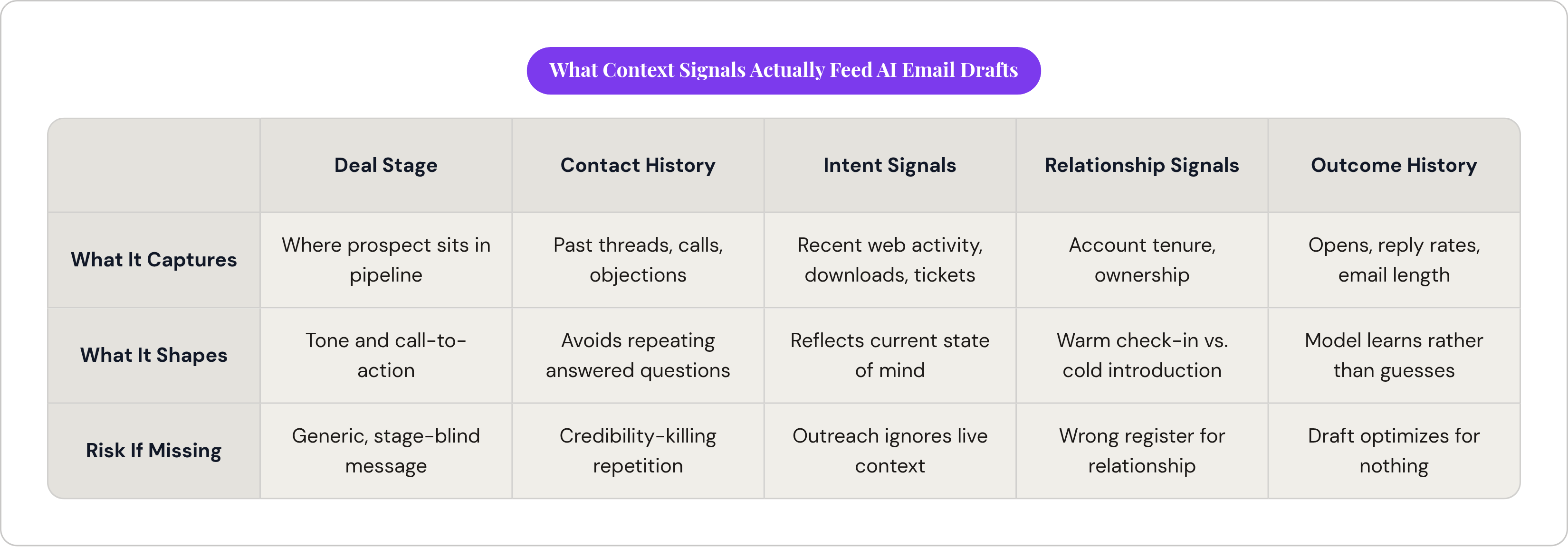
Generic prompts produce generic output. That's a function of how language models work: give them nothing and they default to the statistically average version of "following up on our conversation." A well-configured CRM email workflow needs real signal, and a handful of categories matter more than the rest.
Deal stage is the obvious one. An email to someone in early discovery should read differently from one going to a contact deep in late-stage negotiation, in tone and in what you're actually asking them to do. Contact history matters just as much, things like previous threads, call notes, objections already raised on record. Nothing kills a rep's credibility faster than asking a question the prospect answered three weeks ago. Intent signals, recent web activity, content downloads, support tickets, tell you where someone's head is now, not where it was during the last call. Relationship signals, how long the contact's been in the system, who owns the account, shape whether an email should feel like a warm check-in or a first knock on the door. And outcome history, what subject lines this person has opened before, what length of email actually got a reply, gives the model something to learn from instead of guess at.
Skip these inputs and even a well-written draft fails the one test that matters: does this move this specific conversation forward? A beautifully worded email that ignores the fact the prospect just filed a support ticket about a bug undermines the outreach entirely.
This is also why AI email drafting is downstream of CRM hygiene, not separate from it. A stale, incomplete, duplicate-riddled contact record produces a draft carrying those same flaws forward. Companies lose real revenue to bad CRM data every year, and it's worth saying plainly: the email quality problem and the data quality problem are the same problem in different clothes.
The upside of getting this right is large. Personalized campaigns built on solid context routinely land response rates between 15% and 25%, against generic mass email that often struggles to clear 5%. And yet only around 5% of senders personalize every single email they send, and that small slice sees results two to three times better than everyone else. Most teams are leaving the biggest available gain on the table, not because the technology doesn't exist, but because the context pipeline feeding it is broken somewhere upstream.
How leading CRM platforms have built generative drafting into the workflow
Salesforce built its answer around Agentforce, which grew out of what used to be called Einstein Copilot. The Agentforce Assistant surfaces single-click actions based on whatever page a rep is looking at: "summarize opportunity" shows up on the opportunity page, "draft an email" shows up on the contact page. Reps can query past call transcripts in plain language, asking about customer sentiment, and get a follow-up drafted from what was actually said on the call. The rename from Einstein Copilot to Agentforce in the Winter '25 release signaled a shift in ambition, from AI that helps a rep write something toward AI that goes ahead and takes the action.
HubSpot took a similar direction with Breeze AI. Before a call, Breeze pulls together contact history, deal stage, past notes, and recent activity so the rep walks in prepared. After the call ends, it captures notes, pulls out next steps, and drafts a follow-up without the rep opening a blank email and staring at it for ten minutes. The product runs in three layers: Breeze Copilot for in-the-moment task help, Breeze Agents for automating multi-step workflows, and Breeze Intelligence for enriching the underlying data. HubSpot pushed over 200 AI-related updates in 2025 alone, a pace that suggests ongoing investment rather than a single bolted-on feature.
Zoom out and the broader market tells a similar story. Microsoft currently holds the largest share of the AI-powered email productivity space, with Google, Salesforce, HubSpot, and Zoho rounding out the field. On the revenue operations side, Salesloft and Clari merged in late 2025 to build a combined platform spanning prospecting through forecasting, suggesting the industry sees drafting and forecasting as two ends of the same pipe. Pricing spans a wide range, from around $15 to tens of dollars per user monthly for integrated CRM AI features, up to six-figure annual contracts for full enterprise deployments.
The thread running through all of it: draft quality tracks directly with how deeply the AI sits inside live CRM data. A bolt-on writing tool that isn't actually connected to the contact record, the deal stage, or the call history produces weaker, more generic output no matter how good the underlying model is. Even standalone content platforms that connect to CRM data through a workflow, feeding context in as a brief, follow the same logic. The integration point matters more than the product category.
What the productivity gains actually look like when this works
Start with the clearest number available. HubSpot's 2024 research found 64% of reps save between one and five hours weekly through automation, and separate LinkedIn research from 2025 found sellers using AI for research specifically save around 1.5 hours per week. Bain & Company frames the bigger structural opportunity: if reps currently spend 25% of their time actively selling, and AI clears out enough routine work to double that share, the shift represents a fundamentally different allocation of the workday, not a minor efficiency bump.
Broken down by task, vendor studies report drafting and replying to email running roughly 30% to 50% faster with AI assistance. Data entry sees one to two hours recovered weekly, alongside 30% to 40% fewer errors, which matters more than it sounds, because bad data compounds into bad decisions downstream. Lead nurturing and follow-up scheduling picks up another 30 to 60 minutes a day on top of that.
Here's what those numbers leave out, though: saved time only turns into revenue if reps actually redirect it toward something that matters. AI can hand a rep back forty-five minutes a day, but if that rep spends it scrolling LinkedIn instead of prioritizing the three deals actually close to closing, the savings evaporate without a trace. Deciding which conversation deserves the rep's attention next remains, stubbornly, a human call.
There's a performance signal worth flagging here too, with a caveat attached to it. LinkedIn's 2025 data found 56% of sales professionals use AI daily, and that group is twice as likely to exceed sales targets compared to non-users. Tempting as it is to read that as proof AI drives performance, causality cuts both ways here: it's entirely possible that high performers are simply faster adopters of new tools generally, and that AI usage is a symptom of being good at the job rather than the cause of it.
Which raises the more interesting question the next section actually gets into: does faster drafting produce better emails, or just more emails, faster?
Traditional CRM AI is predictive, covering things like lead scoring, churn prediction, and deal-win probability, all of it analyzing existing data to forecast an outcome.
When AI-drafted emails perform better — and why brevity matters more than most teams expect
The performance case for AI-assisted personalization holds up on its own terms. Campaigns with genuine personalization behind them can land response rates of 15% to 25%, against generic mass email that often sits under 5%. Context-triggered emails, the kind fired off automatically when a prospect visits a pricing page or downloads a case study, consistently beat broadcast blasts on opens, clicks, and conversions. The mechanism isn't complicated; it's relevance and timing, showing up in an inbox right when the thing someone cares about is still fresh.
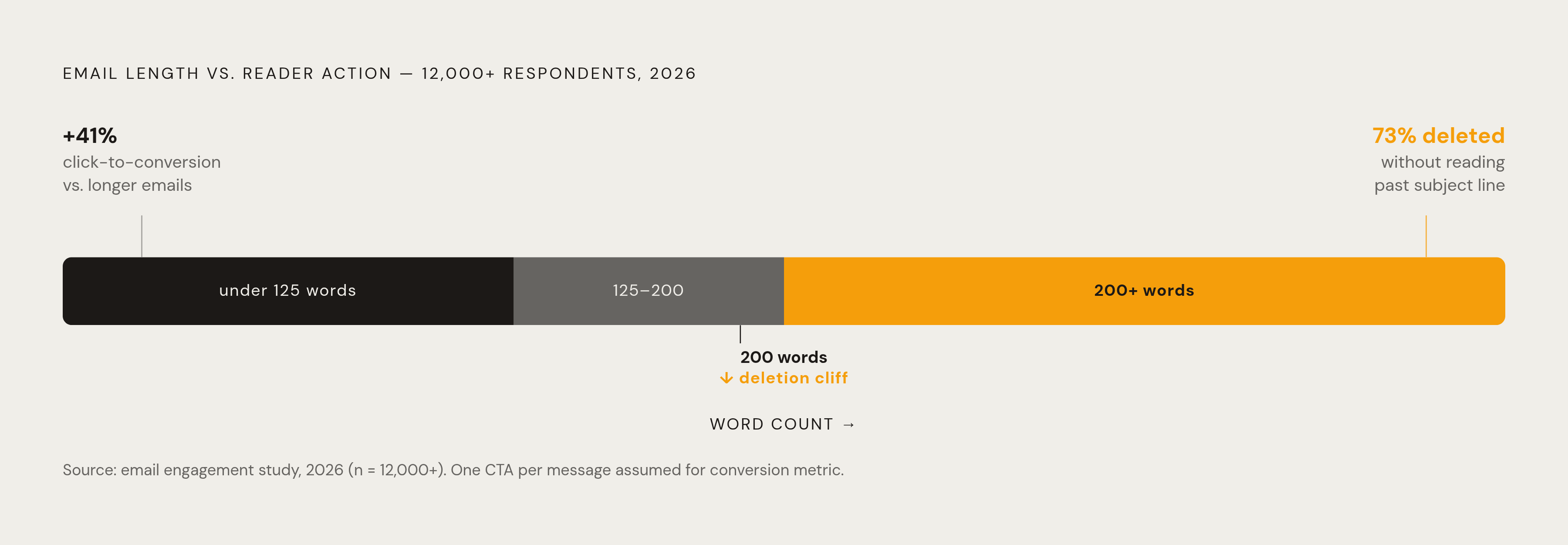
But there's a wrinkle that catches a lot of teams off guard: length matters more than most people assume, and generative models have a natural tendency to run long. A 2026 study of subscriber email behavior, surveying over 12,000 respondents, found 73% of people immediately deleted emails over 200 words without reading past the subject line. Emails under 125 words with one clear call-to-action generated 41% higher click-to-conversion rates than their longer counterparts.
That's a real problem for AI drafting specifically, since language models, left unprompted, tend toward verbosity. They fill space and add qualifying clauses. They restate context the reader already has memorized, because that's what "helpful, thorough writing" statistically resembles in the training data. Ask a model to draft a follow-up and it will often hand you four paragraphs where two sentences would have converted better.
So prompting discipline is the actual lever teams have to pull. The best-performing AI email workflows build in explicit constraints: word count caps, single-CTA rules, plain-language requirements that strip out the throat-clearing. The job of AI in a CRM draft is to write the smallest message that still moves the deal forward at this specific stage. Comprehensive is often the enemy of effective here, even for a tool whose entire selling point is generating more text, faster.
The trust problem with AI-drafted email and what human review actually catches
Here's a finding worth pausing on before you hit auto-send on anything. A 2025 study surveying more than 1,000 professionals, conducted by researchers Coman and Cardon and published in the International Journal of Business Communication, found recipients rated heavily AI-assisted emails as sincere only 40% to 52% of the time. Emails with low or no AI involvement scored 83% on the same measure. Professionalism ratings told a similar story: messages read as human-written earned near-universal approval, while heavily AI-drafted messages dropped to somewhere between 69% and 73%.
Why does this happen? Recipients seem to pick up on AI-heavy phrasing more often than senders expect, reading it as emotional detachment or low effort, particularly in relationship-sensitive work like sales, where the entire point of the email is to signal that a person actually cares how this turns out.
There's a genuinely odd twist buried in that same research. Disclosing AI involvement with a short one-line note performed about as well as not disclosing at all, while detailed disclosures, the kind explaining exactly how much of the email AI generated, actually performed worse on trust measures. Transparency alone doesn't close the authenticity gap; if anything, over-explaining draws more attention to the thing you were hoping the reader wouldn't notice in the first place.
So what does human review actually catch that the model misses? Brand voice consistency is one, since AI drafts to a general professional register, not to the specific, slightly weird way your company actually talks to its customers. Factual accuracy is another, especially when a draft references a past conversation or a pricing detail from a call three weeks ago that the AI has no way of verifying. Strategic alignment matters too, whether this email is the right move at this exact moment in the deal and not just whether the sentences are well-formed. And in regulated industries, compliance nuance is its own animal entirely; a single phrasing choice can carry real legal weight, and no language model currently understands your industry's regulatory exposure the way your compliance team does.
Across enterprise deployments, a meaningful share of AI-generated drafts need manual correction before going out, whether for tone, factual alignment, or compliance language. The draft speeds up the process, but editorial judgment still has to close the gap. Treat the draft as a finished product and you end up apologizing to a client for an email that confidently misquoted last week's pricing call.
AI functions best as a first-draft engine that solves the blank-page problem, and that role stops well short of making it a send-ready system on its own.
Setting up a CRM email workflow where AI drafts and humans decide
The workflow that actually works has a simple shape. AI drafts, a human reviews and decides, the CRM records what happened, and that outcome feeds the next draft. It's a loop, not a one-way pipe, and the loop is the whole point.
It starts with a trigger: a deal stage change, a stretch of time since the last touch, or an intent signal like a web visit or a content download. From there, the AI pulls context, ingesting deal stage, contact history, the last message sent, and any call notes or transcript summaries on file. It generates a draft, ideally short, built around one clear call-to-action, sometimes with a subject line variant or two to pick from. Then comes the checkpoint that matters most: a human reads it for factual accuracy, tone, and whether it's actually the right move right now, then edits it or approves it as-is. The email goes out, the outcome logs automatically, and the open, reply, and conversion data feeds back into how future drafts for this contact, and similar contacts at similar stages, get written.
Where should you actually spend your attention inside that loop? Line-editing every sentence AI produces is generally a poor use of your time. The real value sits at the strategic layer: is this the right ask, for this person, at this moment?
AI does its best work on high-frequency, lower-stakes messages: check-ins, scheduling nudges, meeting confirmations, the stuff that needs to go out reliably but carries little risk if the phrasing runs slightly generic. Post-call summaries converted straight into follow-up emails are another strong use case, along with the middle steps of a sequence, steps two through five, where the core message is already established and personalization is mostly polish rather than heavy lifting.
Your authorship should stay in the driver's seat for first outreach to a cold or warm prospect, where no relationship exists yet to cushion an off note. The same goes for the high-stakes moments: proposals, pricing conversations, re-engagement after a deal's gone cold. Anywhere the wrong word choice could end the relationship outright, you should write the first draft, not edit one.
None of this works without clean CRM data underneath it. That's not a footnote; it's the foundation. A workflow this dependent on context breaks down fast once contact records go stale or incomplete. Platforms like HubSpot's Breeze and Salesforce's Agentforce are built natively for this loop; teams running standalone AI writing tools can build the same loop themselves, as long as they stay disciplined about piping CRM context into every prompt instead of letting the model guess.
Where agentic AI is taking this next — and what teams should watch
Right now, the default setup still has a human in the loop: AI drafts, a person approves, the email goes out. That's the safe, current state of things, and given the trust data covered earlier, probably the sane one too.
The direction of travel points toward AI that doesn't just draft on request but initiates action on its own, deciding when a follow-up is warranted and sending routine messages without waiting for a click of approval each time. Salesforce's own rebrand from Einstein Copilot to Agentforce is a tell here. The industry is naming this shift explicitly, framing the next generation of tools as agents that act on their own initiative, a step beyond assistants that merely suggest.
That raises a real question worth sitting with instead of rushing past: how much autonomy actually belongs here, given that recipients can tell the difference between a heavily AI-written email and a human one, and rate the AI version as noticeably less sincere? Handing a machine full autonomy over an activity where trust and tone are the entire product is a bet worth making carefully, one use case at a time, rather than all at once. The teams worth watching over the next couple of years won't be the ones that adopt agentic sending fastest. They'll be the ones that figure out exactly where the line between "AI can just do this" and "a human needs to see this first" actually belongs, and then hold it.
Sources
- https://superagi.com/the-future-of-crm-how-generative-ai-is-revolutionizing-automation-and-personalization-in-2025-2/
Provided background on how generative AI differs from predictive CRM AI and the shift toward content generation within CRM platforms.
- https://gain.io/blog/future-of-crm
Informed the discussion of multimodal models combining text, calendar data, CRM signals, and voice input as the fastest-growing category.
- https://www.congruencemarketinsights.com/report/ai-powered-email-productivity-tools-market
Provided market-share context for text-based generative models as the dominant category and multimodal models as the fastest-growing segment.