AI Lead Scoring in Modern CRM Platforms
AI models now retrain on closed deals to predict conversions; most teams ignore the score anyway.

I've been staring at lead scores for close to a decade, and here's the actual shift: the number used to be a marketer's gut dressed up as math, and now it comes from a model that checks its work against thousands of closed deals. This piece walks through what's different under the hood, what data feeds these systems, how Salesforce and HubSpot build them into their platforms, and why so many sales teams still ignore the score sitting right in front of them. That last part turns out to matter more than the math does.
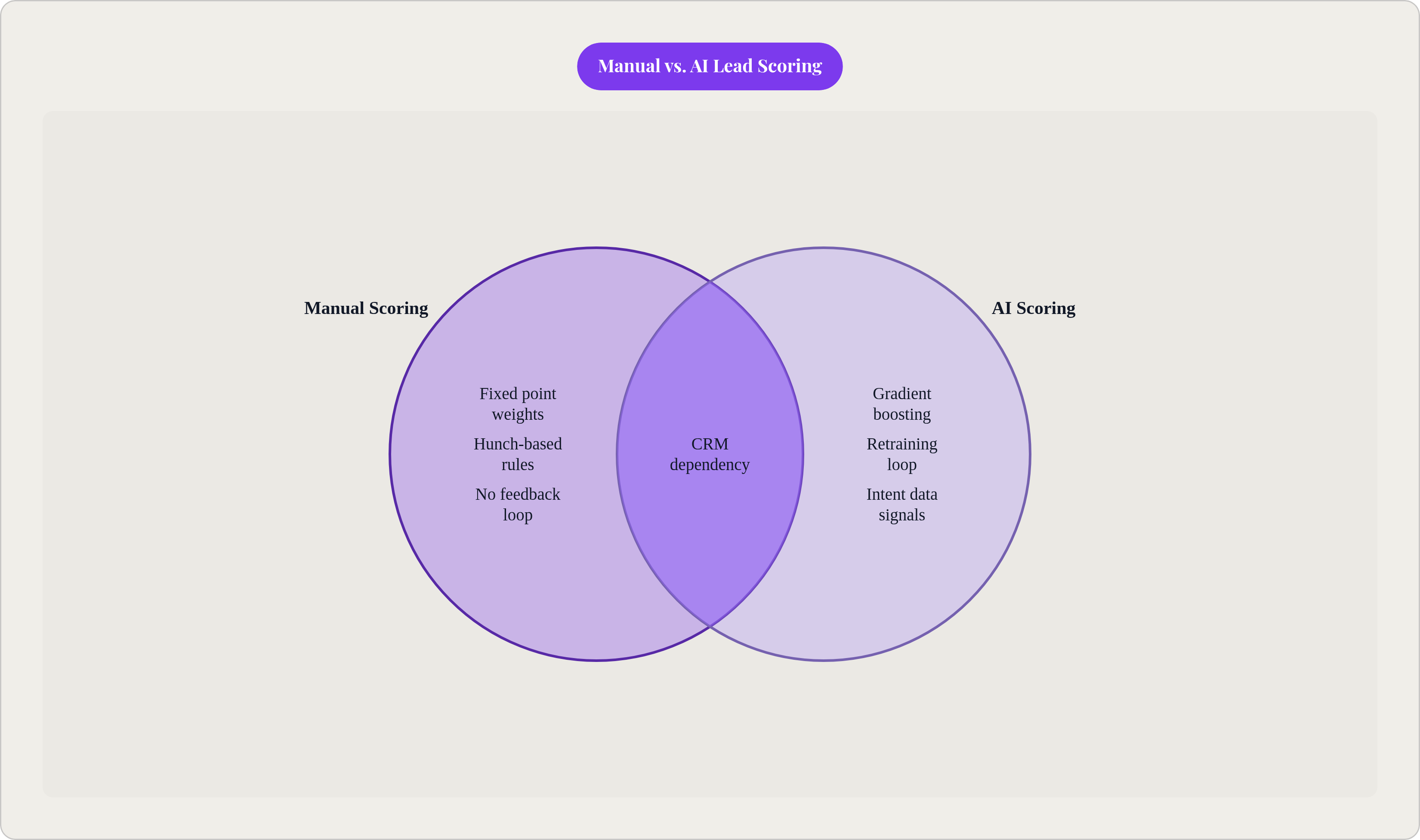
For years, lead scoring meant someone with a spreadsheet deciding a VP title was worth 20 points, a demo request 15, an email open maybe 2, then adding it all up and calling it strategy. The weights got set once, based on hunches about the buyer that felt true at the time. Nobody touched them again until pipeline dried up and someone finally asked why.
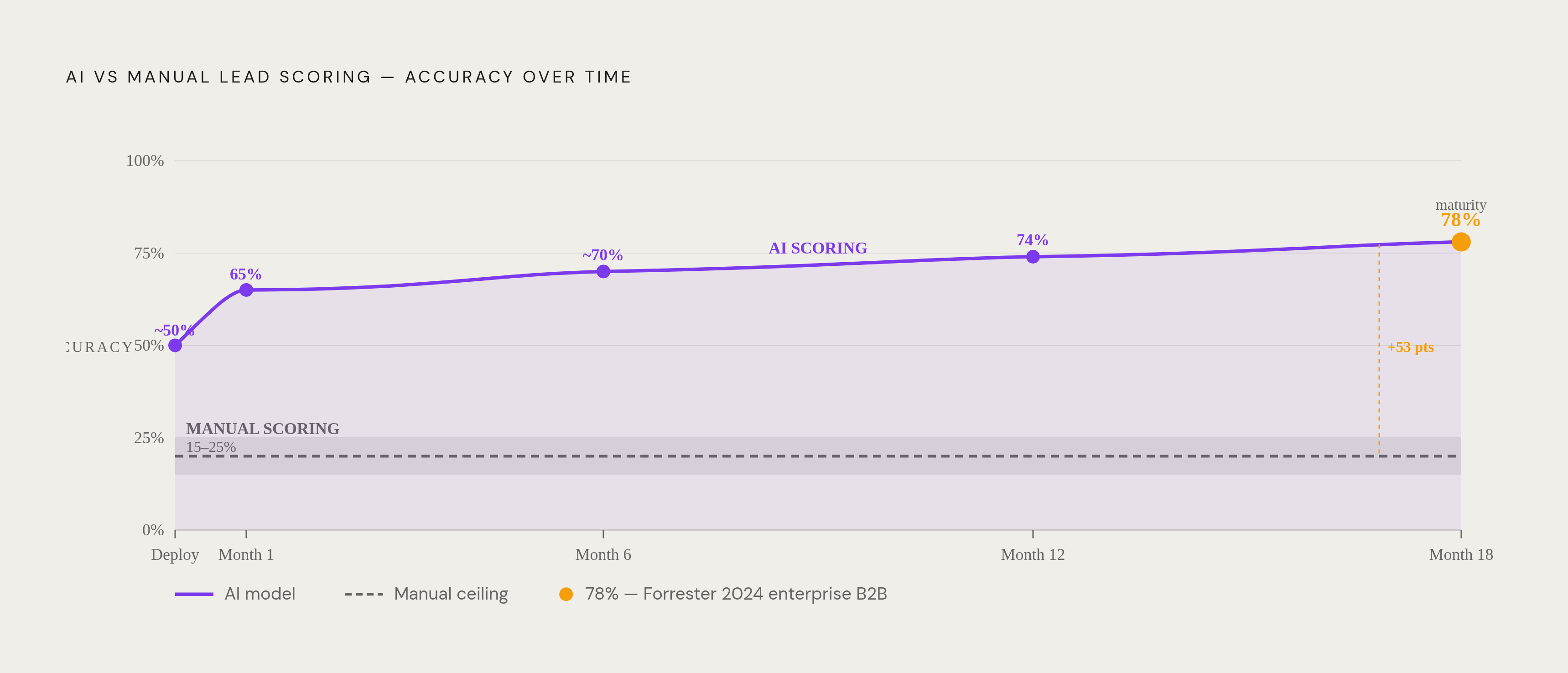
A fixed-weight model describing a moving target breaks eventually. Per the 6sense 2025 B2B Buyer Experience Report, 61% of the buying journey wraps up before a buyer ever talks to a seller, and a score built around form fills and title fields misses almost all of that pre-contact behavior. It was never built to see it. Manual scoring lands somewhere around 15% to 25% accuracy in practice, and the gap between the number your team trusts and the number that actually predicts a close is exactly the space AI moved into.
There's a second failure mode, just as damaging. A model trained once on last year's closed deals goes stale the moment the market shifts, and there's usually no feedback loop to catch it: reps override the score with gut instinct every day, but the model never hears about it and never learns from it. A prospect binge-reading competitor reviews shows up as a real signal, but the old rule-based system has no slot for it unless someone builds one by hand. None of this is a data volume problem, either. Pour more leads into a broken formula and you get more confidently wrong numbers, faster, not a fixed formula.
What AI lead scoring actually does differently under the hood
The shift is structural, not cosmetic. Instead of a person assigning point values off a hunch, a model trains on historical closed-won and closed-lost records and finds, statistically, which combinations of traits actually predicted a deal closing. Nobody's guessing that company size matters here; the model tests it against thousands of real outcomes and tells you by how much it moved the needle.
In production today, that mostly means gradient boosting methods like XGBoost and LightGBM, which handle messy, interacting features well and tend to top the accuracy charts once tuned properly. A 2025 study in Frontiers in Artificial Intelligence reported a gradient boosting classifier hitting 98.39% accuracy in an optimized B2B scenario. That's an academic benchmark under clean lab conditions, though, not what you should expect walking into a live CRM deployment on day one. Random Forest shows up a lot too, mostly because it tolerates missing or noisy fields without falling apart, and that matters when half your CRM records have a blank "industry" field sitting there unfilled. Neural networks, oddly enough, show up less here than in image or language tasks; that same 2025 research found boosting and forest methods beating them for this particular job.
What actually separates this from the old spreadsheet approach is the retraining loop. As reps close deals or lose them, that outcome data flows back into the model, and its sense of what "good" looks like drifts to match reality instead of staying frozen at launch. Early on, accuracy sits around 65% in the first month, barely better than a coin flip. Give it 12 to 18 months of real outcome data, though, and Forrester's 2024 research put the enterprise B2B benchmark at 78% accuracy at maturity, assuming at least 10,000 historical lead records with outcomes attached. Set that against the 15% to 25% ceiling of manual scoring and the 40% to 60% range AI models tend to land in early on, and you're not looking at a small bump. You're looking at something closer to double or triple.
Accuracy still depends entirely on the outcome data you feed the model. A team with sloppy CRM hygiene, opportunity records sitting stale and unclosed for months, or just not enough lead volume yet, hits a cold-start wall long before any of these numbers show up. The algorithm doesn't do magic; it finds patterns, and it needs patterns to actually find.
The signals that feed a modern scoring model
Ask what a model is actually looking at, and four buckets cover most of it. Firmographic data (company size, industry, revenue band, geography) is the classic ICP filter marketers have leaned on for decades. Behavioral data tends to carry the highest signal in most B2B contexts: web visits, how far someone reads into a pricing page, which content they bother downloading, whether they click an email or ignore it outright, whether they book a demo or ghost. Technographic data adds a layer on top, flagging whether a prospect's existing tech stack signals budget, readiness, or an opening to displace whatever they're already using. Then there's intent data pulled from third parties: research spikes on a topic, review site visits, competitor comparisons, the digital footprints someone leaves behind long before they ever fill out a form.
Why does breadth matter this much? Generic models relying only on first-party CRM data risk missing meaningful conversion signals in specialized industries. Feed a model narrow inputs and you get a narrow score back. Simple as that.
Enrichment is where a lot of this either gets fixed or doesn't. Incomplete records drag down anything the model tries to do with them, which is why platforms leaned so hard into third-party data providers. HubSpot's acquisition of Clearbit, now folded into Breeze Intelligence, adds a broad range of B2B attributes to fill the firmographic and technographic gaps a typical CRM record leaves blank.
There are real thresholds worth knowing before you get your hopes up too high. Salesforce Einstein recommends a meaningful minimum of leads with recorded conversion outcomes attached before predictive scoring becomes reliable. Forrester's 78% benchmark assumes 10,000-plus historical records with outcomes. For a team early in its CRM life, the bottleneck isn't the algorithm at all. It's whether you've got enough clean history for the algorithm to actually learn something from.
A fixed-weight model describing a moving target breaks eventually.
How leading CRM platforms implement AI scoring today
Salesforce has been building toward this for years through Einstein, one of the longer-running branded AI features in enterprise CRM software. Einstein scores leads and opportunities based on patterns pulled from closed-won and closed-lost history, training on account data rather than a generic model averaged across all customers. The company has since layered in three tiers: predictive AI for scoring, generative AI for drafting emails and summaries, and agentic AI through Agentforce, which acts on its own rather than just suggesting. Pricing varies by tier, with Einstein included in higher-tier editions and Agentforce available as an add-on at additional cost.
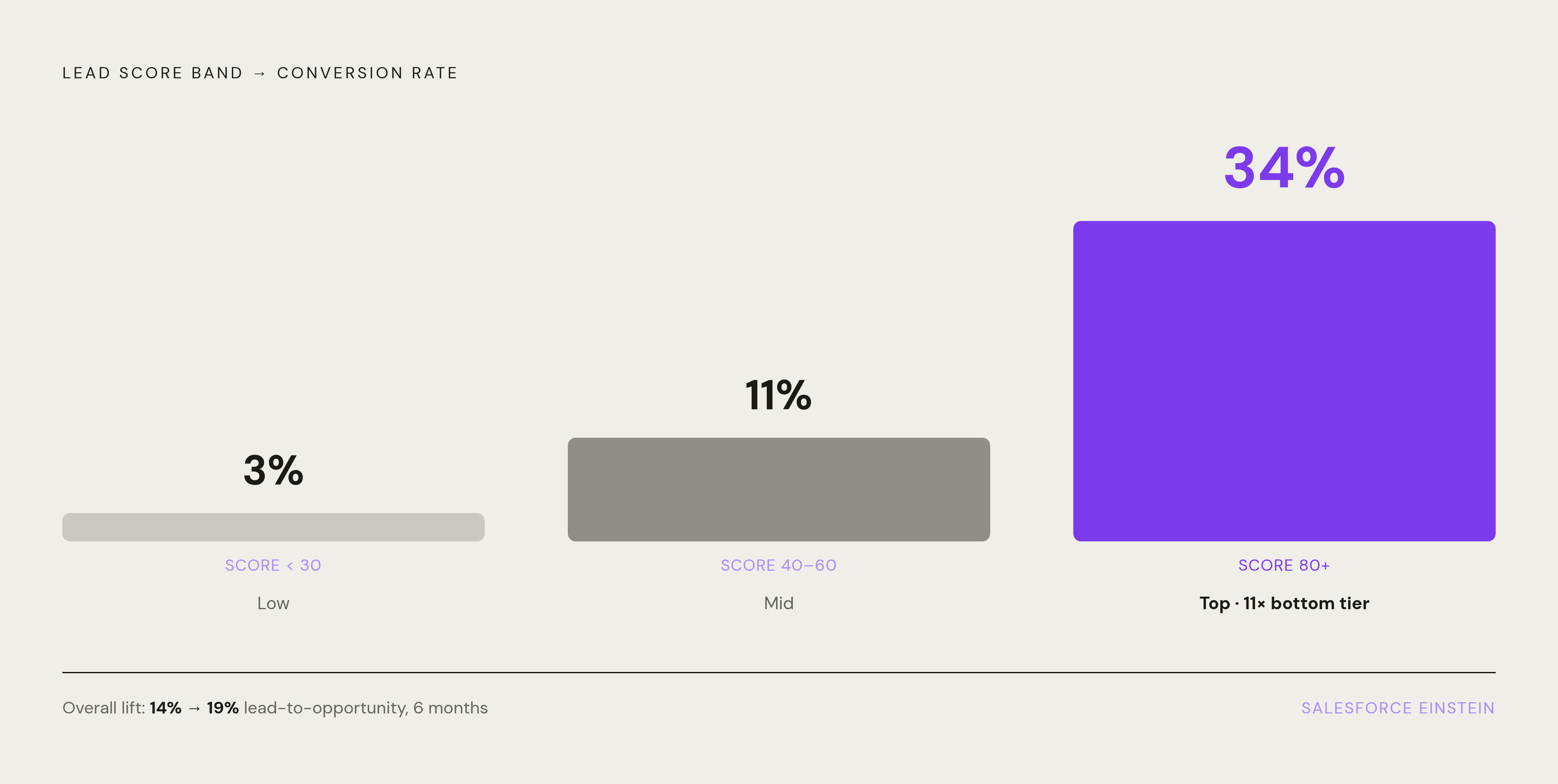
One real deployment tells the story better than any spec sheet. Leads scored 80 or above converted at 34%. Leads in the 40-to-60 range converted at 11%. Leads below 30 converted at just 3%, and routing off those scores lifted overall lead-to-opportunity conversion from 14% to 19% over six months. Salesforce's Einstein Trust Layer also includes data governance and security controls, and emerging AI regulations are placing increasing liability for autonomous agent actions on the companies deploying them. Easy detail to skip past, until it's the one that matters.
HubSpot's approach runs through Breeze, the umbrella for its AI features since the Clearbit acquisition closed and the product got rebranded as Breeze Intelligence. Breeze Copilot handles in-context help while you're working a record, Breeze Agents cover prospecting and content tasks, and Agent Hub coordinates multiple agents working together instead of separately. HubSpot's cold-start floor reflects the general rule that these systems need meaningful runway before anyone should trust them.
In 2024, 56% of CRM platforms added AI features including predictive lead scoring, which tells you this is becoming table stakes fast rather than staying a differentiator on its own. And the platform's scoring is only as account-specific as the training data sitting behind it. A freshly deployed Einstein instance running on six months of thin CRM data is not the same product as one that's been learning from three years of closed deals.
Then there's native scoring versus specialized platforms like 6sense, Apollo, or Warmly. Specialist tools bring richer third-party intent data and deeper account-level modeling; native CRM scoring wins on integration depth, workflow automation, and keeping everything in one place instead of stitched across tools. SalesLoft's use of 6sense Revenue AI generated 24 opportunities and added substantial pipeline, a decent illustration of the ceiling a dedicated intent layer adds on top of what the CRM already does.
Model transparency and why sales teams reject scores they can't read
A score that just says "this lead is an 87" with nothing attached gives a rep zero to act on. Reps know it too, because they've been burned by black boxes before.
The platforms that actually get adoption right surface score drivers, the specific signals pushing a number up or down, so a rep can check the model's reasoning against what they already know about the account. Good transparency in practice names the positive factors (attended a webinar, matches target company size, showed an intent spike on a competitor's review page) next to the negative ones (no decision-maker contact yet, wrong industry segment). Add a trend view showing whether the score climbed or slid week over week, and a rep has something to work with instead of a mystery number to shrug at and ignore.
Skip the explainability layer, and reps route around the score entirely, falling back on gut feel the way they always did before any of this existed. All the accuracy Salesforce and HubSpot spent months tuning never translates into changed behavior, because nobody on the floor believes the number enough to act on it differently. The broader problem of generic models missing conversion signals in specialized industries becomes nearly invisible too, without explainability: neither the model nor the rep can see what's being missed if nothing surfaces the reasoning in the first place.
Transparency isn't a feature buried three pages deep in a product spec sheet. It's the actual bridge between a model's accuracy on paper and whether anyone on the sales team changes what they do because of it.
Fitting AI scoring into a working sales workflow
A score sitting in a dashboard that nobody checks does exactly nothing for anyone. The real value shows up at three points: lead routing, where high scores trigger assignment to senior reps instead of a round-robin queue; prioritization, where reps open a ranked list each morning instead of guessing where to start their day; and SLA enforcement, where leads crossing a threshold trigger time-sensitive alerts or automated outreach through agentic tools.
Research has found AI saves sellers meaningful hours each week on average, which sounds like a clean win right up until the next finding: a large share of sales organizations fail to put that reclaimed time back into anything resembling high-value selling. The organizations that do reinvest it are 3.1 times more likely to beat their lead-to-opportunity conversion goals. That one stat reframes the whole conversation, because the bottleneck was never really the model's accuracy. It's whether the sales process actually changes to use the time and prioritization the model hands it. Give someone a sharper knife and they'll keep cutting the same way they always did if nobody tells them otherwise.
A workable rollout tends to follow a similar shape across teams. Check CRM data quality and outcome history before flipping predictive scoring on at all. Set score thresholds together with sales leadership, not off in a marketing silo disconnected from quota conversations. Run a parallel period where score-based routing sits alongside the existing process, so you can compare outcomes before committing fully, and build in a quarterly check for model drift as market conditions shift underneath it.
The workflow dimension is what makes the payoff concrete. That's not the model working alone; that's a workflow rebuilt around what the model surfaces. Per Gartner's 2025 Sales Technology Report, 89% of revenue organizations now use AI-powered tools, up from 34% in 2023. The baseline is rising fast, and teams that bolt scoring onto an unchanged process end up paying the license fee without collecting any of the conversion lift that's supposed to come with it.
What to look for when evaluating AI scoring in a CRM platform
A handful of things are worth weighing hard before signing anything. Start with data minimum viability: does the vendor tell you plainly how many records you need before scoring gets reliable? If they dodge that question, assume the model is a black box wearing a nice dashboard as a disguise. Check signal breadth next: does the platform pull in behavioral, firmographic, technographic, and third-party intent data, or is it stuck with whatever's already sitting in your CRM fields?
Explainability deserves its own line, separate from everything else. Can a rep see the actual drivers behind a score at the individual lead level, not some aggregate chart buried three clicks deep in an admin report? Model specificity matters too: a score might come from a model trained on your own closed-won history, or from a generic model averaged across every customer the vendor has, and account-specific models pull ahead fast once enough of your own data feeds them. Workflow integration rounds it out. Does the score actually reach routing rules, nurture enrollment, rep alerts, and forecast weighting, or does it just sit there without being used?
Watch for a few red flags while you're at it. Accuracy numbers thrown around with no stated data volume or training period behind them. No disclosed model logic anywhere in the product. Scoring that lives off in its own separate dashboard instead of showing up where reps actually spend their day.
Most revenue teams come out ahead going with native CRM scoring on the build-versus-buy question, since it means lower integration overhead and one data model to keep up, unless the addressable market is narrow enough that a vendor's generic training data can't really speak to it. In that case, layering a specialist intent tool on top makes more sense. The field keeps getting more crowded either way: the predictive lead scoring software market is projected to grow from $5.55 billion in 2025 to more than $25.56 billion by 2035, a 16.5% compound annual growth rate. As the vendor list gets longer, picking carefully matters more, not less.
Lead scoring doesn't sit apart from what generates the leads in the first place. The content that pulls a prospect in and the score that ranks them once they arrive are upstream and downstream of the same funnel, whether anyone building the scoring model thinks about it that way or not. Teams producing sharp, specific content give their model richer behavioral signal to learn from than teams running generic campaigns that all sound like everyone else's. The model is only as smart as the signal you feed it, and that starts well before anyone opens a CRM record.
Sources
- https://www.warmly.ai/p/blog/ai-lead-scoring
Provided the statistic that 61% of the buying journey completes before a buyer speaks to a seller, and the 15–25% accuracy figure for manual lead scoring.