Risks of AI Automation in CRM Data Management
AI amplifies poor data and bias across customer records at dangerous scale.
CRM adoption is basically universal now: 91% of companies with more than ten employees run one, growing at 12.6% a year according to teamgate.com. Seventy percent of those companies have already bolted AI onto their CRM, and 65% use generative AI specifically for forecasting, scoring leads, and writing outreach that pretends a human typed it. The market backing all this is worth $73.40 billion in 2024 and is projected to hit $163.16 billion by 2030, so the money at stake is not small change if any of it goes wrong.
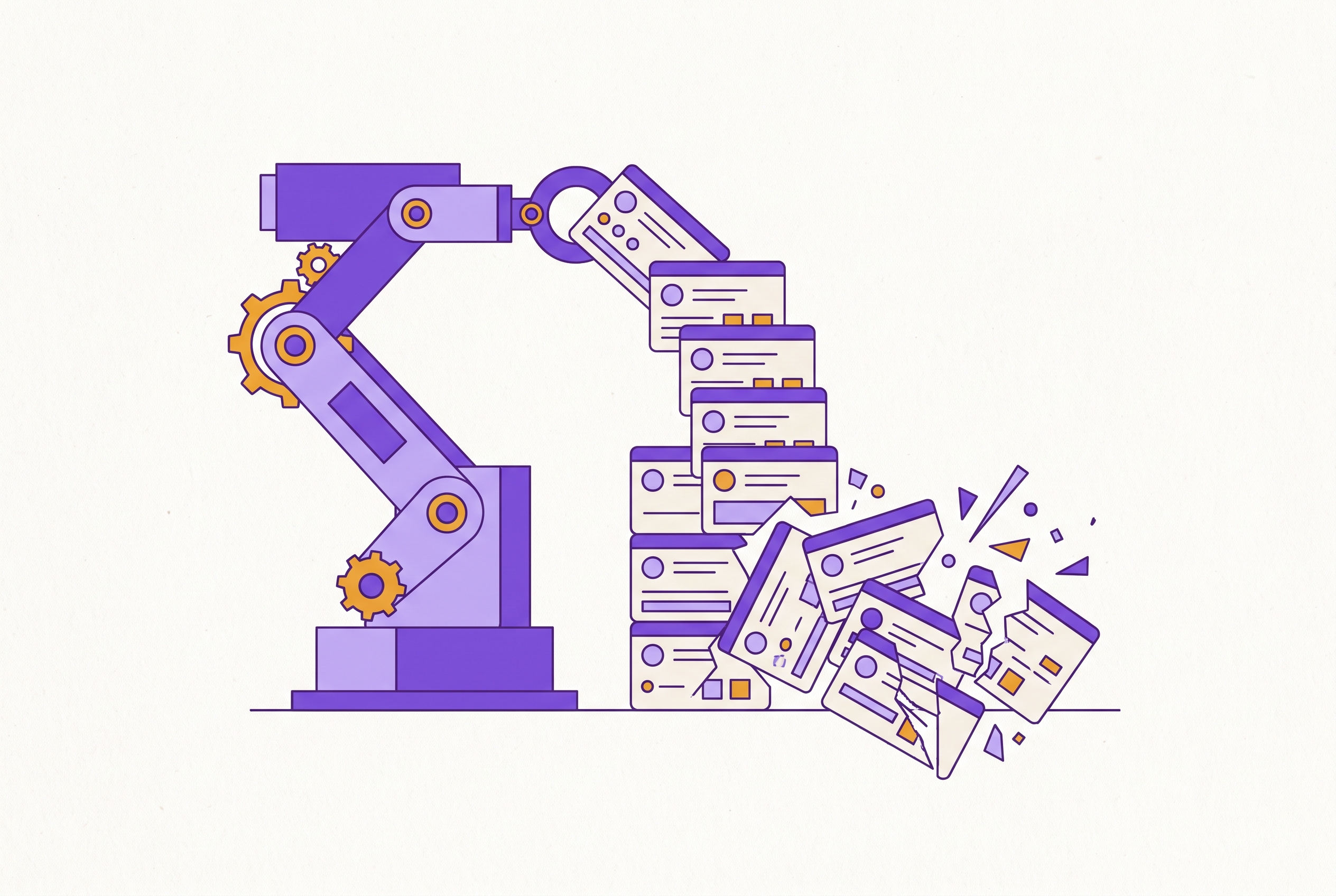
Here's the thing nobody wants to say in the sales deck: AI in CRM takes every failure mode that already existed, bad data, biased patterns, thin security, missing human judgment, and runs it at a speed and volume no human team ever could. Adoption is sprinting ahead of governance, and teams are stacking automation on data infrastructure that was never built to hold it, the way you'd stack a second floor on a house with no foundation and just hope gravity takes the week off. Each section below picks apart one of these failure modes: what it looks like, why AI makes it worse, and what it costs when it plays out at scale.
How AI inherits and amplifies poor CRM data quality before any output reaches a customer
Ninety percent of organizations call their CRM data the backbone of the business, but 76% of those same organizations admit less than half of that data is accurate and complete, according to Validity's 2025 State of CRM Data Management report, which surveyed 602 companies across the US, UK, and Australia. Nine out of ten companies are betting the business on a system that three out of four admit is more wrong than right.
It gets worse before it gets better. Validity's same report found 45% of companies' CRM data isn't prepared for AI at all. That means almost half the industry is pointing a machine-learning model at a dataset that was never cleaned, validated, or organized with automation in mind, and then acting surprised when the output is garbage.
AI doesn't catch bad data; it runs with it. A sales rep looking at a duplicate contact or a stale lead might pause, check with a coworker, and confirm before acting. An AI automation acts instantly on whatever it's given, whether that's a real customer or a ghost record from 2019. Inconsistent or outdated fields don't just sit there quietly; they spread, infecting every downstream output, forecasts, segments, outreach sequences, the whole chain. Industry estimates suggest roughly 60% of AI projects could fail to deliver expected value by 2027 because of exactly this kind of data governance gap.
The revenue hit is not theoretical. Validity's 2025 report found 37% of CRM users say they've lost revenue directly tied to bad data. Separate Martech research found 62% of marketers believe poor CRM data probably or definitely cost their company revenue, whether through missed renewals, inaccurate forecasts, or campaigns aimed at the wrong people entirely. Only 28% say they're very confident their CRM gives them an accurate read on campaign performance and revenue impact, which means most of the industry is operating without reliable visibility into its own numbers.
There's a credibility cost too, and it's an ugly one. Nearly 69% of respondents said a revenue, pipeline, or performance number they presented in a meeting got challenged or quietly walked back because the data underneath it was wrong. Among C-suite executives, SVPs, VPs, department heads, and directors, that number climbs to almost 75%. Presenting a forecast to the board, only to have someone ask where the number came from and realizing you genuinely don't know, is a familiar scenario for many leaders. AI multiplies that moment, because now there are more reports, more forecasts, more dashboards, all built on the same shaky ground.
Gartner has estimated poor data quality costs the average organization $12.9 million a year. IBM's 2025 Institute for Business Value report found 43% of chief operations officers rank data quality as their single most important data priority, and more than a quarter of organizations estimate annual losses over $5 million from it. And yet, 57% of companies are still relying on manual data cleaning while cutting the budget for people whose job is dedicated data quality. Only 18% of organizations without a full-time CRM data quality hire plan to add one in the next twelve months, a 56% drop from 2024, per Validity. Headcount is going down right as AI usage goes up, and that is not a sustainable ratio.
How biased historical data turns AI segmentation into a self-reinforcing loop
Bias in AI-CRM systems is inherited. The model learns from historical CRM data, and historical CRM data reflects historical human decisions, some of which were themselves biased in ways nobody bothered to name at the time. If your sales team spent five years chasing one type of customer, mid-size manufacturing firms in the Midwest, say, the AI trained on that history will often learn that pattern and keep chasing it, regardless of whether the market has moved on.
That's how the loop starts. Biased scoring produces biased outreach, biased outreach produces biased outcomes, and those outcomes become the training data for the next model. Each cycle tightens the same bias a little further. A human rep might notice something's off, maybe try a different pitch, maybe follow a hunch. An automated pipeline runs on weights, and it repeats the same pattern at a volume and speed no rep could match, without ever pausing to ask if the pattern still makes sense.
Where does this actually show up? Lead scoring that quietly downgrades contacts from certain industries or company sizes because historical win rates there were low, even if the market conditions that produced those low win rates no longer exist. Personalization engines that sort customers into segments built on assumptions about who buys what, assumptions that might be five years stale. Churn models trained on a weird quarter, say, a pandemic-era sales slump, that now flag the wrong customers entirely because the training window was an outlier, not a baseline.
Without ongoing data cleansing and bias monitoring, the system doesn't stall out or throw an error. It keeps producing confident-looking outputs while the actual quality of its decisions erodes underneath. That's the trap: everything looks like it's working because the dashboard is full of numbers, and numbers feel like proof.
The business cost here isn't just a fairness problem, though it's certainly that too. It's missed market potential in every segment the model has quietly learned to ignore, and it's resources piling up on the same narrow customer profile the company has always served, because the machine keeps confirming what it already believed. Which raises an uncomfortable follow-up: what happens when that narrow profile intersects with a protected characteristic, and the "pattern" the AI learned starts looking a lot like discrimination? That's not just a revenue question anymore. It's a legal one, and it's where the next section picks up.
Nine out of ten companies are betting the business on a system that three out of four admit is more wrong than right.
Why AI-connected CRM systems have become a high-value breach target and how the attack surface expands with each integration
AI needs data to function, lots of it, all in one place, and that concentration is precisely what can make your CRM a target. Global cybercrime costs are projected to hit $10.5 trillion in 2025, and AI-connected systems sit near the top of the target list, for the simple reason that a CRM database holds detailed records on every customer a company has: names, addresses, dates of birth, emails, phone numbers, purchase history, and often financial identifiers, all bundled in one convenient record.
Here's a real one. In July 2025, Allianz Life Insurance Company of North America disclosed a breach affecting the personal information of most of its 1.4 million US customers. Attackers social-engineered their way into a third-party cloud-based CRM vendor's environment and walked out with names, addresses, dates of birth, emails, phone numbers, and Social Security numbers. It happened to over a million people, through a vendor integration.
That's the expansion problem in a nutshell. Every API connection, every third-party tool, every AI agent bolted onto the CRM stack is one more door. Cloud-based SaaS platforms bring their own privacy headaches when access controls or vendor integrations aren't watched closely, and AI agents given broad read-write permissions across databases, email, and financial systems create a kind of compounded exposure: compromise the agent, and you've compromised everything it can touch.
Then there's shadow AI, a serious risk multiplier. IBM research found 76% of organizations now consider shadow AI a definite or probable challenge, up from 61% previously. Shadow AI incidents add roughly $670,000 to the average cost of a breach, per IBM's Cost of Data Breach Report. This is what can happen when one of your employees, trying to save twenty minutes, feeds a customer list into an unauthorized AI tool to generate a summary or build a quick automation, walking straight past every governance control your company has spent years building.
Even the legitimate workflows carry risk here. Customer data fed into prompts, training pipelines, AI summaries, or passed along to third-party language models can end up processed in ways the original consent never covered. And outdated records, wrong consent status, and stale suppression lists don't just sit there harmlessly; automated outreach acts on them at scale, turning a data hygiene problem into a compliance one.
The regulatory environment that now surrounds AI-CRM: GDPR enforcement trends and the EU AI Act's new obligations
Regulators are not sitting still on this. GDPR breach notifications jumped 22% year-over-year to 443 incidents a day in 2025, with enforcement increasingly zeroed in on AI use cases, adtech, and cross-border data transfers. European data protection authorities handed out a combined €1,145,760,374 in GDPR fines over the same year, which should put to rest any idea that this is a slow-moving or toothless regulatory area.
Layered on top of that is the EU AI Act, Regulation 2024/1689, which adds a whole new compliance track specifically for AI systems. It sorts AI by risk level and assigns obligations accordingly to providers, deployers, importers, and distributors. The penalties are not symbolic: up to €35 million or 7% of global annual turnover for prohibited practices, up to €15 million or 3% for high-risk system violations, and up to €7.5 million or 1.5% for bad documentation. The compliance deadline for high-risk systems, August 2, 2026, is close enough now that it's a live deadline, not a someday problem.
Here's the part that should make your legal team nervous: because GDPR protects fundamental rights around data processing while the AI Act governs AI product safety, a single violation can trigger two separate fines, double exposure from one mistake. If you're running AI against customer data in your CRM, that's a materially new kind of risk that generally didn't exist a few years ago.
There's a technical wrinkle too. The European Data Protection Board's April 2025 report found that large language models rarely meet the bar for true anonymization. If you're plugging third-party LLMs into your CRM data, you're generally expected to run full legitimate interests assessments, a requirement many organizations haven't gotten around to yet.
Add in the fragmented and tightening landscape of US state privacy laws and shifting breach notification timelines, and you get a compliance picture that's genuinely hard to keep straight across jurisdictions. And the exposure that regulators are actually looking for lines up exactly with what earlier sections already covered: bad data driving unauthorized outreach, stale consent records nobody updated, and AI decision-making with no paper trail explaining how it reached its conclusion.
What happens when AI automation in CRM replaces human judgment rather than augmenting it
Automation is moving faster than the oversight built to manage it, and this isn't a hunch, it shows up in the numbers. Research has flagged declining customer experience quality in 2025, the same period automated customer interactions went mainstream. Automated systems miss tone, skip nuance, and apply the same scripted response to a customer who's mildly curious and one who's genuinely furious.
Inside your CRM specifically, this can show up in a handful of recognizable ways: (i) lead scoring routes a high-value prospect to the wrong queue because the model misses a signal a rep would spot in five seconds; (ii) follow-up sequences keep firing at a customer who already bought, complained, or churned, because nobody updated the record fast enough; (iii) churn interventions land on the wrong segment, costing money and eroding goodwill; and (iv) complex or emotionally charged support issues get routed into automated flows that were never built to handle them, and the relationship takes the hit.
Trust is the real casualty here. Research consistently shows consumers gravitate away from businesses that don't show empathy, and it's hard to imagine a fully automated CRM interaction convincingly showing empathy at scale, not without a human somewhere in the loop checking the tone before it goes out.
The internal risk is just as real as the customer-facing one, maybe more so because it's quieter. When AI handles more of your CRM autonomously, the people nominally in charge can lose visibility into what's happening under their own name. Errors may travel further before anyone catches them, and the audit trail can get harder to reconstruct after the fact. Worse, teams get rusty at the exact judgment calls the AI took over, which means when the model does misfire, there's less institutional muscle left to catch it and step in.
So where's the line for your team between automation that helps and automation that quietly does damage? It's a governance decision you make deliberately, about which actions require a human to sign off before anything goes out the door.
What responsible AI-CRM deployment actually requires before speed becomes the priority
Every section above points at the same thing from a different angle: AI can take the risk categories already present in your CRM, bad data, embedded bias, weak security, missing judgment, and run them faster and harder. Fixing this generally means addressing the conditions underneath the model first, not as an afterthought once something has already gone wrong.
Start with the data. Validity's finding that 45% of CRM data isn't ready for AI shouldn't be read as a reason to delay forever; it's a case for an audit gate before deployment, a checkpoint where a team actually looks at what's in the database before pointing an automation at it. Deduplication, consent verification, checking that fields are actually filled in, making sure suppression lists are current: none of this is optional pre-work. It's the foundation everything else depends on. And that investment gap, only 18% planning to hire dedicated data quality staff, down 56% from the year before, tells you most of the industry is moving the wrong direction at exactly the wrong moment.
Governance needs to run alongside the automation, not trail behind it trying to catch up. That means someone actually owns CRM data quality as an ongoing job, not a project that wraps up and gets forgotten. It means deciding, explicitly, which AI decisions need a human to review before they go live: lead routing, churn intervention, outreach to any segment that's been flagged, and building those checkpoints directly into the workflow rather than bolting them on later.
It also means having an actual policy for shadow AI, because pretending employees aren't already feeding customer data into unauthorized tools is wishful thinking with a nicer name.
Speed without a foundation isn't speed at all; it's just falling with better branding.
Sources
- https://www.teamgate.com/blog/state-of-crm-2025-trends-ai-adoption-roi-stats/
Provided the CRM adoption rate, growth rate, and AI usage statistics cited in the opening paragraph.
- https://www.prnewswire.com/news-releases/validity-releases-state-of-crm-data-management-in-2025-report-revealing-disconnect-between-data-quality-and-ai-implementation-302499899.html
Supplied multiple statistics from Validity's 2025 State of CRM Data Management report, including figures on data accuracy, AI readiness, manual cleaning reliance, and staffing trends.
- https://www.cxtoday.com/crm/crm-data-automation-risks-scaling-bad-data/
Provided the Gartner estimate of $12.9 million average annual cost of poor data quality.
- https://www.planetcrust.com/ai-risks-in-customer-resource-management
Provided the $10.5 trillion projected global cybercrime cost figure cited in the security section.