CRM Conversation Intelligence Integration
Automated call intelligence closes the gap between spoken words and actionable CRM data.
A sales call happens, and somewhere between the last "sounds good, talk soon" and the deal actually moving to the next stage, a machine has to turn spoken words into rows and fields a CRM can use. That's the entire trick. Everything else in this piece is really just asking how well companies pull it off, and how badly things go when they don't.
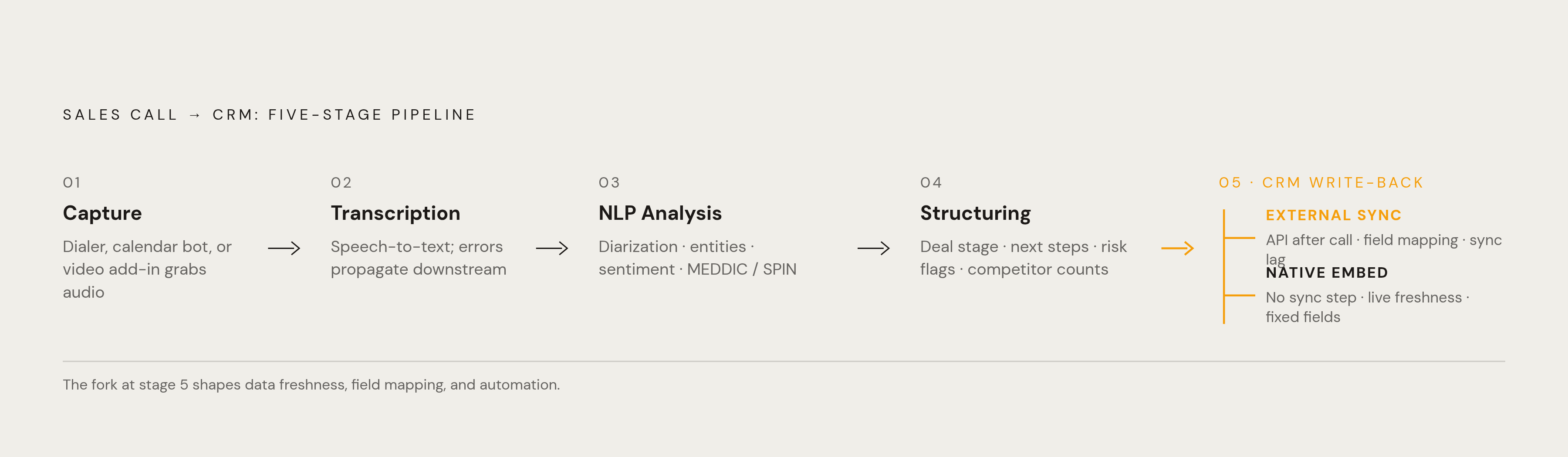
It starts with capture. A call comes in through a dialer integration, a bot joins the calendar meeting, or a video conferencing add-in grabs the audio feed. This process has been automated so nobody has to remember to press a button.
Then transcription, and this step matters more than people give it credit for. Speech-to-text turns audio into words on a page, and any mistake here rolls downstream into everything built on top of it. Garble a competitor's name or mishear a budget number, and the entity extraction that follows inherits that error and passes it along without correction. Non-English conversations make up a real chunk of enterprise call volume now, and multilingual transcription has had to scramble to keep up.
Once the words are down, the NLP layer takes over. It figures out who's talking and splits the conversation into turns, tracking which lines belong to the prospect and which belong to the rep. It pulls entities out: names, competitors mentioned, pricing numbers, objections raised. It scores sentiment, picks up emotional cues, tags topics against whatever sales methodology the company runs, MEDDIC, SPIN, or something built in-house.
From there, structuring turns all that analysis into discrete data objects: a deal-stage update, a next step, a risk flag, a count of how many times a competitor's name came up. This is the translation step, where messy human talk becomes something a database can hold.
Last comes CRM write-back, and this is where the real fork happens. Structured outputs map to specific fields, opportunity fields in Salesforce, deal properties in other CRM platforms. Two architectures handle this differently: external sync pushes the transcript and selected fields into the CRM via API after the call wraps, while native embedding runs the whole process inside the CRM itself and skips the sync step entirely. That single distinction shapes how fresh the data stays, how flexible the field mapping can be, and what automated workflows the system can actually trigger.
Once fields update, workflows fire. A changed deal stage kicks off a follow-up task. A risk flag lands on a manager's dashboard. Coaching assignments get generated without anyone lifting a finger.
Picture a rep finishing a discovery call. The tool pulls three things out of it: budget confirmed, decision-maker identified, a competitor mentioned by name. Three CRM fields update on their own. A follow-up task shows up on the rep's calendar. A risk flag appears in the manager's pipeline view, because that competitor mention correlates with lost deals historically. The rep never opened the CRM. That picture is worth holding onto, because the rest of this piece is really asking what happens when it doesn't go that smoothly, and why it matters so much when it doesn't.
Why sales reps spending 28% of their time on CRM admin makes the integration case
Here's a number: sales reps spend an average of 28% of their working time on admin tasks, a figure reported by Symbioz drawing on sales research. CRM entry, updating records, prepping reports, mostly at the expense of actually selling or talking to customers.
Run that math on a 50-person sales team. Twenty-eight percent of fifty reps' time works out to something close to 14 full-time employees whose entire job is updating records, except there's no such job title anywhere on the org chart. It's spread invisibly across everyone, showing up nowhere on a budget line and everywhere in missed quota.
Automated call summarization has picked up a good chunk of that slack. Adoption of the capability has grown fast, and manual note-taking time has dropped by as much as 40% per user in some measurements. That's real time back in a rep's week.
The time cost, though, is the smaller problem. The bigger one shows up when reps skip logging entirely, because incomplete CRM data doesn't just sit there quietly. It feeds forecasting. Bad forecasting feeds bad resource allocation: wrong headcount decisions, wrong territory assignments. So the admin burden turns into something closer to slow, compounding corruption of every decision built on top of that data, beyond whatever it costs in raw hours.
Reps who skip updates aren't lazy. They're making a rational trade, an hour spent selling against an hour spent typing notes into Salesforce, and most reps, sensibly enough, pick selling. Conversation intelligence changes the terms of that trade by logging the call automatically, whether the rep remembers to or not.
Adoption backs this up. AssemblyAI's 2025 survey found 76% of organizations report conversation intelligence embedded in more than half of their customer interactions. Most of the market treats this as standard infrastructure at this point.
The specific capabilities that determine how much value the integration delivers
Deployments vary widely in the value they deliver, and the gap between barely useful and genuinely transformative comes down to which capabilities actually get switched on.
Automated summaries and field population are the floor, not the ceiling. If that's all a tool does, it still beats manual note-taking, but it's the bare minimum version of what's possible here.
Real-time coaching is where things get interesting. Instead of a manager reviewing a call three days later and explaining what went wrong, the system surfaces prompts while the call is still happening. AssemblyAI's 2025 research found 69% of companies report improved customer service outcomes after rolling this out. Catching an issue mid-call beats reviewing it after the deal has already moved on.
Deal-risk scoring works differently. Models look at patterns across conversations, how often a competitor gets named, how frequently objections come up, how many stakeholders are actually in the room, and correlate those patterns against historical wins and losses. Roughly 29% of platforms offer this today, and where it's live, it's improved forecast accuracy in the 10 to 15% range. Gong Labs' 2025 research adds a useful detail: 77% of deals involve multiple contacts, a pattern conversation intelligence can flag while the deal is still alive, well before someone marks it closed-lost.
Coaching scorecards take the guesswork out of manager reviews. Every call gets scored against a defined framework, whatever methodology the org runs, and managers can move from randomly sampling a handful of calls to prioritizing coaching based on actual data about who needs the help and where.
Compliance monitoring matters far more in some industries than others. BFSI, banking, financial services, insurance, accounts for 22.7% of conversation intelligence demand by one measure, and catching policy violations, missed disclosures, and regulated language automatically is closer to a legal requirement there than an optional feature. Healthcare carries similar pressure. Redaction and audit trails need to get built into the integration from day one, not bolted on the week before an audit.
Finally, the data doesn't have to stay locked in sales anymore. About a third of new deployments now stretch into customer success, compliance, and training analytics, feeding unified dashboards that combine conversation data with revenue metrics and product usage. That marks a shift from the old model, where sales had its tool, everyone else had theirs, and none of it talked to each other.
Then transcription, and this step matters more than people give it credit for.
What the ROI evidence actually shows (and what it requires to materialize)
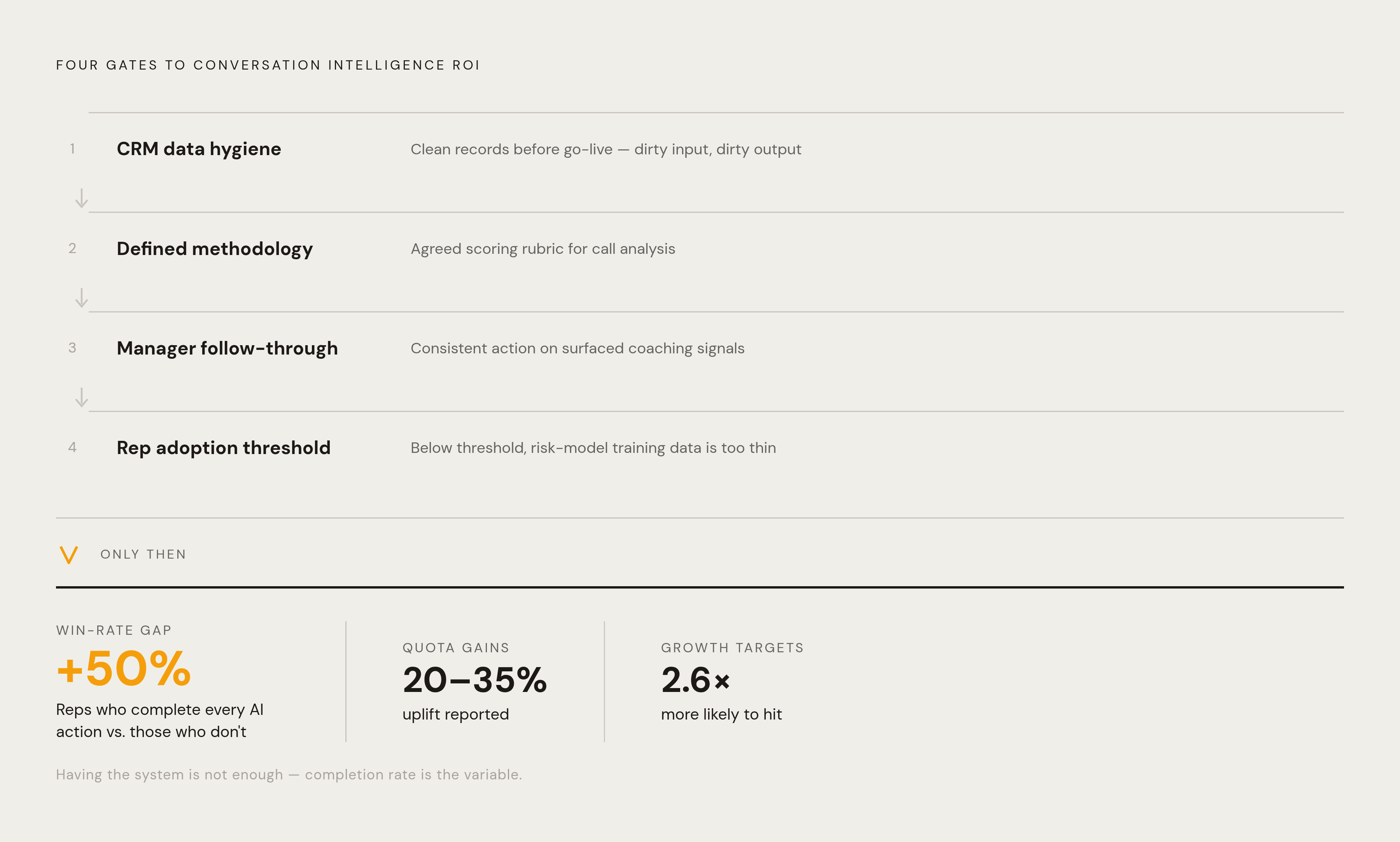
Mature deployments report real numbers, and it's worth laying them out plainly, since the point of this section is separating what's documented from what's marketing gloss. Early adopters report quota achievement gains of 20 to 35%, per market research cited by Yahoo Finance, alongside reported improvements in win rates, ramp time, and manager review hours across mature deployments.
There's a catch buried in the Gong Labs 2024 findings that deserves more attention than it usually gets: sellers who completed every AI-recommended action item saw win rates 50% higher than sellers who didn't follow through consistently. Having the system in place isn't enough for it to pay off; it has to get used, completely and repeatedly, which sounds obvious on paper and gets ignored constantly in practice.
Gartner's 2025 survey of chief sales officers found something similar at the organizational level: companies that give sellers AI-enabled next-best actions are 2.6 times more likely to hit their commercial growth targets. That's a substantial multiplier, and it tracks with the broader pattern where teams running mature conversation intelligence report meaningfully faster new rep ramp times.
Four conditions decide whether those numbers show up in a company's actual results, or whether the tool just becomes an expensive way to generate transcripts nobody reads.
CRM data hygiene has to exist before the integration goes live. A tool that writes clean structured data into a CRM full of duplicate records and stale fields is just automating the mess faster. A sales methodology has to be defined and agreed on, because conversation intelligence scores calls against a framework, and with no framework there's nothing to score against. Managers have to actually act on the coaching the system surfaces, consistently, not just when someone remembers to check a dashboard. And rep adoption has to clear a meaningful threshold, because below it the data feeding risk models is too thin to train anything reliable.
The ROI, then, is real and shows up across multiple sources. But it scales with the discipline behind the implementation, not with how sophisticated the software is on its own.
How the major integration architectures differ and what that means for implementation
Two architectures split the market, and the choice between them shapes almost everything downstream, more than any single feature does.
External sync is the older, more common pattern. The conversation intelligence tool handles recording through a dialer, calendar bot, or video add-in, runs transcription and analysis on its own infrastructure, then pushes selected outputs, summaries, fields, scores, into the CRM through an API call after the conversation ends. The upside is flexibility: a company picks the best tool for the job independent of which CRM it runs, and that tool can often connect to more than one CRM instance if the company happens to run several. The downside shows up in the gaps. API calls add latency, field mapping gets messy fast, sync failures leave holes in the data, and conversation history often ends up living permanently in two systems that don't fully talk to each other. Legacy tech stacks made this worse by forcing teams to stitch together separate tools for enrichment, recording, and outreach, building workflows so complicated a lot of reps just gave up on them.
Native embedding takes the opposite path. The conversation intelligence engine runs inside the CRM itself, so data never leaves the CRM's data layer and there's no sync step at all. Field updates happen live, full deal context is available during the call itself, there's no data-transfer risk, and the compliance story simplifies because the data only ever lives in one place. The tradeoff is dependency: a company is locked into whatever CRM it picked, and the feature roadmap follows that CRM vendor's priorities, not a specialized vendor's.
A third pattern is starting to show up at the edges of enterprise deployments: agentic orchestration, where one coordinating agent manages several specialized agents during a single call, one on sentiment, another on compliance, another on knowledge retrieval, another on outcome optimization. The promise is that conversation insights flow automatically into deal scoring, forecasting, and coaching, without the manual hand-offs external sync still requires today.
Before picking an architecture, a few questions deserve honest answers. Which CRM fields actually drive forecasting and routing, because those are the fields that can't afford sync failures? What triggers downstream workflows, since that answer decides whether a few seconds of sync latency is tolerable or a dealbreaker? Where does compliance require the data to physically sit, which can rule out external sync before the conversation even starts? And does the existing tech stack already suffer from fragmentation, since bolting another external tool onto an already patchworked system tends to make things worse, not better?
How the leading platforms compare on CRM integration depth
The useful lens here is how completely each platform closes the loop back into the CRM, since that's what decides whether analysis reaches a usable record or stalls out somewhere along the way.
Gong is a prominent name in post-call deal intelligence, operating on an external sync model that records conversations and pushes transcripts and deal signals into the CRM after the call ends. Its integration with Salesforce continues to evolve as both platforms update their connection paths. Gong's real strength sits in post-call analytics and deal review; real-time in-call coaching is a newer addition, layered on top of that foundation rather than central to it.
Revenue.io takes the native route, running inside Salesforce with no external sync required. It coaches reps during live calls and scores conversations against defined methodologies while pulling full deal context into every interaction. It fits teams where Salesforce already functions as the system of record, and where data residency or sync delay is a genuine worry.
Chorus, folded into ZoomInfo Copilot as of 2024, doesn't run as a standalone roadmap anymore. It now functions as one piece of a broader ZoomInfo data enrichment stack, worth evaluating in that context rather than as a standalone conversation intelligence purchase.
Clari Copilot, Salesloft, and Outreach all embed conversation intelligence inside a larger revenue platform or sales engagement suite. The upside is fewer integration points, since conversation data feeds pipeline forecasting and outreach sequencing within the same system. The tradeoff: the conversation intelligence features move at the pace of that broader platform's roadmap, not their own.
Avoma processes a large volume of meeting minutes every month and rolled out automated coaching features in 2025. Its strength is meeting intelligence and collaborative note-taking with CRM sync, and it tends to draw mid-market teams looking for something lighter than a full enterprise deployment.
Salesforce's own Einstein Conversation Insights is the native option for Salesforce-first shops, and it's increasingly becoming the landing spot that external tools, Gong included, push transcripts into. Its standalone feature depth trails specialized vendors, though it carries zero sync overhead and gives full CRM context by default.
The architecture divide matters more here than any single feature comparison, because it decides data freshness, compliance posture, and how much workflow automation is even possible.
What a well-structured implementation looks like in practice
None of the capabilities or ROI numbers above show up automatically the day a contract gets signed. The work that decides success happens before the tool ever goes live.
Start with an audit of current CRM field usage. Which fields actually drive forecasting? Which ones inform territory routing? Which ones grab a manager's attention when a deal looks shaky? Most CRMs, after a few years of use, pile up dozens of fields nobody looks at and a handful that genuinely run the business. Conversation intelligence should write to the fields that matter, reliably, rather than scattering data across every field the CRM happens to offer. That's a discipline decision as much as a technical one; it forces a company to admit, often for the first time, which parts of its own CRM it actually relies on.
That audit alone tends to surface uncomfortable truths. A field meant to track "next step" might sit empty on a majority of records, not because reps forgot, but because nobody enforced it and the field turned optional in practice. Fixing that before conversation intelligence goes live matters more than picking the fanciest vendor on the shortlist, because a tool that writes clean data into a field nobody trusts still produces a report nobody trusts.
That's the thread running through this whole piece: capture matters, transcription quality matters, the architecture choice matters, the vendor comparison matters. Every one of those pieces sits on a foundation that has almost nothing to do with artificial intelligence itself, the unglamorous work of deciding what data actually matters, agreeing on a methodology to score conversations against, and holding managers accountable for acting on what the system tells them. Skip that part, and even the most advanced conversation intelligence pipeline just automates the process of piling up recordings nobody uses, only faster, and with better transcripts.
Sources
- https://www.assemblyai.com/2025-research-report
Provided the statistics on conversation intelligence adoption rates, real-time coaching outcomes, and win-rate improvements from AI-recommended actions.
- https://www.marketreportsworld.com/market-reports/conversation-intelligence-software-market-14723140
Provided figures on manual note-taking time reduction, forecast accuracy improvements, and the share of new deployments expanding into customer success and compliance.
- https://www.globalgrowthinsights.com/market-reports/conversation-intelligence-software-market-104923
Provided the statistic that roughly 29% of platforms offer deal-risk scoring today.