AI Content Personalization Driven by CRM Data
CRM data unlocks AI content that actually converts instead of getting ignored.

AI content generation is table stakes now; any brand can spin up copy in seconds. What separates content that converts from content that gets deleted unread is context, and the richest source of that context sitting inside most companies is a CRM database that nobody's fully plugged in. This piece walks through how CRM data and AI content systems connect, layer by layer, so marketers can close the gap between what customers expect and what most brands actually deliver.
The perception gap marketers need to reckon with before building anything
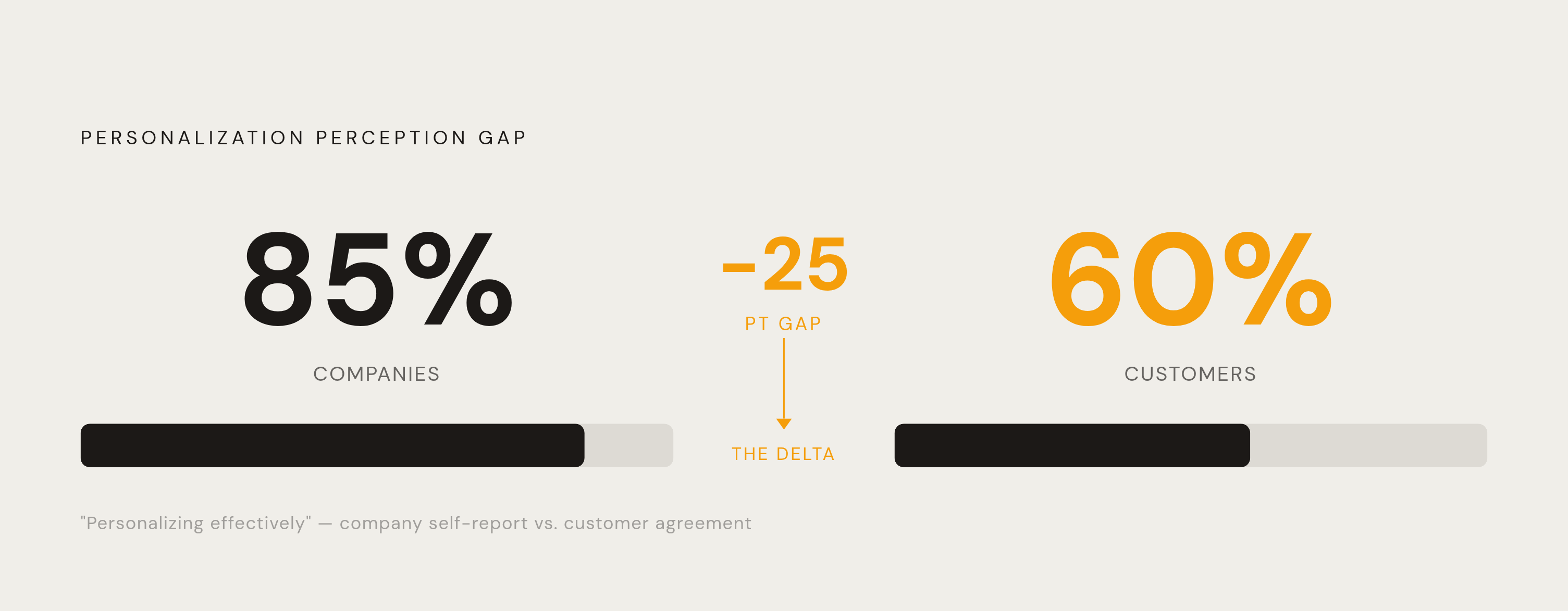
Here's an uncomfortable stat to sit with: 85% of companies believe they personalize effectively, but only 60% of customers agree, according to industry research on personalization. That's not a rounding error. A quarter of the market is operating on a delusion, patting itself on the back for a job the customer doesn't think got done.
So what's actually broken? It's tempting to blame the technology, but that's usually a cop-out. The real culprit is almost always a data quality and integration problem dressed up as a strategy problem. Segmenting people by job title or industry vertical is just narrower broadcasting, the kind where you've swapped a megaphone for a bullhorn and called it a conversation. Actual personalization needs behavioral signals, recency, and lifecycle stage: the kind of granular, time-sensitive information a CRM is theoretically built to hold and surface. Theoretically being the operative word.
The ambition is real, though. Marketing decision-makers overwhelmingly consider personalization essential to their business's success over the next few years, per industry research on the topic — 89% say so, to be exact. That's not a fringe opinion anymore; it's consensus. Infrastructure to back it up is what's missing.
One caveat worth sitting with before racing off to personalize everything: Forrester's research found that a third of US consumers say they never want personalized interactions at all. That points toward building permission and preference management into the system from day one, so "personalized" doesn't become a synonym for "creepy." If you can't tell the difference between a customer who wants to be remembered and one who wants to be left alone, you've got a bigger problem than your CRM fields.
What CRM data actually contains and why most of it goes unused
Crack open a modern CRM and you'll find four rough categories of data staring back at you. Transactional data covers purchase history, order value, frequency, and returns. Behavioral data tracks email engagement, website activity, content consumption, and feature usage. Relational data holds support tickets, sentiment signals, and account health scores. And declared data captures preferences, survey answers, and opt-in choices — the things customers tell you directly, which means you don't have to infer them.
This data typically lives in silos, scattered across the CRM platform, the email tool, the ad platform, and the support desk. Nobody's unifying it into one coherent customer record, so the right hand genuinely doesn't know what the left hand bought last Tuesday.
Consider this: only about 55% of customer insights inside CRM systems are actually derived through AI analysis, according to research from Wifitalents. Nearly half the "insight" in these systems is either manually interpreted, stale, or simply never generated. And freshness matters more than people give it credit for. A profile reflecting a purchase from 18 months ago, frozen in amber with no updates since, is arguably worse than a thinner profile built on last week's behavior. Stale data doesn't just fail to help; it actively misleads.
Marketers love to talk about the "360-degree customer profile." In vendor decks, it sounds like a fully rendered hologram of your customer's soul. In practice, it's usually three data sources stitched together with duct tape and a shared customer ID field, if you're lucky. That gap between the pitch and the plumbing is exactly why the audit step (actually checking what data exists, where it lives, and how fresh it is) gets skipped so often. It's unglamorous work. Nobody puts "ran a data quality audit" on a highlight reel. But as third-party data keeps eroding under privacy regulation and browser changes, the first-party data sitting in your CRM stops being a nice-to-have and becomes the whole ballgame. Clean it, connect it, or watch your personalization ambitions stay theoretical.
How AI reads CRM data to generate personalized content decisions
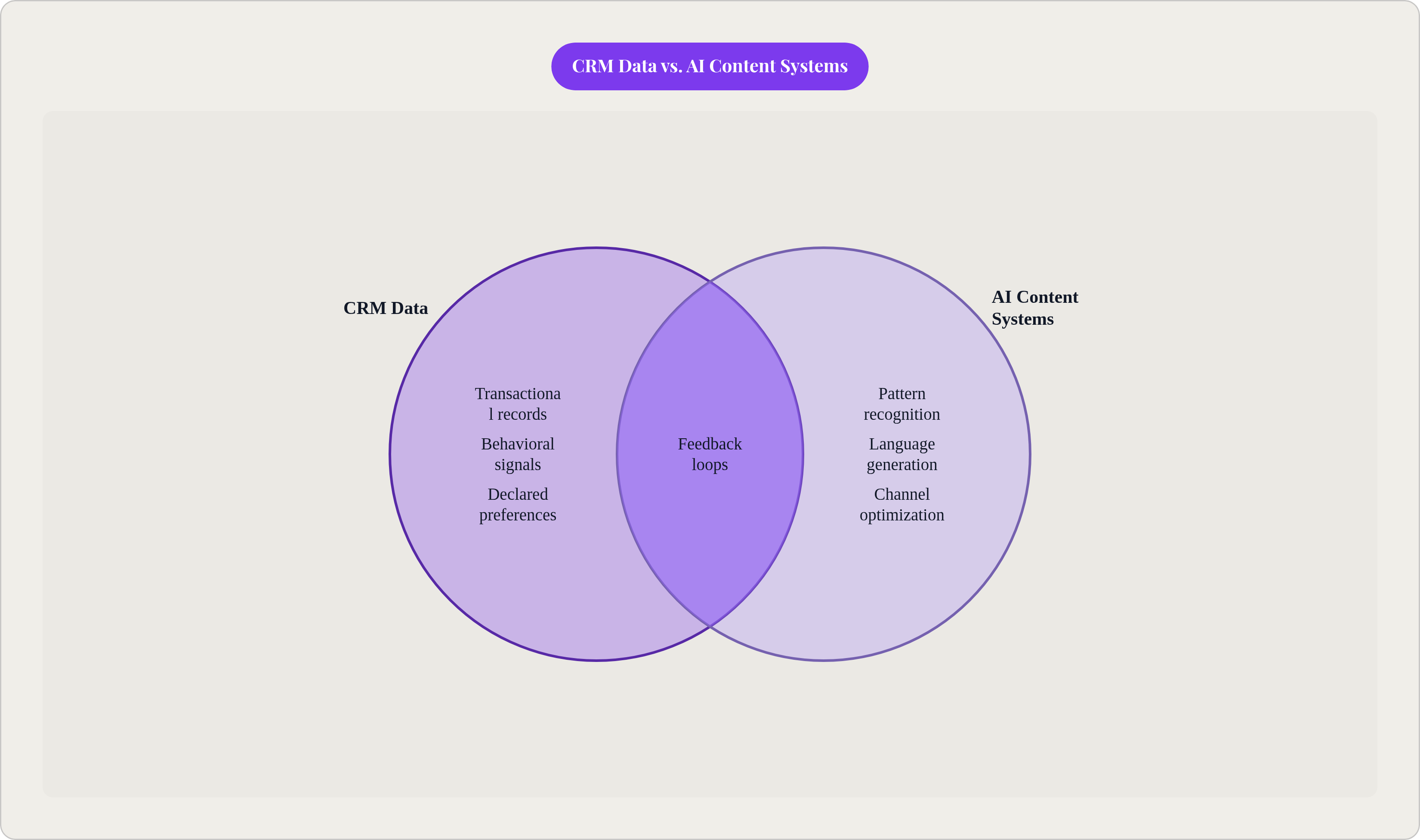
So what does AI actually do once it has clean, connected CRM data to chew on? Four things, mainly. It recognizes patterns across behavioral signals to predict what a customer's likely to do next. It refines segmentation, moving groups from broad buckets ("enterprise buyers") down to micro-segments or, ideally, individual profiles. It generates language that actually incorporates context: name, product category, lifecycle stage, the support ticket from last week. And it optimizes for channel and timing, figuring out not just what to say but when and where to say it so it actually lands.
That last part matters more than people think. A perfectly worded email sent to someone who only checks their phone on the subway won't get read in time to matter.
A growing portion of marketing automation happening inside CRM platforms already involves some form of AI-driven content recommendation. Worth pausing on the distinction here between rule-based personalization (the old if/then logic where "if customer bought X, then send email about Y") and model-driven personalization, which is probabilistic and actually learns from outcome data over time. The first works like a flowchart. The second continually updates its confidence as new information comes in.
Take the personalized call-to-action as a case study. Slapping someone's first name into a subject line functions as a mail merge with extra steps, nothing more. Real personalization means surfacing an offer relevant to where that person actually sits in their journey, and personalized CTAs tend to outperform generic ones. The mechanism that makes this improve over time is the feedback loop: opens, clicks, and conversions get routed back into the CRM as signal, and the model gets sharper with each cycle.
This is worth sitting with, though: the AI surfaces context; it doesn't decide your message architecture, your tone, or your editorial framework, and it certainly doesn't do your job for you. Skip that human layer and you get output that's technically personalized (correct name, correct product, correct timing) but strategically hollow.
It's tempting to blame the technology, but that's usually a cop-out.
The practical workflow for connecting CRM data to AI content production
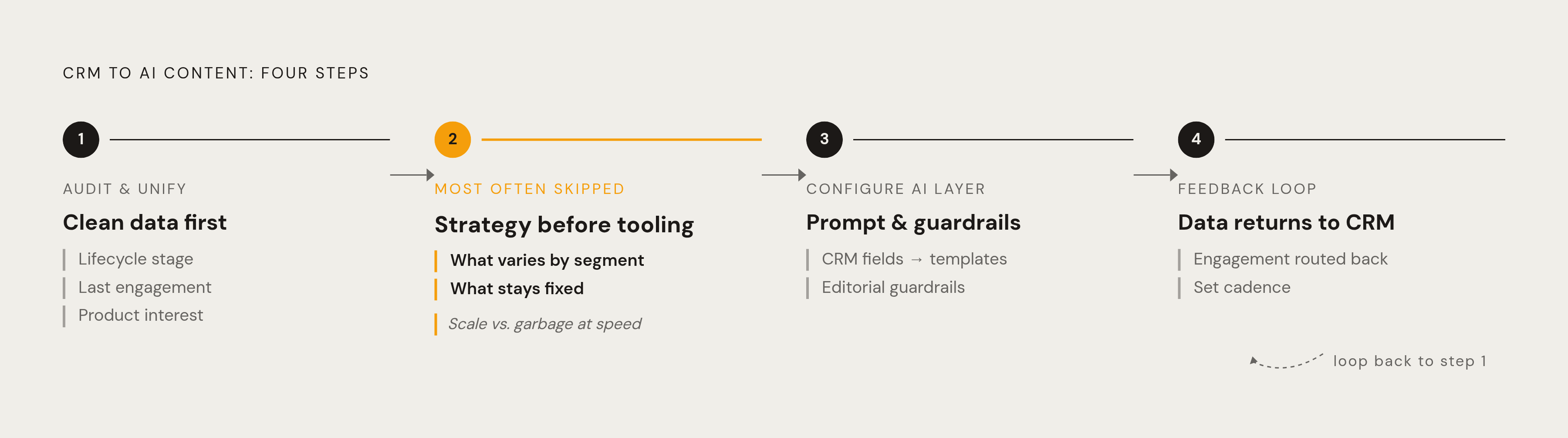
Here's where theory has to become a checklist, because good intentions don't ship content.
Step one: audit and unify the data. Figure out which systems hold customer information and which ones aren't actually talking to the CRM. Then define the minimum viable customer record you need for personalization to work at all: lifecycle stage, last engagement, primary product interest. You don't need every field imaginable; you need the ones that actually change what you'd say to this person.
Step two, and this is the one teams skip most often: define the personalization logic before you touch the AI tooling at all. Map out what actually changes by segment, offer, tone, and use-case angle, and what stays fixed, brand voice, core value proposition. This is the strategy-first move that keeps AI from generating noise at scale. Skip it, and you've built a very expensive machine for producing garbage quickly.
Step three: configure the AI content layer itself. Feed CRM fields into your prompt templates or generation workflows, and set real editorial guardrails, approved messaging frameworks, tone parameters, and clear boundaries on what the system shouldn't say.
Step four: build the feedback loop. Route engagement data back into the CRM so your segments and signals actually update, and set a cadence, monthly, biweekly, whatever fits, for reviewing which content variants convert and which need a rewrite.
The most common failure mode isn't technical at all. Teams connect the systems perfectly, wire up every API, and never define the strategy layer sitting on top. The result is AI generating content that sounds personalized without any coherent editorial direction underneath it. Content platforms with CRM integrations can bridge this gap when the workflow is designed with intention, but the software accelerates a strategy that has to exist first. Inventing that strategy for you isn't something it can do.
Where the major CRM platforms stand on AI-driven personalization in 2025
Salesforce holds a dominant share of the global CRM software market by revenue. That scale shows up in its AI push: its AI capabilities are aimed at helping teams act on CRM data across sales, service, and marketing workflows, not just surface recommendations for a human to act on.
Some platforms built for small and mid-market teams offer AI capabilities aimed at connecting business data for real-time insights and personalized strategy suggestions rather than static reports.
Microsoft Dynamics 365 integrates AI-assisted capabilities drawing on data across the broader Microsoft ecosystem. If your organization already runs on Microsoft infrastructure, the integration story here is genuinely compelling; if you don't, it's a heavier lift.
Here's the structural caveat that vendor marketing tends to gloss over: the differentiation between platforms at the AI layer is often smaller than the pitch decks suggest, and the real variables worth interrogating are privacy handling and cost structure, not some mythical secret algorithm.
The bigger shift on the horizon is agentic AI. Industry analysts broadly expect agentic AI deployments to expand rapidly across enterprise applications in the near term. What does that mean for content? Agentic CRM systems will start initiating content workflows on their own, well beyond simply surfacing data for a human to act on. Marketing leaders who want a say in how that plays out need to design the governance for it now, not after the agents are already sending things.
What the ROI evidence actually shows and where it's overstated
The credible numbers first, because they're genuinely strong without needing embellishment. McKinsey's research shows personalization can cut customer acquisition costs by as much as 50%, lift revenues 5 to 15%, and increase marketing ROI 10 to 30%. There's also a compounding effect worth noting: faster-growing companies drive 40% more of their revenue from personalization than their slower-growing peers, per the same body of McKinsey research.
CRM-specific data backs this up from another angle. Research from Teamgate found that breaking down data silos between sales, marketing, and service can meaningfully boost customer retention. That's not a marginal improvement; that's the difference between a healthy renewal rate and a leaky bucket.
Now, the honest caveat. Twilio Segment's research claims consumers spend 38% more when experiences feel personalized, a figure meaningfully higher than McKinsey's modeled range. Worth asking why. Vendor-sponsored perception surveys tend to measure what business leaders believe is happening, which isn't the same as what's independently verified to be happening in customer wallets. That's not a knock on the data collection, it's just a reminder to read the source before you build a board deck around the number.
You'll also notice the 40% figure shows up in more than one form across different McKinsey analyses. That's worth flagging so it doesn't get treated as gospel; it's a directional benchmark pulled from real research, not a guarantee stamped on a contract. What actually moves ROI in practice is less glamorous than any single statistic: data freshness, segment precision, alignment between content strategy and what the data's actually telling you, and discipline in maintaining the feedback loop. The platform doesn't produce these numbers. The people running it do.
For anyone building an internal business case, use the conservative McKinsey range. The flashier vendor figures will get challenged in the room, and you'll want your numbers to survive that conversation.
What marketing leaders need to own to make this work at scale
About 70% of companies already use AI somewhere in their CRM as of 2025, according to industry research. That baseline is rising fast, which means access to the tools stopped being the differentiator a while ago. What separates the companies actually converting from the ones just automating noise is how well the strategy layer sits on top of the tooling.
Three things belong squarely in marketing's lap, not IT's, not the agency's. First, the data strategy: what gets collected, how it gets unified, and who's accountable for keeping it clean. Second, the content framework, the editorial logic dictating what varies by segment and what stays constant; without this, AI just produces volume dressed up as value. Third, the feedback architecture, making sure performance signals actually route back into the CRM and sharpen the model over time instead of evaporating into a dashboard nobody checks.
There's a quieter risk worth naming here too: the agency dependency problem. Outsource the entire CRM-to-content workflow to an external partner, and the strategic intelligence (the actual understanding of what's working and why) stays parked outside your organization. Adapting gets slower, and iterating gets more expensive, because every adjustment requires a phone call instead of a message to the person sitting three desks away.
Speed is the whole game, really. The window between a behavioral signal (a product page visit, an open support ticket, a lapsed subscription) and a relevant content response is narrow, sometimes just hours before the moment's gone cold. Teams that own this workflow internally can close that gap in hours. Teams routing everything through external approval chains are often still closing it in weeks, by which point the customer's moved on, emotionally or literally.
AI-powered content tools with CRM integration work best as an accelerant for a strategy marketing already owns, supporting rather than replacing the editorial judgment that decides what gets said and to whom. CRM data fuels AI that can produce content reflecting an actual relationship rather than a broadcast. But that only happens if someone in the building owns the full chain: the signal, the strategy, and what finally lands in the customer's inbox.
Sources
- https://www.teamgate.com/blog/state-of-crm-2025-trends-ai-adoption-roi-stats/
Provided CRM adoption trends and AI integration statistics referenced in the article's discussion of the current state of CRM usage.
- https://www.contentful.com/blog/personalization-statistics/
Supplied personalization statistics underlying the article's discussion of the gap between customer expectations and brand delivery.
- https://crm.org/crmland/crm-statistics
Provided foundational CRM industry statistics informing the article's framing of CRM data as a rich, underutilized context source.
- https://emarsys.com/learn/blog/personalization-statistics/
Supplied personalization effectiveness data supporting the article's argument that context-driven content converts better than generic content.
- https://researchworld.com/articles/artificial-intelligence-signal-loss-and-consumer-personalization-the-rising-importance-of-first-party-data-in-2025
Informed the article's emphasis on first-party CRM data as the richest source of customer context for AI-driven personalization.