AI-Powered Lead Scoring in Modern CRMs
AI lead scoring replaces guesswork with patterns learned from your own pipeline history.

AI-powered lead scoring changes what a CRM is actually for. Rather than just logging what happened, it ranks prospects by the odds they'll close, based on patterns the model pulls out of your own pipeline history. That's the whole idea. Understanding what's happening underneath the dashboard, mechanically, is what separates teams that get real conversion lift from teams that just bought another tool and hoped.
For most of CRM history, the software's main job was memory. It logged emails, tracked calls, and held onto whatever notes a rep bothered to type after a demo. Rarely did it tell anyone who to call first. Rules-based lead scoring showed up to fix that: assign point values to things like job title, form fills, and company size, add them up, get a number that supposedly means something. The flaw was baked in from day one, though. Those point values were guesses, frozen the moment someone built the model, and they stayed frozen while the market kept moving underneath them. A VP title was worth 15 points whether the company had three employees or three thousand. A whitepaper download counted the same in March as it did the following January, even if the buyer's whole situation had changed in between. Static rules also treat every signal as equally weighty, which anyone who's actually worked a pipeline knows is nonsense. A demo request and a footer newsletter signup are not the same species of interest, yet a lot of rules engines score them almost identically.
The bigger issue is scale. A modern B2B pipeline throws off web visits, email opens, content downloads, technographic data, third-party intent signals, sometimes all from the same account in the same week. No sales ops person can manually reweight a spreadsheet fast enough to keep pace, and the gap shows up as good leads sitting untouched for four days while a rep works down an alphabetical list instead. I went looking for adoption numbers to see whether this was actually as widespread a problem as it felt, and the scale of the shift surprised me: per Gartner's 2025 Sales Technology Report, 89% of revenue organizations now use AI-powered tools, up from 34% in 2023. That kind of jump says plainly that manual prioritization stopped scaling a while back. The rest of this piece walks through what's actually happening inside these systems, section by section, so the next time someone says "the AI scored this lead an 87," you know roughly why.
What AI lead scoring actually does differently from rules-based systems
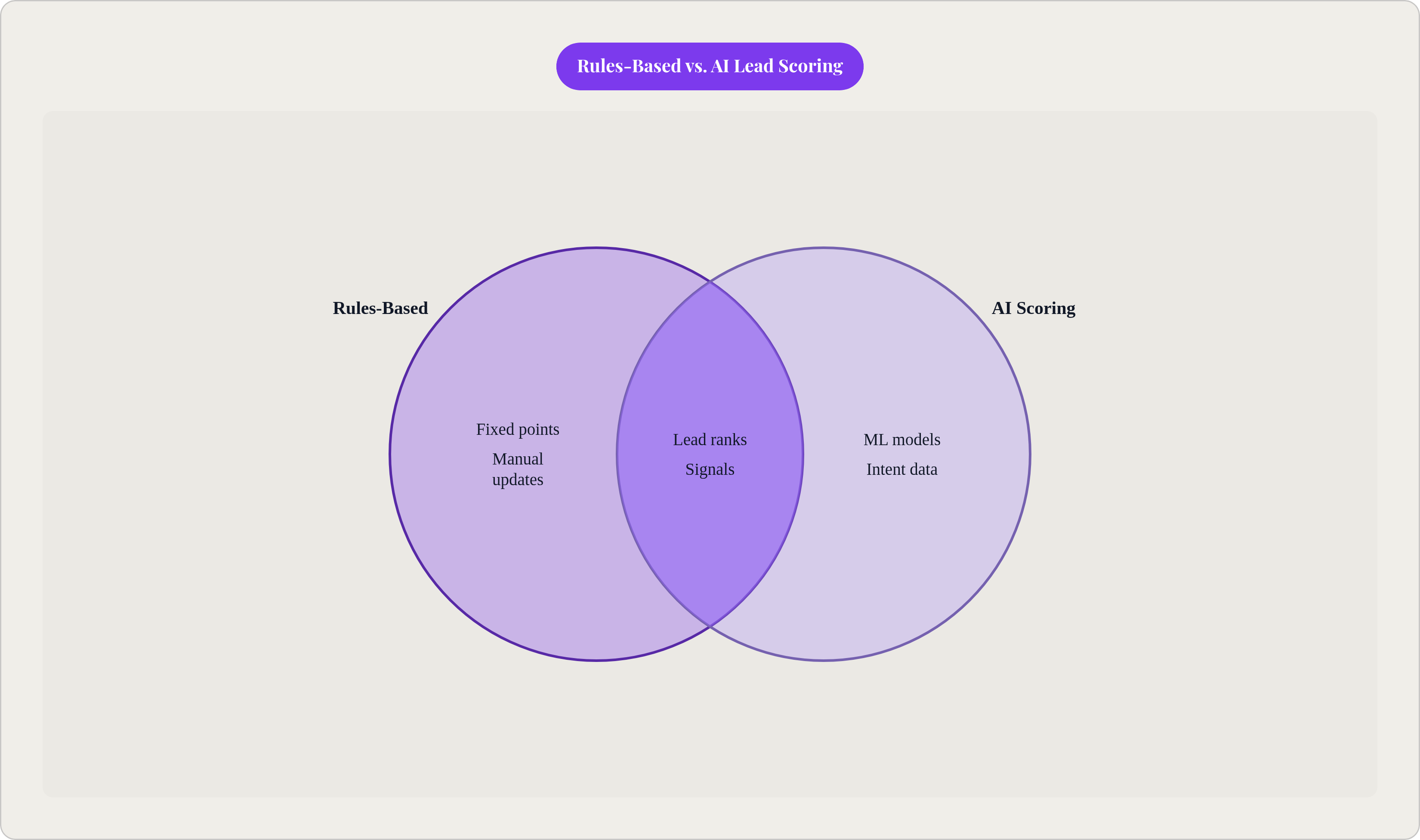
The basic swap: a model trains on your actual closed-won and closed-lost history and finds the patterns that separate the two. It relies on pattern recognition rather than point arithmetic. As new deals close or die, the model updates its own weights. Nobody has to open a settings panel and manually re-rank "attended webinar" against "downloaded case study" every quarter.
What comes out the other end is a conversion probability, one number representing the model's estimate of how likely this lead is to become a customer, built from learned patterns rather than stacked-up points. That distinction matters more than it sounds like it should. A rules-based score near the top of the scale tells you a lead checked a lot of boxes. A high conversion probability tells you that leads who looked like this one, historically, closed at a strong rate. One is a bookkeeping exercise. The other is a bet, backed by your own data.
The model eats a wide mix of signals to get there. Firmographic data covers industry, company size, revenue band, geography, the stuff you'd put on a lead's profile card. Behavioral data covers page visits, email opens, content consumption sequences, product trial activity, the digital footprints a prospect leaves without thinking about it. Technographic data looks at what software the prospect already runs, since a company already using a competing tool behaves differently than one starting from zero. And intent data, usually bought from third parties, shows research activity happening across the open web, often before that prospect has ever visited your site.
The logic shift underneath all of it is subtle but real. A rules engine asks, "is this action worth 10 points?" A trained model asks, "what combination of signals showed up before deals that actually closed?" That's a harder question, and it's one only a machine sorting through thousands of historical records can really answer.
I had to sit with this stat for a while before it clicked: research consistently shows that a substantial portion of the buying journey is already finished before a prospect ever talks to a seller. This means the behavioral signals AI scoring depends on are often piling up weeks before a rep gets involved at all. The model is catching timing intelligence that would otherwise stay invisible until the prospect finally picks up the phone, on top of measuring plain fit.
The machine learning methods behind the scores
Knowing which algorithm family a vendor uses isn't trivia. It's a proxy for how readable, scalable, and accurate the resulting scores will actually be. Vendors rarely lead with this in their marketing decks, but it's worth digging for anyway.
Ensemble methods, specifically Gradient Boosting Classifier variants, sit at the top of the leaderboard right now. The idea behind boosting is simple: chain together a bunch of weak, mediocre prediction models, have each one fix the mistakes of the one before it, and end up with a combined model stronger than any single piece. A 2025 study published in Frontiers in Artificial Intelligence hit 98.39% accuracy using a Gradient Boosting Classifier for B2B lead scoring, a number that sounds almost too clean until you remember it comes from a controlled research setup, not a messy CRM with a decade of inconsistent data entry behind it.
Random Forest shows up consistently near the top too, and it has one real edge over boosting: you can actually see which features drove which decisions. That matters a lot when a sales VP asks why a lead got scored the way it did. XGBoost and LightGBM round out the field, especially strong with large datasets where features interact in complicated, non-obvious ways.
Here's what surprised me when I dug into this, since I'd assumed "more advanced" always meant "more accurate": that same Frontiers study found neural networks add complexity without adding proportional accuracy for lead scoring specifically. The simpler ensemble methods just do the job better here.
None of this works without enough historical data to learn from, and the minimums are worth knowing before anyone gets frustrated with a fresh deployment. Per Forrester's 2024 research, mature models in enterprise B2B environments land around 78% accuracy, but only after climbing from roughly 65% in month one, and only after 12 to 18 months of continuous training on more than 10,000 lead records. AI scoring grows into itself over that runway. Plan for the wait.
How the major CRM platforms implement AI scoring differently
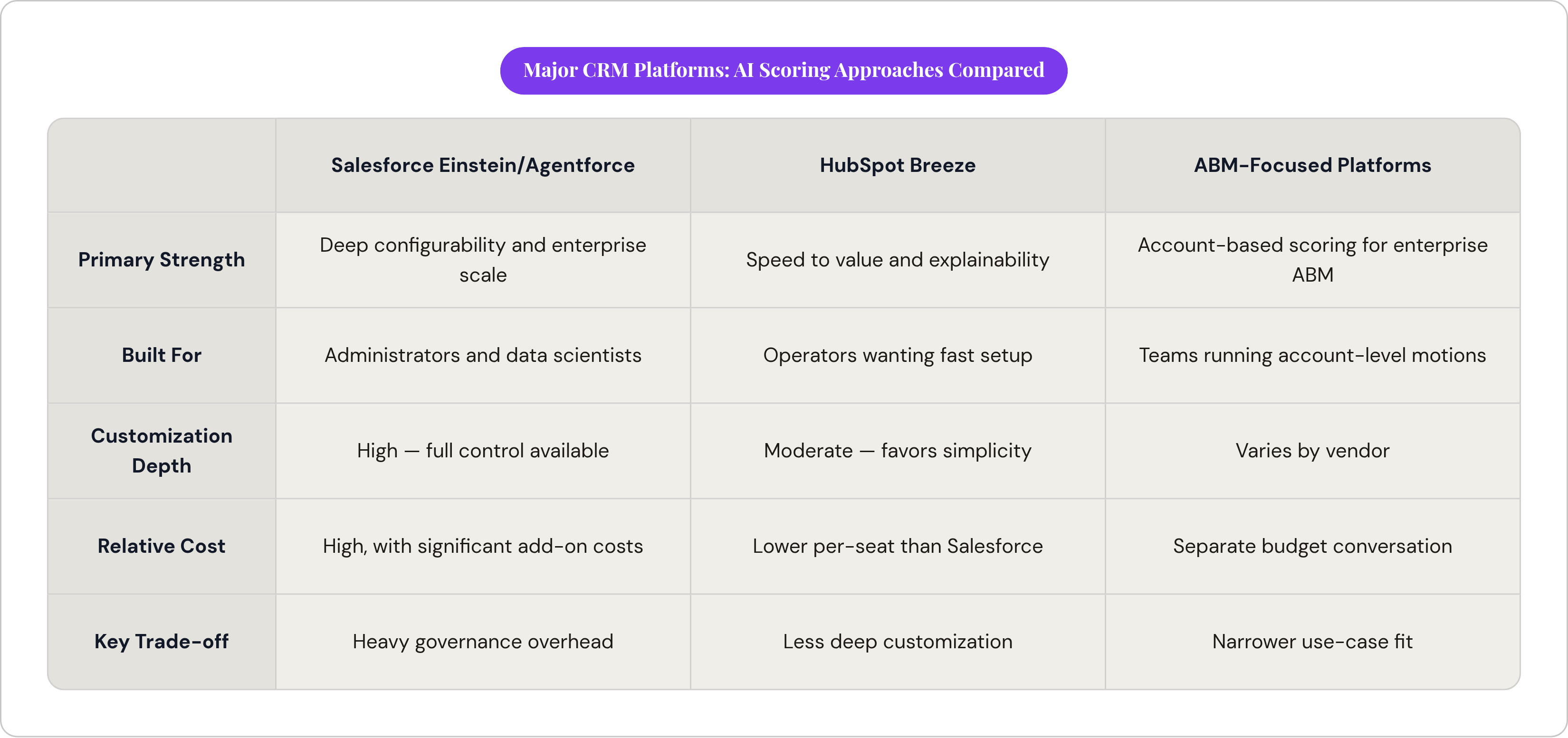
The major CRM platforms take meaningfully different approaches to AI scoring, and the right choice depends more on who owns the system than which product has the longest feature list. Salesforce splits the job in two now. Einstein handles the predictive side, the scoring, forecasting, and recommendations, while Agentforce handles autonomous workflow execution. It's built for administrators and data scientists, with heavy configurability and equally heavy governance overhead. Setup is substantial and so is the cost, with add-ons that carry meaningful per-user costs stacked on top of the base subscription. The platform is built for enterprise scale, which gives you a sense of how much of this already runs quietly in the background of large sales operations.
Some platforms took a different road. Rebuilt lead scoring tools in this category added multi-model support and, notably, explainability features showing which signals actually contributed to a given score. Through enrichment layers, these platforms can enrich records with a broad range of B2B attributes, plugging the firmographic and technographic gaps that quietly wreck a lot of scoring models before they ever get a real chance. Platforms in this category favor speed to value over deep customization, built more for the operator than the developer, and they tend to deliver a large share of what enterprise-tier systems offer at a noticeably lower per-seat cost.
Other platforms take account-based approaches, strongest for enterprise ABM motions, and tend to sit in a different budget conversation entirely. Still others aim at teams that want scoring wired directly into outreach rather than sitting in a report someone checks once a week.
The real dividing line, once you look past the feature lists, is who's going to maintain the thing day to day. Some platforms are built for operators who want fast setup and are fine trading away deep customization. Others are built for administrators who want full control and don't mind a longer runway to get there. Pick based on who owns the system, not whichever demo had the shiniest chart. Per Teamgate's 2025 CRM report, 76% of companies now choose pre-built AI solutions over building something custom in-house, and that's a big part of why platform-native scoring has become the default path instead of the exception.
That kind of jump says plainly that manual prioritization stopped scaling a while back.
What the performance data actually shows — and where it comes from
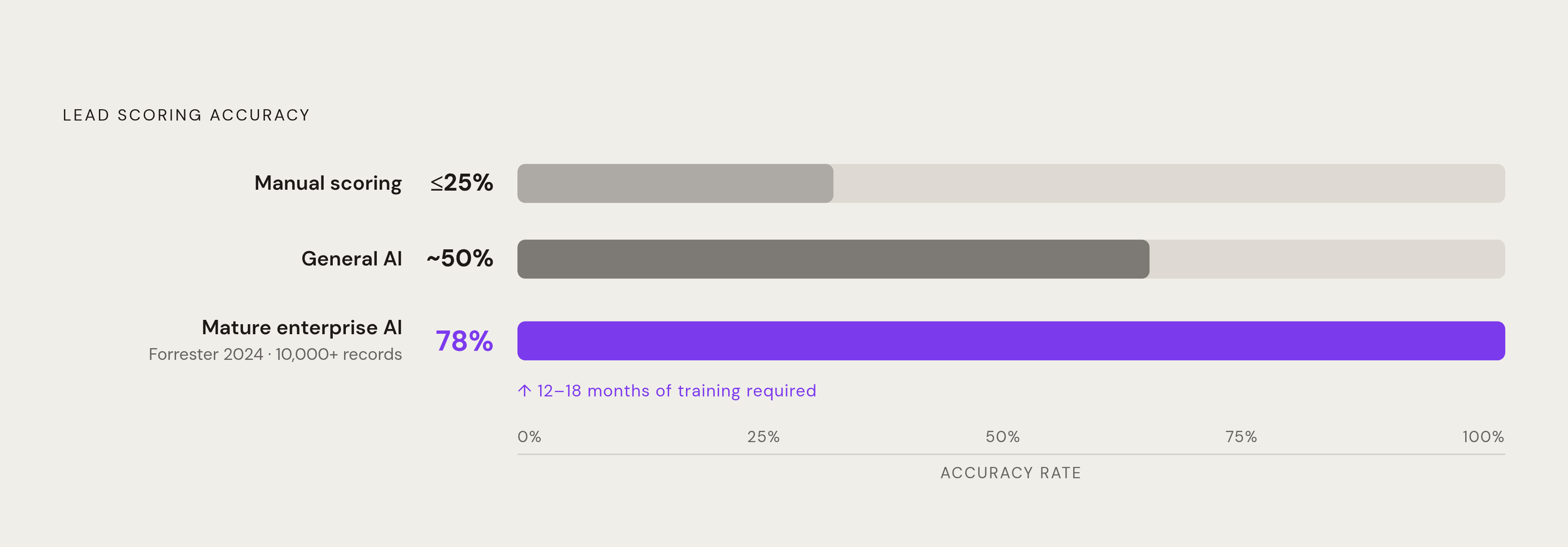
The accuracy gap between manual and AI scoring is real, but the honest version needs a couple of caveats attached to it. Traditional manual scoring generally lands somewhere between 15% and 25% accuracy. AI scoring in general implementations runs 40% to 60%. That's a genuine leap, but it's nowhere near the 98.39% figure from the Frontiers study, which reflects optimized academic conditions rather than the average CRM with years of inconsistent tagging behind it. Real-world enterprise deployments cluster closer to 78% at maturity, per Forrester's 2024 numbers. I had to cross-check several sources before trusting that gap was real rather than an artifact of how each study defined "accuracy."
The conversion data backs up the direction, at least. Per Salesforce's 2024 State of Marketing report, covering more than 5,000 marketing organizations, B2B companies using AI-powered lead generation saw an average 73% increase in qualified leads within six months. Separately, AI lead scoring has been tied to a 25% improvement in lead quality and a 17% increase in conversion rates. Gartner's 2024 research, drawn from more than 300 B2B teams, found AI-powered lead qualification hitting 43% or higher lead-to-opportunity conversion rates, with top implementations reaching 60% to 70% after 12 or more months of tuning.
Now the part that's a little harder to sit comfortably with. Research indicates AI saves sellers meaningful time each week, yet a large share of sales organizations fail to put that freed-up time into higher-value selling work. That time just evaporates into whatever filled the hours before. The organizations that do reinvest it consistently show stronger lead-to-opportunity conversion outcomes, which tells you something worth chewing on: the tool creates the opportunity, but whether that opportunity turns into anything real is entirely up to the humans standing around it.
One more thing worth wrestling with before anyone gets impatient with a fresh rollout. The 12-to-18-month maturation window Forrester cites isn't a footnote; it's the whole story. Teams that check ROI at the three-month mark are grading a system that hasn't finished its homework yet.
The data quality problem that undermines most implementations
Poor data quality is the most common reason AI lead scoring underdelivers, and it's a problem that has to be solved before the model is turned on, not after. Everyone nods along when you say a model is only as good as the data feeding it. Fewer people act like they actually believe it. The failure modes are boring, unglamorous, and everywhere once you start looking.
Incomplete records are the obvious one: missing job titles, missing company size, missing industry classification. That's exactly the gap enrichment tools like Breeze Intelligence exist to fill, feeding in firmographic detail that never got captured at the point of lead creation. Inconsistent historical tagging is quieter but arguably worse. If closed-won and closed-lost records get labeled differently depending on which rep entered them or which year it was, the training signal is corrupted before the model even starts learning. Recency bias creeps in too, since a model trained on three-year-old conversion patterns may be confidently wrong about how your current ideal customer behaves today. Then there's signal-outcome misalignment: tracking the wrong behavioral events as stand-ins for real intent, like treating a newsletter click the same as a demo request because someone set up the tracking that way back in 2021 and nobody's touched it since.
Per Gartner's B2B Marketing Survey of more than 800 marketing leaders, 52% of B2B organizations had implemented AI-powered lead scoring as of 2024. That number tells you adoption is wide. Yet it tells you nothing about how many of those implementations are producing scores anyone should actually trust, and that gap between adoption and trust is worth dwelling on rather than skating past.
The practical takeaway: data infrastructure work, enrichment, standardization, and a real audit of historical records, is a prerequisite, not a follow-up project you get to later. Before flipping the switch on AI scoring, a revenue team should check the volume of closed-won records on hand, how consistently deals got tagged, how complete the firmographic fields really are, and how recent the training data is. Skip that step and you're just automating a guess, only faster.
How to read and act on AI scores inside the CRM workflow
A score functions as a prioritization signal, and treating it as a verdict is where that distinction gets lost constantly, which is where a lot of otherwise solid deployments quietly go sideways.
Somebody has to decide the threshold: what score triggers immediate rep outreach, what score goes to a nurture sequence, what score gets disqualified outright. Those thresholds aren't permanent either. As the model matures and its accuracy climbs from that rough 65% starting point toward the 78% maturity benchmark Forrester describes, the meaning of "score: 75" shifts along with it, so the thresholds built around it need revisiting, not left to calcify on a dashboard nobody rechecks.
Explainability matters more than most teams expect going in. Some platforms have specifically added features showing which signals contributed to a score, and the logic is plain: reps don't act on numbers they don't trust. A rep who sees "Score: 87" and nothing else has no idea what to say on the call. A rep who sees "high because this contact visited the pricing page three times and their company just added Salesforce to their stack" has an opening line and a reason to believe it'll land.
This connects straight back to the reinvestment problem from the last section. Time freed up by AI prioritization has to go somewhere useful, sharper personalization, better-researched outreach, more thoughtful follow-up, or it just evaporates into busywork. That's the behavioral shift separating teams seeing real conversion lift from teams seeing only a tidier dashboard.
Feedback loops close the circle. Every rep disposition, contacted, not interested, or wrong timing, feeds back into the model and sharpens the next round of predictions. That loop is what actually drives the accuracy climb described earlier. Somebody, ideally a named somebody, needs to own the model on an ongoing basis: watching score distributions for drift, noticing when something looks off, and refreshing training data as the market shifts. This needs continuous tending well past initial setup, not a one-time configuration.
Where AI lead scoring fits in a broader content and demand generation strategy
Every behavioral signal the model depends on, page visits, content consumption sequences, and email engagement, gets generated by content somebody actually wrote. The scoring model sits downstream of the content program, and that order matters more than most demand gen teams give it credit for.
Think about two prospects. One reads three blog posts and downloads a pricing comparison sheet. The other fills out a single gated form and disappears. Both look like "leads" in the CRM. Only one of them left behind a rich trail the model can actually learn from. Content built around specific buyer-stage intent, awareness content versus evaluation content versus decision-stage content, throws off signals that map cleanly onto where someone actually sits in their journey. Vague, generic content throws off vague, generic signals, and no algorithm can conjure specificity out of a data trail that never had any to begin with.
That's the core idea worth carrying out of this whole piece, and it took working through all the platform and accuracy data above to see it clearly: AI scoring amplifies whatever content strategy already sits underneath it. If the content isn't producing differentiated engagement patterns, the model simply has less to work with, no matter how good the underlying algorithm is. For marketing leaders, that reframes the investment question. AI lead scoring gives a reason to put real money into content quality and signal coverage alongside the scoring software itself; the two are interdependent parts of one system, not separate line items on a budget spreadsheet.
Per Teamgate's 2025 CRM data, 65% of companies now use generative AI across tasks including lead scoring, forecasting, and personalized outreach, and the teams pulling the most value out of scoring tend to be the same ones using AI to sharpen the content those leads engage with in the first place. Faster, sharper content production feeds richer behavioral data back into the scoring model, which sharpens the score, which sharpens the outreach, which, if the reinvestment problem from earlier actually gets solved, shows up in the conversion numbers eventually. Speed and editorial quality end up compounding into better pipeline intelligence down the line, quietly, in a way that's easy to miss if you're only checking the dashboard once a quarter.
Sources
- https://www.teamgate.com/blog/state-of-crm-2025-trends-ai-adoption-roi-stats/
Provided the statistics on companies choosing pre-built AI solutions, the 65% generative AI adoption figure, and the 65% baseline accuracy figure cited in the maturation timeline.
- https://www.warmly.ai/p/blog/ai-lead-scoring
Provided the adoption figures (89% and 34%) and the accuracy range comparisons between manual and AI scoring (15%–40%–60%).
- https://crmexpertsonline.com/ai-powered-crm-for-sales-pipeline-management-2025-trends/
Provided the 25% accuracy figure for manual scoring and the 17% conversion rate improvement statistic attributed to AI lead scoring.
- https://www.thestarrconspiracy.com/insights/benchmarks/ai-lead-generation-benchmarks-2025
Provided multiple benchmark figures including the 78% maturity accuracy, 10,000 lead record threshold, 73% increase in qualified leads, 43%–60% lead-to-opportunity conversion rates, 5,000 marketing organizations sample size, and the 52% AI adoption statistic.