Risks of AI-Generated CRM Insights
Dirty data and hallucinations quietly undermine AI-CRM performance at scale.
81% of organizations now run AI-powered CRM, right up there with email and spreadsheets on the list of tools nobody questions anymore. And yet a good chunk of those same organizations will tell you, if you catch them off the record, that the AI barely moved the needle on performance. That gap is what this piece is actually about: why so much AI-CRM output fails to deliver on the promise that got it funded in the first place.
The adoption numbers aren't subtle. Over half of businesses rank generative AI as the top CRM trend right now, and roughly two-thirds have already shipped features like predictive lead scoring or automated content drafting. Businesses using generative AI in CRM were 83% more likely to exceed sales goals in 2025, which is exactly the kind of stat that gets a budget approved in one meeting instead of three. Gartner projects that by the end of 2026, 40% of enterprise applications will carry task-specific AI agents, up from under 5% in 2025. That's the shift from AI as a helpful intern who flags things for you to AI as an operator running tasks unsupervised, inside workflows that used to require a human to at least glance at them before anything shipped.
This raises a question worth sitting with before the next quarterly review: if adoption is basically universal at this point, why do so many teams report the lift as minimal or nonexistent? The answer isn't one big failure. It's five smaller ones, stacked on top of each other, each quietly undermining the exact decisions the AI was brought in to improve.
How data quality determines what AI-CRM systems can actually deliver
AI amplifies whatever data quality already exists, full stop. A model has no idea whether a record is clean or garbage; it just processes what it's fed, faster and at a scale no human rep could match, which means errors that used to spread at the speed of one person's bad habits now spread at the speed of an API call.
Validity's 2025 State of CRM Data Management report surveyed 602 CRM users across the U.S., the U.K., and Australia, and the results aren't flattering. 76% of respondents said less than half their organization's CRM data is accurate and complete. Read that again: three out of four companies are running AI on top of a database where most of the records can't be trusted. 37% reported losing actual revenue over bad data quality, and 45% admitted their CRM data isn't AI-ready, even as leadership keeps pushing them to deploy it for high-stakes work anyway. That's an organizational gap where the mandate to "use AI" showed up faster than the housekeeping needed to make it worth using.
Data decay doesn't take a day off, either, which is what makes this worse than a one-time cleanup job. B2B databases lose somewhere between 22.5% and 70% of their accuracy annually, depending on the field, and email addresses alone go stale at around 3.6% a month. A separate study on B2B contact data puts decay closer to 2.1% a month, over 22% a year, meaning a database scrubbed clean last quarter is already rotting by the time this quarter's board deck gets built. Gartner pegs the cost of poor data quality at roughly $15 million a year per organization; Fullcast's benchmark lands closer to $12.9 million. Different methodologies, same order of magnitude, same conclusion: this is a line item somebody should be losing sleep over.
So what happens when AI gets pointed at that mess? Somewhere between 35% and 55% of typical CRM records carry a material quality issue, and once AI agents start qualifying leads against that dirty data, their accuracy drops to somewhere between 68% and 78%. Outreach open rates fall 30% to 50% below baseline. Reps notice, too. Trust in AI-qualified leads tends to collapse within six to ten weeks, as people quietly stop acting on the recommendations, and agent productivity turns negative, because the humans downstream figured out the AI was wrong often enough to tune it out. The question every organization should be asking, honestly, is whether its data is clean enough to make the output worth trusting. Most haven't asked it at all.
What AI hallucinations look like when they surface inside a CRM workflow
Hallucination, stripped of the jargon, is a model generating something that sounds right but isn't. No error message, no crash, no red flag. Just a confident, well-formatted, entirely wrong answer, delivered in the exact same tone the model uses when it happens to be correct.
The rates swing wildly depending on context, which alone should kill any claim that this is a solved problem. General-purpose language models using retrieval-augmented generation hallucinate in roughly 3% of responses, low enough to sound reassuring. Push those same architectures into specialized or technical domains, though, and the rate can spike to 60%. Some newer systems, in controlled testing, have hit hallucination rates as high as 79%.
Picture the customer-facing version: a support bot tells someone they qualify for a same-day refund when the actual policy window is 30 days. The model is filling a gap in an incomplete knowledge base with the most statistically plausible-sounding answer, and plausible has never been the same thing as true. Trace that failure back one section and the root cause looks familiar: models trained on noisy, incomplete, or biased data hallucinate more, which means the data problem from the last section never actually left. It just resurfaced wearing a different hat.
Scale is what turns this from embarrassing into dangerous. One wrong answer from a customer service bot affects one customer. The same flawed logic embedded in a CRM workflow, feeding scores or summaries to an entire sales team, can misinform dozens of decisions before anyone spots the pattern. About 80% of enterprises cite bias, explainability, or trust as barriers to scaling AI, and in customer-facing settings, a single high-profile hallucination is enough to trigger churn, complaints, or a compliance headache nobody budgeted for. McKinsey found only 27% of organizations were monitoring and reviewing AI-generated content before it went into use. Flip that number around: nearly three-quarters of deployments have zero human checkpoint between "the model said this" and "a customer heard it." Treat hallucination as a baseline condition, not an edge case, and build a review process for anywhere the output touches a customer or a forecast.
It's five smaller ones, stacked on top of each other, each quietly undermining the exact decisions the AI was brought in to improve.
How algorithmic bias in CRM quietly shapes who gets what treatment
Bias in CRM doesn't announce itself with a warning label. It just inherits whatever patterns already lived in the historical data, including the inequities baked into how reps used to segment, price, and prioritize customers long before AI showed up to automate the habit.
It shows up first in lead prioritization, where certain demographic profiles score lower, not because they're actually less valuable, but because historical rep behavior treated them that way and the model learned the behavior instead of the value. It shows up in segmentation, where algorithmic preferences produce outcomes that disadvantage particular groups, compounding discrimination that was already quietly sitting in the training data. And it shows up in pricing and eligibility, where CRM data can end up offering certain services to some customer segments while functionally locking others out, intentionally or not.
Insurance makes this vivid. AI systems trained on biased medical data have been shown to assign riskier scores to specific demographic groups, which then translates directly into higher premiums for those groups, regardless of their actual risk. The same mechanic can replicate inside any CRM environment carrying demographic signals in its historical data, which is to say, nearly all of them.
What makes this hard to catch is the opacity of it. A black-box model rarely produces one obvious rule that looks discriminatory on its own; the bias emerges from the aggregate, thousands of small weightings that each look neutral and collectively produce a skew. Regulators have stopped treating this as a reputational footnote. Under the EU AI Act, non-compliance with prohibited AI practices can carry fines up to €35 million or 7% of worldwide annual turnover, whichever is higher. That's a number that shows up on an earnings call, not buried in a footnote.
Worth pausing on how differently bias behaves compared to hallucination. Hallucination is a random wrong answer, unpredictable and inconsistent from one query to the next. Bias is consistently wrong in the same direction, systematically disadvantaging the same group over and over, which means it doesn't average out over time. It compounds, quietly, the way interest does.
The security exposure that grows when AI touches more of the CRM data layer
AI needs more of the CRM to function than a traditional integration ever did. Personal identifiers, purchase history, communication logs: all of it now moves across more systems, frequently through the cloud, to feed the model whatever context it needs to produce something useful. Every one of those new connections is also a new point of exposure.
The Gartner AI Security Survey found that 73% of enterprises experienced at least one AI-related security incident in the prior 12 months, with an average breach cost of $4.8 million in those cases. That's the majority experience, not a hypothetical risk model somebody dreamed up in a whitepaper. CRM platforms aren't incidental targets, either. In one documented campaign, criminals went after Salesforce CRM systems at more than 700 organizations in a single coordinated operation to steal customer data.
The threat vectors here are specific to AI in ways older CRM security models never had to plan for. Prompt injection manipulates the AI's inputs to extract or corrupt data it shouldn't touch. Data poisoning corrupts the training data itself, quietly warping how the model behaves later. Model inversion attacks reconstruct pieces of training data straight from the AI's outputs, a threat that simply doesn't exist in a traditional, non-AI CRM setup because there was no model there to invert in the first place.
The recurring pattern behind most of these incidents is overprivileged access: AI tools handed a broader reach into the data layer than the task actually needs. That excess access is exactly what attackers exploit; once inside, it lets them roam the data layer with far less friction. Layer GDPR's requirements around consent, data minimization, storage limits, and transparency on top of that, and compliance risk stacks on security risk fast, the moment AI starts touching customer data across multiple linked systems. The vulnerability, in the end, usually sits in the access architecture built around the model rather than the model itself, and in how few organizations audit that architecture before something breaks rather than after.
What happens to sales judgment when teams defer too much to AI-generated signals
AI-powered CRMs are widely credited with boosting team productivity, yet over-reliance remains a recognized risk, which means many teams are living inside a contradiction: the tool that speeds them up is the same tool that might be quietly dulling their instincts.
Here's roughly how that erosion happens in practice. AI outputs arrive fast and dressed in the language of precision: a score, a probability, a "recommended next action." That precision feels efficient, so it becomes the shortcut. Over months, reps and managers stop stress-testing the numbers; the AI's recommendation quietly displaces the contextual judgment, the stuff built from actually talking to customers, that used to catch the anomaly before it turned into a mistake. Some teams start to feel cut out of the decision-making loop entirely, and that sense of exclusion erodes ownership, because it's hard to feel accountable for a call you didn't really make.
This is where the earlier failure modes in this piece stop being separate problems and start feeding each other. Bad data produces misleading scores. Hallucinations produce confidently wrong answers. Bias produces prioritization skewed in one consistent direction. None of that actually costs the business anything unless someone acts on the output without questioning it, and over-reliance is precisely the thing that removes that last check.
Forecasting is where this gets expensive fast. An AI-generated pipeline forecast looks authoritative in a board deck; it's got a chart, a confidence interval, a nice clean number. But if the data underneath has decayed and nobody interrogated the model's assumptions before the slide got built, that forecast is a structured guess wearing a suit. There's a slower cost too: teams that lean too hard on AI signals can lose the ability to notice when the market moves faster than the model's training data did, because the model, by construction, is always looking backward at a world that's already changed. A healthier setup treats AI output as one input among several, with clear points where a human has to sign off before anything happens. That structural check is what keeps the first four risks from turning into actual losses.
What appropriate scrutiny of AI-CRM outputs actually requires
This is the part about what should happen before you flip the switch on AI in a CRM, and most organizations skipped straight past it, jumping to deployment because 81% adoption creates its own kind of peer pressure. Nobody wants to be the last team still doing lead scoring by hand.
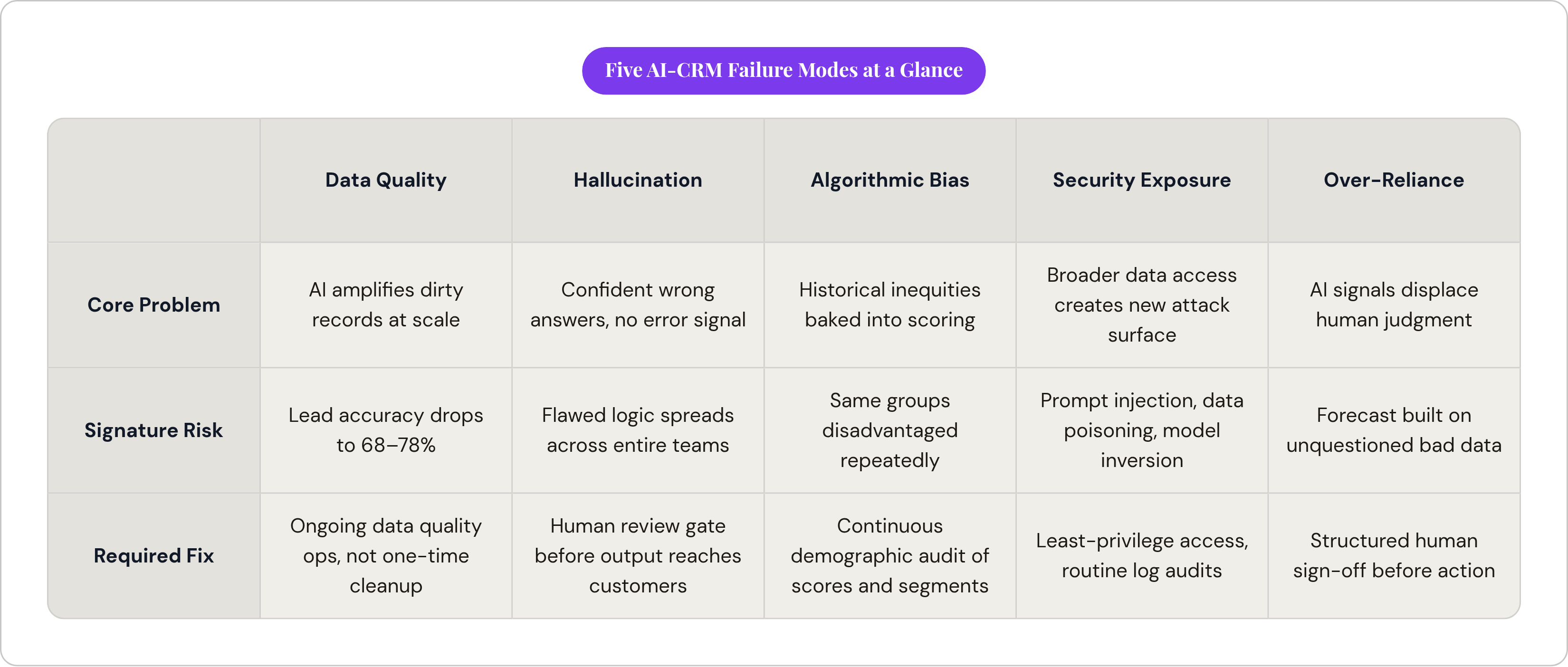
Data quality comes first, as a prerequisite. Before turning on AI features, an organization should know what percentage of its CRM records meet a defined quality bar; given that 76% report less than half their data is accurate and complete, most would fail that test today if they actually bothered to run it. And because decay never stops, this can't be a one-time cleanup sprint. It has to become an operational habit, the same way you'd patch software or reconcile the books.
Hallucination needs a governance layer: a clear answer to which AI outputs get human review before they reach a customer or a decision-maker. Customer-facing messages, pipeline forecasts, and qualification calls sit at the top of that priority list. McKinsey's 27% figure sets a fairly low bar; most organizations have no review loop right now, so building even a basic one puts you ahead of most of the field.
Bias requires an audit habit, run continually rather than once and forgotten. Lead scores, segmentation outputs, pricing recommendations: all of it should get reviewed periodically for demographic patterns, treated as evidence to examine rather than a verdict to trust blindly. With the EU AI Act's fine structure now in force, this has moved from best practice to compliance requirement, whether or not a given company has fully absorbed that yet.
Security comes down to access architecture. Apply least-privilege principles so AI tools only reach the data layers their specific function actually needs, and audit those access logs as routine practice, ideally before an incident like the Salesforce campaign makes the news, not only after.
Judgment stays in the loop by design. AI-generated signals work as inputs to a decision, especially anywhere the output feeds forecasting, key account strategy, or executive reporting. Any content or messaging shaped by AI-CRM insights benefits from a human editorial pass that brings the strategic context the model simply doesn't have, because it was never trained on your company's specific relationships, history, or judgment calls.
So here's the plain version: organizations that get real value out of AI-CRM will treat its outputs with calibrated skepticism from day one. Every failure mode in this piece is documented, foreseeable, and manageable, provided somebody actually manages it. Adoption speed won't decide who wins this. The habits built around review, auditing, and access will.
Sources
- https://www.nutshell.com/blog/ai-in-crm
Provided the Gartner projections on AI agent adoption in enterprise applications by 2026.
- https://www.rapidionline.com/blog/ai-crm
Provided the statistics on AI-powered CRM adoption rates and sales goal outperformance figures.
- https://www.planetcrust.com/ai-risks-in-customer-resource-management
Provided hallucination rate figures including the 79% ceiling and the McKinsey statistic on organizations monitoring AI-generated content.
- https://www.ibm.com/think/topics/algorithmic-bias
Provided the EU AI Act penalty figures for non-compliance with prohibited AI practices.