Best CRM Platforms for Real Estate Agents
The right CRM depends on team size, lead flow, and how much automation you actually need.

Nearly four in ten agents worldwide still run their business out of spreadsheets and their inbox, and that gap shows up in commission checks, not just in convenience. Firms running dedicated CRM software report a 29% jump in sales over those tracking relationships by hand, and among agents earning six figures or more, 60% have a CRM behind them, according to data cited by Ascendix. A simple spreadsheet won't grab a fresh lead off a home search at 11 in the evening, pair it with the agent covering that zip, or get a follow-up message out before things cool off. The typical sales CRM, made for software firms or brokers, seldom does this: it lacks a native MLS feed, property-matching logic, and lead routing built for the way real estate leads actually arrive.
That gap has pushed vendors into clear lanes, and agents often err by choosing a platform built for another one. A solo agent juggling forty leads with no assistant needs something different from a twenty-person team whose manager needs to see who's ignoring their leads, and both need something different from a brokerage negotiating access for a thousand agents at once. Commercial specialists handling lease structures need one tool with zero residential logic.
Actually, the real gaps between each platform come down to 6 things, but most lists bury the key one: do leads come in automatically, or does an agent move them from an email into a field.
The depth of IDX and MLS integration ranks next. Plugging straight into the MLS puts more up-to-date, richer property data in an agent's hands than a plain IDX feed, yet platforms push that angle harder in their sales pitches than it really matters to a run-of-the-mill agent from one workday to the next. Automation sophistication ranks next: a plain basic drip email campaign isn't the same as steps that adapt based on which links a lead actually clicks, yet neither one of those matches an AI tool acting by itself, with no one approving it beforehand.
Team capabilities are enormously important for some agents and irrelevant for the rest. Lead routing, accountability reporting, shared inboxes, and leaderboards matter little for any solo agent, yet it's nearly required when a group reaches 5 agents or above. Integration breadth also deserves a look: platforms built on Salesforce work with 4,300-plus outside tools, while Zoho links to 28 and BoomTown to just 24. Any agent using an existing software stack who won't rebuild everything will feel the gap clearly. Pricing math shifts with size, because per-user fees, one flat rate for everyone, and a plan your brokerage negotiated can leave you paying wildly different amounts on a platform that's functionally identical.
It's worth checking how far the AI actually reaches in this generation of tools. Offering an action for someone to sign off on is not like executing it unprompted, agentic rather than assistive, while that split is beginning to set newer platforms apart from legacy ones. Worth checking prior to paying: the rebrand of kvCORE is BoldTrail, and brokerages including eXp Realty supply it, so many agents who never touch the tool may soon spend on it a second time.
Follow Up Boss, best for teams that need lead routing and accountability more than anything else
For Follow Up Boss, real estate teams with about 3 to 20 agent work best when leads come from several places and a person gives them out. Leads flow in automatically via Zillow, Realtor, and over 250 additional integrations, while shared inboxes, phone tracking, plus pipeline reporting make it one of the top team-visibility tools for this category.
In head-to-head matchups, its ISA (Inside Sales Agent) functionality earns 8.5 on 10, versus kvCORE at 7.2, while its SMS deliverability posts 22 to 28% replies against a kvCORE range of 18 to 24%. The new AI additions write reply drafts inside the inbox, sum up lead threads, and recommend follow-up steps. It’s assistive rather than autonomous, so it’s worth understanding up front.
Pricing starts at $69 a user on Grow ($58 billed annually), climbs to a higher tier for up to 10 people ($416 annually), and reaches $1,000 for up to 30 with Platform ($833 annually). The dialer add-on costs $33 for each user, with 14 days free available. Onboarding demands real effort, messaging automation comes in thinner than rival competitors provide, and it lacks a built-in page builder intentionally, since it plugs right into an agent's existing web setup.
Once you grow, the pricing gap widens quickly: Follow Up Boss charges $6,900 for 100 people each period, while kvCORE bills just $2,000. That split is precisely why larger teams ought to weigh things carefully before defaulting to whichever platform carries the stronger name. Before a brokerage commits, it should work the math if picking over 30 spots, because Follow Up Boss earns its cost through that team-accountability layer instead of sheer count.
Lofty (formerly Chime), the most AI-forward option for solo agents and small teams
Lofty, which rebranded from Chime in 2023, now positions the platform among the most AI-heavy real estate CRMs out there. Leads get nurtured by the sales assistant, which does follow-up sequences alone, while Smart Plans selects drip sequences based on lead behavior. Lofty bundles a social-media copy generator that uses AI, plus AI-driven IDX property suggestions.
Solo agents and small teams who need AI built into their workflow, not bolted on as an add-on, will find this suits them. For any agent handling leads solo, agentic follow-up feels something close to getting part-time assistant help without raising payroll.
Pricing details are available upon request, making early cost estimates tougher than necessary. Although Smart Plans goes past one basic drip campaign, this multi-step conditional logic has its own limits, meaning agents should not pay for it thinking they’ll get something categorically smarter from a lower-cost platform.
kvCORE and BoldTrail, the brokerage-distributed platform with IDX depth
kvCORE is distributed through brokerages such as eXp Realty, giving many agents entry through their brokerage without laying out cash for an extra subscription, and many of them have no idea. Built using that same infrastructure, BoldTrail represents the next step for the brand's platform, handling solo agents and teams plus large firms together.
IDX infrastructure is its core: the platform bakes in lead generation instead of bolting it on later. The Behavioral Smart CRM automates nurture sequences using what people actually do there, while the Smart Assistant, a ChatGPT texting plus email tool, drafts lead messages itself. On BoldTrail's dashboard, you'll find AI tools that handle prioritizing follow-up, tracking agent results, plus basic IDX connectivity and MLS.
Pricing starts at $400 for up to 10 people, then scales to $2,000 at 100, a fraction of the $6,900 Follow Up Boss's charges for the same team. Automation depth becomes the tradeoff: the platform has gaps in multi-step conditional sequencing and cross-channel follow-up. The Integration count also falls short of other tools in this category. Any agent who already has a big stack of tools should pause before deciding the cheap cost is the full picture.
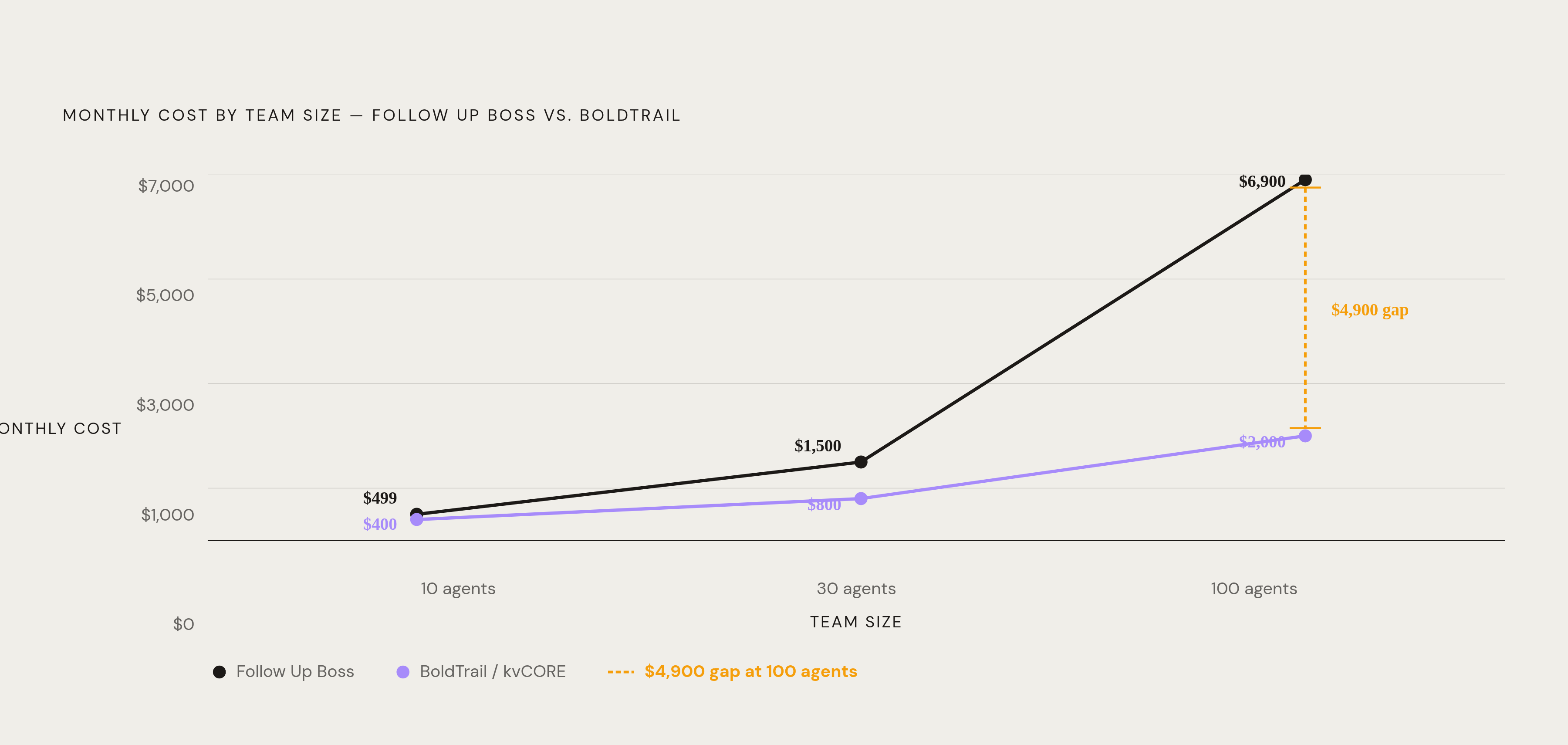
Team capabilities are enormously important for some agents and irrelevant for the rest.
BoomTown, built for brokerages that want managed lead qualification
What makes BoomTown's standout offering isn't software. BoomTown's Success Assurance service has people who work incoming leads, chase after them, check for genuine interest, and pass only the good ones to that agent's group. Layered above it, the AI-driven CRM tracks actions across property listings, predicts demand, and recommends steps to take.
BoomTown works as a brokerage or multi-agent-team tool, not for the solo agent paying toward help they don't require. Those lead accountability tools, the agent leaderboards, plus manager-facing pipeline reporting serve shared-lead teams, not a solo user. BoomTown links to just 24 outside tools, fewer than any other platform listed here, so solo agents juggling lots of programs to hook up should think that over before signing up.
Pricing isn't published; it's available only after asking, placing BoomTown among platforms where pricing details follow a conversation. For workflow automation, BoomTown has gaps in conditional sequencing. The concierge layer earns its worth, not automation, so shoppers hoping for more will be let down.
Top Producer, direct MLS integration and managed lead generation for nurture-focused agents
Top Producer connects directly to the MLS, unlike some rivals using IDX feeds, and that gives agents materially richer property data. Through Social Connect, the advertising staff at Top Producer's manage campaigns on Facebook plus Instagram to push each agent's property listings, routing every lead they pull into their CRM.
Segments help categorize and prioritize leads, MLS snapshot emails go out automatically to everyone involved, and lead replies and follow-ups happen without anyone triggering them. Because richer MLS data helps you make better outreach during an extended nurture, this platform suits agents who lean on depth instead of chasing lead counts.
Pricing starts at $129 for every user each billing cycle, one of the more expensive entry points here, and Social Connect helps explain the price. If Agents actually tap into managed ad tools, they see real returns on their spend. Those who don't end up paying extra for MLS entry you can find more cheaply somewhere else.
LionDesk and Wise Agent, capable platforms for budget-conscious agents who don't need enterprise depth
LionDesk was priced at $39 per month, one of the more affordable options before its discontinuation. Designed mobile-first and built so agents can use it during showings, the setup offered messaging with clips, customizable drip campaigns, plus tools to run Facebook ads, handle email campaign work, and track deals.
Its AI-powered lead follow-up tool, formerly branded "Gabby," was discontinued before the platform itself shut down in September 2025. If you buy based on cost only, remember: a dead deal never does better than one that works.
Wise Agent starts at $49 a month for up to five users, a flat rate that holds up well for a small team instead of scaling per seat the way most competitors do. It's built to be a general-purpose, broad toolset whose price stays affordable, and thrifty agents trust it.
Neither platform reaches Lofty's agentic depth, Follow Up Boss's accountability tools, or BoomTown's concierge layer. Playing dumb about it hurts agents choosing between the two. Both fit when agents have a real constraint in cost, not company size, while neither belongs judged beside tools built to meet different needs.
HubSpot and Pipedrive, general-purpose CRMs that work for real estate with the right setup
Built for use in general business, HubSpot's Smart CRM makes that clear the instant agents hunt for an MLS feed that's simply missing. You can shape its email tracking, pipelines, plus marketing automation around workflows for real estate, though getting there takes hours of work from a person who has done this before. Its Breeze AI Assistant drafts emails, summarizes client records, and prepares meeting notes directly from CRM data, and the platform automatically enriches contact records using a database of more than 200 million profiles.
There is a free plan, while plans cost from $50 per user monthly for the CRM, plus sales and marketing hubs at $15 to $20 monthly per user on top. This tool suits brokerages that can afford developers to create real estate-specific workflows, instead of agents expecting such functionality ready immediately. It has no built-in MLS or IDX connection, while the free plan hits its contact limit so soon that it's a test, not a real choice.
Built around customizable Kanban-style pipelines, Pipedrive uses a general-purpose setup for agents juggling several property collections at once. Drag-and-drop lanes carry leads cleanly from phase to phase, one per property set. Pricing starts at $14 per user per month on the Lite plan billed annually ($24 on monthly billing), one of the lower per-user costs in this entire roundup. This pipeline tool shows deals clearly but doesn’t do lead generation, and since it doesn’t have any MLS integration plus real estate-native parts built into it, agents who want those should shop around.
AscendixRE and Buildout, purpose-built options for commercial real estate
Commercial real estate uses different math. Complex transactions, lease rules, taxonomies of property-type, plus finance terminology sit far from anything residential, so any residential-built CRM usually fails commercial users however strong the lead-routing and drip campaigns it offers seem in theory.
AscendixRE runs on Salesforce with AI tools that read CRE terminology natively, skipping the workarounds agents would otherwise configure for lease abstraction or stack tracking. Pricing starts at $79 per user per month, including a Salesforce license, with its AI Suite (which integrates both Claude and ChatGPT) available as a paid add-on. Since Salesforce powers it, the tool connects with over 4,300 third-party integrations, giving it the deepest integration choices among every platform featured in our roundup.
It's built to serve commercial brokers plus firms needing enterprise-level infrastructure where CRE logic arrives pre-baked in, rather than residential users trying to force a known tool toward a different field.
Sources
- 17 Best CRM for Real Estate Agents in 2025
Provided the statistic that 60% of six-figure agents use a CRM and the figure of 4,300-plus integrations available through Salesforce-based platforms.
- Best CRMs for US Real Estate in 2025
Provided pricing figures for Follow Up Boss's Platform tier and LionDesk's monthly cost.
- https://boomtownroi.com/features/success-assurance/
Provided details about BoomTown's Success Assurance service, which uses people to qualify leads before routing them to agents.
- https://www.topproducer.com/real-estate-mls-integration
Provided information about Top Producer's direct MLS integration, which gives agents richer property data than IDX feeds alone.
- https://www.luxurypresence.com/blogs/top-producer-pricing/
Provided Top Producer's starting price of $129 per user per billing cycle.