CRM for SaaS Companies Managing Subscription Lifecycles
A CRM built for subscriptions must track the full lifecycle loop, not just pipeline closure.
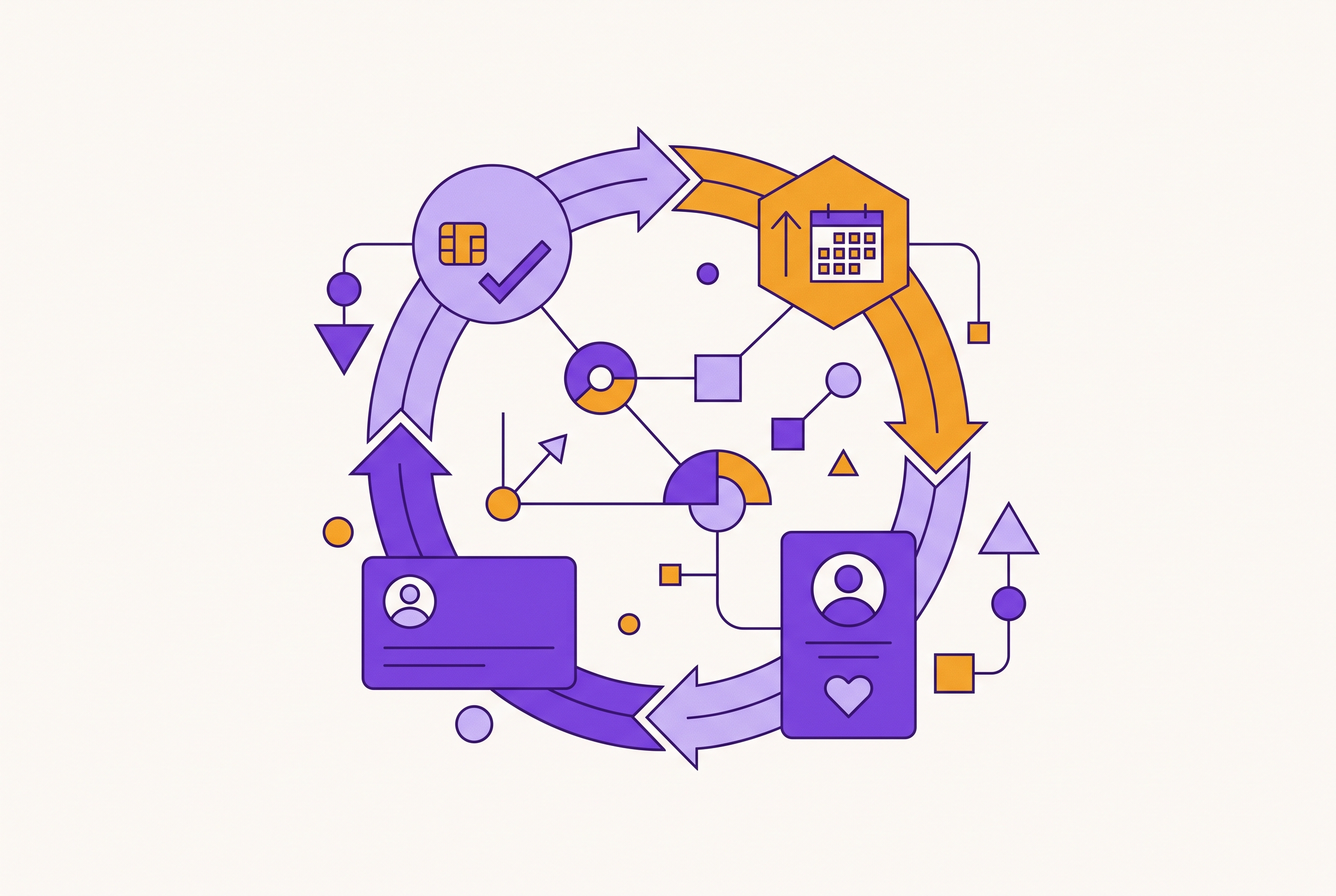
The global SaaS market hit $408 billion in 2025, and B2B subscriptions now account for over half of all subscription revenue worldwide. At that scale, how a company manages a paying subscriber stops being a tooling decision and becomes an infrastructure question. Most CRMs get this wrong at the foundation: they were built to celebrate a signature, treating the subscription relationship as if it ended where it actually begins.
What makes a subscription lifecycle structurally different from a sales pipeline
A pipeline has an end, but a subscription lifecycle is a loop, and loops don't resolve so much as keep spinning until something breaks them.
Trial and acquisition feeds onboarding, which feeds adoption, which feeds renewal and expansion. At any point in that chain, a customer can exit sideways into churn, the only "stage" a traditional sales pipeline was ever built to recognize as an ending. Everything else, the lifecycle treats as ongoing, ambient, unresolved.
Break it down concretely. Trial and acquisition converts a signup into a paying subscriber, while onboarding gets the customer to first value before the contract term runs out. Adoption means watching product usage as a stand-in for whether the customer is actually getting value, rather than just paying for the hope of it. Renewal is active management for annual deals and mostly passive, until it suddenly isn't, for monthly ones. Expansion covers upsell, cross-sell, and seat growth, while at-risk and churn prevention means catching decline before the customer has consciously decided to leave. Winback runs on its own economics entirely, separate from new acquisition.
Revenue refuses to sit still in this model either. It shows up as new MRR, expansion MRR, contraction MRR, churned MRR, and reactivation MRR, and each needs its own line of sight. Contract structure shapes the whole thing: monthly contracts run roughly 18% churn versus about 8% for two-year agreements, which makes contract term a behavioral variable worth tracking closely, not a field buried three tabs deep in most systems.
A system that only knows "open" and "closed" cannot represent any of this.
The gap between what general-purpose CRMs offer and what subscription teams actually need
Bolting subscription tracking onto a general-purpose CRM with a third-party app becomes a tax the business pays forever, in maintenance hours and in the lag between when something goes wrong and when anyone notices.
General-purpose CRMs do not natively track the five components of MRR movement. Getting there means extra configuration or a plugin, and that plugin becomes one more thing someone has to manage. The gaps cluster into three buckets. A revenue visibility gap, where ARR, MRR, NRR, and churn rate are typically not surfaced in the standard deal record, so teams rebuild them in spreadsheets that live next to the CRM instead of inside it. A lifecycle automation gap, meaning no native health scoring, no proactive churn alerting, no stage management tied to what the product logs actually show about behavior. And an integration gap: billing systems, product analytics, support platforms, and marketing automation each hold a partial view of customer health, and a CRM that doesn't stitch those together forces someone to do it by hand, on a schedule, forever.
The practical result is a customer success team managing renewals on gut feel and calendar reminders instead of live usage signals. These tools were built to optimize pipeline velocity, while a subscription business actually needs lifetime value and net revenue retention optimized. Roughly 53% of businesses now integrate subscription management platforms directly with their CRM and ERP systems, which is the market quietly admitting no single tool covers the whole job.
The churn reality that makes these gaps expensive
Most dashboards reduce churn to a single number, which obscures more than it reveals. SMB SaaS sees annual churn anywhere from 30% to 58%, while enterprise SaaS holds at 10% or lower. Infrastructure SaaS, the unglamorous plumbing layer, sits around 1.8% monthly. The category a company competes in sets its baseline risk before a single retention tactic ever enters the picture.
Marketing and sales tools sit at the rough end, 4.8% to 8.1% monthly, driven by fierce competition and the fact that the buyer is often an individual contributor rather than an executive with skin in the renewal decision. Buyer seniority correlates with churn 3.6 times more strongly than segment alone does. Buyer seniority correlates with churn 3.6 times more strongly than segment alone, which should reorder a lot of retention strategies that currently spend more energy on vertical than on org chart.
The 2025 B2B SaaS startup benchmark from Lighter Capital shows median revenue churn climbing from 11.34% to 12.50%, a line pointed away from self-correction.
Here's the number that should make a finance team sit up straight: the gap between 3% and 8% annual logo churn can represent a two-to-threefold difference in valuation multiples. Churn carries weight well beyond an operational annoyance filed under customer success. It's a line item in the term sheet.
Then there's involuntary churn, driven by payment failures rather than unhappy customers walking out the door. It averages 0.8% in B2B SaaS, according to Recurly, and fixing it can lift revenue by 8.6% in the first year. That's the most recoverable churn category in the entire lifecycle, and it happens to be the one most CRMs simply don't touch. Acquiring a new customer costs somewhere between five and twenty-five times more than keeping an existing one. Once that math is on the table, every gap described above stops looking like an inconvenience and starts looking like a budget line.
What a CRM must do at the acquisition and trial stage
A trial user has already shown intent, and the CRM's job shifts from nurturing to time-sensitive activation, with the clock running whether the CRM notices or not.
A few things need to be true. Signups from self-serve channels should route automatically into CRM records, with nobody manually typing a name and email into a form at 4pm on a Friday. Trial needs to exist as its own lifecycle state, with automation triggered by days remaining rather than by whatever a rep happens to remember. The CRM needs a live wire to product analytics, so the record reflects whether the trial user hit a real activation milestone, rather than just logging in once and vanishing. Contact records need actual deduplication, because the same email domain shows up across multiple trials and multiple products more often than anyone expects.
Go-to-market complexity makes this harder. Product-led growth, inside sales, self-serve, and partner channels often run simultaneously inside one company, and the CRM has to represent where a customer came from, because origin predicts behavior downstream. A trial-to-paid conversion carries different weight than a closed-won deal in a traditional pipeline: the contract term picked at conversion, monthly versus annual, immediately sets the churn trajectory the system now has to manage. CRMs that close the deal record and move on are throwing away the most useful signal they'll get all year.
Trial and acquisition feeds onboarding, which feeds adoption, which feeds renewal and expansion.
Health scoring and usage signals as the engine of retention
A health score takes a pile of separate signals, product usage frequency, feature adoption breadth, support ticket volume and tone, NPS or CSAT, billing history, stakeholder engagement, and turns them into one number a human can act on. The entire value of the exercise sits in the word "predictive." A health score dipping ahead of a renewal date should trigger a retention workflow on its own, without requiring a CSM to happen to notice something felt off during a call.
Some signals carry more weight than others, and this is where most health scoring models get lazy, treating every input as equally important because that's easier to build. Login frequency measures surface engagement, which is useful but shallow. Core feature adoption matters more, because it tells you whether the customer is using the parts of the product that create real switching costs; a customer who's only ever touched the login screen has nothing keeping them from leaving tomorrow. Champion risk sits in its own category: if the main point of contact goes quiet, or their LinkedIn suddenly shows a new employer, the account is at risk regardless of what the usage dashboard says. Support escalation patterns function as a leading indicator too. By the time churn shows up in the revenue numbers, the support team usually clocked it weeks earlier.
NRR above 100% means the existing base is growing faster than it's shrinking, and the strongest SaaS businesses run at 110% to 130% or higher. Below 90% is where investors start asking uncomfortable questions in board meetings. Health scoring is arguably the only mechanism that pushes that number in the right direction over time, and a CRM without it native pushes CSMs straight back into spreadsheets, defeating the entire point of centralizing lifecycle management in the first place.
Renewal and expansion management as a revenue motion in the CRM
Renewal deserves its own pipeline, full stop. Treating it as a task bolted onto the original deal record misses that it has its own stages (risk identified, health reviewed, negotiation, confirmed), its own timeline running backward from the contract end date, and usually its own owner, since customer success runs renewals, not the account executive who closed the original deal.
The CRM should surface renewal risk on its own, without a CSM building a report to go find it. Accounts with a sliding health score, or a contract date creeping closer, should land in a managed queue automatically. Expansion runs on its own mechanics: seat-count growth is a trigger, usage creeping against plan limits is an upsell signal that should spin up a task without anyone remembering to check manually, and cross-sell depends on connecting usage patterns to adjacent products the account hasn't touched.
Roughly 71% of businesses now offer both monthly and annual plans, and that creates a specific headache: monthly subscribers have no discrete renewal date to build a workflow around, so the CRM has to lean on engagement signals instead of a calendar. Expansion MRR tracked apart from new MRR shows whether growth comes from the existing base or fresh acquisition, and that distinction changes both the forecast and the story told to investors. The LTV:CAC ratio ties renewal and expansion performance back to how efficiently the company acquired the customer in the first place.
Dunning, payment recovery, and involuntary churn as a CRM workflow
Involuntary churn gets ignored in CRM design because it feels like a billing problem, separate from a relationship problem. A customer who churns because a card expired has the exact same revenue impact as one who left after a bad support experience, and the lost dollar doesn't know the difference.
That 0.8% average involuntary churn figure sounds small enough to ignore, right up until fixing it lifts revenue by 8.6% in the first year. The math is lopsided in the best possible way: small effort, disproportionate return.
A working dunning process needs a few pieces working together. An automated card updater refreshes expired card data before a charge ever fails. Smart retry logic schedules attempts at the times most likely to succeed, instead of repeating the same declined charge attempt five times in an hour. Tiered dunning sequences escalate tone over time, from a soft reminder to real urgency to a cancellation warning, adjusted by account value. Grace periods keep access open temporarily while the payment issue sorts itself out, which cuts down on customers who churn by accident rather than by choice.
The CRM's job here is escalation with context. If automated dunning fails after several retries, the account should land in front of a human CSM with the full picture attached, health score, contract value, relationship history, rather than a flag that just says "payment failed" and nothing else. Voluntary and involuntary churn call for different responses, and a CRM that lumps them together sends the wrong message every time it fires off a workflow. Emailing a customer about all the great features they're missing when their actual problem is a declined card creates noise, and probably annoys them more than the decline itself did.
The metrics a subscription-aware CRM must make visible at every stage
MRR broken into its five movements, new, expansion, contraction, churned, reactivation, is the foundational view of revenue health. A single blended MRR number can look perfectly fine while quietly hiding the fact that churn is eating the business alive underneath it.
NRR is arguably the one metric that captures subscription health better than any other, for operators and investors alike. Above 100% means the existing base grows on its own, without new logos doing any of the work, while below 90% is where investors start asking uncomfortable questions about the business's trajectory.
A CRM built for this world surfaces ARR and MRR broken out by segment, plan, and cohort. Health score per account, not buried in a separate tool. Churn rate split cleanly between voluntary and involuntary, since conflating them leads straight to the wrong response, as the dunning section already made clear. NRR and gross revenue retention side by side, plus LTV:CAC, plus product adoption by feature and tier, plus NPS and CSAT actually tied to the account record instead of floating in a survey tool somewhere.
That data being absent from the CRM doesn't mean the business lacks it entirely. It just means the data lives in five different places and someone stitches it together by hand, which adds lag and error into decisions that need to happen on a Tuesday, not three weeks later. Cohort reporting, watching how a group acquired in the same month behaves over six, twelve, twenty-four months, separates real lifecycle intelligence from a snapshot that only tells you how things look today. That belongs inside the CRM natively, not as a side project handed to a BI team every quarter.
How AI and predictive modeling are changing what CRMs can do for retention
AI is shifting CRMs from systems that record what already happened toward systems that flag what's about to happen, and for subscription businesses that lands squarely on churn prediction. The idea is straightforward: instead of a CSM noticing a problem after usage has already dropped, a predictive model scans the same signals, logins, feature adoption, support tickets, billing history, and looks for the pattern that has historically preceded churn before a human would catch it by eye.
This sharpens the health scoring model from earlier rather than replacing it. A rules-based score might weight five signals evenly and flag an account when the total crosses some threshold. A predictive model, trained on how past accounts actually behaved before they churned or renewed, weighs those signals differently for different segments, since what predicts churn for a five-seat startup account and what predicts churn for a five-hundred-seat enterprise account are not the same thing at all. Vendor studies in this space tend to report accuracy in the low 90s for churn prediction models, though how that holds up depends heavily on how much clean historical data a company has to train on in the first place, worth remembering before trusting any single number too far.
The same modeling extends to expansion, flagging accounts that look ready for an upsell based on usage patterns resembling other accounts that expanded before, and to renewal forecasting, giving revenue teams a probability instead of a shrug. Predictive scoring narrows where a human spends attention, working alongside the human relationship rather than replacing it: the system points to the account quietly slipping, and the CSM does the work from there.
What ties every section here together is one idea in different clothes each time: a subscription business runs on signals that unfold continuously, not on a single event that closes a file. The CRM that wins in this category is the one built, from the ground up, to treat the sale as the opening chapter, with churn rate, health score, and NRR quietly measuring, in real time, whether the story is actually going anywhere good.
Sources
- https://recurly.com/blog/saas-subscription-management/
Provided the statistic that roughly 71% of businesses offer both monthly and annual subscription plans.
- https://www.vitally.io/post/saas-churn-benchmarks
Provided Recurly-sourced figures on involuntary churn averaging 0.8% in B2B SaaS and the potential 8.6% revenue lift from fixing it.
- https://www.lightercapital.com/blog/2025-b2b-saas-startup-benchmarks
Provided the 2025 B2B SaaS benchmark figures showing median revenue churn rising from 11.34% to 12.50%.
- https://focus-digital.co/average-churn-rate-by-industry-saas/
Provided industry-specific monthly churn figures including 1.8% for infrastructure SaaS, 4.8%–8.1% for marketing and sales tools, and the finding that buyer seniority correlates with churn 3.6 times more strongly than segment alone.
- https://livmo.com/blog/saas-churn-benchmarks-valuation/
Provided the valuation impact figure showing that the gap between 3% and 8% annual logo churn can represent a two-to-threefold difference in valuation multiples.
- https://www.gtm8020.com/blog/saas-churn-rate-statistics
Provided the figure that acquiring a new customer costs five to twenty-five times more than retaining an existing one.
- https://salesso.com/blog/saas-churn-statistics/
Provided the churn rate comparison showing monthly contracts run roughly 18% churn versus about 8% for two-year agreements.