E-commerce CRM Features for Direct-to-Consumer Brands
Retention economics, not acquisition speed, should drive every CRM feature you choose for DTC.
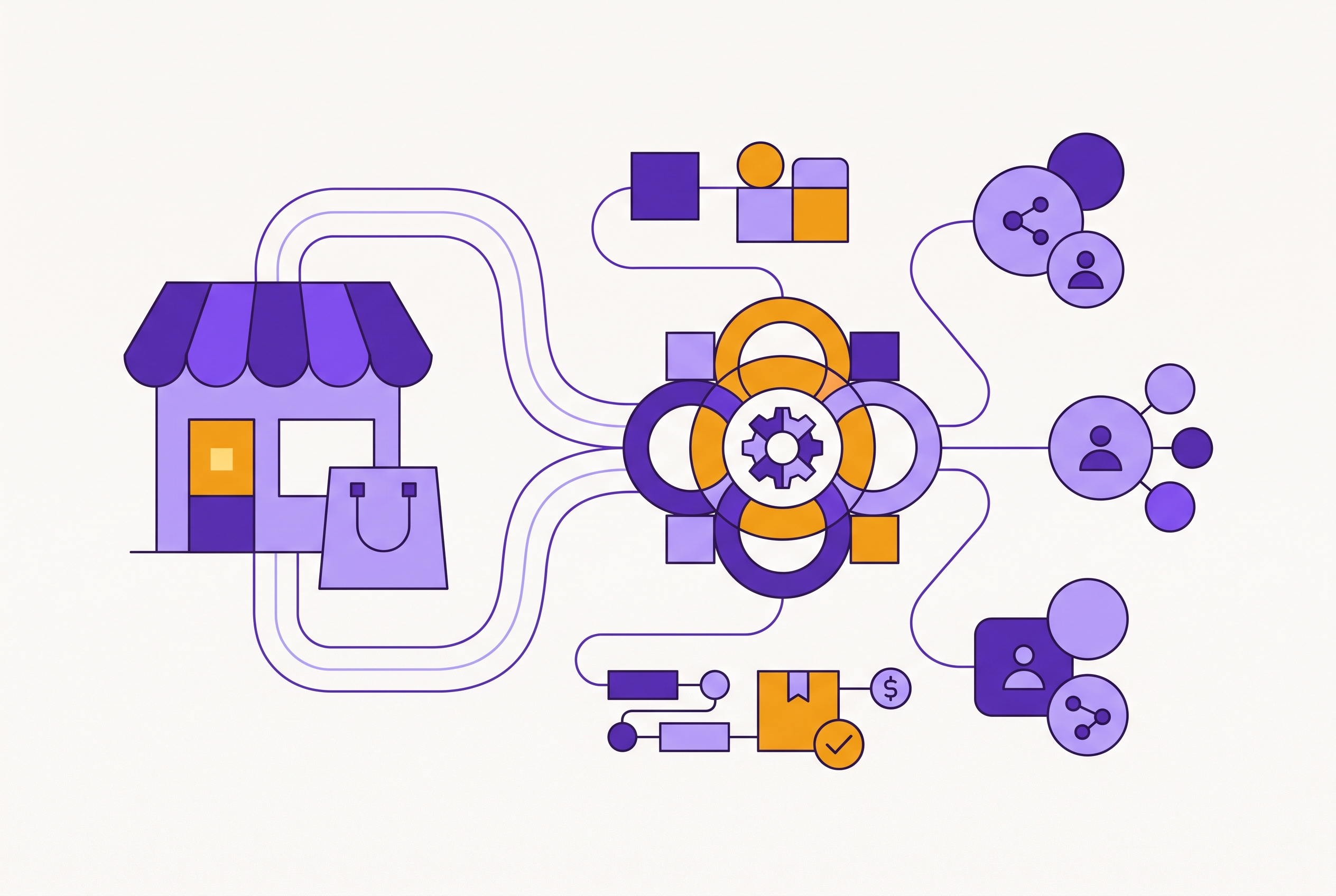
Direct-to-consumer brands face a math problem, not a marketing one. It costs more and more to win customers, there are no retailers to share the risk, and every dollar of customer value has to come from data the brand gathers, keeps, and uses itself. That changes what a CRM needs to do for a DTC company: it's not a sales pipeline tool dressed up for e-commerce, it's the retention engine that decides whether the business survives its own acquisition costs.
Pause on that for a moment, since most CRM feature arguments in DTC circles take their language from enterprise B2B software. Sales pipelines, lead scores, rep dashboards. None of it fits a business with no sales rep, no deal, and no thirty-day sales cycle, only a customer tapping "buy" at 11pm on their phone. DTC brands need features tied to clear, measurable pressures, and we'll cover them all here.
The retention economics that should drive every feature decision
Getting a new customer costs about five times more than holding onto one you already have. The idea's old news, yet DTC teams still keep spending too much on paid acquisition, chasing growth numbers that paid media delivers faster than retention programs do. Bumping retention by 5% can lift profit between 25% and 95%, and repeat buyers shell out 67% more per order than newcomers. Compare those two numbers and the budget choice becomes clear: retention isn't the soft, feel-good side of the business. It's what drives profit.
Conversion rates make the argument even tougher to dismiss. Repeat buyers convert 60% to 70% of the time; fresh prospects convert at just 5% to 20%. That's not a small gap, it's a tenfold difference, and every dollar spent steering a current customer to buy again pays off far more than a dollar spent chasing a stranger.
Loyalty, specifically, has become a switching factor rather than a bonus feature. Three out of four consumers say they'd switch brands for a better loyalty program. And the data shows a real gap: 81.2% of consumers want customized rewards, but only about half of brands actually offer them. This isn't a minor shortfall, it's an opening competitors can take, and whether a CRM closes it or widens it comes down to personalization being built in or tacked on later.
So here's the filter for every feature discussed below: does it cut churn, lift lifetime value, or swap a paid acquisition touch? If a CRM feature doesn't meet at least one of those tests, it's enterprise software dress-up.
Unified customer profiles: the foundation everything else depends on
A unified profile brings purchase history, email activity, on-site browsing, support tickets, and channel attribution together in one record per customer. It seems obvious. It isn't, because most DTC tech stacks spread this data across multiple disconnected tools, and piecing it together later is slow, manual, and often wrong by the time anyone handles it.
Worth being precise about terminology here, because "CRM" and "CDP" get used interchangeably and they're not the same thing. A CRM keeps structured first-party data, contact details, order history, and support records. A CDP pulls data from many sources to create a wider, marketing-ready customer picture. DTC brands need to know which one they're really getting, since vendors are happy to fudge the difference if it seals a sale.
Lacking one shared record, segmentation becomes guesswork, automated flows trigger on outdated signals, and support reps ask repeat callers for order numbers the system already has, treating them like strangers. First-party data now leads the sources marketers use for audience targeting, while CRMs hold most of a brand’s structured customer data, making the CRM the core data asset behind the business, not merely a tool.
There’s also a regulatory side worth noting. Gathering your own data in one place keeps you on the right side of privacy rules like GDPR and CCPA, and that matters more every year as third-party cookies disappear. What to actually check when evaluating a vendor: does the profile update in real time when a purchase happens? Does it link identity across channels? Can a support rep or marketer pull up a customer's full timeline without exporting a spreadsheet or getting an engineer to run a query?
Behavioral segmentation and RFM: moving past spray-and-pray email lists
RFM scoring, recency, frequency, monetary value, groups customers into named buckets like Champion, At Risk, and Hibernating, each with a marketing job. This method is decades old, yet it still holds up because it relies on real purchase history instead of fuzzy demographic guesses.
Segmentation performs best when you layer methods instead of relying on one. RFM is the transactional base. Behavioral data, like clicks, browsing, and abandoned carts, sits on top as an engagement layer. Demographic data gives context. Predictive scoring looks ahead to guess what comes next. They build on each other instead of swapping out, like a good recipe layering flavors rather than choosing only one.
In practice, you send a win-back flow to a Hibernating segment, early access to a new drop or a loyalty bonus to a Champion segment, and a price incentive to an At Risk segment before they slip off to a competitor. A CRM should handle these separately and built in, not patched together with a spreadsheet and a prayer. Email databases are still the go-to tool brands use for this kind of targeting, and transactional purchase data produces most actionable retail insight, which shows you where the signal really sits.
The event types a system recognizes are what set DTC segmentation apart from basic CRM grouping. Generic CRM software organizes around abstractions like "lead score" or "contact stage." DTC segmentation needs to fire on Placed Order, Viewed Product, Started Checkout, the actual verbs of an e-commerce session. Klaviyo's segment builder, which lets a marketer type something like "customers who bought shoes in the last 60 days but haven't opened an email in 2 weeks" in plain language, is a useful example of where this is headed: segmentation logic accessible to someone who's never written a query in their life.
Lifecycle automation: the flows that replace what paid ads used to do
These flows aren't optional anymore. A CRM should handle abandoned cart sequences, post-purchase onboarding, win-back campaigns, VIP retention series, and browse abandonment itself or through a tight integration, not a fragile add-on that breaks whenever the platform updates.
In 2025, Omnisend looked at over 20 billion campaign emails and found that automated messages brought in roughly 37% of email revenue despite accounting for just 2% of sends. That gap is worth pausing on: a sliver of email volume doing over a third of the revenue work, because it fires off real behavior rather than a date someone chose in a planning meeting.
Industry-wide cart abandonment now exceeds 70%, making an abandoned cart flow one of the automations with the best returns a brand can build. Leaving it out isn't a small mistake, it's letting obvious revenue go unclaimed. Shopify's own data found that combining SMS with email in the same workflow lifted conversion by 54% compared to email alone, meaning a CRM needs to handle multi-channel sequencing as a core capability, not a premium add-on buried behind a paywall.
But unchecked automation hurts you. Many consumers say they want fewer messages, and Razorfish's 2025 holiday CRM data found a large majority of shoppers had unsubscribed from a retail brand in the prior three months. So what really matters isn't only "does it send," it's trigger fidelity (firing on the right event, not a rough one), channel mix (email, SMS, and push in one builder), and suppression logic (the flow stopping once the customer converts, not nagging someone who already bought).
Getting a new customer costs about five times more than holding onto one you already have.
Native e-commerce platform integration: why "works with Shopify" is not enough
Real-time order sync, product catalog access, and storefront event tracking aren't differentiators, they're just the basics. A CRM still using nightly batch syncs or manual CSV exports can't run real-time automation, period, however slick the sales demo looks.
Vendors don't always tell you whether they're selling a native integration or a third-party connector, and the two aren't the same. Native means the CRM's segmentation engine is designed around e-commerce events themselves. With a connector, e-commerce data lands in generic CRM fields, and detail fades along the way, like a photocopy of a photocopy. Native Shopify integrations automatically sync orders, customers, products, and event data to build segments from e-commerce events, is a solid example of what native really means in practice.
Subscription brands need more than this: native subscription engine support with built-in automatic payment retry and dunning rules, not just basic order syncing. You can fix a declined card before it quietly loses a subscriber, but the CRM has to catch the billing event first.
Before you sign, ask any vendor: when a customer buys, does the integration update their profile right away? Can segments keep up with changing behavior on their own, or must someone refresh them by hand? Does the CRM catch refunds, exchanges, and partial orders, or only the tidy, successful ones?
AI-powered predictive analytics and churn modeling: from reactive to proactive retention
Companies using AI-driven customer lifetime value models report lifetime value increases in the 20% to 35% range, mainly because the models show which customers may bring the most future revenue and which retention actions work for them. That's a lot different from handling every at-risk customer the same way.
Churn prediction models built with real behavioral feature engineering hit 85% to 92% accuracy, a handy benchmark for checking any vendor's marketing claims. Using K-means clustering on RFM variables, a peer-reviewed study identified three behavioral clusters (loyal, at-risk, occasional) and found an XGBoost churn model reached 0.81 accuracy and 0.85 AUC, outperforming a Random Forest model that scored 0.76 on both. Model choice isn't a side note here, it separates a system that really predicts churn from one that just says "AI" on the label.
A CRM with real predictive CLV can put retention money where it counts: toward high-value customers showing early churn signals, instead of handing out the same incentive across everyone flagged as at-risk and burning budget on people who weren't going to leave anyway. After its mid-2024 upgrade, Adobe's AI Assistant lets marketers create segments using everyday prompts like "high-value customers who haven't purchased in 60 days," so teams without a data scientist don't need to wait on an analyst. Salesforce launched Agentforce in 2024 to run autonomous AI agents across its ecosystem, turning raw data into action without a human clicking through five dashboards first.
Over half of U.S. consumers say they'll use generative AI shopping online in 2025, and Salesforce found AI-powered interactions shaped a notable share of 2024 holiday purchases somewhere along the way. At some point, the CRM also needs to link up with that AI-driven discovery layer, not only the owned channels a brand already controls.
Loyalty program integration: making retention structural rather than promotional
Loyalty members shop more often and spend more per order, with most having earned or redeemed a reward within the prior six months. That's not a small uptick, it's the bulk of your loyalty members regularly buying through the program.
Loyalty isn't just about keeping customers. It's also a revenue play: 43% of customers say they spend more with brands they feel loyal to, so the program can pay for itself twice over if built right. That gap from earlier in this piece hasn't moved: 81.2% of consumers want customized rewards, but only about half of brands deliver them. A CRM should tailor rewards to each person, not give everyone in the "Gold" tier the same 10%-off coupon and call it a day.
Maestra.io launched its Shopify loyalty app in late 2025 so brands can run loyalty programs and sync first-party data at the same time, showing how a single system keeps loyalty and CRM info on one record rather than splitting it across tools you have to match up by hand. Integrated loyalty means points balances sit right on the customer profile, reward redemptions fire CRM events on their own, and tier shifts update segmentation with no spreadsheet in sight. Disconnected loyalty is a standalone app spitting out CSVs nobody opens, segments updated by hand, and no way to tell if a loyalty interaction truly came before a repurchase or was mere coincidence.
Omnichannel data capture including social and SMS: where customers actually are
Social platforms made up roughly 20% of global holiday sales in 2024, and social referrals drove a meaningful portion of e-commerce traffic. Social isn't a side channel now, it's a real path for acquisition and re-engagement, and a CRM that ignores it misses where more customers begin their journey.
More and more, customers start their journey in a social feed or AI chat prompt rather than an email inbox you control. When a customer interacts with a brand on Instagram, a CRM designed for this reality should pick up on that signal and send a personalized follow-up via email, push, or SMS, instead of ignoring the interaction simply because it occurred on a platform the brand doesn't own.
SMS is worth more than treating it as "just another delivery channel." Remember the 54% conversion lift Shopify saw when SMS and email were paired in win-back flows: that figure is no fluke, it shows SMS belongs in the primary contact strategy rather than sitting unused as a last resort for customers who have opted out of everything else. Per Razorfish's 2025 research, brand-specific AI search traffic has also jumped year over year, and CRMs will keep stretching to tie those AI-driven discovery moments back to owned-channel follow-up, something most platforms are barely beginning to build.
About 72% of companies now collect first-party data across multiple channels, making the CRM the system of record for it all. How well you gather that data shapes every automation, segment, and prediction that follows. Garbage in, garbage out, though here it's closer to fragmented in, fragmented automation out. What to look for: is the CRM tracking social engagement events? Can it handle back-and-forth SMS, not just one-way sends? Can a customer's profile connect email, SMS, and on-site behavior without someone piecing the data together by hand in a spreadsheet at 2am?
Revenue-focused analytics built into the CRM, not bolted on
If your CRM lacks built-in e-commerce analytics, a small marketing team ends up just building reports, pulling data out, switching apps, or chasing an analyst for figures that belong on a dashboard. This isn't a one-off hassle, it's a standing charge on every planning meeting.
Analytics fit for DTC tie revenue to segments, campaigns, and specific automation flows, not merely open rates and click-through rates passed off as a business outcome. A CRM should be able to say which RFM segment brought in the most revenue this quarter, which win-back flow actually pulled back the most lapsed customers, and how lifetime value compares for customers gained through loyalty versus those gained through paid ads. These aren't advanced business-intelligence questions for a data team, they're basic CRM questions a DTC-built system should answer on its own.
In 2025, personalizing campaigns with first-party data and AI raised ROI substantially, but that figure is useless unless your analytics can prove the gain rather than guess at it. Subscription brands need reporting beyond the standard set: churn rate by cohort, payment retry success rate, dunning recovery rate, numbers a typical CRM dashboard built for one-time purchase businesses doesn't show.
The practical test, and maybe the simplest one in this entire piece: can a marketing manager answer "what did the CRM generate in revenue last month" without opening a spreadsheet or filing a request with someone in data? If the answer requires an email to another department, the analytics aren't built in. They're tacked on, and tacked-on analytics tend to fail right when someone needs them most.
Sources
- The Connected Advantage: 2025 Holiday CRM Trends
Provided data on consumers unsubscribing from retail brands and on AI search traffic growth used in the automation and omnichannel sections.
- https://techrt.com/first-party-data-statistics/
Supplied the statistic that 72% of companies collect first-party data across multiple channels and the 60–70% repeat buyer conversion rate figures.
- Integrating Business Intelligence and CRM Systems With a Machine Learning Approach for Predictive Customer Retention in E‐Commerce
Provided the peer-reviewed XGBoost and K-means clustering findings on churn model accuracy and AUC scores cited in the predictive analytics section.
- https://www.digitalapplied.com/blog/ai-predictive-analytics-clv-churn-guide
Provided the 85–92% churn model accuracy benchmark and the 5–20% prospect conversion rate figures used in multiple sections.
- https://www.digitalapplied.com/blog/rfm-segmentation-2026-ecommerce-customer-framework
Provided the statistics on automated emails generating 37% of email revenue and the 54% conversion lift when SMS and email are combined.