CRM for Professional Services and Agency Client Management
Track client relationships across delivery and billing, not just the pipeline.

Ask a consulting partner what "the client" means, and the honest answer changes by the week. A single account might include a CFO who signs the contract, a VP who approves scope changes, a director who sits in the working sessions, and a junior analyst who answers every email within four minutes because that's the job now. None of these people want the same thing from the relationship, and a contact record with a name, an email, and a "last touched" date captures approximately none of that texture.
Professional services firms sell judgment, time, and a promise that the next deliverable holds up as well as the last one, which means the product reinvents itself with every engagement. That produces a strange side effect: the client relationship becomes both the thing being sold and the main channel through which new business arrives. Referrals and reputation are the pipeline. Lose the thread on one relationship and the damage doesn't stop at that account; it echoes into the three prospects that account might have referred, quietly, without anyone filing a complaint.
What actually needs tracking, then, goes well past "who do we call." Interaction history across months or years. Proposal and statement-of-work status. Whether the active project is healthy or quietly on fire. Billable utilization tied to a specific client, and retainer consumption, because a retainer sitting nearly fully burned with six weeks left on the term is a renewal conversation waiting to happen, whether anyone schedules it or not.
A generic CRM handles the first two items on that list well enough. Everything past the proposal stage tends to live somewhere else, or nowhere at all. In most sales software, the client lifecycle ends at closed-won. In professional services, closed-won marks the start of the real relationship, and the real risk.
Where generic sales CRMs break down for agencies and consulting firms
Generic CRMs are built around a simple shape: move a record from lead to opportunity to closed deal, then hand it off. That handoff arrives right where professional services work starts, which means the tool built to manage the relationship stops paying attention right when the relationship gets complicated.
Call it the pipeline-to-project gap, and it deserves to be named as the actual defect here. A deal closes in the CRM. Nothing about that closure tells anyone to set up a project, staff the team, or schedule kickoff. Someone, usually a project manager with better things to do, manually recreates the account context in a separate project management tool: who the stakeholders are, what was promised, what the timeline looks like. That's a second opportunity for the details to get scrambled on the retype, the professional-services equivalent of a game of telephone played across two pieces of software that were never introduced to each other.
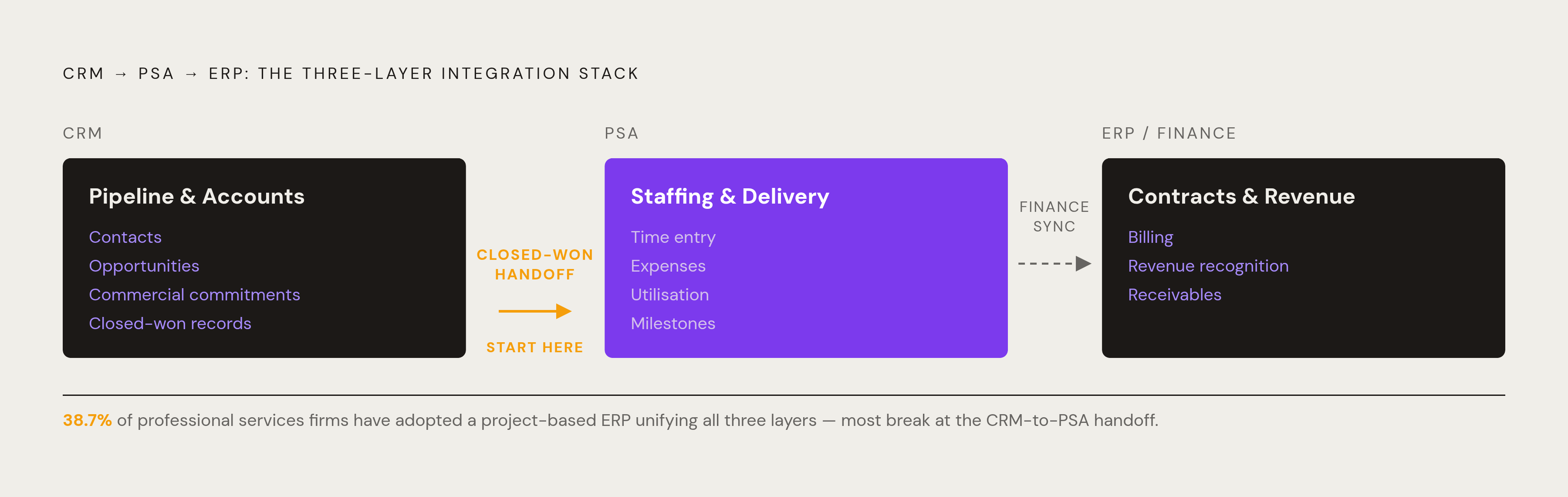
Three systems need to talk to each other for this to work at all. The CRM handles pipeline, accounts, contacts, and commercial commitments. A PSA (professional services automation) tool handles delivery: staffing, time entry, expenses, utilization, milestones. The ERP or finance layer handles contracts, billing, revenue recognition, and receivables. Without deliberate architecture connecting these three, firms get delayed project starts, client data that disagrees with itself depending on which system someone checks, billing leakage, murky margins, and someone in finance spending Friday afternoons reconciling numbers that shouldn't need reconciling in the first place.
Left without a real system, plenty of firms fall back on the oldest CRM there is: a spreadsheet, plus whatever a project lead remembers from the last call. Industry surveys consistently find a significant share of salespeople still rely on informal methods like spreadsheets and email to store customer data. That's a bad habit anywhere, but it's a particularly expensive one in professional services, where the relationship context that drives renewal lives in someone's head instead of a shared record. A missed renewal date or a billing mistake reads as "this firm doesn't have its act together" to the client, and that is not the message any consultancy wants to send to the person who signs the renewal.
The integration architecture that separates adequate from excellent CRM in this context
If there's one moment worth obsessing over in this system, it's the instant an opportunity closes. That's the second the CRM's commercial record needs to become the PSA's operational one: project created, resources baselined, kickoff scheduled, without a human retyping the client's name for the third time that week. Firms that treat this handoff as optional are, functionally, paying a project manager to do data entry instead of managing the project. That shows up on the P&L eventually.
From there, the chain keeps going. Approved time and expenses in the PSA should flow into billing, cost accounting, and revenue schedules in the finance layer automatically. Do that well and margin visibility becomes continuous instead of a monthly surprise that lands two weeks after the numbers would have mattered.
Industry research indicates the strong majority of managed service providers now consider integration between core operational tools essential to how they run the business. Set that against the 2026 SPI Professional Services Maturity Benchmark Report, which found only 38.7% of professional services firms have actually adopted a project-based ERP solution unifying CRM, PSA, and core financials, and the gap between what operators say they want and what they've actually built becomes hard to miss.
There are two reasonable ways to close that gap, though only one of them suits most firms this size, and it's worth saying so directly rather than pretending it's a coin flip. Best-of-breed means a strong standalone CRM connected via API or middleware to a separate PSA and finance tool, buying flexibility at the cost of real configuration work up front, usually requiring a systems integrator or an internal engineer nobody budgeted for. All-in-one means a platform built to combine pipeline, project management, time tracking, and billing in a single system, trading some flexibility for a far lighter integration lift. A 200-person firm with a dedicated ops team can make best-of-breed work, while a 40-person consultancy usually can't, or rather it can, but it burns a year of runway proving what the all-in-one platform would have shown on day one. Firm size and delivery complexity decide the answer; what matters is that the integration exists at all, in some form, before go-live.
A generic CRM handles the first two items on that list well enough.
How to evaluate the leading CRM platforms against professional services requirements
Given everything above, the evaluation checklist basically writes itself. Does the platform handle multiple stakeholders per account? Does it support a real pipeline-to-project handoff? Can it track retainers and recurring revenue, expose billable hours and utilization, and integrate cleanly with PSA and finance tools? Judge candidates against those questions, not against how polished the dashboard looks in a demo. A slick demo and a working handoff can be two different products wearing the same logo, and the sales rep is not obligated to tell which one is being shown.
Salesforce sits at the top of the market by share, holding roughly 21.7% of global CRM market share and posting $37.9 billion in total FY2025 revenue. That scale buys enormous ecosystem depth, and its configurability and AI tooling through Einstein run genuinely deep. Implementation is a real project, though, one that tends to suit large, complex firms with dedicated CRM administration staff rather than a 40-person consultancy trying to move fast.
Microsoft Dynamics 365 is built with the professional services lifecycle explicitly in mind, from inquiry through delivery and support, and it's growing quickly, up 23% in FY25 Q4 while holding about 5.2% market share. Firms already living inside the Microsoft ecosystem, Outlook, Teams, SharePoint, tend to find it a natural extension rather than a bolt-on.
Then there's the category that actually deserves the closest look for a delivery-heavy firm: Productive, Scoro, and BigTime, built specifically for agencies and consultancies rather than adapted from a general sales tool. Productive markets itself as a single source of truth from first contact to final invoice, combining CRM, project management, time tracking, budgeting, and invoicing in one place. Scoro links pipeline data directly to project profitability and team capacity. BigTime focuses on real-time visibility into utilization, profitability, and performance across the client lifecycle. None of the three carry Salesforce's brand weight, and none need to; for the firm this piece keeps circling back to, that narrower focus carries real advantages once implementation timelines enter the picture.
Smaller shops with simpler business development pipelines often land on Pipedrive, visual and sales-focused but thinner on the delivery side. Zoho CRM comes up frequently among project-focused consulting firms that want boards, timelines, and Gantt charts alongside standard CRM functions. No platform wins across every firm profile. The pattern that holds regardless: firms doing delivery-heavy, retainer-based work are, on the whole, well served by the smaller, purpose-built tools, and the market-share numbers above measure popularity, not fit.
What strong CRM implementation actually produces for professional services firms
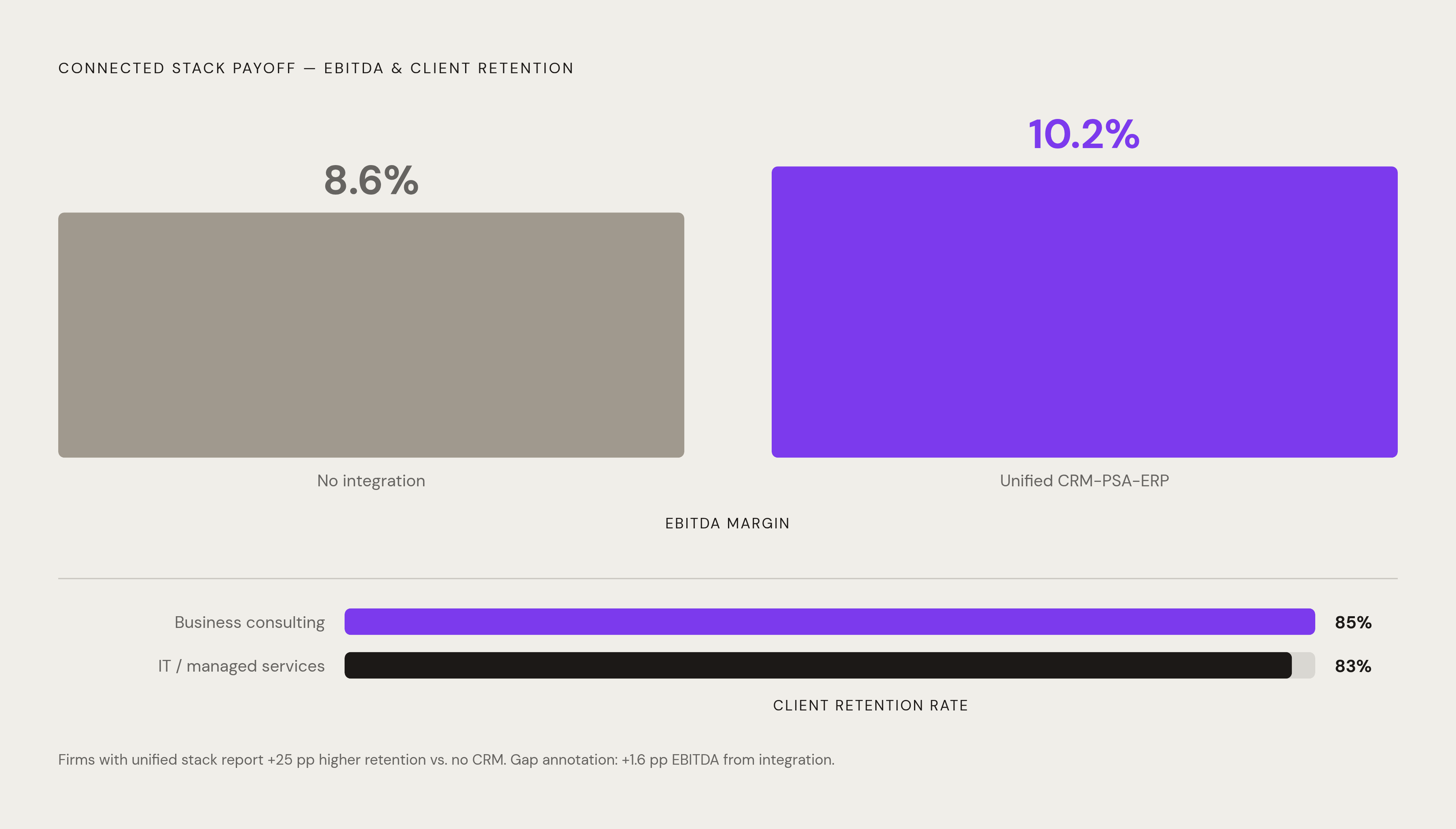
Retention is the number worth leading with, because retention functions as revenue in a retainer business in a way it doesn't in a transactional one. Professional services firms using CRM report 25% higher client retention than those without. Sector benchmarks put achievable retention at 85% for business consulting and 83% for IT and managed services when CRM is used well, and those figures are the direct output of relationship management that's actually working.
Productivity gains show up too, and they're often undersold relative to retention. Documented implementations at some professional services firms show meaningful increases in billable hours within the first six months after CRM adoption. That tracks: time no longer spent on manual data entry is time that goes back onto a timesheet against a client code, and in an hourly-rate business, that compounds fast, quarter over quarter.
Cross-industry estimates of CRM return on investment are worth treating as a floor rather than a promise; professional services sits among the verticals seeing the strongest returns, largely through faster response times and better retention. The integration point from earlier tells the same story from a different angle: firms running a unified CRM-PSA-ERP stack report 10.2% EBITDA against 8.6% for firms without. The connected system, more than the CRM alone, produces that gap. That is the argument of this piece, restated as a single comparison.
Implementation priorities that determine whether a CRM investment pays off
Start with the handoff, not the pipeline. That is the single highest-leverage instruction in this piece, and it deserves to be stated flatly: the first workflow worth configuring is what happens the moment a deal closes, because if that handoff into delivery isn't automatic, the rest of the platform sits half-used no matter how good the pipeline stages look. Firms that configure the pipeline first and leave the handoff for "later" are solving the easy 20% of the problem and calling it done. Later rarely arrives.
Before selecting a tool, map three questions honestly. What does the firm actually need from CRM: pipeline, accounts, contacts? Does delivery need PSA functionality built into the same platform, or will a separate tool get integrated in? And how does billing connect to all of it, cleanly, or through someone's after-hours reconciliation ritual?
Retainer management deserves its own line item, because it's non-negotiable for most agencies and still gets treated as an afterthought. Confirm, before signing anything, that the platform tracks retainer consumption, remaining budget, and renewal dates at the account level, rather than in a finance spreadsheet only one person knows how to open.
Adoption is where most implementations actually die, not at the technical level but at the human one: a CRM only reflects relationship depth if people log the interaction. Configure the system, then, to cut data entry friction rather than add it. AI-assisted note capture and automatic email logging are table stakes now, and a platform still asking staff to manually log every call in 2025 is asking too much of people who bill by the hour for a living.
Speed of setup matters more than it gets credit for. A system that takes six months to configure before anyone can use it has already cost the firm real money: missed pipeline visibility, billing that leaked out the side while everyone waited for go-live. Platforms offering strategy-first onboarding with pre-built professional services workflows close that gap considerably, and it's a fair question to put to a vendor directly during the sales process, not one to discover the hard way during implementation.
Measure from day one, against the metrics that actually matter: retention rate, billable utilization, proposal turnaround, retainer renewal rate over pipeline vanity numbers that look good in a slide deck and mean little to the partners deciding whether the renewal happens. The firms getting the most out of this exercise stop treating CRM as a sales tool that delivery teams grudgingly touch, and start treating it as the connective tissue running from the first meeting to the final invoice. That posture, more than any feature comparison in this piece, is what actually pays for the software.
Sources
- https://www.demandsage.com/crm-statistics/
Provided the survey finding that a significant share of salespeople still rely on spreadsheets and email rather than a dedicated CRM to store customer data.
- https://www.bigtime.net/blogs/crm-for-professional-services/
Supported the discussion of how professional services firms need CRM, PSA, and finance systems to work together and the consequences of gaps between pipeline and project delivery.