Zoho CRM Review for Growing Businesses
Professional tier unlocks the sales process automation most growing teams actually need.
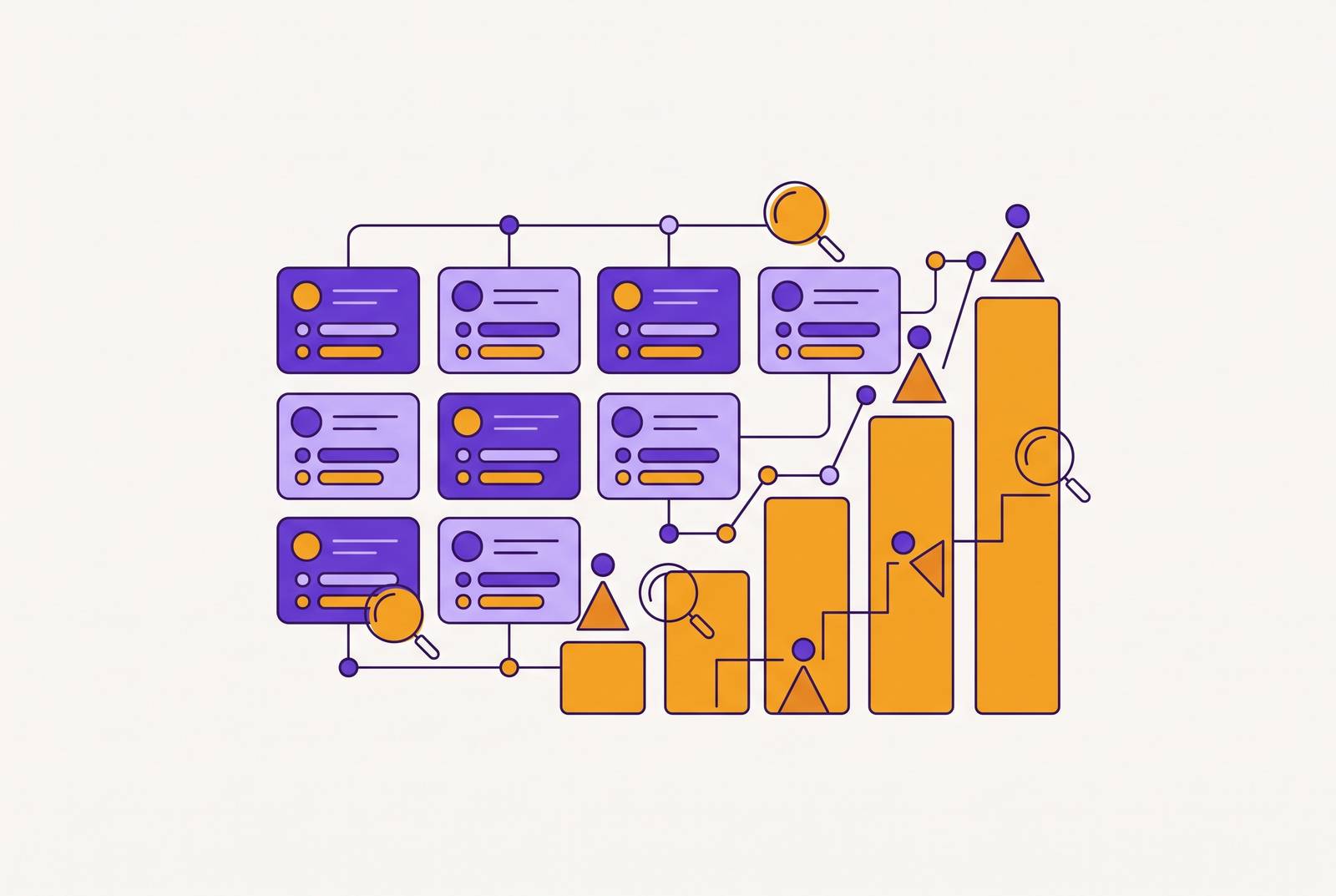
Zoho CRM sells itself on a simple promise: enterprise-grade sales and support software that scales from a three-person free-tier team to multi-department operations without requiring a jump to costly enterprise-tier plans. That promise holds up under scrutiny, but only partly, and the gap between what the platform can do and what a given team can configure without help is where this review spends most of its attention.
What Zoho CRM is and who it is built for
Zoho CRM is a cloud-based system that folds sales, marketing, and customer support into one platform, and the feature that matters most for a growing business is how it scales. A three-person team can run it on the free tier, scaling to multi-department operations, without needing to jump to costly enterprise-tier plans.
It launched in 2005, and Zoho's own figures put usage at hundreds of thousands of companies, inside a corporate portfolio that reports a vast global user base as of its 2026 anniversary announcement. Scale like that doesn't happen by accident. It happens because the architecture is modular: a business adopts lead management first, adds workflow automation later, and layers in omnichannel support whenever it's ready, rather than buying a monolith on day one.
That modularity extends outward too. It also connects with more than 1,100 third-party apps, including Microsoft Office, Slack, QuickBooks, Google Chat, Microsoft Teams, Zoom, and GoTo Meeting. Business.com named it the top pick for growing businesses, and Business News Daily separately named it best for remote teams, two distinct editorial calls that point at breadth rather than one standout feature.
None of that is in dispute. What's less settled is whether a company without a dedicated systems person can actually extract that breadth without a bruising setup process, and that tension runs through the rest of this review.
Where the meaningful pricing thresholds are
Zoho CRM's pricing is tiered so that each step up unlocks meaningfully different capabilities, not just higher limits, so choosing the wrong tier is a substantive mistake, not just an overpayment.
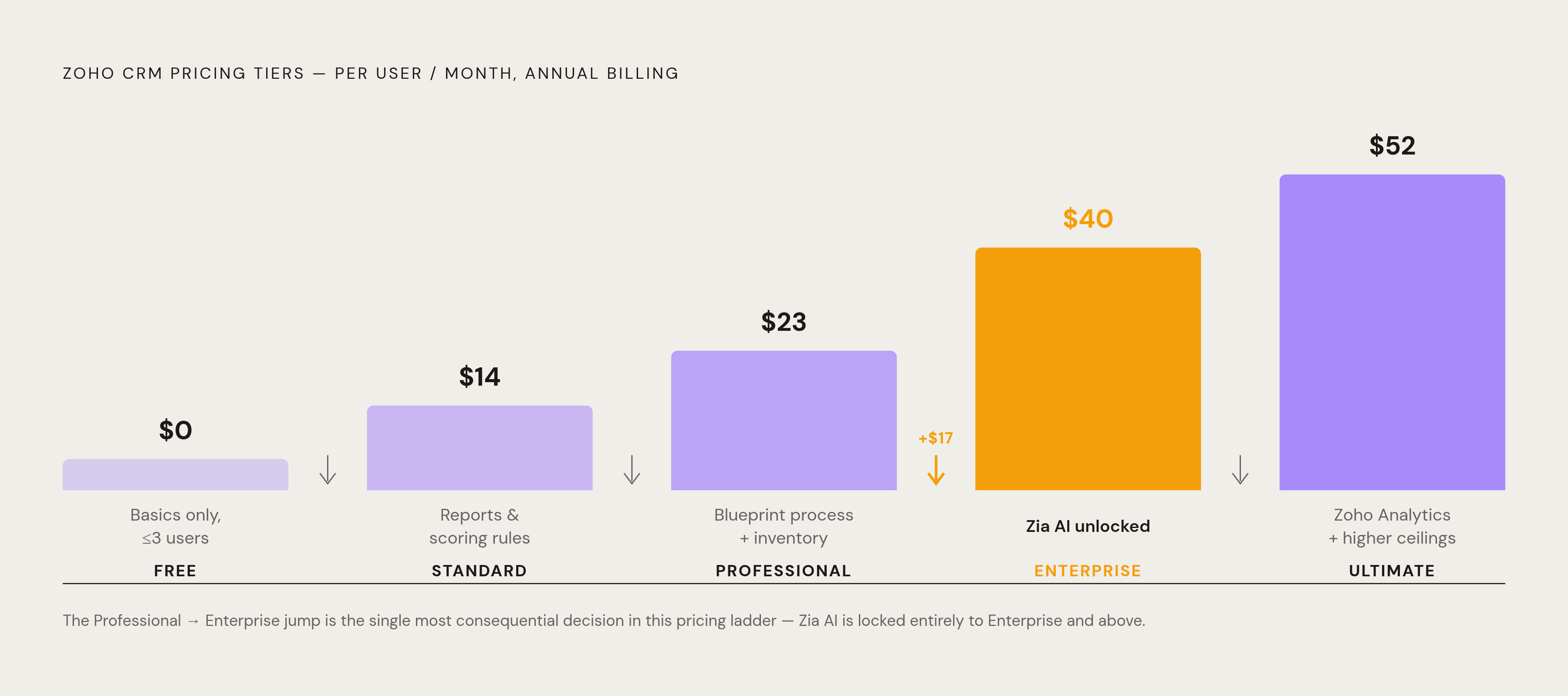
On annual billing, Standard runs $14 per user per month, Professional $23, Enterprise $40, and Ultimate $52. Paying monthly instead of annually adds a meaningful premium at every level, so annual billing can save close to a third over the course of a year. The free tier caps out at three users and covers the basics: leads, contacts, accounts, tasks, and standard reports. It's a fine way to kick the tires before a business commits to anything, but it has no real automation depth, no email integration to speak of, and no advanced analytics, so a company that's actively growing will outgrow it fast.
Standard is priced to be an easy first purchase, but Business.com's review flags a list of absences that matter, including no Google Ads integration, no contact deduplication, no data encryption, and no webhooks. Those are not edge-case features. A team running paid acquisition or handling any volume of duplicate leads will hit those walls quickly.
Professional, at $23 a user, is where Zoho positions its most popular plan, and for good reason. It introduces Blueprint, the tool that standardizes a multi-step sales process across a whole team so that deals move the same way regardless of who's working them, and it also unlocks inventory management, invoicing, and quotes. For a team that has a sales process worth documenting, this is usually the first tier that feels like real software rather than a glorified spreadsheet.
Enterprise, at $40 per user per month, is where Zia AI fully unlocks, making the jump from Professional to Enterprise the most consequential single decision in the pricing structure. The jump from Professional to Enterprise is arguably the single most consequential decision in this entire pricing ladder, and the next section explains why in detail. Ultimate, at $52, adds deeper analytics and higher limits on top of that, but most growing companies, in the roughly 10-to-200-employee range, will find Enterprise is as far as they need to go.
There's also Zoho One, the all-in-one suite spanning more than 50 Zoho applications, priced around $90 a user under its Flexible User model or roughly $37 a user if every employee in the company is enrolled. It's not for everyone. It makes sense specifically for a business that wants the full Zoho ecosystem and can commit its entire headcount to the plan, and it reframes the cost conversation for anyone already leaning that direction.
Feature set by tier, including where Zia AI fits in
Breadth is Zoho CRM's clearest strength. Lead management, pipeline visualization, workflow automation, omnichannel engagement, marketing automation, reporting, mobile access, developer tools, it's all in one system. But breadth on a pricing page and breadth in daily use are different things, and the practical value of any one of those features depends heavily on which tier a company is paying for.
Enterprise is where the platform starts behaving like genuine enterprise software: full Zia AI, deeper customization, the Canvas no-code layout editor (which is actually available on every paid plan, not gated to Enterprise), territory management, and multi-user portals. Ultimate stacks enhanced analytics through Zoho Analytics, higher automation ceilings, and a dedicated database cluster on top of that, which matters for data-heavy operations but isn't a default recommendation for most small and mid-sized teams.
Zia decides whether Enterprise is worth the jump from Professional, so it deserves the closest look here. It's locked to Enterprise and Ultimate only. What it actually does: it scores leads and deals using engagement signals and historical win patterns, with those scores refreshing daily, it flags anomalies in performance metrics before they show up in a standard report, giving a manager a warning instead of a postmortem, and it recommends the best time to reach out to a given contact based on past response behavior.
Zoho has also been building past static scoring. In February 2025, it released a preview of Zia AI agents inside Zoho CRM, autonomous agents built to carry out predefined tasks across support, sales, and marketing workflows. Later in 2025, that effort expanded into Zia Agent Studio, a no-code and low-code builder for creating custom agents, paired with a separate Agent Marketplace stocked with prebuilt ones. That's a meaningfully different posture than a bolt-on chatbot: it's Zoho trying to make agentic automation something a non-developer can assemble.
Zia has real limits. It doesn't draft personalized follow-up emails, it doesn't summarize call transcripts, and it can't answer a free-form question about a deal using context pulled from outside the CRM. And it needs time to become useful: lead and deal scoring require roughly 30 days of activity and approximately 30 closed deals before the model produces reliable outputs, so new teams should not expect Zia to be useful on day one. The honest way to frame Zia is that its value comes from breadth and bundled price rather than depth in any single AI category a specialized point solution might deliver.
Zoho CRM covers sales, marketing, and customer support in a single system, and it scales from a three-person free-tier team to multi-department operations without requiring a jump to costly enterprise-tier plans.
On reporting, real-time dashboards, KPI tracking, and custom report builders show up across the paid plans, and Business.com specifically calls out the butterfly chart, a side-by-side comparison visualization, as a distinctive touch. Real business intelligence through Zoho Analytics, though, sits behind Ultimate or a separate add-on. And for technical teams, there's a full set of developer tools: APIs, custom extensions, and Deluge scripting for building custom functionality. That's a genuine asset for a team with an engineer on staff. For a team without one, it turns into a support ticket, which the adoption section below covers directly. In June 2024, Zoho introduced "CRM for Everyone," an update designed to facilitate cross-departmental collaboration (a structural change, not a cosmetic one), relevant for growing businesses with sales, support, and marketing teams sharing the same CRM data.
Zoho CRM compared to Salesforce, HubSpot, and similar options on price and fit
Zoho's strongest argument in the market is that it delivers a feature set comparable to far pricier competitors. But price parity with a rival isn't the same as fit, and which platform actually suits a team's stage and working style is arguably more important.
Salesforce prices rose by roughly 6% in 2025, with further increases expected into 2026. It remains the right call for organizations that need deep enterprise customization and have the internal resources, staff or budget for consultants, to build and maintain that customization over time. HubSpot, by contrast, has kept pricing relatively stable, and its real edge is cohesion: sales, marketing, and service tools that feel like one product, plus a support experience that consistently gets high marks. That ease of use isn't a soft benefit. It directly affects how much of the tool a team actually ends up using.
Microsoft Dynamics 365 starts noticeably higher than Zoho CRM for basic sales functionality, and it earns its price mainly for organizations already committed to the Microsoft stack. One consultant-led comparison, run by a Zoho-consulting firm and worth reading with the obvious grain of salt given who published it, found Zoho CRM substantially cheaper than both Salesforce and HubSpot over a three-year window while claiming comparable functionality. That same source cites a migration example: a company moved off Salesforce Professional, at a considerably higher per-seat cost, onto Zoho CRM Standard, and cut its annual CRM spend by a wide margin. Take the framing with appropriate skepticism, but the underlying mechanism, that per-seat savings compound fast across a growing headcount, holds regardless of who's telling the story.
Choose Salesforce for deep customization backed by an established partner network, choose HubSpot when cohesion across sales, marketing, and service plus painless onboarding outweighs unit price, and choose Zoho CRM when a wide feature set at a lower per-user cost fits the budget and the team has the technical capacity to configure it. That last condition is doing a lot of work, and it's the subject of the next section.
Zoho's data residency options stand out for companies in regulated industries handling sensitive customer information, a consideration that rarely surfaces in head-to-head competitor writeups but matters a great deal to that specific segment of buyers.
The adoption risk that can erase the cost savings
An honest counterweight to everything above follows. Zoho CRM's complexity, combined with support that a lot of users describe as inconsistent, creates a real risk that can quietly erase the cost advantage if a growing team doesn't plan for it up front.
CRM adoption is a weak spot across the entire industry, not a Zoho-specific failure. Average adoption rates across sectors stay low, and most people who are handed a CRM license never fully engage with the system. A cheap, underused CRM is worth less than a pricier one a team actually lives in every day. That reframes the whole cost conversation: the per-seat price is only half the equation.
The friction concentrates in predictable places: non-technical users tend to struggle most with webhook setup, automation configuration, and any integration that requires writing Deluge scripts. A Gartner Peer Insights review from May 2026, an Operations Manager in travel and hospitality who scored the platform 3.0, called it sophisticated but flagged friction for lean teams trying to run it without dedicated support. A Capterra reviewer in legal services, writing in April 2026, described the interface as cluttered when moving between modules or customizing layouts, enough to slow new users down. Another Capterra review, from July 2026, a senior business development rep in software, called certain workflows less intuitive than they should be. And a separate Gartner reviewer pointed to a ceiling on UI customizability that becomes frustrating for teams trying to deliver a polished internal experience, plus API concurrency limits that create real constraints once a company scales up its usage.
Support is where opinions split hardest. Business News Daily's review found that Standard (Classic) support is limited to weekdays, and Premium or Enterprise support requires additional payment on any plan. One particularly rough Capterra review, from a CEO in professional training and coaching in February 2026, describes a billing dispute that escalated into an actual service suspension, a failure that turned a software problem into an operational one overnight. Slower response times, unsurprisingly, cluster on the lower-priced plans. G2 tags "Poor Customer Support" in a notable share of CRM reviews, and Zoho's Quality of Support score of 7.6/10 on G2 falls below HubSpot Sales Hub's 8.5 and Freshdesk's 8.8.
None of this means the platform is stuck. The June 2024 "CRM for Everyone" release and the newer Zoho One Dashboard 2.0 have both pulled in more positive usability feedback, and the trend line looks like it's moving in the right direction, even though the backlog of complexity complaints hasn't cleared out of current reviews. The fair takeaway for a buyer: for a team without a dedicated CRM administrator or a technically capable champion, the time cost of configuration and the risk of under-adoption are real budget items that the per-user price difference does not automatically cover. G2 CRM reviews flag learning curve and complexity as recurring concerns across a notable number of reviews. Support quality is Zoho's most polarizing dimension.
The plan and setup path that fits each stage of growth
The right plan was never mainly a features question. It's a question of team size, how much technical capacity exists in-house, and which specific pain point is actually driving the search for new software right now.
For a company at one to three people, pre-revenue or barely past it, the free tier is a legitimate place to start. Use it to check whether Zoho's data model actually matches how the sales process really works before spending anything. Once there's a defined sales process and at least one team member comfortable with technical configuration, Standard or Professional both become reasonable, and it's worth starting directly at Professional if Blueprint's process standardization or the inventory and invoicing tools are needed immediately rather than eventually.
For teams with a structured sales operation already running, the range worth evaluating is between Professional and Enterprise. The move to Enterprise makes sense once Zia's lead scoring and anomaly detection become genuinely decision-relevant, but only once there's enough historical data, roughly 30 closed deals and about 30 days of activity, for its outputs to mean anything. Jumping to Enterprise before that data exists just means paying more for a feature that isn't ready to earn its keep yet.
Once a business has multiple departments, sales, marketing, and support all pulling from the same CRM data, Enterprise becomes the floor rather than an optional tier. At that point, it's worth evaluating Zoho One directly, particularly for a company already leaning on several Zoho products, since the per-user math on the full suite can end up cheaper than piecing tools together individually. Whichever tier ends up being the right fit, the decision holds up best when it's made with a clear eye on both sides of the ledger: what the platform can do, and what it will actually take, in hours and in a support ticket now and then, to get a team using it the way it's built to be used.
Sources
- Zoho CRM Review 2026:Pricing & Features
- Zoho CRM Reviews & Ratings 2026 | Gartner Peer Insights
- Zoho CRM Review and Pricing in 2026
- Zoho CRM Reviews 2026. Verified Reviews, Pros & Cons | Capterra
- In-Depth Zoho CRM Review 2026: Fully Tested and Rated
- Zoho CRM Pricing 2026: Plans, Costs & What You Actually Pay
- Zoho CRM Pricing 2026