Switching CRM Platforms After a Failed Implementation
Half of CRM rollouts fail—but usually because of people and process, not the software itself.
Switching CRM Platforms After a Failed Implementation⟦c1⟧.
Why CRM implementations fail
Roughly half of CRM implementations fail to deliver what they promised, and switching platforms without figuring out why is the single most expensive mistake an organization can make twice⟦c2⟧. The numbers vary depending on who's counting, but they never land anywhere reassuring: Gartner reported a 50% failure rate, Forrester came in at 47%, and other analysts have put the range as wide as 30% to 70%⟦c3⟧. Johnny Grow's 2025 research settled on 55%, defined precisely as implementations that failed to hit their planned objectives⟦c4⟧. That's not a rounding error or a soft miss, either. When those objectives went unmet, the average variance was 51%, more than half of what the project was supposed to deliver⟦c5⟧.
There's also a perception split baked into these numbers that rarely gets discussed. Ask IT whether the implementation hit its goals and 54% will say yes; ask the business side, the people actually using the system to sell and serve customers, and only 41% agree⟦c6⟧. Same rollout, same budget, same go-live date, and yet two entirely different verdicts depending on who's answering ⟦c25⟧.
None of this is a legacy problem fading into the past. It is the current baseline, still holding steady, and it should reset how any organization approaches its own failed rollout. Failure isn't the exception that happened to your team. It's the norm the entire industry operates inside of. Low/Code found that average CRM adoption is approximately 26% across sales organizations, with the platform running but the data not flowing⟦c7⟧.
Cause of the failure: the breakdown most post-mortems get wrong
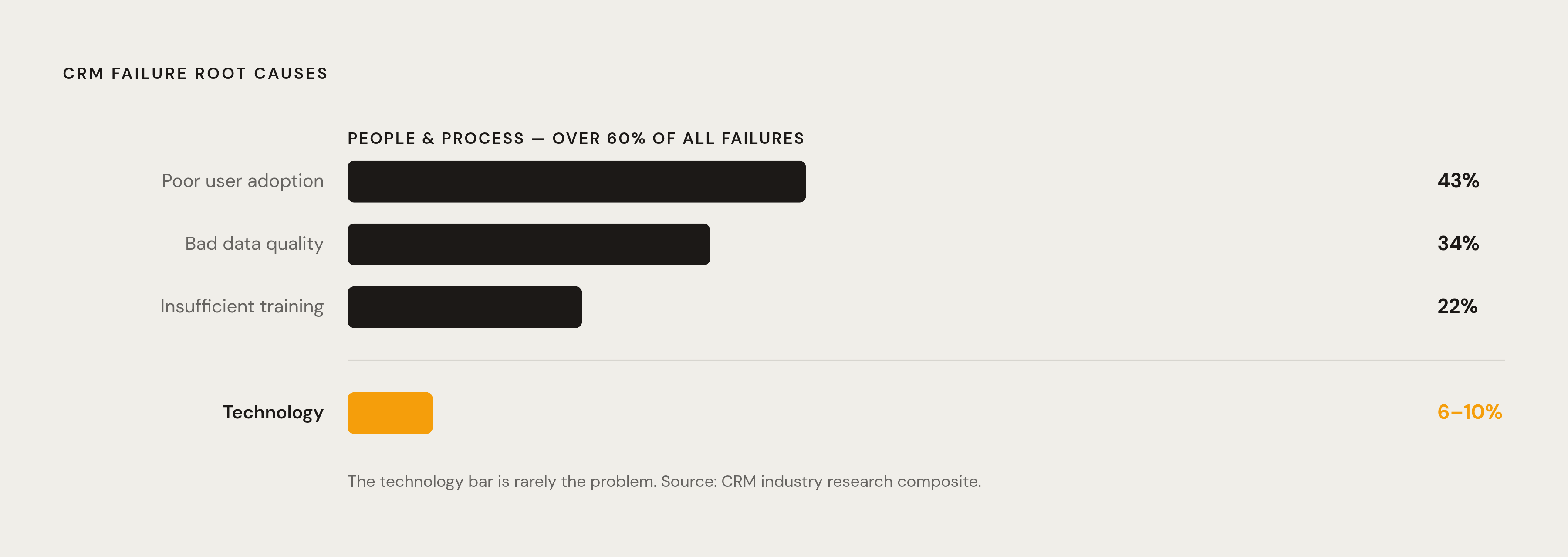
The instinct after a bad implementation is to blame the software. Interfaces get called clunky, workflows get called rigid, and someone eventually says the platform "just wasn't right for us." The evidence points somewhere else almost every time. Low/Code's research found that over 60% of CRM failures trace back to people, while only 6 to 10% stem from the technology itself⟦c8⟧.
Poor user adoption accounts for 43%, bad data quality for 34%, and insufficient training for 22% of the top three root causes⟦c9⟧. Vantagepoint's research sharpens the picture further, tying 47% of failures to poor adoption and 33% to a lack of executive buy-in⟦c10⟧. Reps won't use a system leadership doesn't visibly believe in, and leadership rarely notices the disconnect until the data's already useless.
The mechanics behind "poor adoption" get concrete fast once the visible facts are examined. Over half of organizations, 52%, have no internal CRM champion at all⟦c11⟧. Training gets treated as a checkbox: 65% of users say training is essential to success, yet 49% report their onboarding ran longer than expected, which usually means it was rushed or incomplete from the start⟦c12⟧. When executives don't reference CRM data in their own meetings, or don't log into the tool themselves, reps stop treating adoption as a habit and instead perform it as a compliance exercise under duress⟦c13⟧. That produces what's sometimes called the surveillance trap: a CRM configured to report on the sales team rather than help it close deals, with required fields serving management dashboards and stage gates modeled on leadership's mental map of the pipeline rather than the rep's actual day⟦c14⟧.
Process failures compound the disagreement over basic definitions among people. Sales, marketing, and service teams frequently disagree on basic definitions, what counts as a qualified lead, what a pipeline stage actually means, before the CRM is ever configured⟦c15⟧. Radin Dynamics found that roughly half of CRM implementations fail specifically because of poor data quality, which makes data a structural failure baked in at the foundation, not a cleanup task to handle later⟦c16⟧. Teams also fall into the over-customization trap, bending the new platform to replicate old workflows instead of asking whether those workflows deserved to survive the move⟦c17⟧. And when the CRM gets framed as an IT project rather than a business one, ownership of behavior change evaporates, because IT can configure a system but it can't make a regional sales director actually use it⟦c18⟧. The 60/30/10 people/process/technology split is the central argument this section must land clearly, as every later section depends on it⟦c19⟧.
The honest audit: questions to ask before deciding anything about the platform
Most organizations skip this step entirely. They decide to switch platforms before ever auditing what went wrong with the first one, which means whatever caused the original failure rides along into the new contract. Vantage Point's own research on the People-Process-Technology framework found that organizations applying it in that order, people first, process second, technology last, are 86% more likely to exceed their CRM goals⟦c20⟧. Sequence matters more than most buyers assume.
Start with the people dimension. Did frontline users get a seat in designing the system, or was it handed to them finished, with no chance to flag what wouldn't work for their actual day-to-day? Was there a named champion with real authority to push adoption, not just a title? Did leadership visibly use the CRM themselves, or did they only ever demand reports pulled from it⟦c21⟧? Was adoption tracked deliberately, or simply assumed once training wrapped?
Move to process. Were success metrics defined before the implementation started, or only assembled after the fact to justify the spend? Were existing workflows actually documented and evaluated, or automated as-is, warts included? Did sales, marketing, and service agree on shared definitions before configuration began, or did each department quietly keep its own?
Then technology, the dimension everyone wants to interrogate first and should interrogate last. Did the platform genuinely lack capabilities the team needed, or did it have them and nobody used them? Were integration failures a limitation of the software, or a scoping mistake made during setup? Was customization driven by a real workflow need, or by an urge to recreate what the old system looked like out of familiarity?
There's a useful gut check buried in all this: the data trust test. If people on the team have quietly stopped trusting what's in the CRM, pin down exactly when that started and why ⟦c2⟧. That kind of trust erosion is almost always behavioral, tied to a moment when the data clearly diverged from reality and nobody fixed it, rather than a technical limitation of the software itself⟦c22⟧. The audit should end with something concrete on paper: a written determination of which category, people, process, or technology, actually dominated the failure. That document, not a vendor demo, is what should drive the next decision.
When switching platforms is warranted
Switching is rarely the correct first diagnosis. The audit above is the prerequisite, not a formality to rush through on the way to a new contract. Some signals genuinely point to the platform itself as the bottleneck.
Reps logging activity outside the CRM because the tool itself is too slow or too cumbersome to use in real time is one⟦c23⟧. Managers pulling reports manually because the dashboards can't flex to the question they're actually asking is another. IT fielding a steady stream of tickets to fix integrations that were supposed to run without intervention is a third. Wave Connect's CRM statistics report found 30% of users describe their tools as inefficient, and 20% of those who switched platforms did so specifically over poor usability⟦c24⟧. Those are technology signals, not people signals, and they're the ones that actually justify a platform change.
The appetite for switching is already substantial across the market. Gartner finds that 38% of organizations plan to change their primary CRM within two years, citing dissatisfaction, shifting requirements, tool consolidation, and demand for more advanced capabilities⟦c25⟧. Artificial intelligence has become one of the more legitimate reasons to migrate. Roughly 65% of businesses have adopted CRM systems with generative AI features built in, and those that have are 83% more likely to exceed their sales goals⟦c26⟧. Predictive lead scoring, deal intelligence, and automated workflow suggestions are now standard offerings on modern platforms, but every one of them depends on clean, structured data to function at all⟦c27⟧. An organization migrating specifically to unlock those capabilities has a forward-looking rationale that's fundamentally different from "the old system didn't work," and it's a stronger basis for the decision⟦c28⟧.
Consolidation is the other legitimate driver. An organization juggling a legacy CRM, a separate marketing automation tool, a bolted-on sales engagement platform, and a disconnected customer success system has a genuine architecture problem, and a single unified platform can solve that in a way no amount of process tweaking can⟦c29⟧. What doesn't justify a switch: an audit that comes back pointing at people and process failures. Move that organization to a new platform and the same failures move with it, because the failure was never a function of the software to begin with.
The cost of a failed implementation and why a botched switch costs more
Many end up requiring a full restart, which effectively doubles the total investment before anything works. Scale changes the math further: Vantagepoint's February 2026 research found organizations with revenues over $1 billion are 2.1 times more likely to blow their budget than smaller companies⟦c31⟧. Low/Code's own figures put budget overruns at 49% of all CRM projects, averaging 32% over the original estimate⟦c32⟧.
Migration itself carries its own separate price tag, distinct from the original implementation cost. The line items that consistently blow past estimates are the ones nobody budgets for properly. Data audit and cleaning is the most underestimated cost on nearly every project, and yet a dedicated pre-migration cleanup phase actually reduces total project cost by 25% to 35%, which makes skipping it a false economy⟦c34⟧.
A practitioner who migrated off Salesforce to a simpler system offers a cautionary case⟦c36⟧. On launch day, the team discovered 18,000 duplicate contacts, missing deal histories, and integrations that had silently broken⟦c36⟧. The sales team lost access to critical customer data for three days, revenue tracking came out materially wrong, and the organization had to roll the whole thing back and start over, absorbing significant consultant fees, hundreds of hours of internal labor, and months of lost productivity in the process⟦c36⟧. That's not a worst-case outlier dreamed up to scare buyers.
Switching platforms is not an escape hatch from cost. It is a second major capital investment that fails at rates comparable to the first, unless the underlying people and process problems get solved before a single record moves. Failed implementation baseline costs are typically 30–50% over budget, with median overrun at 30–49%, productivity loss of 6–18 months, and often a requirement to restart the process, doubling total investment⟦c30⟧. The migration-specific cost range shows average B2B CRM migration to a custom build running $25,000–$150,000, with enterprise migrations involving custom objects and complex integrations regularly exceeding $250,000⟦c33⟧. Each third-party integration adds $2,000–$8,000 to reconnection costs, and a team with many integrations should budget this as a major line item, not a footnote⟦c35⟧. The Bloor Group, cited in an Oracle whitepaper, found that over 80% of data migration projects exceed timelines or budgets, with cost overruns averaging 30% and time delays reaching 41%⟦c37⟧.
Executing the migration without repeating the original mistakes
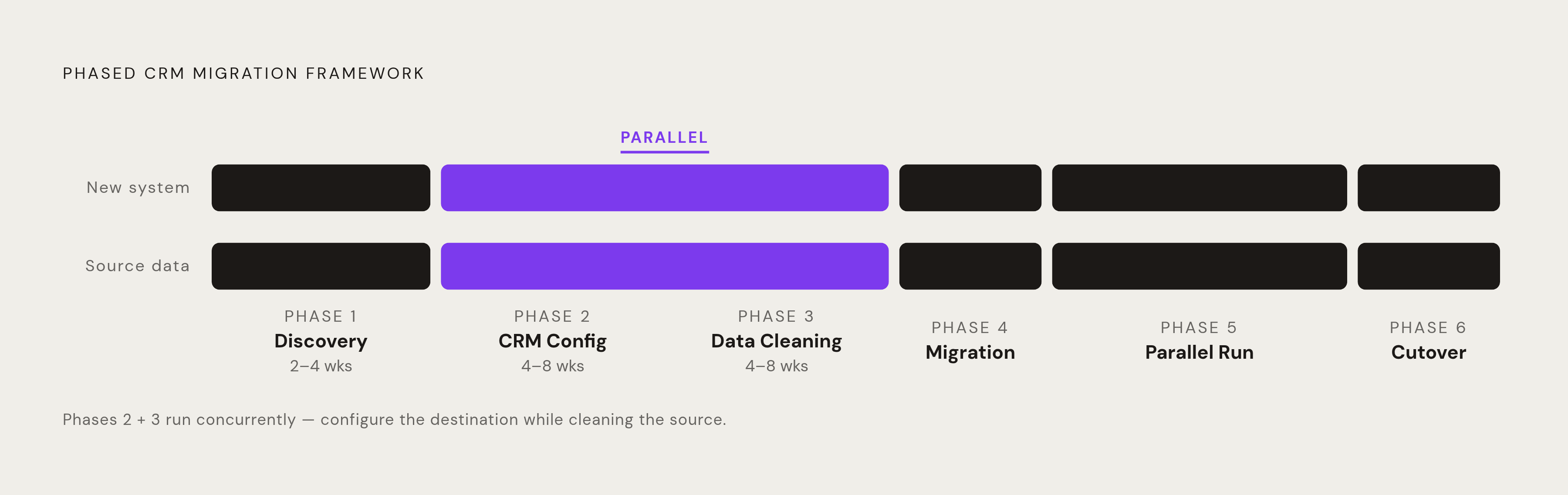
Phase one is discovery and scoping, typically two to four weeks, covering object counts, a field mapping specification, a full integration inventory, documentation of every existing automation, a data quality audit, and clear go/no-go criteria⟦c39⟧. Nearly everything the migration will ultimately cost gets discovered right here, which is exactly why rushing this phase is the single most common way budgets blow up later.
Phase two, destination CRM configuration, runs four to eight weeks and happens in parallel with phase three, cleaning the data still sitting in the source system⟦c40⟧⟦c41⟧. Phase four is the actual migration execution, phase five is a period of parallel running where both systems operate side by side to catch discrepancies before anyone fully commits, and phase six is cutover followed by a stabilization window⟦c42⟧⟦c43⟧⟦c44⟧. Timelines swing widely by scale: a small business with under ten thousand records can move through the whole process in two to four weeks, while an enterprise Salesforce migration involving complex custom code can stretch to roughly six months⟦c45⟧⟦c46⟧.
Not everything should move. The working rule is to migrate 60% to 70% of total records, archive 20% to 25%, and delete the remaining 10% to 15% outright⟦c47⟧. Carrying every historical record forward out of caution just imports the old system's clutter into the new one. Cleansing itself takes real time, too: a database with moderate quality issues typically needs three to four weeks of dedicated cleansing before migration even begins, and exact-match deduplication isn't sufficient on its own, since real-world duplicates tend to be fuzzy⟦c48⟧. Nearly every source on this topic states the same blunt rule: never migrate dirty data. Clean before the move, not after.
A solid pre-launch checklist reinforces the same discipline. Assign one dedicated migration owner, a RevOps lead or project manager, who holds the whole timeline in their head⟦c50⟧. Configure the new CRM environment completely before any data arrives, rather than building the house around furniture that's already moved in⟦c51⟧. Brief every user on the timeline, what's expected of them, and what their specific role is during the transition, well before cutover day⟦c52⟧. Skipping any of this is exactly how the earlier 18,000-duplicate-contact scenario happens ⟦c36⟧. And sequencing itself matters independent of everything else: Low/Code's data found phased rollouts are 2.8 times more likely to succeed than big-bang, flip-the-switch-overnight implementations⟦c53⟧. Scope and pacing decide outcomes here more than which platform gets chosen. Low/Code Agency's 2026 six-phase migration framework runs in sequence and parallel⟦c38⟧. A pre-launch checklist from thehigherpitch.com (2026) is provided⟦c49⟧.
Rebuilding adoption and process governance so the second implementation sticks
The organizations that actually succeed with CRM, and it's a minority, share one trait: they treat the project as a behavior change effort, not a software installation⟦c54⟧. Low/Code's research backs this up directly, finding that companies investing in structured change management are 3.5 times more likely to succeed than those that treat the rollout as a purely technical exercise⟦c55⟧.
The most dangerous window isn't launch week. It's months three through six after go-live, when the initial training has faded, the novelty has worn off, and old habits start creeping back in⟦c56⟧. Go-live is a starting line, not a finish line, and treating it as the finish is how the second implementation quietly turns into the third.
A handful of structural changes tend to separate a second attempt that sticks from one that repeats the first. Frontline users need a real hand in design and testing before go-live, not a finished system dropped on their desks. Champions need actual authority to escalate friction points, not a symbolic title. Executive sponsorship has to be visible in practice, not just claimed: leaders referencing CRM data in their own reviews, holding the organization accountable to it, using the system themselves⟦c57⟧. Adoption itself needs to be tracked as a real KPI through that critical three-to-six-month window, not assumed once the ribbon-cutting is over⟦c58⟧.
Process governance matters just as much, and it's where the surveillance trap tends to creep back in if nobody's watching for it⟦c59⟧. Success metrics need to be locked down before configuration starts, not backfilled to justify the spend after the fact. Required fields and stage gates should be built around how reps actually work the pipeline, not around what looks clean on a leadership dashboard. Regular CRM reviews should be scheduled on the calendar permanently, since the system needs to keep pace with how the business changes, not freeze in the shape it had on launch day⟦c60⟧. Data governance, validation rules, duplicate checks, ongoing maintenance, needs to start at launch as a standing discipline, not get scheduled as some future phase nobody circles back to.
The real test of whether any of this worked is simple to state and hard to fake: reps use the CRM because it helps them sell, not because they're required to log activity for a pipeline review⟦c61⟧.
Platform criteria for the second implementation
Selection criteria should come directly out of the audit, not out of a generic feature checklist copied from a vendor comparison chart. The platform that fixes one organization's failure mode won't necessarily fix another's, because the root causes differ even when the symptoms look identical from the outside.
If poor adoption was the dominant failure the first time, usability becomes the primary filter for everything that follows. The new platform has to reduce friction for the people actually entering data every day, not add more required fields and more clicks in the name of better reporting. Wave Connect's 2026 report found that 20% of organizations that switched platforms did so specifically because of poor usability in the tool they left behind⟦c62⟧, making usability a measurable, previously-proven failure point worth testing for directly during any evaluation, not an assumption to take on faith from a sales deck.
Sources
- CRM Implementation Failure Rate Explained 2026 | LOW/CODE
- The CRM Failure Rate is 55% in 2025 - Johnny Grow
- Why Do 70% of CRM Projects Fail? | People-Process-Technology Framework
- CRM Statistics 2026: 80+ Facts and Data | Wave Connect
- Why Your CRM Implementation Failed (And How to Get It Right This Time)
- CRM Data Migration in 2026: The Complete B2B Guide
- Why CRM Data Migration Is Still the Biggest Bottleneck in 2026
- 10 Proven CRM Migration Best Practices for 2026