Free CRM Tiers Worth Using vs. Loss Leaders
Zoho's free plan offers genuine automation and workflows without forcing an early upgrade.
Free CRM tiers exist because the math works out for the vendor, not because software companies suddenly discovered generosity. This piece breaks down which free CRM plans can give your small team real, lasting functionality and which ones are built to run out on you right when you're depending on them most. About 91% of companies with 10 or more employees run a CRM, but only around half of businesses under 10 employees do, according to research from wavecnct.com. That gap is not a coincidence: it's the exact seam every free tier is designed to work into.
How freemium became the default go-to-market strategy in CRM
The CRM market was valued at well over a hundred billion dollars in 2025 and is projected to reach several times that size by 2034. When a category grows like that, acquiring users cheaply becomes worth almost any short-term cost, and free tiers are the cheapest acquisition channel there is. So don't mistake a free CRM plan for charity. It's a funnel, and vendors have modeled the economics down to the decimal point.
You'll run into three basic structures out there. Some are forever-free plans with real, working core functionality, and several major platforms fall into that bucket to varying degrees. Others are freemium in the classic sense: the basics are free, but anything a real business actually needs sits behind a paywall. And then there are free trials dressed up as free plans, timers quietly ticking in the background of the marketing copy.
Here's the number that explains everything else in this article: freemium-to-paid conversion for CRM and sales tools sits around 4 to 6% per 2026 benchmarks. Vendors know, going in, that 94 to 96% of free users will never pay a cent. So the free tier has to do one of two jobs: turn into a referral engine, or manufacture upgrade pressure at exactly the right moment. Neither job requires the vendor to actually like you.
Several major CRMs are clean examples of this logic in action. Their free plans were not launched as a nice thing to do for small businesses; they were launched as a mechanism to get the right kind of customer in the door early and convert them as their needs (and their headcount) grew. That's not a criticism, exactly. It's just worth naming plainly, because it changes how you should read every feature limit that follows.
The criteria that separate a genuinely useful free tier from a loss leader
Everything below is the yardstick. Every platform section after this one gets measured against these seven criteria, so if you only read one part carefully, make it this one.
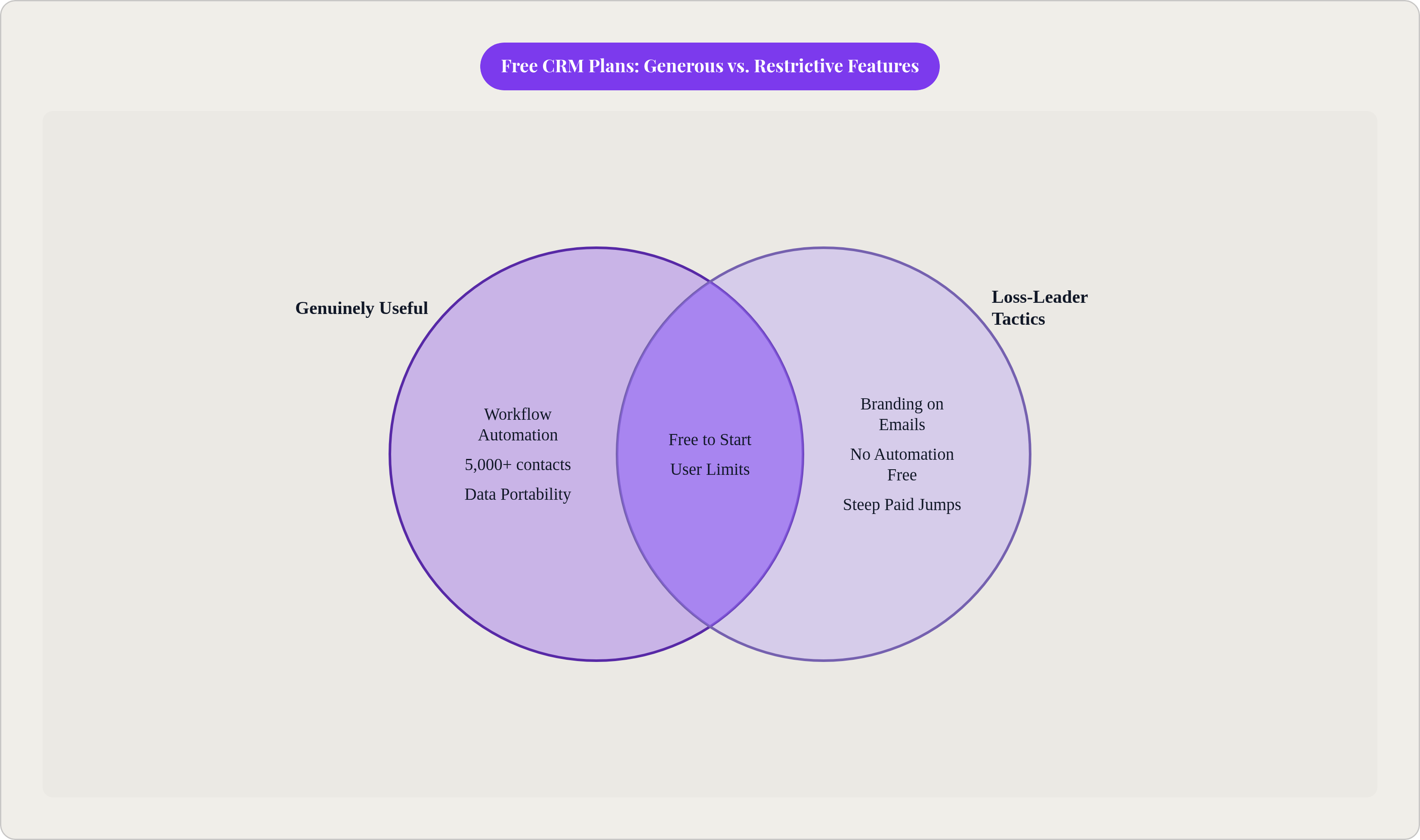
Contact and record limits that match small-team reality. A cap of 1,000 contacts sounds like plenty until you've run one decent outbound campaign; it fills up faster than founders expect. A cap of 5,000 gives you actual runway. And ask the follow-up question nobody asks: when you hit the ceiling, does the CRM just stop letting you add new contacts, or does it lock the data you already have?
Automation that isn't paywalled. Basic workflow automation, meaning follow-up tasks, deal-stage triggers, email reminders, is not a premium feature in 2026. It's table stakes. If a CRM makes you pay to automate a follow-up task, what you actually have is a contacts spreadsheet with a different label.
User limits that reflect how small teams actually operate. A 2-user cap can exclude your third co-founder, or the part-time salesperson you just brought on. Three users is workable. Unlimited users is the rare case where a vendor is being genuinely generous, and we'll get to the one platform that does this, along with its catch.
Data portability and account continuity. Can you export your contacts whenever you want, no strings? And what happens to your account, and your data, if you go quiet for a few weeks because business got busy? One vendor in this roundup deletes your account after 50 days of inactivity. We'll name it. It's a real problem sitting behind a genuinely appealing feature set.
Integrations that work without upgrading. Gmail, Outlook, basic calendar sync: these should be free everywhere, full stop. Gating them forces an upgrade before a team has even validated whether the tool works for them.
Branding restrictions. Vendor branding on your outbound emails, your chat widget, your forms; it's a soft cost, easy to overlook, and it matters more once you're actually emailing prospects instead of testing the platform internally.
Upgrade path transparency. A fair free plan leads somewhere predictable. A trap is a free plan where the first paid tier is a steep cliff, or bundles five features you don't need just to get the one you do.
Keep these seven in your back pocket. Every section from here forward is really just these criteria applied to a specific product.
One major CRM's free tier: the broadest starting point, but the limits have tightened sharply
Here's something a lot of older reviews and buying guides still get wrong: HubSpot cut its free contact limit down to 1,000 for new accounts in September 2024, and capped free users at two. If you're reading a comparison article written before that date, the numbers in it are likely stale. That's not a small tweak, either; it's a meaningful narrowing of what used to be one of the more generous free tiers on the market.
What's still genuinely good, though: contacts, deals, tickets, and basic pipeline management all work fine, and you get 30 landing pages, 30 website pages, and a basic blog thrown in. Gmail, Outlook, and Exchange integration work without needing to upgrade, which checks the integration criterion cleanly. HubSpot also gives free-tier users access to its App Marketplace, and that includes Slack, Stripe, QuickBooks Online, Xero, and Zoom at no cost. You also get 2,000 marketing emails a month, which is enough to run a real, if modest, outreach motion.
Now the part where the loss-leader mechanics show up. There's no workflow automation on the free plan, meaning (i) no automated follow-ups, (ii) no deal-stage triggers, and (iii) no behavior-based actions of any kind. Any of that requires the Starter plan, priced at $50 a month. You also get exactly one deal pipeline and 10 custom properties, which is limiting the moment you're tracking more than a single product line or sales motion. Every outbound touchpoint, meanwhile, carries the platform's own branding: emails, landing pages, meeting links, chat widgets, all of it. And the AI features this platform is actually known for, like data enrichment and its AI sales forecaster, sit entirely outside the free tier.
The pattern that plays out for most teams: you hit a wall somewhere around 6 to 12 months in, and suddenly you're staring down $50-plus a month for features you assumed, reasonably, were already included.
There is one structural point in this platform's favor worth calling out, though. It lets you upgrade only the specific hub you've outgrown, Marketing Hub or Sales Hub for instance, instead of forcing you into one giant all-in-one paid jump. That's fairer than how most competitors structure their upgrade path, and it's worth crediting even while flagging everything else.
Some are forever-free plans with real, working core functionality, and several major platforms fall into that bucket to varying degrees.
Zoho CRM's free plan: the most automation for the smallest team
Here's the differentiator that may actually surprise you: Zoho includes basic workflow automation on its free plan. Most competitors lock this behind a paid tier. Zoho doesn't. That single decision can change the calculus for your team.
The free plan covers up to three users and 5,000 records per module, which is five times the tightened free contact limit common among competing platforms. You get lead management, deal tracking, and yes, that workflow automation, plus mass email capability capped at 250 emails per day per organization. File storage sits at 1GB for the whole org.
Apply the criteria and the cracks show up fast, though. There's no social integration or analytics on the free tier, a real gap if you're tracking engagement across channels. That 1GB of storage can fill up quicker than you'd think once your team starts sharing documents or attaching proposals to deals. And 250 emails a day is fine for early-stage outreach, but it starts to pinch the moment you're running anything like a systematic nurture sequence.
Worth noting: Zoho's broader ecosystem includes more than 45 apps under Zoho One, covering invoicing, helpdesk, and email marketing. That means the CRM can talk to other parts of your business without bolting on third-party connectors, which is an underrated free-tier advantage that doesn't show up in most feature comparison charts.
Zoho was named a Visionary in the 2025 Gartner Magic Quadrant for sales force automation, and its paid plans start at $14 per user per month on the annual Standard tier. Against the upgrade-path-transparency criterion, that's about as clean and proportionate as this category gets.
Bitrix24's unlimited-user free plan: the feature set is real, but the gotchas are serious
Unlimited users. Every other platform in this roundup caps you at two or three; Bitrix24 just doesn't. For a team of five or more that wants to onboard the whole company before spending a dollar, that's a genuinely rare offer, and it's the headline reason Bitrix24 makes this list at all.
The free plan gives you unlimited contacts, leads, deals, and companies, plus a basic CRM pipeline, task management, 5GB of document storage, a built-in phone system, and email sync. No credit card required to start. You also get a choice between cloud and on-premise deployment, which is unusual at this price point and genuinely relevant if you're in healthcare, public sector, or finance and have to think about data residency.
The cost comparison here does a lot of the persuading on its own: 90 users on Bitrix24 runs $199 a month, versus roughly $2,250 a month on Salesforce at comparable scale. That free tier, in other words, isn't just free, it's setting a price anchor that makes the whole platform look cheap by comparison later.
But now the gotchas, and they're not small ones. If no user logs into the account for 50 days, Bitrix24 automatically deletes it, giving you exactly one week to contact support and try to restore it. For a system meant to be your single source of truth on customers and deals, that is a serious data continuity risk, and it fails Criterion 4 outright, no matter how generous the user limit looks. Ease of use scores 2.8 out of 5 in review data (3.6 overall), and setup complexity is real enough that teams over roughly 20 users typically need an implementation partner, which runs $1,000 to $5,000. Paid tier jumps are steep too: cross the 51st user and you're looking at a $100-a-month tier increase.
So, unlimited users, real feature set, and a 50-day countdown clock sitting quietly underneath all of it. Worth using. Worth watching.
Freshsales' free plan: AI lead scoring as a genuine differentiator, with a short runway
Freshsales includes AI-based contact scoring on its free tier, a feature most CRMs tend to reserve for paid plans running well above basic paid tiers per user per month. The scoring ranks leads by engagement signals, so your reps spend their limited hours on contacts most likely to actually convert instead of working a list alphabetically and hoping for the best.
Beyond that, the free plan supports three users and includes a built-in phone, chat, and email, plus 24/5 support, which is unusually generous access to a human at this price point.
Where it falls short: the contact cap sits at 1,000, the same ceiling seen on other tightened free plans in this category, and it can fill up fast once you're actively prospecting. There's also no workflow automation at all, not even the basic kind; no automated task creation, no email reminders nudging a rep to follow up.
And here's the tension worth sitting with for a second: AI lead scoring is most valuable precisely when you have volume, when there are enough leads that a rep genuinely can't eyeball which ones matter most. But the 1,000-contact cap can limit you right at the scale where that AI scoring would start paying for itself. It's a genuinely good feature, constrained by a plan too small to let it reach its potential.
How to read a free CRM plan before you commit
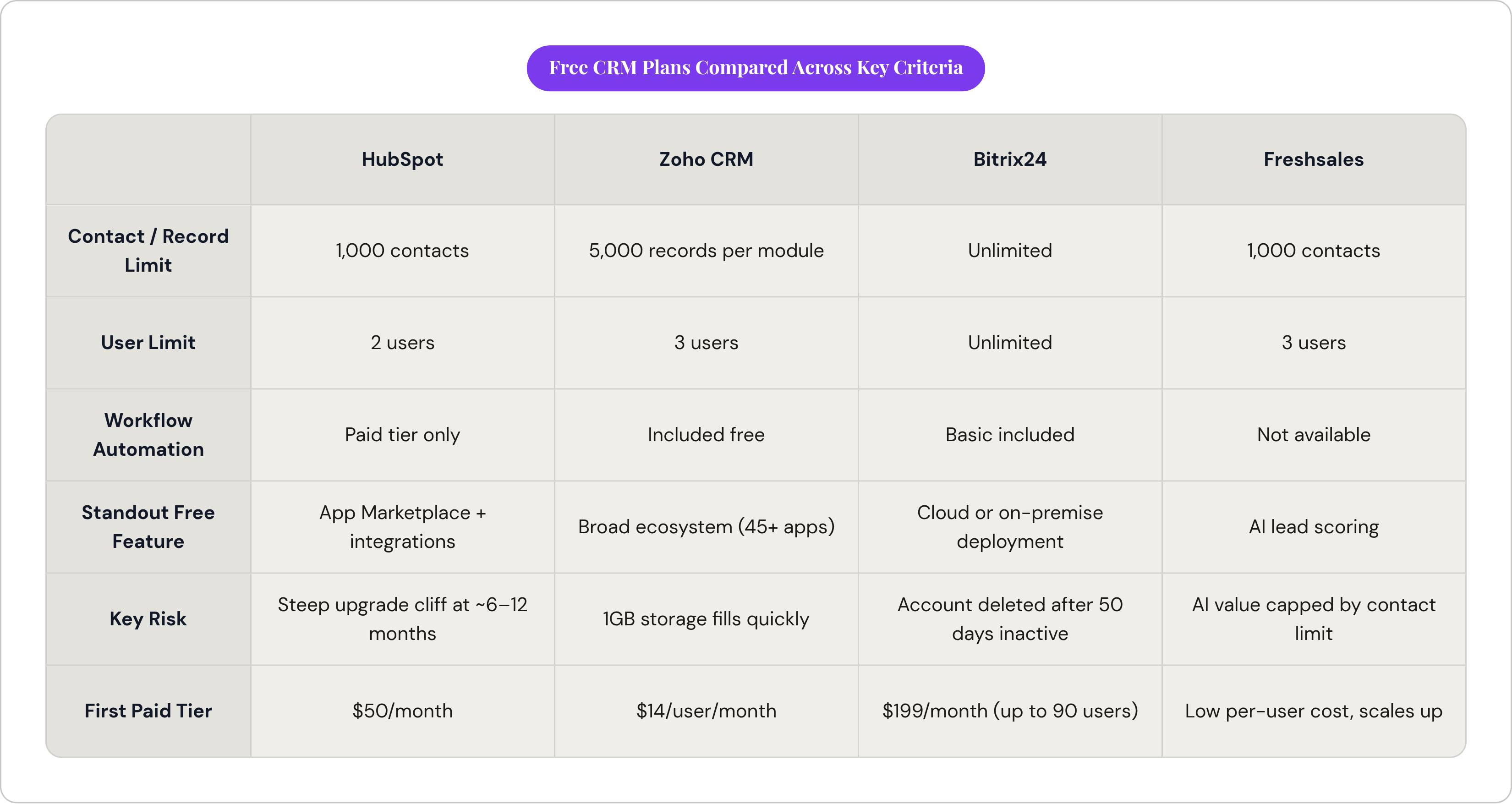
No platform here wins across all seven criteria. That's not a cop-out; it's the actual finding, and it's the one I kept circling back to while weighing these against each other. The right pick depends entirely on which constraint is going to bite you first.
A two-person team doing early-stage outreach with light automation needs can get real value out of a platform with strong integrations and landing pages, limits and all. A three-person team that needs automation and expects to blow past 1,000 contacts fairly quickly should look hardest at Zoho. A team of five or more that wants everyone in the system before committing budget will find Bitrix24's unlimited users genuinely compelling, provided someone owns the job of making sure nobody's account goes dark for 50 days. And a team that wants AI-driven lead prioritization from day one, and can live inside a 1,000-contact ceiling for now, has a real option in Freshsales.
Before you sign up for any of them, ask a short set of pointed questions. What happens to your data if you don't upgrade, or don't log in for a while? Which features vanish the moment you cross the free limit, and what does the first paid tier actually cost once you're there? Is basic automation included, or is this, once again, a contact spreadsheet with a nicer interface? And does the vendor's branding on your emails and forms change how you look to the customers you're trying to win?
It's worth noting this same evaluative trap shows up outside CRM too. Teams picking content or marketing tools run into the identical pattern: a platform that looks free at the entry point but gates the features that actually produce usable output behind a paid wall. The instinct to check functionality against real constraints, rather than trust the marketing page, applies just as well there as it does here.
The honest conclusion is this: a genuinely useful free CRM tier lets a small team run real work, meaning contacts, pipeline, automation, and the ability to take your data with you, without a forced upgrade inside the first year. Fewer plans clear that bar than the marketing suggests. But they exist, and now you know exactly what to check before you find out the hard way.
Sources
- https://www.zite.com/blog/free-crm-for-small-business
Provided the 5,000-contact figure used to illustrate what a genuinely useful free-tier record limit looks like.
- https://www.techrepublic.com/article/best-free-crm/
Supplied the Zoho CRM Standard tier starting price of $14 per user per month cited in the Zoho section.
- https://saascrmreview.com/bitrix24-crm-review/
Provided the cost comparison figures for Bitrix24 versus Salesforce at scale and the paid-tier price jump cited in the Bitrix24 section.
- https://www.g2.com/products/bitrix24/reviews
Supplied the ease-of-use and overall review scores for Bitrix24 cited in the Bitrix24 section.