CRM Onboarding and Implementation Timelines
Plan for disagreements, not just software features, when budgeting CRM rollout time.

CRM implementation timelines run anywhere from four weeks to over a year, and the biggest predictor of which end you land on has nothing to do with the software. It comes down to whether your team can agree on what "qualified lead" means before anyone touches a pipeline stage. This piece walks through the phases that eat time in a CRM rollout, scaled by company size, so you can build a timeline that survives contact with actual humans and their actual disagreements.
If your business is past a certain headcount, you've likely already lived through a CRM implementation, or you're about to. Despite that, a large share of these projects still run over time and over budget, which is a strange thing to say about a product category that's been mainstream since roughly the George W. Bush administration. The phases are well documented. The failure modes are, too. What's usually missing is the willingness to plan for them honestly instead of hopefully.
Ask your project team why the timeline slipped and most will point to the platform, the feature list, or how many demos the sales rep crammed into one call. The delays usually trace back to people who can't agree: who owns a lead once it's "qualified," whose definition of a closed deal wins when two departments disagree, who gets final say when two records contradict each other. Pick Salesforce or pick something scrappier, it won't matter if that stuff isn't settled. And the overruns that really hurt aren't the ones where someone guessed two weeks and it took four. They're the ones where an entire requirement never showed up in planning at all. Let's go phase by phase and see where the time actually goes.
How company size shapes the overall timeline before a single phase begins
Three rough bands cover most of what you'll run into. Small teams, meaning under twenty or so users in one department with minimal integrations, are looking at a few weeks to a couple of months. Mid-market teams, spanning multiple departments, several integrations, and a legacy system they're finally ready to leave behind, should plan on a few months, often creeping toward a full quarter. Large enterprises, with tangled org charts, dozens of stakeholders, and custom builds, commonly run six months to a year or more. A CRM consultant I talked to who works mostly mid-market clients put the upper end of a genuinely strategic enterprise project at close to a full year, which sounded excessive until she described what happens in the stakeholder meetings.
The real multiplier is the number of people who need to sign off before a single field gets built. A twenty-person company can settle a pipeline-stage argument over lunch, maybe even before the check arrives. A twenty-thousand-person company needs that same tiny decision to survive four departments, two regional VPs, and somebody in legal with strong feelings about data retention policy.
Enterprise CRM projects fail more often than small-business ones, and the software is rarely to blame. The politics and the org charts are usually the real drivers, the stuff that never shows up on a Gantt chart but absolutely decides whether the Gantt chart means anything. The phases themselves don't change shape by company size. What changes is how many people are standing in the room when each phase happens. Know your band walking in, and you can set your leadership's expectations before the timeline becomes a surprise to somebody with a calendar invite and an attitude.
What the discovery and requirements phase actually produces — and why it determines everything downstream
Discovery exists to surface every decision that would otherwise ambush the project mid-configuration. Done properly, it produces a short list of concrete artifacts: (i) agreed pipeline stages and deal definitions across every team touching the system, (ii) an honest data audit covering what exists and how messy it really is, (iii) a map of which integrations are needed on day one versus month six, (iv) a role and permission design, and (v) a written definition of what "success at go-live" actually looks like.
That last item gets skipped constantly. It's also the one that saves you the most pain later.
The most common discovery failure is treating it like a form to fill out rather than a room full of people who need to actually agree on something. Leave a pipeline-stage disagreement unresolved here and it doesn't vanish; it comes back during configuration and testing, except now it costs more to fix and everyone involved is crankier about it. If you're a small team, you can often compress discovery into a week or two. Mid-market teams should plan on two to four weeks. Enterprise discovery often turns into its own sprawling, multi-workstream project, which sounds excessive until you weigh it against what it prevents.
Here's a pattern worth internalizing: the more of your total effort you front-load into planning and data prep, the faster everything after that moves. It holds often enough across implementations that I've started treating it as close to a rule rather than a hunch.
Data migration: the phase that takes longer than teams budget for
Nearly every team walks into migration convinced their data is cleaner than it actually is. Then someone opens the export file.
Migration breaks into sequential steps, and none of them compress well no matter how tight the deadline gets: (i) cleansing, killing duplicates, standardizing fields, patching gaps; (ii) field mapping, lining up the old data structure against the new schema; (iii) a test migration, moving a subset over to catch failures before you commit the whole dataset; (iv) the full migration; and (v) reconciliation, confirming record counts and relationships actually survived the trip.
For a mid-size company, cleansing alone can eat several weeks on its own; the full migration process, testing included, often runs multiple months. Skip cleansing and you're importing bad data into a shiny new system, arguably worse than leaving it in the old one, where at least your team already knew not to trust it. Users who stumble onto obviously wrong records stop trusting the CRM fast, and once trust is gone, usage goes with it. Manual data entry consistently ranks near the top of the reasons people avoid their CRM, according to adoption surveys across the industry. So migrating data in a way that minimizes the manual cleanup users face later is directly tied to whether anyone's still using the thing six months out.
One planning question resolves more migration headaches than everything else combined: who owns the call when two records disagree? Settle that during discovery. Settle it mid-migration instead, and you'll stall the whole phase on judgment calls nobody wants to make alone.
Ask your project team why the timeline slipped and most will point to the platform, the feature list, or how many demos the sales rep crammed into one call.
System configuration and integration: where scope creep quietly extends the project
Configuration covers pipeline structure, automation workflows, custom fields, reporting dashboards, calendar and email hookups, and permissions. It's the part that feels most like actually building something, which also makes it the part most prone to quietly outgrowing its own plan.
Integrations with outside systems, your ERP, marketing automation, accounting software, support desk, are where the weird edge cases live. Every integration you bolt on expands your testing surface, and a project juggling several of them can end up spending a lopsided chunk of its total timeline just on integration QA. This is also where scope creep sneaks in through the side door: stakeholders who sat out discovery finally see the configured system and, right on schedule, start adding requirements. Nobody's being difficult on purpose. They're seeing it for the first time and having thoughts, the way anyone would.
The fix is a formal change-control step: any new requirement raised after configuration begins gets assessed for timeline and budget impact before anyone says yes. It sounds bureaucratic. It's also the only thing standing between you and a launch date that keeps sliding to the right, week after week.
Platform choice matters here too. Some platforms configure fast for teams staying inside their native feature set, and then complexity climbs sharply the second requirements push past that boundary. Others offer deeper configurability but demand more technical firepower to implement, and the cost gap between options for a mid-size company can be substantial, not a rounding error. If your team also runs a separate content or campaign platform, that's another integration point worth scoping explicitly now rather than discovering it during week six. Small teams typically wrap basic configuration in one to two weeks; mid-market builds with several integrations usually run three to four weeks before testing even starts.
Testing: the phase teams cut short and regret at go-live
Testing runs on two tracks, and both need real time, not a rushed afternoon the day before launch. Technical testing checks whether automations fire correctly, integrations pass data cleanly, and permissions behave the way they were designed to behave. User acceptance testing, UAT, checks something less mechanical: do actual users doing actual jobs find the system intuitive, and do they trust the data in it?
UAT is where teams discover that whatever looked perfectly sensible during configuration doesn't match how salespeople or marketers actually spend their day. Better to find that gap now than after go-live. And yet teams skip past it constantly. The most common shortcut is letting the project team run UAT instead of the people who'll actually live in the tool, which guarantees the real friction doesn't surface until customers, or worse, quarterly numbers, are riding on it.
Finding bugs during testing is the entire point of the phase. You want to catch these in a sandbox, not in production in front of your VP of Sales, who does not find field errors charming. If you're a small team, two weeks for testing is a reasonable budget. If you're mid-market, plan on two to three weeks including UAT rounds. Enterprise runs longer, especially once integrations get tangled. The output here should be a documented go/no-go checklist, signed off by the project sponsor, before anyone gets near the launch button.
Training and change management: the gap between going live and actually being used
Most CRM failures trace back to people, not code: thin training, missing executive buy-in, adoption that never took hold. The research on this holds up consistently across different studies. Average adoption across sales organizations stays stubbornly low even at companies that technically shipped their CRM without a hitch, which tells you something worth sitting with: launching the system and getting people to use it are two separate projects wearing the same name.
Training isn't an event you bolt onto go-live day. It's a phase with its own shape. Role-based sessions matter, because sales reps, managers, marketing, and admins need genuinely different training, not the same slide deck read aloud four times. Just-in-time reinforcement, short follow-ups in the first two to four weeks post-launch, catches the real questions that don't surface until people are actually using the tool for real work. And documentation needs to live where people already are, not three folders deep in a shared drive nobody opens after week one.
Executive sponsorship acts as a multiplier, in either direction. Leadership visibly using the CRM, referencing its numbers in review meetings, that drags adoption upward. Leadership ignoring it teaches everyone, instantly, that the tool is optional, and optional tools get left in a drawer. Since manual data entry is such a reliable adoption killer, training that shows people how automation trims their own busywork hits the exact friction point most likely to sink the whole effort. Change management budget gets left out of initial cost estimates all the time, and it's often the reason a technically clean launch turns into a practical failure six months down the line. Even a fast, well-run SMB implementation can hit strong adoption quickly, but only when training gets treated as its own phase with its own calendar, not a half-day session squeezed in the morning of go-live.
Go-live and the post-launch window most plans underestimate
Go-live isn't the finish line. It's the starting gun on the adoption curve, and the first four to eight weeks after launch decide whether early problems get caught and fixed or quietly harden into permanent bad habits.
Post-launch monitoring should track a short list of specific things: (i) login frequency and which modules are getting used versus ignored, (ii) whether records are being filled in properly or whether your users are inventing workarounds, and (iii) whether connected systems are still passing data cleanly or throwing edge cases nobody saw coming. A hypercare period, typically two to four weeks of elevated support availability, meaningfully cuts the odds that early frustration curdles into quiet abandonment.
Budget explicitly for a configuration refinement cycle in month one, because real-world use always turns up requirements UAT never caught, no matter how careful that UAT was. A meaningful share of CRM implementations that launch cleanly still fail within a couple years, and the common thread is usually that the post-launch optimization habit never formed. Teams treat go-live as the finish line instead of the starting point of an ongoing project. The success metrics agreed on back in discovery are what give this monitoring phase actual teeth. Skip those benchmarks and you have no honest way of knowing whether the implementation is working, or whether everyone's just being polite about it in the Monday standup.
A realistic timeline summary by company size, and where to protect your schedule
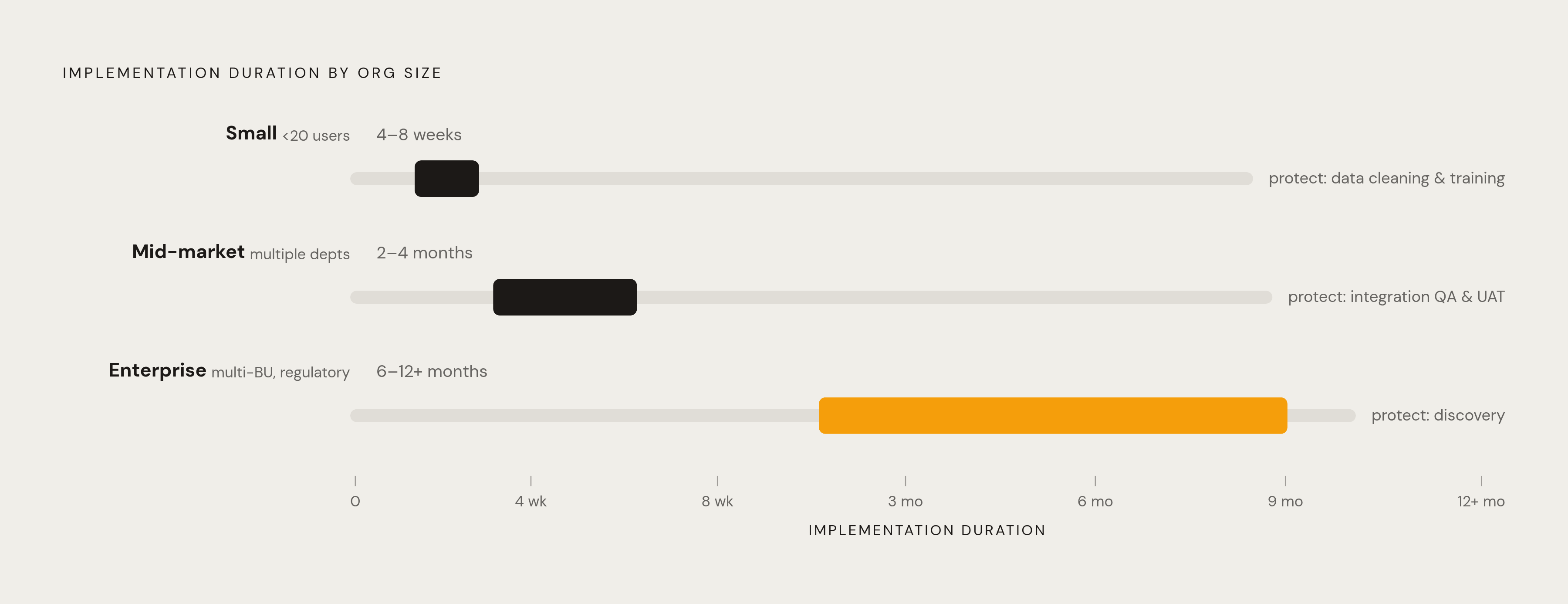
Small teams, under twenty or so users in one department with minimal integrations, can generally expect four to eight weeks start to finish. Protect data cleaning and training here specifically; they're the two corners you're most likely to cut first in the name of speed, and both feed adoption directly. There's a documented case of an SMB launching in under thirty days, but it took unusually clean data and dedicated internal staff time most teams simply don't have sitting around. Treat that as the ceiling, not the expectation.
If you're mid-market, spanning multiple departments, several integrations, and legacy data to migrate, plan on two to four months, often sliding toward four when integrations get complicated or the data's a mess. Protect integration QA and UAT here specifically; they're the two phases most likely to surface the surprises that push your go-live to the right. A real change-control process on scope isn't optional at this size. Stakeholders piling on requirements mid-project is the single biggest reason mid-market implementations end up in the overrun column.
If you're running a large enterprise, with multiple business units, heavy customization, and regulatory requirements stacked on top, you can expect six months to a year or more. That consultant's estimate of roughly a year for a genuinely strategic project at this scale isn't pessimism, it's just what the track record shows across enough of these to trust the pattern. Protect discovery above everything else. More stakeholders in the room means discovery genuinely needs more time, and shortchanging it multiplies cost at every phase that follows it. Build in explicit budget contingency too, since cost overruns show up more often at larger organizations, and hoping for a clean run isn't a plan so much as a wish.
Across every size band, the same idea holds: time you invest in planning can pay itself back several times over during execution. If you squeeze the planning phase to hit an earlier launch date, you'll often end up with a slower, messier rollout than the one you were trying to dodge in the first place.
Sources
- https://www.mercuriusit.com/crm-implementation-timeline-how-long-it-takes-common-blockers-to-avoid/
Covers common blockers and failure modes in CRM rollouts, including organizational and political factors that the article discusses as the real drivers of timeline slippage.
- https://getcoherence.io/blog/crm-implementation-timeline
Provided the phase-by-phase breakdown of CRM implementation timelines that the article walks through.