Must-Have CRM Integrations for B2B Marketing Stacks
Your CRM just became the operational center everything else connects to.

This piece maps the CRM integrations that actually make a B2B revenue team function, and the argument is simple: your CRM has stopped being a filing cabinet for contacts and become the operational hub that every other tool has to answer to. The Digital Bloom's 2025 data shows marketing automation platform centrality dropping from 30.7% to 26%, and the tempting read is that MAPs are losing relevance. The more accurate read is that MAP functionality is getting swallowed into the CRM layer or replaced by composable tools that plug directly in, which means the CRM is gaining gravity, not the other way around. Get this wrong and you end up with the two oldest problems in B2B revenue: marketing and sales arguing over whose spreadsheet is real, and nobody able to say which campaign actually made money. So this piece maps the integration categories that matter, in the order they matter, and what each one is supposed to unlock when it's wired up correctly.
Worth sitting with for a second: Salesforce's research found that only a small slice of B2B marketers can confidently attribute revenue back to the channels that generated it. That gap traces back to plumbing rather than tooling. Signal gets generated in one system and dies before it reaches the CRM. Ricoh Europe's research adds the human cost: teams lose a meaningful chunk of the work week just chasing data across systems that don't talk to each other, which is a polite way of saying people spend Tuesday afternoons exporting CSVs instead of doing their jobs. This is an integration problem wearing a data problem's clothes.
How to think about integration quality before picking any specific tool
Integrations exist on a spectrum, and treating "we're connected" as a finish line is how most of this goes sideways. A one-way data push, where a tool dumps information into the CRM on some schedule and never asks for anything back, sits at the weak end. Real-time, bi-directional sync sits at the strong end, where information flows both ways and updates propagate close to instantly. In between you've got native integrations built by the vendor, middleware platforms that stitch two systems together, and no-code connectors that RevOps teams assemble themselves. Each comes with its own tradeoffs in latency, who has to maintain it when an API changes, and how faithfully the data survives the trip.
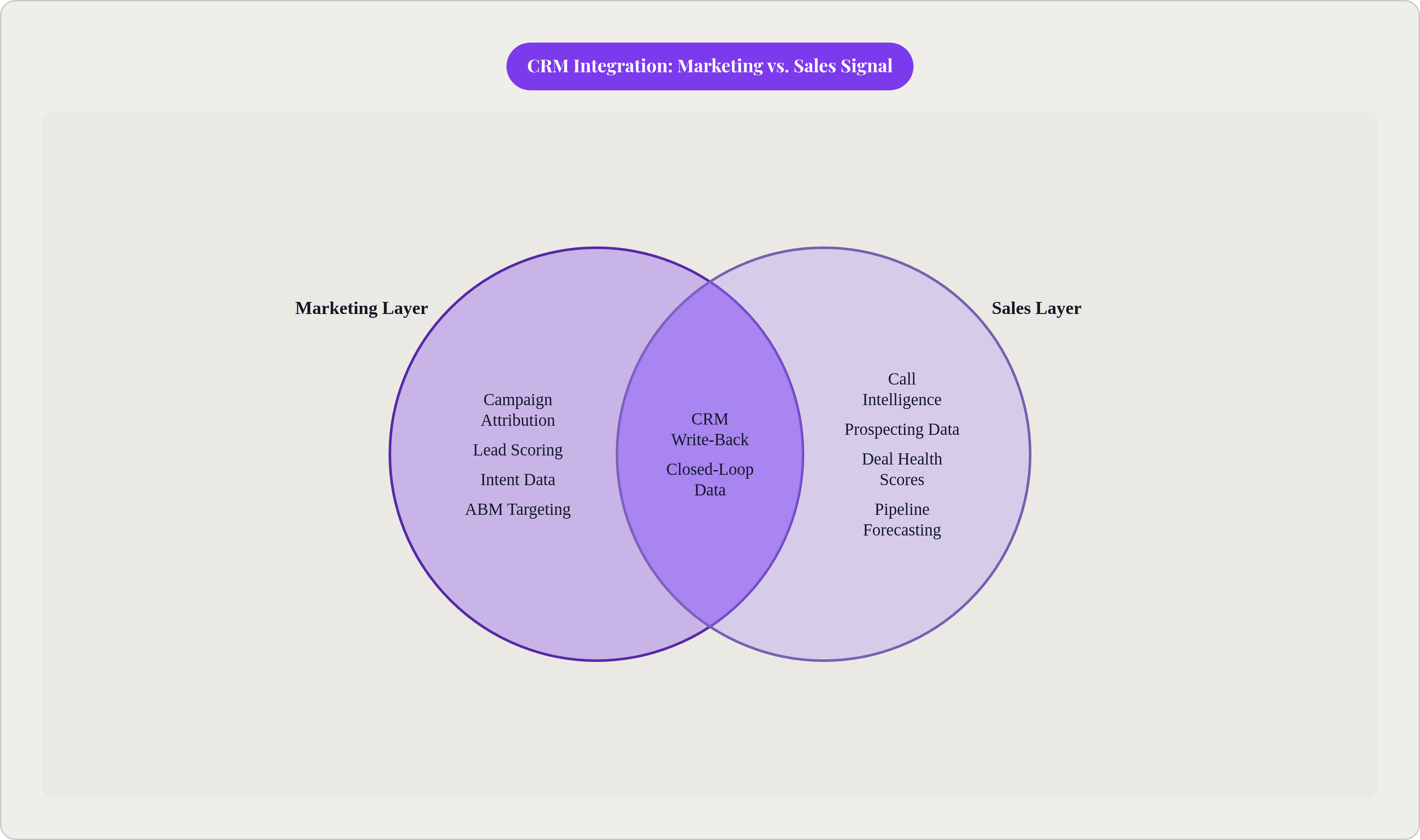
Here's the harder question, though: what does a genuinely well-integrated stack actually require? Three things, and they're not optional extras. First, shared definitions. If marketing's version of a "qualified lead" and sales' version live in separate glossaries, no amount of syncing fixes the argument that follows. Second, write-back capability. A marketing signal that sits in a dashboard nobody in sales opens might as well not exist; it has to land on the CRM record itself. Third, closed-loop data, meaning deal outcomes from sales flow back upstream so marketing can see what actually turned into revenue, not just what generated a form fill.
A useful "center-out" test for evaluating any integration you're considering: what does this tool add to the CRM record, and what does it receive back? A tool that only exports data and never receives anything is a weak link dressed up as a strength, something that looks connected on paper while behaving like a one-way mirror in practice. Every section that follows applies this same test to a different category, so keep it in your back pocket.
Marketing automation platforms: the most foundational CRM integration
This comes first because it's the integration that makes lead data mean anything at all. Engagement history, lead scores, campaign responses: none of it matters if a sales rep can't see it inside the CRM in real time, mid-call, without opening a second tab and praying the sync ran last night.
Done properly, bi-directional MAP-CRM sync gives marketing something better than an MQL count: it gives them campaign performance tied to pipeline that actually closed. Sales gets full engagement history on every contact without leaving their workflow, which sounds small until you've watched a rep discover mid-call that the prospect downloaded three pricing guides last week and nobody told them. And closed-won data flowing back into marketing closes the loop that lets a team say, with a straight face, which campaigns fed real revenue rather than just filled a funnel report.
Marketing automation is close to standard equipment at this point, according to Marketing Automation Institute's 2024 numbers on enterprise adoption. So the real question isn't whether you have a MAP, it's whether it's wired in well. Demand Gen Report's 2024 data adds a complication worth flagging: a notable share of enterprise marketing teams run more than one MAP at once, often as a legacy of an acquisition or of a regional team that never migrated off its old tool. That's not just double the maintenance; it's double the chance of two conflicting records fighting for the same CRM field.
On the platform side, the tradeoffs are fairly distinct. Some platforms bake CRM and MAP into one system, which sidesteps the integration question entirely, since there's no gap to bridge if the record was never split in the first place. Adobe Marketo Engage brings serious enterprise lead scoring and ABM depth, and its Salesforce integration is mature, though it rewards teams willing to do careful field mapping rather than accept the defaults. ActiveCampaign fits mid-market teams that want real journey automation without enterprise-platform overhead. Salesforce Marketing Cloud, being native to Salesforce, has the highest ceiling for customization, and correspondingly the highest implementation lift; nobody stands this up in an afternoon.
Speaking of timelines: Starr Conspiracy's 2025 research pegs full enterprise MAP deployments in months, not weeks, once you count data migration, workflow build-out, and training. Anyone promising a two-week rollout is either lying or hasn't met your data. And given the centrality numbers from the opening, it's worth an honest internal audit: are you paying for a standalone MAP that's quietly duplicating something your CRM already does natively?
ABM platforms: turning account intelligence into shared sales and marketing signal
ABM integration asks a different question than MAP integration does. MAP is about what one contact did; ABM is about what an entire buying committee is doing, which stage they're collectively in, and which accounts are actually in-market right now versus just browsing. That's a richer, messier signal, and if it never leaves the ABM platform, sales never sees it and it might as well not exist.
LinkedIn Ads shows up as the anchor here, integrated into 37.5% of B2B martech stacks per The Digital Bloom's 2025 data, well ahead of any other social advertising channel. Makes sense: it's the one place you can reach a buying committee by role and company with any precision.
Gartner's 2025 Magic Quadrant for ABM Platforms named 6sense, Demandbase, and ZoomInfo as Leaders, and each earns that spot for a different reason. 6sense scored highest on ability to execute; its intent model runs on a large proprietary data network plus Bombora's cooperative feed, producing buying-stage scores that push into CRM records and can trigger sales outreach automatically. Demandbase led on completeness of vision, with reporting embedded directly inside Salesforce, so a rep never has to leave the CRM to see account intelligence; it's a strong fit for teams running heavy media programs who want a B2B DSP, programmatic buying, and web personalization under one vendor. ZoomInfo took the Customers' Choice distinction, which tracks with its pitch: enrichment, intent, and ABM activation from a single relationship instead of three separate contracts.
For teams that find Demandbase or 6sense out of budget range, RollWorks is worth a look; it's widely regarded as meaningfully cheaper at comparable scale and holds its own on digital advertising and audience management.
Enterprise teams often do better stitching a few specialists together than betting everything on one platform. A workable architecture looks something like: 6sense or Demandbase running targeting and scoring at the top, ZoomInfo or Clearbit keeping the underlying account data clean, and something like Factors.ai closing the loop on attribution at the bottom. The CRM test still applies here, unchanged: account-level intent scores and buying-stage classifications need to land on the CRM account record automatically. If a rep has to log into a separate ABM dashboard to find out an account is in-market, the integration is failing at the one job it exists to do.
Data enrichment: keeping CRM records accurate enough to act on
Your CRM data doesn't sit still, it rots. Cognism's research puts B2B contact data decay at 22.5% a year, and the decay is worse at exactly the seniority levels marketing and sales care most about: CMO-level records decay at 35% annually, CEO-level at 26%. So the people your ABM program is most excited to reach are the ones most likely to have changed jobs since the last time anyone checked. A CRM without continuous enrichment is actively getting worse over time, and every scoring model and segmentation rule built on top of it degrades right along with the underlying data.
Four kinds of enrichment matter here, and they're doing different jobs. Contact enrichment covers verified emails, direct dials, titles, employment history. Firmographic enrichment covers company size, revenue, industry, and where a company sits in its corporate hierarchy. Technographic enrichment tells you what software an account already runs, which matters enormously for positioning and for filtering who even fits your ideal customer profile. Intent data tells you who's actively researching, which is where enrichment starts talking to the ABM layer from the section before.
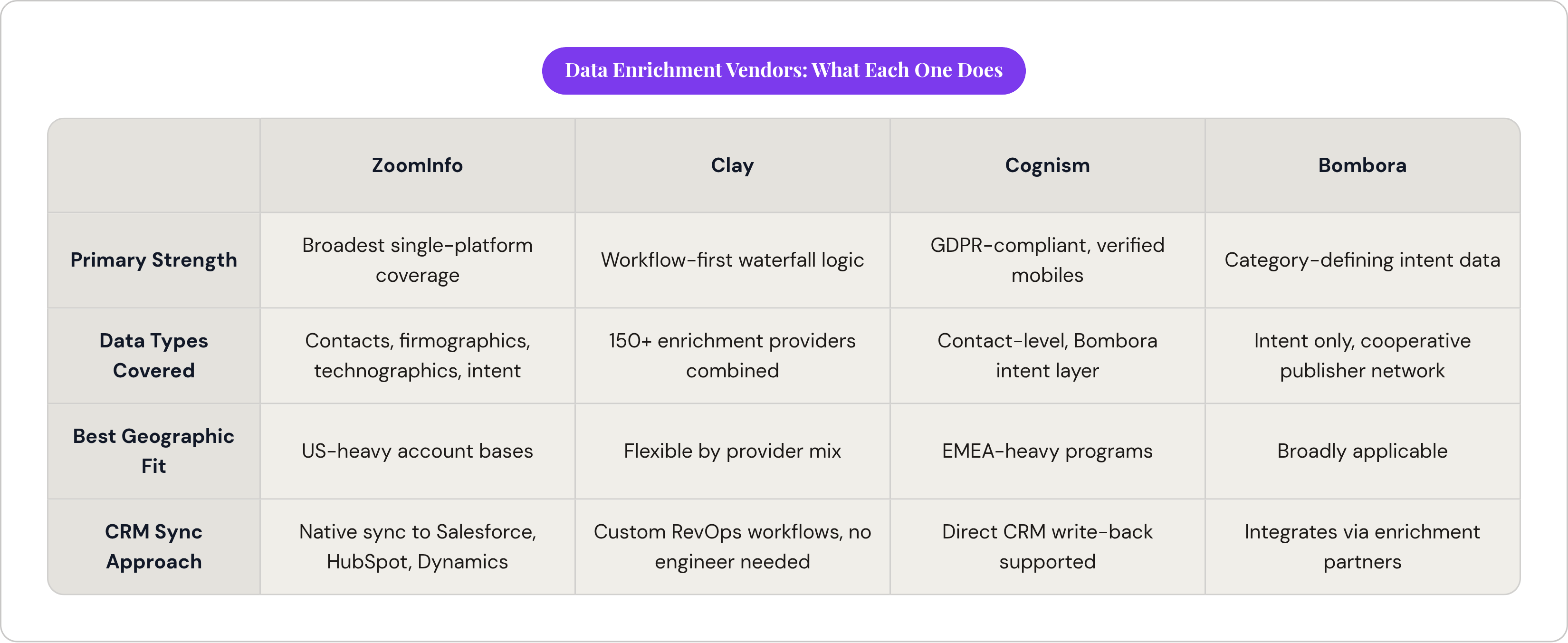
The vendor landscape splits along fairly clear lines. ZoomInfo offers the broadest single-platform coverage: contacts, firmographics, technographics, and intent together, with native sync into Salesforce, Dynamics, and other major CRM platforms that doesn't require anyone to manually export a CSV; SBL.so's 2026 analysis flags it as strongest for US-heavy account bases specifically. Clay takes a different approach entirely, a workflow-first model that runs waterfall logic across more than 150 enrichment providers, querying them in sequence until a field actually gets filled, which lets RevOps build custom enrichment logic without needing an engineer on call; its pricing is tiered and public, so the cost-per-record math is transparent rather than something you find out at renewal. Cognism focuses on GDPR compliance and human-verified mobile numbers, making it the preferred pick for EMEA-heavy programs per that same SBL.so analysis, and it partners with Bombora for intent layering on top. And Bombora itself is close to the category-defining name in intent data; Forrester's Q1 2025 Wave called it the standard-bearer, built on a cooperative publisher network that no single competitor has managed to replicate.
Salesmotion's 2026 analysis suggests most B2B teams need at least two enrichment tiers running simultaneously: something contact-level like Apollo, Lusha, or Cognism, and something platform-level like ZoomInfo or Clearbit. One without the other leaves a gap. And the standard for the CRM connection is the same one from every section so far: enrichment should write directly to your CRM fields on a set schedule, not require someone on your team to remember to run an import job every other Friday.
LinkedIn Sales Navigator: closing the gap between prospecting and the CRM record
Here's a scene that plays out constantly: a rep spends twenty minutes in Sales Navigator, finds out the prospect just changed jobs, notices a mutual connection worth mentioning, and then closes the tab. None of that intelligence ever touches the CRM. The next person who opens that account record has no idea any of it happened, which means the CRM's version of the account is already stale the moment it's saved.
Given that LinkedIn Ads already sits inside 37.5% of B2B stacks as an ABM channel, per that same Digital Bloom 2025 figure, Sales Navigator is really just extending an investment that's already been made, pushing it down from the account level to the individual relationship level. Done right, the integration surfaces real-time buyer signals, like job changes or company news or content engagement, right inside the CRM record, no extra login required. It maps mutual connections onto the account itself. And it logs activity automatically: InMails sent, connection requests, profile views, all captured without a rep having to remember to type it into a notes field at 6pm on a Friday.
Integration maturity differs by CRM, and it's worth knowing which lane your team is in before you commit. Salesforce pairs with Sales Navigator most maturely of the three, with real-time sync and LinkedIn profiles embedded right on contact and account records. Some mid-market CRM platforms offer solid integrations, syncing contact and company records both ways and covering the core activity logging workflow. Microsoft Dynamics benefits from LinkedIn and Microsoft being under the same corporate roof, which tends to produce a tighter native connection for teams already living in that ecosystem.
The line that separates a real integration from a nice-looking demo is write-back. If LinkedIn signals and activity don't feed CRM fields that actually inform lead scoring and attribution, you've got an embedded profile picture and not much else.
Revenue intelligence and conversation data: the signal most CRMs are missing
Every CRM can tell you a deal moved from "Proposal" to "Negotiation" last Tuesday. None of them, on their own, can tell you why the prospect suddenly went quiet, which competitor got name-dropped on the call, or which objection killed the momentum. That's sequence without substance, and it's exactly the gap revenue intelligence platforms exist to fill.
These tools record and analyze calls and meetings, flagging talk-time ratios, competitor mentions, and risk signals that suggest a deal is quietly dying. They give sales managers a way to coach without sitting through every call live. And they produce deal health scores based on what was actually said, not just how many CRM activities got logged that week, which is a much better proxy since anyone can log an activity for a five-minute call that went nowhere.
Gong and Chorus, the latter now under the ZoomInfo umbrella, are the names you'll run into most often in this category; Clari layers pipeline forecasting on top of the same conversation data, which is useful if forecast accuracy is the bigger pain point than coaching. The integration requirement here follows the pattern set by every section above: call summaries, action items, and deal risk flags need to write back to the CRM opportunity record automatically. Leave that data sitting in the revenue intelligence platform alone, and marketing never finds out what's actually closing deals or why.
And that's the part marketing tends to undervalue. When conversation data actually reaches the CRM, your marketing team can start correlating specific content, a case study, a comparison page, a pricing one-pager, with deals that closed. Which assets showed up in won deals? What messaging kept surfacing in late-stage calls? That's the loop that can turn content production from a volume game into something aimed at a real target, feeding deal intelligence straight back into content briefs and campaign messaging instead of guessing at what resonates.
Analytics and attribution: connecting CRM pipeline data to marketing investment
Back to where this piece started: only a small share of B2B marketers can confidently trace revenue back to the channel that generated it, per Salesforce's research. The reason is a familiar one by now: attribution software exists in most stacks already, but the CRM sitting underneath it never received clean signal from any of the five categories covered above.
Good attribution is downstream of everything else in this piece, not a category unto itself. It needs MAP write-back, so campaign source and full engagement history land on every contact record. It needs ABM write-back, so you know the account's intent stage at the actual moment marketing touched it, not some stale snapshot from a month prior. It needs enrichment accuracy, because segmentation and cohort analysis built on wrong firmographic data just produces wrong conclusions with more confidence behind them. And it needs conversation intelligence write-back, tying deal outcomes to the actual messaging and content that shaped them.
Which brings the argument full circle. Attribution serves as the report card for how well every other integration in this piece was actually built, more than a tool you simply buy at the end of the process. Get the MAP sync, the ABM write-back, the enrichment schedule, and the conversation data flowing cleanly into the CRM, and attribution stops being a quarterly guessing exercise and starts being math. Skip any one of them, and you're back to arguing in the pipeline review about whose numbers are real, which is, after all, where this whole piece started.