Account Based Marketing Lead Generation in CRM
Rebuild your CRM around accounts, not contacts, to catch buying signals earlier.
By the time a buyer contacts a vendor, most of the decision has already happened without you. Shortlists are built. Requirements are defined. Preferences have formed through anonymous research on G2, industry forums, and syndication networks. In many competitive deals, the winner was already favored before a single sales call occurred. That pattern should fundamentally reframe how CRM is architected, because most CRM systems are designed to capture the last chapter of a story that started without you.
Traditional CRM tracks the visible layer: form fills, email opens, demo requests. It is built around the moment a prospect raises their hand. But the decisive moments happen before any form is submitted. If your system only logs post-identification behavior, you are not managing a pipeline; you are documenting outcomes that were largely predetermined upstream.
Then there is the unit of measurement problem, which is quieter but more damaging. Most CRMs track contact behavior. A contact from IT opens a whitepaper. A contact from Finance attends a webinar. Logged separately, they look like two moderately engaged individuals. Aggregated at the account level, they are a warm buying committee showing multi-stakeholder movement. A CRM that cannot make that distinction is not just incomplete; it turns a meaningful signal into noise by distributing it across individual records that no one is trained to read together.
Intent data providers like Bombora and 6sense have reported that in-market accounts represent approximately 5% of a target market at any given time, though methodologies vary across providers. The directional implication is that most of an addressable market is not ready at any given moment. Volume-based outreach aimed at everyone is structurally wasteful. What CRM needs to track instead is anonymous intent before a form appears, engagement aggregated at the account level across multiple stakeholders, and timing indicators that suggest when an account is entering an active cycle. The data model itself has to be rebuilt before any workflow improvement matters.
Building the Target Account List Inside CRM Rather Than Alongside It
Most teams build their target account list outside the CRM. A spreadsheet. A vendor export. A back-and-forth between sales ops and marketing that lives in a shared drive somewhere. Then it gets imported, and that import is where the list starts dying.
A static import has no memory. It does not update when an account's intent score rises. It does not reflect the conversation the AE had last Tuesday. It does not flag when a key contact switches jobs, which is often the exact moment an account re-enters buying mode. A living target account list has to exist as a structured CRM object, not a CSV someone re-uploads quarterly.
Every account record needs a firmographic fit score, tier assignment, intent score, prior opportunity history, assigned account executive, and current engagement status. These are not enrichment fields you get to when you have time. They are the operational foundation for every workflow downstream.
Before any of that, the ICP has to be defined and genuinely agreed upon by both sales and marketing. ABM programs can fail when sales and marketing operate from different definitions of what a good account looks like, and the misalignment goes undetected until the list is already built and campaigns are running. When tier assignments feel arbitrary, sales does not trust the list. When sales does not trust the list, they ignore the workflows built on top of it. The whole thing collapses from the inside.
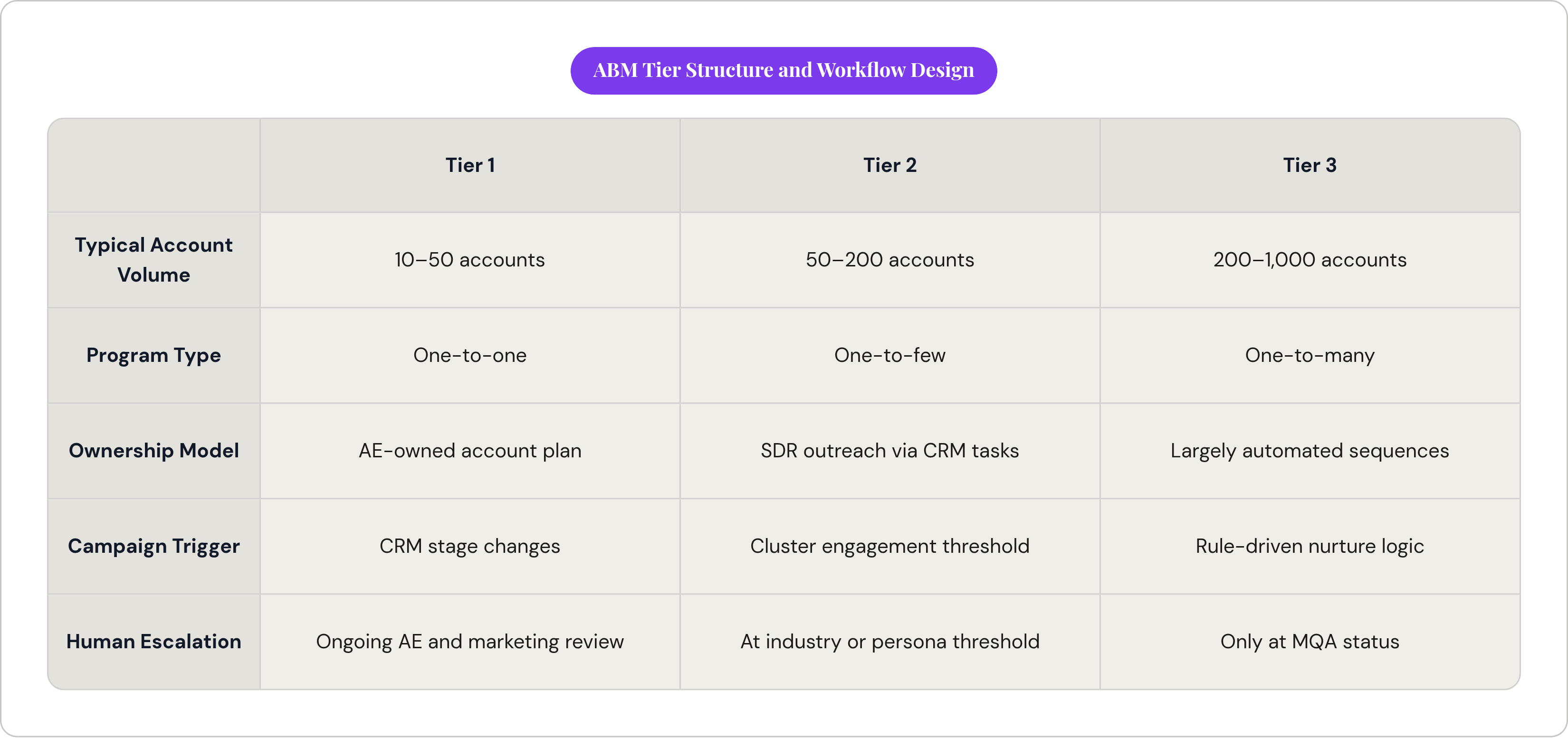
Scale matters to workflow design. Rough benchmarks: ten to fifty accounts for one-to-one programs, fifty to two hundred for one-to-few, two hundred to one thousand for one-to-many. A bespoke, AE-driven account plan is not scalable to a Tier 3 list of several hundred accounts. The tier field on the account record is the variable that determines which workflow fires.
And this one is structural: accounts should be the primary record. Contacts nest beneath accounts with relationship fields and seniority designations. If your CRM is currently contact-primary, flipping that hierarchy is the single most important structural change an ABM program requires. Everything else depends on it.
Replacing the MQL With the Marketing Qualified Account Inside Your CRM Schema
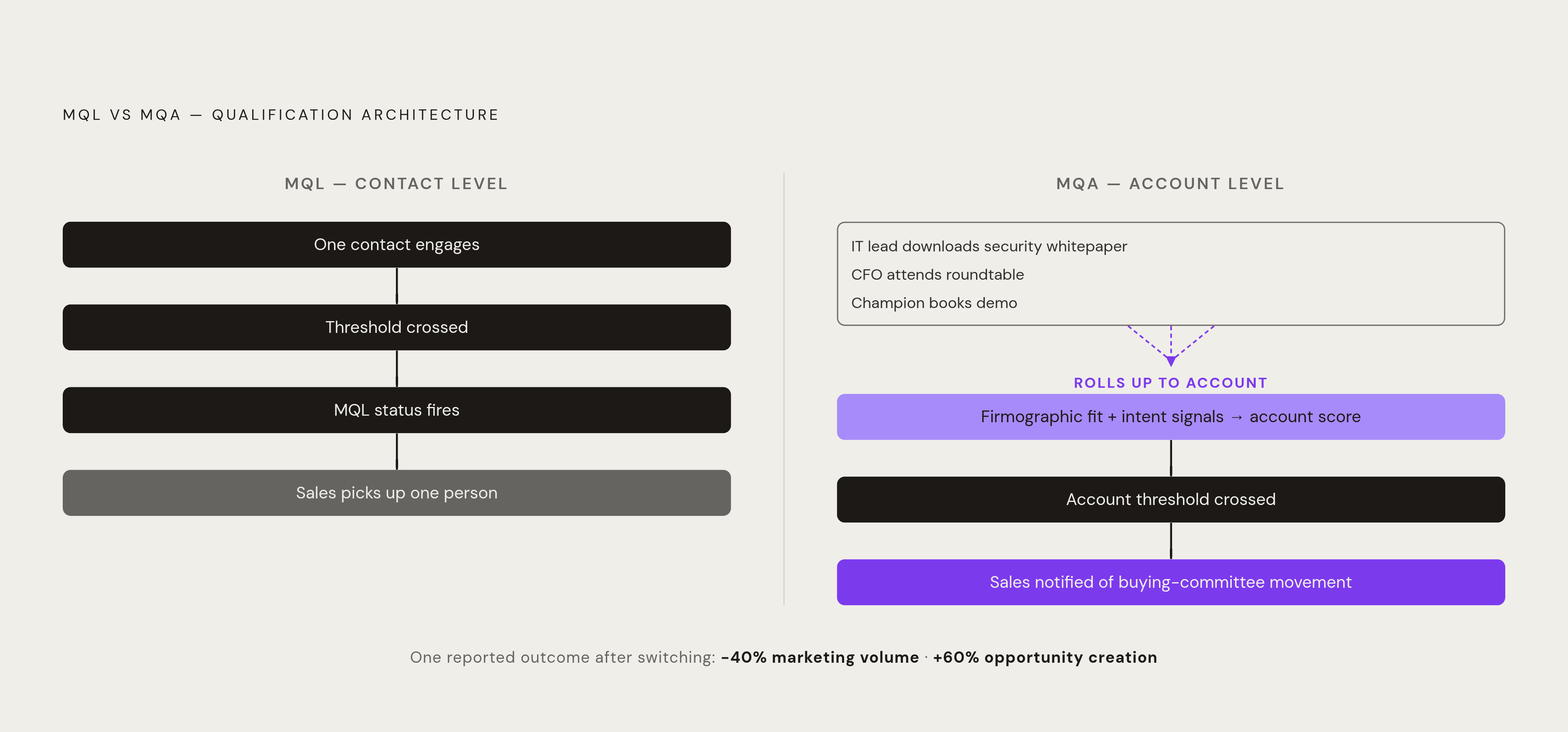
The MQL was designed for a different kind of buying process. One person's engagement crosses a threshold, a notification fires, sales picks it up. Clean, scalable, genuinely effective for high-volume inbound programs where individual buyers have purchasing authority and short evaluation cycles.
It breaks for complex B2B deals. Gartner research puts the average enterprise buying group at six to ten stakeholders; other studies push that figure toward fourteen for larger organizations. An MQL system treats each of those people as a separate entity. When the IT lead downloads a security whitepaper and the CFO attends a roundtable two weeks later, the system generates two separate low-score leads and misses the account signal entirely, because it was never designed to see it.
The Marketing Qualified Account replaces that logic. An MQA triggers when collective engagement across the buying committee, combined with firmographic fit and intent signals, crosses a defined threshold. No single individual has to fill out a form. The account qualifies because the account is showing buying-committee-level movement.
One reported case from a B2B SaaS company describes moving to an MQA model and seeing marketing volume decrease by 40% while opportunity creation increased by 60%, sales cycle length shortened by approximately one quarter, and average deal size grew by 35%. The source of these figures has not been independently verified and should be treated as directional rather than representative.
The MQA model is most appropriate when average contract value clears a meaningful threshold and sales cycles exceed 60 days. Below those thresholds, MQL logic remains the right tool, and the two models are not mutually exclusive. A dual-funnel approach handles inbound individual leads through MQL logic while running ABM target accounts through MQA logic, preserving existing infrastructure while building account-level qualification in parallel. Most mature ABM programs operate both.
The CRM implementation is specific. You need an Account Qualification Score field that aggregates individual contact engagement scores, threshold rules that trigger MQA status when the account score crosses the defined level, and an automatic notification to the relevant sales stakeholders. The key architectural reversal: engagement scoring rolls up from contact to account, not down from account to contact. That one change determines what the system can see.
How Intent Data and AI Signals Plug Into CRM Account Records
The operational question is how you identify which accounts are genuinely in-market without waiting for them to raise their hand. Intent data is the mechanism, and it is increasingly paired with AI to make the signals actionable at scale.
The signals that matter go beyond first-party behavior: third-party topic consumption, reviewing competitors on G2, engaging in industry forums, and consuming content on syndication networks: these are pre-form signals that indicate active research. Technographic shifts at a target account, new job postings in specific functional areas, leadership transitions, all of these are potentially predictive without requiring the prospect to identify themselves. The account is telling you it is moving. You just need a system that can hear it.
The integration pattern works like this. An intent platform pushes a weekly intent score to a designated field on the CRM account record. When that score crosses a threshold, the CRM workflow fires automatically. It moves the account up a tier, assigns an SDR outreach task, or shifts the account from passive nurture into an active engagement track. The signal does the routing; the human does the outreach.
Despite the availability of this infrastructure, intent data remains underutilized. Most CRMs have the field capacity. Most teams simply have not built the integration, and they are paying for that gap in the form of late signals and reactive outreach.
AI's most immediate application here is synthesis. A buying committee account has a dozen contact records, each with their own engagement history, each touched by different campaigns at different times. Manually assembling that into a coherent readiness assessment before an AE makes a call is time-consuming and inconsistently done. AI-enriched CRM records can surface that synthesis automatically, presenting the AE with a single account readiness signal derived from multi-stakeholder engagement data. The rep enters the account already oriented, rather than spending the first fifteen minutes of call prep reconstructing a picture the system should have assembled.
Research from organizations including McKinsey & Company and the Bridge Group has documented that sales reps spend a significant portion of their time on preparation and administration rather than active selling. That is largely a data architecture problem. AI-enriched CRM records, fed by integrated intent signals, are designed to reduce that preparation burden. Whether any given platform delivers on that promise depends entirely on whether the underlying account data model is clean enough to feed it.
Structuring CRM Workflows So Marketing and Sales Operate From the Same Account View
The persistent problem in B2B go-to-market is that marketing and sales each have their own view of the account, and neither view is complete. Marketing tracks campaign-level engagement. Sales tracks contact-level activity. Without deliberate CRM design, the account-level picture exists nowhere, and both teams make decisions with partial information about the same prospect.
The foundational fix is a bidirectional sync between the CRM and the marketing automation platform, creating a unified account timeline where campaign touches, email opens, sales calls, content downloads, and intent score changes all appear in a single chronological view on the account record. With that in place, a marketer can see what the AE said on their last discovery call. The AE can see which content the CFO consumed before agreeing to a meeting. The account becomes legible to both teams simultaneously, rather than each team holding a fragment and treating that fragment as the whole thing.
Without this connection, teams duplicate effort, miss engagement signals that crossed organizational boundaries, and deliver fragmented prospect experiences because neither side knows what the other has already done. Buyers feel that fragmentation, even when they cannot name it.
Workflow design should vary by tier. Tier 1 accounts warrant an AE-owned account plan inside the CRM, account-specific content sequences triggered by CRM stage changes, and joint weekly reviews of account engagement scores by sales and marketing. Tier 2 runs on industry or persona-cluster campaigns that fire when cluster engagement scores cross a threshold, with the CRM automatically assigning SDR outreach tasks. Tier 3 is largely automated: rule-driven nurture sequences that escalate to human attention only when an account crosses MQA status.
The SLA between marketing and sales should be documented inside the CRM itself, not in a policy document no one reads after the first month. What does marketing deliver at each account stage? How long does sales have to follow up after an MQA trigger? What constitutes a disqualified account, and how does it re-enter the target list? These questions need codified answers inside the system that runs the workflow, because the moment they live in a slide deck, they start getting ignored.
Tracking Engagement Across the Buying Committee Inside a Single Account Record
B2B deals involve multiple decision-makers, each with a different functional stake, different informational needs, and a different engagement timeline. Gartner research cites a range of six to ten stakeholders per deal, climbing higher for larger organizations. Multi-threaded outreach is the strategy that accounts for this reality. CRM must structurally support it.
Every contact record needs a stakeholder role field tied to a defined buying committee model: Economic Buyer, Champion, Technical Evaluator, Legal and Procurement. These designations do two things at once. They surface engagement gaps, showing which roles have gone dark or have never been engaged. And they enable content routing, ensuring the right material reaches the right person based on where they sit in the decision process.
Personalization follows directly from role mapping. A Champion needs ROI calculators and customer case studies. A Technical Evaluator needs integration documentation and security specifications. An Economic Buyer needs a business case framework. If role fields are not populated, the CRM has no basis for routing personalized content, and the default becomes sending the same sequence to everyone. The CFO gets product comparison sheets. The IT lead gets pricing information. Both disengage, for entirely predictable reasons, and the account goes cold.
The single-threaded account risk deserves particular attention. If only one stakeholder is engaged and that person goes quiet, the deal stalls with no warning. CRM should automatically flag single-threaded accounts as at-risk based on engagement recency across contact roles. A deal where only one role shows recent activity is a deal at risk of stalling, and the system should flag it before it does.
Stakeholder map completeness should be a field on the account record, treated as a hygiene metric reviewed jointly by sales and marketing. An incomplete map means incomplete engagement data, and every downstream signal built on that data is unreliable. This is a point that gets overlooked in many ABM implementation guides. But garbage in, garbage out does not stop being true just because you added an intent data integration.
What the Sales Handoff Looks Like When CRM Is Structured for ABM
Most handoff failures are not failures of intent. They are failures of information transfer. Sales receives a notification that an account has qualified, with no engagement history attached, no stakeholder map, no explanation of what drove the account score. The AE either starts from scratch or, more commonly, ignores it entirely. All the upstream investment in building and warming that account dissipates at the exact moment it was supposed to convert.
A CRM-structured ABM handoff looks different. It includes the account engagement score and the specific activities that drove it, the full stakeholder map with recency data for each contact's last engagement, prior opportunity history if the account has ever been in pipeline before, a recommended next action based on the content the account has consumed, and explicit AE and SDR role assignments so there is no ambiguity about who owns what next.
The handoff should trigger a pipeline stage change inside CRM, moving the account from "Marketing Active" to "Sales Engaged," with a documented SLA clock that starts when the stage changes. Sales has a defined window to make first contact. If that window closes without action, the system flags the account for review. The clock is not punitive; it is structural. It makes the handoff visible and measurable rather than aspirational.
Research, including findings published in the ITSMA and Momentum ITSMA State of ABM reports, documents that ABM accounts tend to produce higher win rates and larger deal sizes than non-ABM accounts. A dropped handoff wastes all of that upstream investment. The handoff is where ROI either materializes or evaporates, and many programs treat it as an afterthought.
The feedback loop is equally critical and equally neglected. Sales must be able to push account status back into the marketing-visible CRM record: "Not ready, return to nurture" with a reason code, or "Disqualify" with defined criteria. Those inputs allow marketing to refine scoring thresholds over time. Without them, the scoring model never improves. It stays calibrated to whatever assumptions were made at launch, which is rarely the right calibration six months in.
A properly structured CRM handoff stage is precisely where ROI measurement becomes possible, because pipeline can be traced back to specific engagement milestones on the account record. The data is there when the structure is right.
The Tools and Platforms That Support ABM-CRM Workflows, Including What to Look For
No single platform does everything an ABM-CRM workflow requires. The operational stack has layers, and the design question is which combination gives marketing and sales a shared account record they both trust and consistently use.
The CRM layer is the record of truth. Salesforce is the predominant choice for enterprise programs, while other platforms serve mid-market teams effectively. Most support account-level objects, custom scoring fields, and native integrations with marketing automation platforms. The platform matters less than the data model built on top of it, which is a point that often gets overlooked in vendor evaluations.
The intent data layer identifies which target accounts are actively researching. Bombora provides topic-level B2B intent signals aggregated from publisher networks. 6sense offers predictive account scoring that synthesizes intent, technographic, and behavioral data into a single account-level readiness score. G2 Buyer Intent surfaces in-category research signals from buyers actively reviewing solutions. All three integrate with major CRMs through native connectors or middleware.
The marketing automation layer, Marketo Engage and comparable platforms, must sync bidirectionally with the CRM so that account engagement history flows in both directions. A one-way sync creates information asymmetry between teams and undermines the shared account view that ABM requires. This is a common implementation shortcut with persistent downstream consequences.
ABM-specific platforms such as Demandbase, Terminus, and RollWorks add account identification, advertising targeting, and engagement analytics on top of the CRM foundation. They are most applicable for Tier 1 and Tier 2 programs with the budget and account volume to support them. Their effectiveness is only as strong as the CRM data feeding them, which is why the data model has to be right before the platform conversation begins.
Content execution is the workflow bottleneck the stack rarely addresses adequately. ABM requires personalized content at the persona and role level, triggered by account stage changes, delivered at a cadence the buying committee actually experiences as coherent. Producing that volume of targeted content without a six-week agency cycle is a production problem as much as a creative one. Platforms like Letterstory, an end-to-end content automation platform, sit in this gap by handling drafting, editorial, and publishing in a single workflow. Markettailor handles web personalization at the account level. For teams wrestling with the broader challenge of producing coordinated, role-mapped content sequences at scale, the evaluation criteria should center on whether the tool integrates with CRM stage changes and supports multi-stakeholder routing, not just content creation in isolation.
Mid-sized enterprises represent a growing segment in ABM adoption, but they typically cannot absorb enterprise platform licensing costs. For these teams, CRM-native workflows combined with targeted point solutions represent a more viable architecture than an integrated ABM suite. That is a design constraint worth naming explicitly when evaluating the stack, because the vendor conversations will not name it for you.
Measuring Whether the CRM Structure Is Actually Working
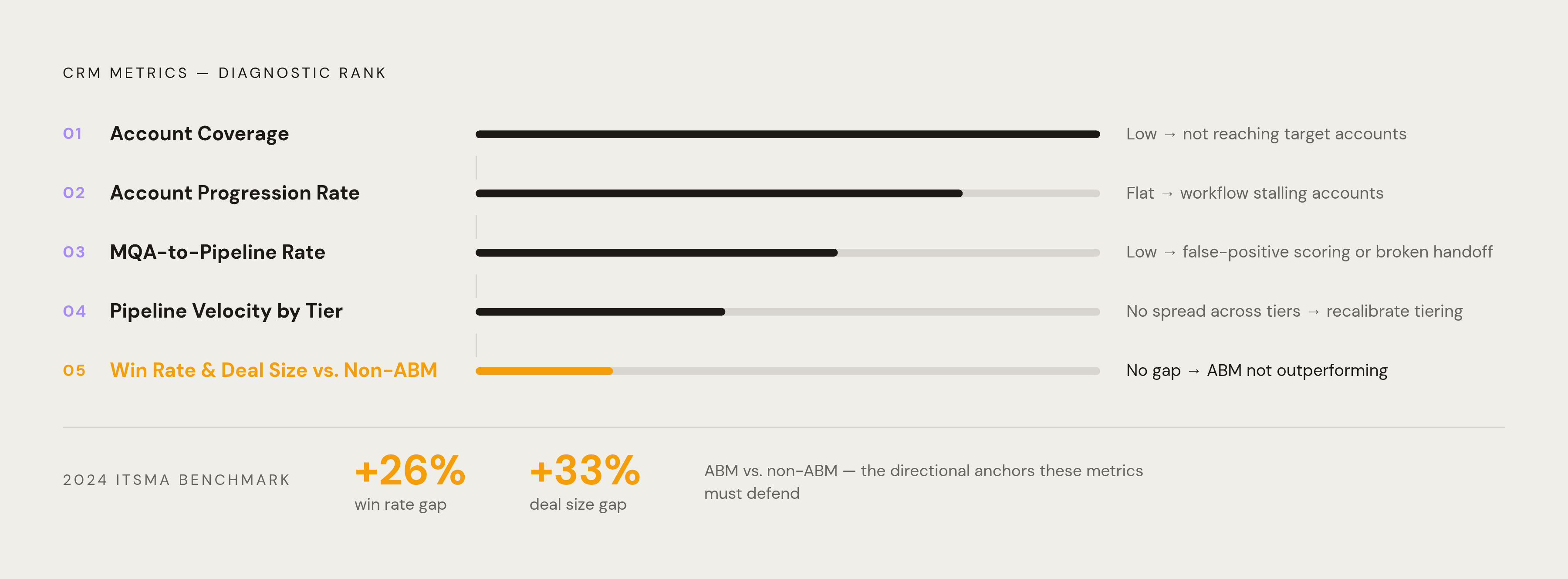
Research from Momentum ITSMA and others documents higher win rates and larger deal sizes for ABM programs at maturity, though results vary by program design and market context. Those outcomes are only measurable when the CRM captures the right stages. Most programs cannot demonstrate ROI because the data architecture does not connect account engagement history to pipeline outcomes. The measurement problem is a structure problem.
The right metrics are account-level, not campaign-level, not contact-level.
Account coverage measures what percentage of target account list accounts have a complete stakeholder map and active engagement within the past 90 days. If coverage is low, the program is not actually reaching the accounts it claims to be targeting, regardless of what the campaign reports say. This is the metric most teams skip, and skipping it is how ABM programs accumulate the appearance of activity without the substance.
Account progression rate tracks how many accounts moved from one CRM stage to the next in a given quarter. Flat progression means something in the workflow is stalling accounts: engagement sequences are not working, scoring thresholds are miscalibrated, or content is not matching the buying stage. The metric tells you something is wrong. Diagnosing which of those three is the actual problem requires looking at the underlying record.
MQA-to-pipeline conversion rate measures what percentage of accounts that triggered MQA status became active pipeline opportunities. A low rate means either the scoring model is generating false positives or the sales handoff is failing. Both are structural problems, not motivational ones, and the fix is different for each.
Pipeline velocity by tier answers whether Tier 1 accounts are closing faster and at higher contract values than Tier 2 and Tier 3 accounts. If they are not, either the tiering model or the investment per tier needs recalibration. The tier distinction only creates value if it reflects a meaningful difference in treatment and outcome.
Win rate and deal size compared to non-ABM accounts are the baseline benchmarks. The 2024 State of ABM report from Momentum ITSMA documents a 26% win rate gap and a 33% deal size gap between ABM and non-ABM accounts. Use those as directional benchmarks and track your own program against your own historical baseline.
Two diagnostic signals indicate that the CRM structure itself is failing, not just the campaigns running on top of it. MQA triggers that sales does not follow up on within the defined SLA point to a broken handoff process. Account engagement scores that stay flat across the target account list despite ongoing marketing activity suggest either a missing intent data integration or a scoring model that does not reflect genuine buying-stage movement.
Both symptoms point back to the same root cause. The CRM was not designed for ABM. It was designed for contact management and retrofitted. Fixing that is not a weekend project, but it is the prerequisite for everything else working.