Lead Handoff Process Between Marketing and Sales
Qualification signals, context, and next steps separate a real handoff from a lead dump.

A lead handoff is not forwarding a contact record. That's a lead dump, and most teams are doing exactly that without realizing it.
A genuine handoff carries three things: a qualification signal, a context package, and a next-step instruction. The qualification signal is evidence the lead meets agreed criteria, not just demographic fit. The context package is behavioral history, engagement timeline, campaign source, what the lead has already seen or done. The next-step instruction tells the rep what to do without making them reconstruct the entire conversation from scratch. Strip any one of those three and you haven't handed off a lead; you've just moved a name between systems and called it progress.
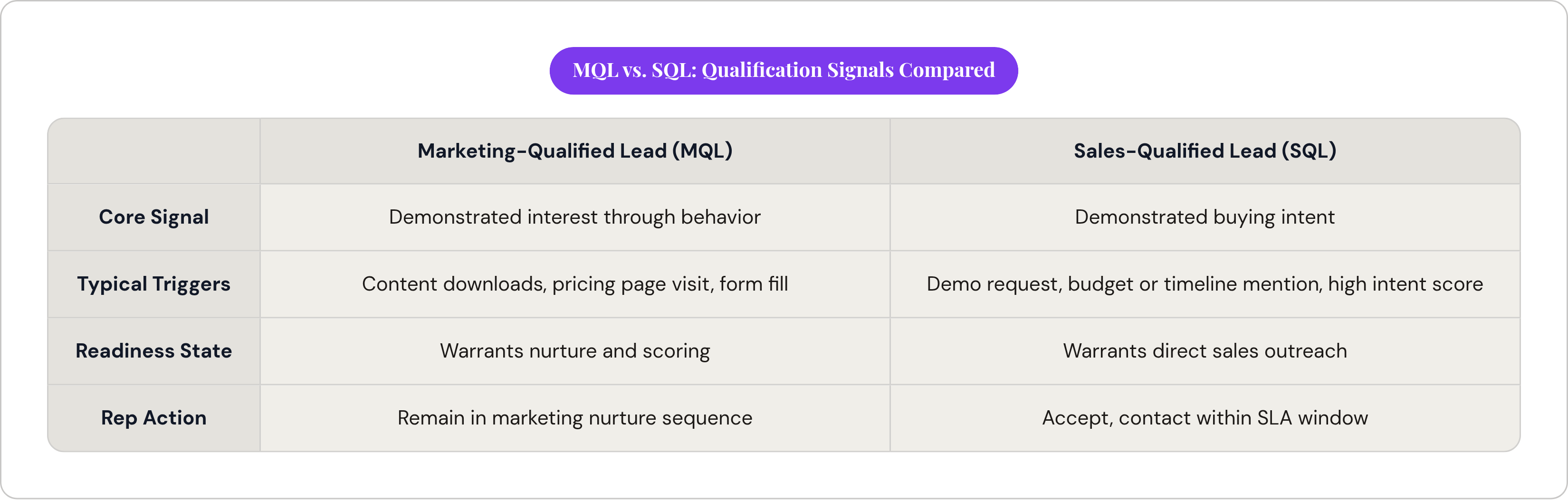
The MQL and SQL distinction lives inside this framework. A marketing-qualified lead has demonstrated interest through behavior: content engagement, pricing page visits, form fills. But it hasn't yet signaled buying intent with sufficient force to justify a direct sales conversation. A sales-qualified lead has crossed that threshold: a demo request, a budget or timeline mention, an intent score high enough to warrant outreach. Without a shared definition of those two stages, the handoff threshold shifts depending on who's asking. That inconsistency compounds downstream into missed revenue, quietly and consistently.
Only a small minority of buyers feel that sales reps genuinely understand whether a solution fits their situation. Poor handoffs are a direct contributor. A rep who receives a name and a job title will make a cold call. A rep who receives a behavioral history will open a relevant conversation. Content marketing platforms like Letterstory, which automate topic curation and publishing, exist partly to make that behavioral trail richer. Those are not the same call. They don't produce the same results.
Agreeing on What Makes a Lead Sales-Ready Before Anything Else
The single most common root cause of a broken handoff is that marketing and sales have never formally agreed on what "qualified" means. Every other step in the process rests on this one.
A shared lead scoring model has to account for firmographic fit: does the account match the ideal customer profile in terms of company size, industry, geography? Role and authority: is this contact likely to influence or make a buying decision? And then behavioral signals, which is where most teams are sloppy. High-intent behaviors are repeat visits to pricing or comparison pages, demo requests, case study downloads, direct replies to sales emails. Lower-intent signals are a single whitepaper download, one blog visit, a webinar registration where the person didn't actually show up. The difference matters. Finally, explicit intent indicators: budget or timeline mentions in form fields, technographic signals, third-party intent data.
The model translates all of that into point values and a threshold score that triggers routing to sales. The threshold should reflect what reps actually convert, not what marketing can generate at volume. When behavioral and intent signals drive that threshold rather than demographics alone, qualification becomes predictive rather than merely descriptive, and conversion rates move accordingly.
This step requires a joint workshop. Not an email thread, not a shared doc with comments accumulating in the margins. A room, or a video call, with both teams present and willing to argue about it. Sales reps need to weigh in on which signals they actually find meaningful. Marketing needs to hear which lead types reps work and which ones they quietly ignore. The output is a documented MQL definition and a scoring model that both teams have signed off on, stored somewhere you can both find it and revisit it when the data shifts.
Building the Handoff Package So Context Travels With the Lead
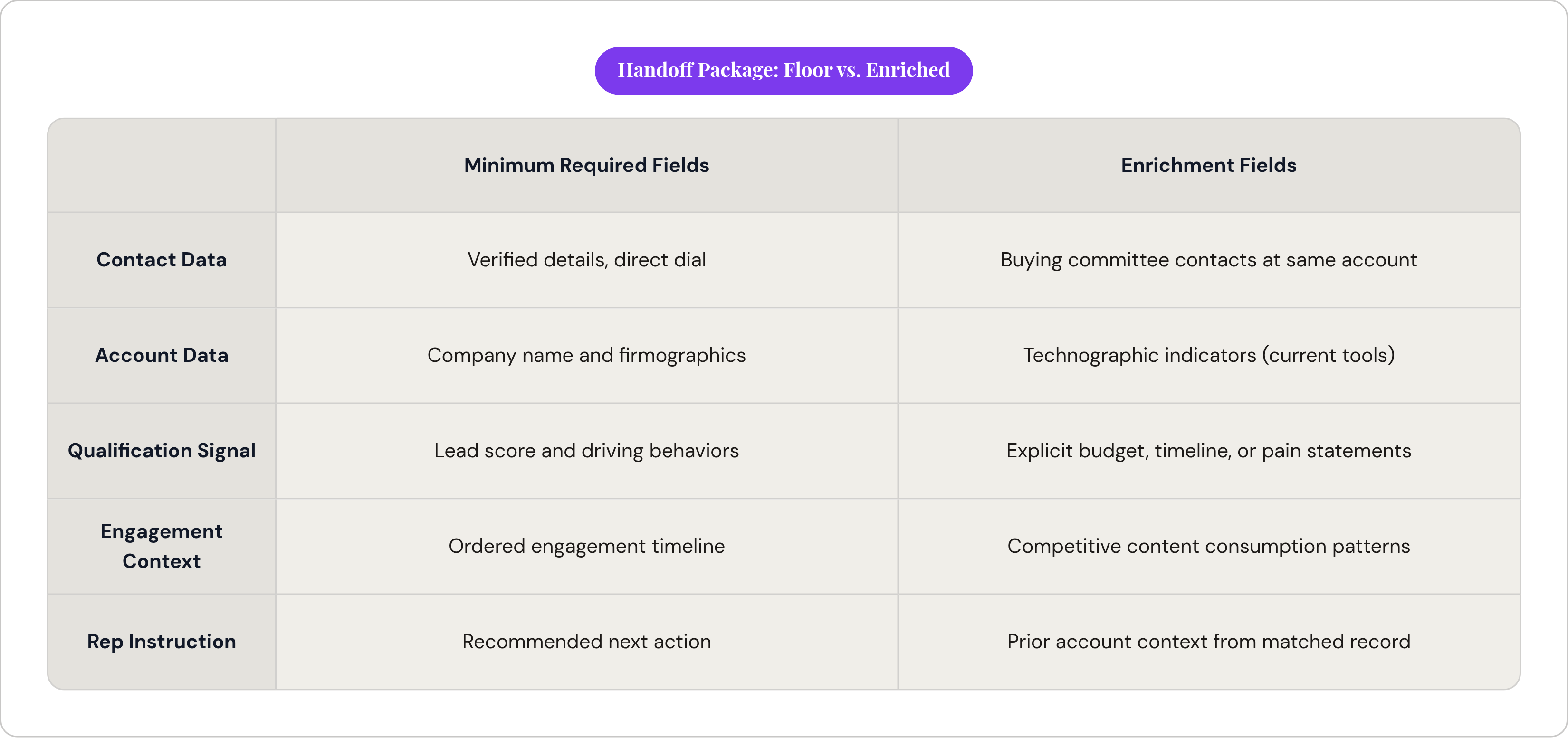
The handoff package is the unit of transfer. It's a structured record assembled before the lead touches the rep's queue, and it gives sales everything needed to open a relevant first conversation.
Minimum required fields: verified contact details including direct dial where available, company name and firmographic data, contact role and title, lead score and the specific signals that drove it, an engagement timeline showing what the lead did and in what order, source and campaign attribution, and a recommended next action for the rep. That's the floor.
When available, enrichment fields make the package substantially more useful: technographic indicators showing what tools the prospect currently uses, buying committee signals identifying other contacts at the same account who have engaged, and any explicit statements from form fields about budget, timeline, or pain points.
A rep who sees that a prospect spent three weeks reading competitive comparison content, attended a webinar, then came back and hit the pricing page twice, is opening a fundamentally different conversation than one staring at a name and a job title. That difference shows up in conversion rates, in deal velocity, in whether the prospect feels understood or ambushed.
One constraint worth naming: the package has to assemble automatically. If it requires manual copying between systems, the context will be incomplete by the time it reaches the rep. That incompleteness feels like a minor inconvenience until you trace a quarter of cold leads back to the same empty fields.
Setting the SLA That Defines Ownership and Response Obligations
A marketing-to-sales service level agreement is a written commitment that answers three questions: when does marketing's ownership end, when does sales ownership begin, and what are both teams obligated to do in the interval between those two moments?
Marketing's commitments in a well-formed SLA are these: (i) leads passed to sales must meet the agreed scoring threshold, (ii) the handoff package must contain the required fields before transfer, and (iii) volume targets and lead source transparency are maintained. Sales commits to response-time obligations by lead type. High-intent leads, demo requests and pricing inquiries, warrant contact within a few hours at most. Content-based MQLs warrant contact within one business day. Sales also commits to an accept-or-reject decision within a defined window; if the rep does not act, the lead returns automatically to marketing nurture. And if a lead is rejected, the rep documents a reason, because that reason is the data that makes the next iteration of the scoring model more accurate.
A substantial share of B2B organizations have no formal SLA governing lead handoffs at all. Research has found that organizations with one in place are materially more likely to see year-over-year improvement in ROI. An SLA without enforcement is a document, not an agreement. It only functions if dashboards and alerts make compliance visible to both teams in real time. High-growth teams revisit SLA terms quarterly, because a static SLA becomes obsolete faster than most teams expect.
Routing Logic That Gets the Right Lead to the Right Rep Quickly
Routing is the operational layer between qualification and contact. It determines which rep receives which lead, based on what rules, in what order, and without unnecessary delay.
Common routing dimensions are: (i) territory, where geographic region maps to a rep or regional team; (ii) industry vertical, where specialist reps receive leads from their segment; (iii) deal size or account tier, where senior reps handle larger or more strategic accounts; and (iv) availability, where weighted rotation prevents leads from queuing behind reps who are at capacity or out of the office.
Manual routing fails for a specific, measurable reason. When a human must copy data from a form into a CRM and then notify a rep by email, the average time from form submission to first contact stretches well beyond what any reasonable SLA allows. One audit found the gap approached two full business days under manual processes. Leads reached within minutes of inquiry convert at dramatically higher rates than those contacted even an hour later.
Automated routing removes that lag. When a lead meets entry criteria in your marketing system, it moves directly into enrichment, the package assembles, and routing logic assigns it to a rep's queue without a human making a manual decision in the middle. For account-based programs, the routing layer also needs to handle lead-to-account matching, connecting a new lead to an existing account record so the rep with prior context receives it and duplicate outreach is prevented.
The return-to-nurture path is part of routing, not an afterthought. Rejected leads should route automatically back to marketing nurture sequences, not sit dead in the CRM. The rejection reason field is the connective tissue between what sales experienced and what marketing will do differently next time.
Closing the Loop With Feedback That Improves Future Handoffs
Most handoff processes don't break all at once. They degrade, quietly, because there's no structured feedback from sales to marketing about what happens to leads after transfer.
I've seen this pattern more than once. A revenue operations manager traces a quarter of missed targets and pulls the pipeline data. The leads were there, hundreds of them, but when she traces the rejection reasons in the CRM, nearly sixty percent carry the same note: "no context on why they reached out." The handoff package existed on paper. Nobody enforced that it be filled out. One field, consistently empty, had quietly collapsed the conversion rate over three months.
Closed-loop feedback means sales reps document lead quality assessments in the CRM with accept-or-reject decisions and documented reasons. Not in email. Not in memory. In the system both teams share. Conversion data flows back to marketing: which lead sources, campaigns, and content touchpoints produced leads that became opportunities and closed deals. And marketing has visibility into whether leads are being worked at all, how many contact attempts were made, how prospects responded.
The metrics that make this loop visible: lead acceptance rate, because if sales is rejecting a large share of marketing's leads, the MQL definition needs revision; MQL-to-SQL conversion rate, which is the earliest warning sign that the qualification model has drifted from reality; time-to-first-contact; MQL-to-SAL rate; and pipeline contribution by channel, the downstream metric that unifies both teams around a common outcome.
Forrester research has found that teams running structured win/loss programs and feeding findings back to marketing see measurable improvement in messaging relevance and in how often sales actually uses marketing content in deals. A shared weekly or biweekly pipeline review keeps the feedback loop operational. A monthly report does not.
The Organizational Conditions That Make the Process Stick
A well-documented process fails if the teams operating it are rewarded for different outcomes. This is the root cause that process alone cannot fix.
When marketing is compensated on lead volume, the incentive is to pass as many leads as possible. When sales is rewarded only for closing, the incentive is to reject leads that require significant development. Neither team is behaving irrationally; they're each responding to how they're measured. Fixing the handoff process without addressing the incentive structure produces temporary improvement, and then a slow drift back to the original dysfunction.
Shared revenue goals change the calculus at the individual level, not just the leadership level. When marketing has a stake in pipeline contribution and closed revenue, and when sales is rewarded for providing useful feedback rather than just rejecting leads without documentation, the cooperation the process requires becomes self-interest rather than goodwill, which is considerably more durable.
Single-point accountability is also necessary. Both teams share ownership of the handoff, but one person, typically in revenue operations, is responsible for enforcing SLA compliance, surfacing conversion data, and convening joint reviews. Without that owner, accountability is diffuse and compliance is essentially voluntary.
A significant share of B2B organizations report that sales and marketing alignment stops at the planning phase: the two teams agree on strategy in the room and then operate independently. Revenue operations provides: (i) a neutral owner of the shared CRM and the data flowing through it; (ii) cross-team dashboards that surface SLA compliance and conversion rates without requiring either team to trust the other's reporting; and (iii) the authority to call a joint review when metrics deteriorate.
Alignment requires a recurring operating rhythm: joint planning, shared dashboards, and a defined escalation path for when leads fall through, because they will.
Technology Choices That Support Each Step Without Adding Complexity
The process should drive technology selection, not the reverse. The tools exist to automate what the teams have already agreed to do. Buying software before the agreement exists produces expensive dysfunction, and the software vendors are not going to warn you about it.
Several major CRM and marketing automation platforms support lead scoring, automated routing, and closed-loop reporting natively, and many have added AI-assisted qualification features in recent cycles. If your team wants tighter data continuity without building custom integrations, Zoho's native connection between its CRM and marketing automation suite is worth evaluating. These are the core-layer decisions, and for most teams, getting this layer right is sufficient.
For more complex needs, specialist tools exist at specific points in the process. Scheduling and routing tools like Chili Piper reduce friction at the moment of highest intent, when a lead books a meeting, by handling that handoff with minimal lag. Account-graph routing platforms like LeanData solve lead-to-account matching at scale for teams running account-based programs, a problem that CRM-native matching handles imprecisely as account complexity grows. Revenue operations platforms focused specifically on routing logic, like LeadAngel, offer accuracy rates in lead-to-account matching that vendors cite favorably in their own materials; independent validation varies, so evaluate against your own data before committing.
Sales engagement platforms like Outreach and Salesloft sit at the rep-facing end of the handoff, providing sequencing, activity tracking, and the reporting that feeds back into the loop. They work well when the package arriving from marketing is complete. When the package is incomplete, they automate the wrong thing faster.
Define your qualification criteria first. Build the handoff package. Write the SLA. Design the routing logic. Close the feedback loop. Then choose tools that execute each step automatically and surface the metrics both teams need. Technology enforces a process; it does not create one.