Sales and Marketing Alignment Frameworks That Work
Misaligned sales and marketing costs B2B companies $1 trillion annually.

The number is $1 trillion annually, and it is not a rounding error. For a $50 million company, the math works out to roughly $5 million in losses per year. Those losses show up in identifiable places, at identifiable moments, across every stage of the funnel.
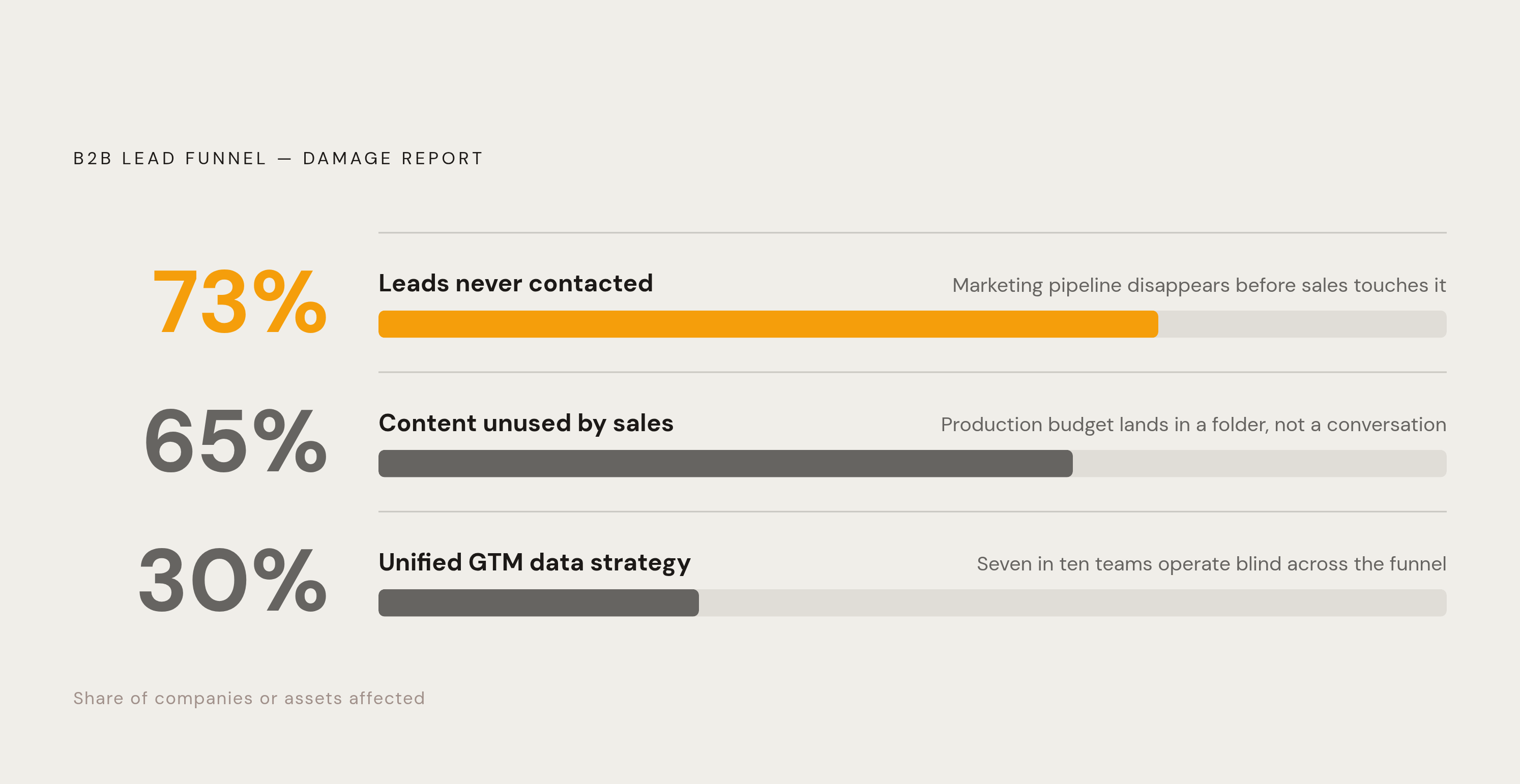
The lead pipeline is where the damage is most acute. 61% of B2B marketers send all leads directly to sales, yet only 27% of those leads are actually qualified. And 73% of marketing-generated leads are never contacted by sales at all. Nearly three-quarters of everything marketing produces, gone, untouched. It is tempting to call this a behavior problem, a cultural one, a trust issue between two teams that have never really liked each other. But that diagnosis lets the structure off the hook. What you are actually looking at is two functions operating with incompatible scorecards: marketing measuring on volume, sales filtering by a definition of quality that marketing never agreed to. Nobody is wrong, exactly. The system just was never designed for them to agree.
Content waste runs parallel to this. 65% of marketing content goes completely unused by sales, and reps without proper enablement spend a meaningful portion of their week hunting for or rebuilding materials that should already exist. That time does not come back.
Technology fragmentation layers on top. 61% of sales and marketing professionals cite different platforms as a direct cause of misalignment. Only 30% of companies have a unified data strategy across go-to-market functions. When teams cannot see the same data, they cannot even agree on what the problem is, let alone how to fix it.
Every one of these failures points back to the same absence: no shared definitions, no shared handoff process, no shared feedback loop. The frameworks below are designed to install exactly that.
Why the B2B Buying Shift Makes Structural Alignment Non-Negotiable Now
The external environment has changed in ways that make internal misalignment far more consequential than it was five years ago.
Forrester's 2024 research found the average B2B buying group now includes 13 people. Every touchpoint across that group is a potential exposure point for misalignment. Buyers spend only 17% of their time in direct contact with vendor sales reps across the entire journey. The rest of the evaluation happens without the rep present: in content, peer conversations, digital research, places where the rep has no visibility and no ability to course-correct in the moment. Alignment failure is largely invisible to the rep and entirely visible to the buyer.
Between 50% and 90% of the B2B buying journey now occurs before a prospect speaks to anyone in sales. This means that the content and brand experience marketing creates is functionally part of the sales conversation, whether sales participated in building it or not. 92% of B2B buyers begin the process with at least one vendor already in mind. 41% have a single preferred vendor before formal evaluation begins. Misaligned messaging at early touchpoints shapes shortlists that sales never sees and cannot influence after the fact.
The buyer experience data confirms it directly. 49% of B2B buyers in Europe report encountering inconsistent messaging from sales and marketing most of the time. That inconsistency erodes trust before a call is ever booked. The average sales cycle has lengthened 22% over the past five years, which means more decision-makers, more scrutiny, and considerably less tolerance for contradictory signals across channels.
Alignment cannot be treated as an internal efficiency project. It is a buyer-experience requirement, and buyers have made that clear.
What Structural Alignment Actually Produces in Revenue Terms
The return on structural alignment is well-documented, and it is not marginal.
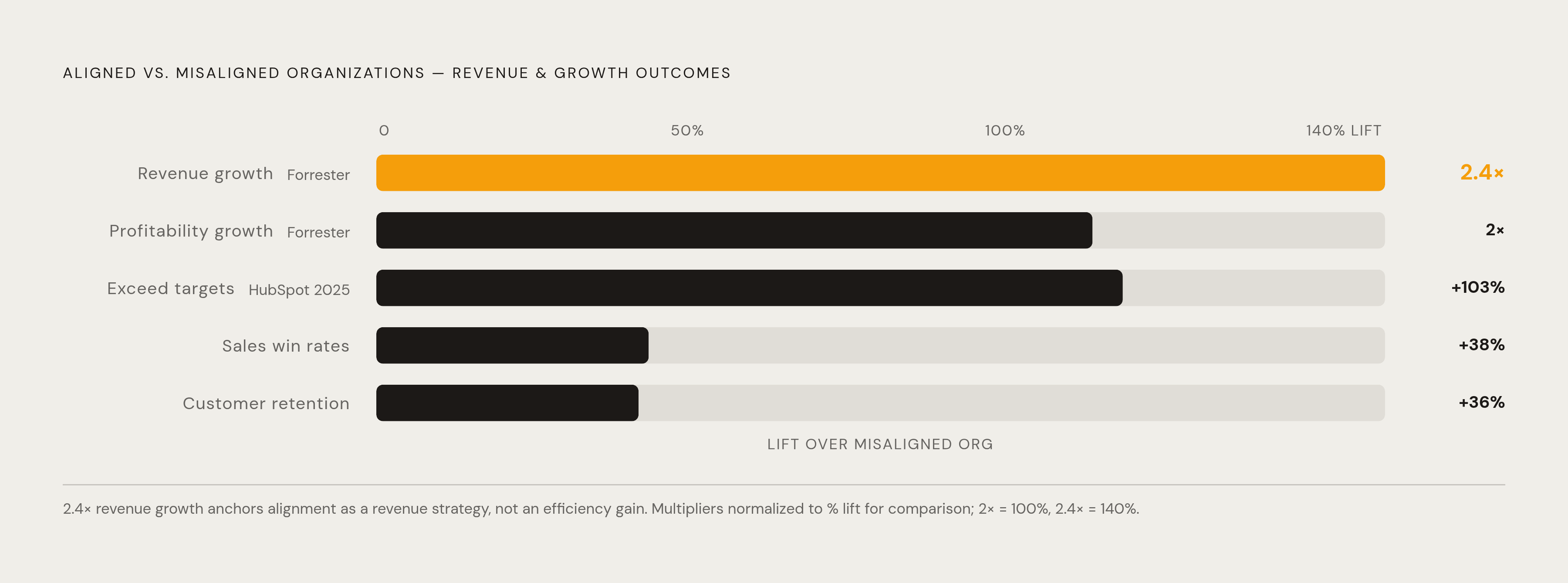
Forrester found that aligned organizations achieve 2.4 times higher revenue growth and 2 times higher profitability growth compared to misaligned peers. B2B organizations with tightly aligned sales and marketing operations achieve 24% faster three-year revenue growth, 27% faster three-year profit growth, and a 38% improvement in sales win rates.
Research from 2025 found that sales reps in aligned organizations are 103% more likely to exceed their targets. The advantage compounds past acquisition: aligned organizations achieve 36% higher customer retention, which means the revenue impact extends across the full customer lifecycle rather than resetting at every new deal.
Even partial progress generates real returns. McKinsey's 2024 research found that moderate alignment improvements yield 5 to 10% revenue growth within six to twelve months. The bar for a meaningful return is not perfection.
The upside does not come from working harder. It comes from removing structural friction, which is precisely what the frameworks below address.
The Shared-Definition Layer That All Other Frameworks Depend On
Here is the most pervasive structural failure in alignment work: two functions operating with incompatible definitions of a qualified lead, both teams convinced they are measuring the same thing. The operational consequences cascade downstream into every other process, and they are almost impossible to diagnose if you do not know what you are looking for.
Four definitions must be established, documented, and jointly owned before any other alignment framework can function reliably.
The Ideal Customer Profile describes the firmographic, behavioral, and situational criteria that define a prospect worth pursuing. It is a filter, not a persona. It answers who the organization should actually be targeting, not who they theoretically serve on a good day.
The Marketing Qualified Lead is a specific, binary threshold of engagement or fit that marketing certifies before handoff. It must be documented and non-discretionary. A judgment call is not a definition; it is a well-intentioned guess that produces inconsistent results at scale.
The Sales Qualified Lead is what sales confirms after their own qualification step. It marks the transfer of ownership from marketing to sales, and that transfer should be explicit rather than assumed.
The Opportunity designates when a sales-qualified lead has confirmed budget, authority, need, and timeline to a defined threshold. This is when committing significant sales resources is actually warranted.
These definitions must be built jointly. Not handed down by marketing to sales, not imposed by sales on marketing, but co-authored by both. Joint authorship is the mechanism that creates joint accountability. A shared definition document, version-controlled, referenced in onboarding for both functions, reviewed at a fixed cadence, is the practical implementation of this layer.
Gartner's 2024 survey of 412 senior leaders found that sales and marketing collaborate on just 3 of 15 key commercial activities. The definitional layer is where that collaboration has to begin, because without shared inputs, every downstream framework produces divergent outputs regardless of how sound the structure looks on paper.
The Sales-Marketing SLA as the Operating Agreement for the Handoff
A sales-marketing SLA is not a legal document. It is a formal operating agreement that encodes shared definitions into mutual, time-bound commitments. It defines the rules of engagement at the handoff and makes both parties accountable to obligations they both helped write.
An effective SLA has three components. Marketing commits to a defined volume and quality of MQLs within a given period, bounded by agreed ICP criteria. Sales commits to contact-attempt speed and follow-up frequency after an MQL is handed off. Both sides commit to a feedback loop: sales must document why a lead was rejected, providing the data that allows marketing to refine lead scoring over time. Without that third element, the SLA solves the handoff but not the learning process. It becomes a ceiling rather than a foundation.
Speed-to-lead deserves its own clause. Research cited by InsideSales.com found that 78% of B2B customers buy from the vendor who responds first, while average industry response times stretch across multiple days. A sub-24-hour contact commitment in the SLA is a structural competitive advantage that most organizations leave on the table because nobody wrote it down.
Governance is what separates a functional agreement from a document that quietly decays after Q1. SLAs need a fixed lifespan, quarterly reviews at minimum, and built-in checkpoints from the initial drafting. The review must assess whether performance data warrants realignment of activities or goals. Think of it as a contract that expires on purpose, forcing both sides to recommit rather than coast on whatever they agreed to eighteen months ago.
Ownership must be named explicitly. In most organizations, the SLA is owned by a shared VP of Revenue, a RevOps function, or a designated owner from each team. Without a named owner, compliance drifts in a way that is entirely predictable and almost always attributed to the wrong cause.
Revenue Operations as the Structural Architecture for Sustained Alignment
RevOps is the operating model that unifies sales, marketing, and customer success around one plan, one dataset, and one process. The key distinction from traditional sales operations is scope: RevOps owns the entire funnel and post-sale lifecycle, eliminating the seam between marketing's pipeline and sales' pipeline by assigning accountability to a single function rather than leaving it disputed between two teams who both have plausible claims to it.
Adoption has reached a meaningful inflection point. As of 2025, a large majority of organizations have a formal RevOps function, with a substantial share of those teams established within the past two years. Gartner projected that by 2026, a large majority of the highest-growth companies will deploy a RevOps model.
RevOps addresses three specific structural failure modes. It eliminates the handoff problem by owning the full funnel rather than deferring ownership to whichever team is louder in a given quarter. It enforces a single source of truth for data, resolving the quality and silo issues that undermine alignment at the diagnostic level. And it creates accountability for the full revenue lifecycle, which is why aligned organizations show better retention numbers, not merely better acquisition numbers.
The financial case is quantified. Deloitte Digital's 2024 B2B sales research found that organizations with established RevOps functions were 1.4 times more likely to exceed revenue goals by 10% or more. Forrester found that organizations aligning people, process, and technology across the demand engine experience 36% higher customer retention and up to 28% more profitability.
RevOps requires a unified tech stack, or at minimum a single system of record with the CRM as the shared source of truth. It requires shared dashboards that both functions see simultaneously, not separate reporting views that each team interprets independently. And it requires cross-functional leadership buy-in, because RevOps fails the moment either function perceives it as the other team's infrastructure.
One clarification worth making: RevOps does not replace the SLA. It provides the infrastructure within which the SLA can actually operate at scale.
The Feedback Loop Frameworks That Prevent Alignment from Decaying Over Time
Alignment is not a destination you reach and then maintain passively. Organizations that implement definitions and SLAs without feedback infrastructure find themselves rebuilding the same agreements twelve months later, often with the same frustrations and less goodwill than they started with. The structural work decays because there is no mechanism to catch the decay early.
The primary feedback mechanisms are not complicated, but they require genuine execution discipline. Joint pipeline reviews, held weekly or biweekly, bring both functions to the same data simultaneously: a single shared meeting with a single shared view of the funnel. Win/loss analysis, shared across both functions, converts sales intelligence into marketing input and surfaces whether positioning and targeting are actually working in the market or just in the slide deck. MQL rejection tracking requires sales to formally document why a lead was disqualified rather than simply marking it unqualified and moving on; this is the mechanism that allows the lead definition to evolve based on actual field evidence rather than conference room assumptions. Content usage feedback closes the production loop by signaling which assets are actively used in deals so marketing can prioritize what is working and retire what is not.
Cadence matters as much as the mechanism itself. Feedback loops require a fixed schedule, named owners, and a documented record. Informal channels do not produce structural change because they rely on individual initiative, and individual initiative is the first thing that erodes under quota pressure. The moment a rep is behind on their number, the informal feedback conversation gets deprioritized. That is not a character flaw; it is just how pressure works.
A practical structure: a monthly quantitative review covering pipeline, MQL volume, rejection rates, and content usage, paired with a quarterly qualitative SLA review that asks whether definitions still reflect reality, whether commitments are being met, and what needs to change. The quantitative review catches the symptoms; the qualitative review addresses the cause.
The Content Alignment Layer That Most Frameworks Overlook
65% of marketing content goes unused by sales, and the reflexive explanation is that sales does not value content, or that marketing does not understand the field. Neither diagnosis is accurate. The actual problem is structural: marketing produces assets based on campaign calendars and brand priorities, while sales needs assets based on specific objections, specific buyer roles, specific moments in a live deal. Without a shared process for connecting those two production logics, the outputs diverge reliably, and the gap gets attributed to personalities rather than process.
Content alignment requires three structural elements, and none of them are particularly glamorous.
The first is a content-to-deal-stage map: for each stage of the sales process, a documented set of assets that support specific conversations. This map must be built jointly. A content map that marketing created without sales input is just marketing's model of the buyer journey, which does not always match what sales actually encounters when a deal is in motion.
The second is a formal sales content request process, lightweight but documented, that allows sales to surface recurring objections or buyer questions that marketing should address in production. This converts field intelligence into a content development input rather than an informal request that gets deprioritized when someone has a campaign deadline.
The third is content tagging by buyer role and deal stage, so reps can locate the right asset for the right conversation without improvising or rebuilding from scratch. Hours spent searching for or recreating materials that already exist somewhere are not recoverable. Tagging and organization are infrastructure problems; they get treated as administrative overhead because they are unglamorous, not because they are unimportant.
Getting the shared language right is foundational. Marketing and sales need identical definitions around buyer personas, lead quality, content assets, and pipeline stage, and those definitions need to live in a single source of truth both teams reference continuously, not in separate wikis that drift apart over two quarters. Letterstory embeds sales enablement into the content creation workflow itself, reducing the friction of translating marketing output into sales-ready material by building alignment into production rather than retrofitting it afterward.
The content layer is where the shared-definition framework, the SLA, RevOps, and the feedback loops all converge in daily practice. If the definitions are right, if the SLA governs the handoff, if RevOps holds the data layer, and if feedback loops surface what is actually working, then content alignment is how all of that becomes visible to the buyer.