CRM Attribution Models for Multi-Touch Campaigns
Every attribution model is a formalized assumption about buyer behavior dressed up as arithmetic.

Every attribution model encodes a prior belief about which touchpoints matter most. That choice is not a neutral technical decision; it is a formalized assumption about buyer behavior, expressed as arithmetic.
First-touch attribution gives all credit to the initial recorded interaction, the channel that created awareness or generated the lead. Last-touch gives everything to the final interaction before conversion, typically a sales call, a demo, or a direct visit. Both models are easy to implement and easy to explain on a Monday morning. First-touch systematically overstates awareness channels while ignoring everything that closed the deal. Last-touch credits the final handshake and erases months of nurture work that made the handshake possible. Teams optimizing against either model are optimizing against a version of buyer behavior that does not exist.
Linear attribution corrects that single-touch bias by distributing credit equally across every recorded touchpoint, but it introduces its own distortion: a branded display impression gets treated the same as a product demo request. Time decay weights recent touches more heavily, on the reasonable intuition that proximity to conversion signals influence. For short sales cycles measured in days or a few weeks, that holds up. For B2B cycles measured in quarters, time decay systematically punishes early brand work, sometimes the very activity that put you on the shortlist in the first place.
U-shaped attribution concentrates the majority of credit at the first and last touches and distributes the remainder across the middle. W-shaped models add a credit milestone at lead creation, recognizing the moment a prospect formally enters the pipeline as its own conversion event. Full-path models extend this further, adding milestones at opportunity creation and closed-won. These position-based models fit naturally with how B2B CRMs organize pipeline stages, but all of them are still rule-based. The weights are assumed, not derived. A team configuring a W-shaped model with 30 percent at first touch, 30 percent at last touch, 20 percent at lead creation, and the remainder distributed across middle touches has made a series of judgment calls dressed up as measurement.
Shapley value and Markov chain models derive credit from actual conversion patterns rather than assumed rules. Shapley value calculates each channel's marginal contribution across every possible combination of touchpoints, borrowed from cooperative game theory. Markov chain models analyze the probability of reaching a conversion from any state in the buyer journey, then measure how removing each channel degrades that probability. These approaches are the most accurate and the least transparent, and that tension is not a solvable problem; it is a structural feature of every attribution decision. Algorithmic models also require a large volume of clean, unified conversion events. Feed them thin or inconsistent data and they will produce outputs that look precise and mean very little.
How Major CRM Platforms Implement Attribution Natively
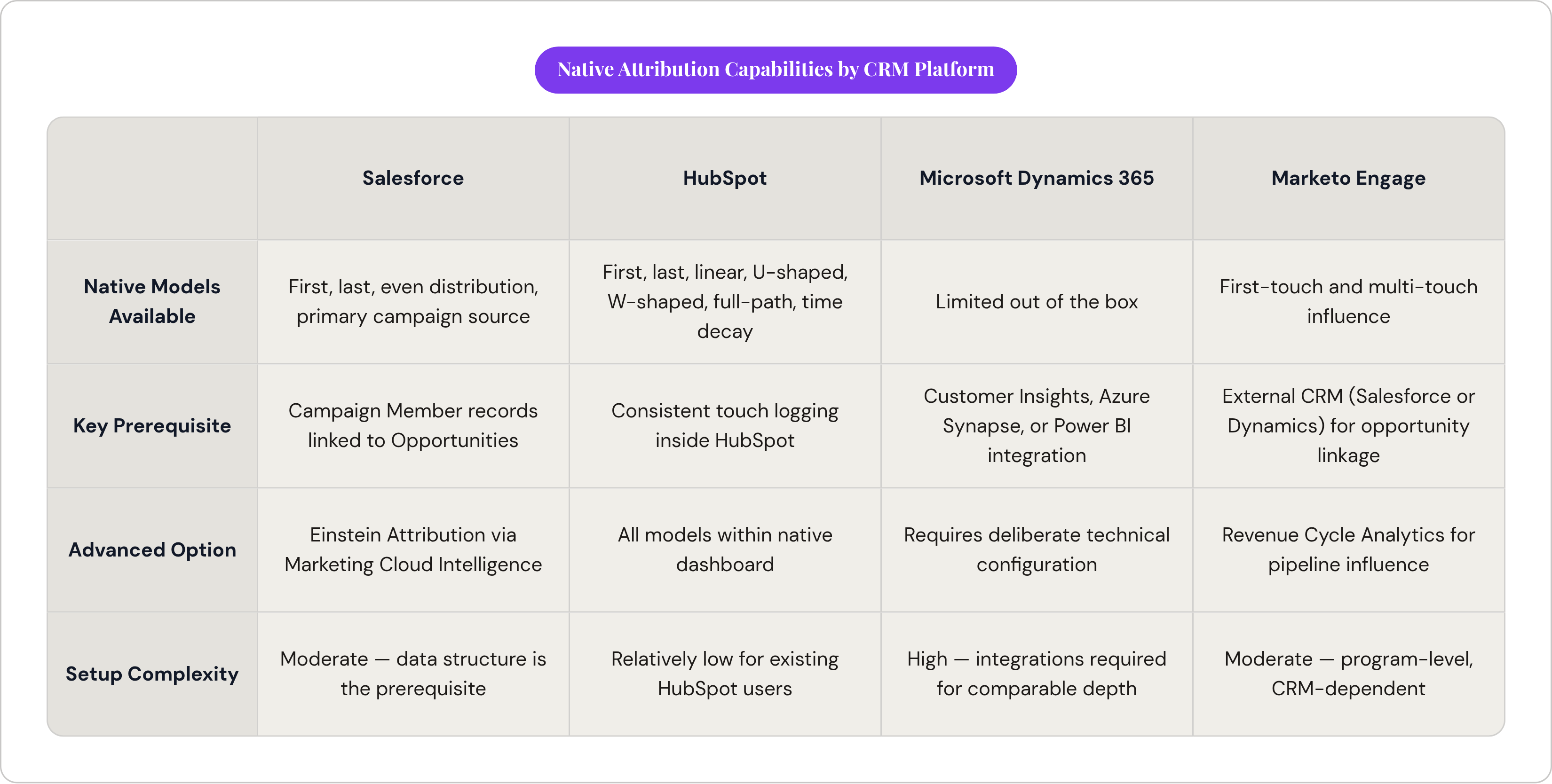
Most teams are not going to bolt on a dedicated attribution platform before extracting value from what is already inside their CRM. Native implementation is where most attribution decisions actually live, which makes it worth understanding what each major platform actually offers and where the gaps appear.
Salesforce offers configurable models including first touch, last touch, even distribution, and primary campaign source. The prerequisite is not model selection; it is data structure. Campaign Member records must be properly linked to Opportunities before any model produces meaningful output. Einstein Attribution, available through Marketing Cloud Intelligence, adds machine learning-based attribution for teams with sufficient data volume and budget to support it.
HubSpot's multi-touch revenue attribution, available on Marketing Hub Professional and Enterprise tiers, covers the broadest native model library among major CRM platforms: first touch, last touch, linear, U-shaped, W-shaped, full-path, and time decay, all within the native dashboard. The system connects Contact and Deal records to the marketing activity timeline, which makes it relatively approachable for teams already logging touches consistently inside HubSpot.
Native multi-touch attribution in Microsoft Dynamics 365 is less mature out of the box. Teams running Dynamics typically need Customer Insights, Azure Synapse, or Power BI integrations to reach comparable depth, and that requires deliberate technical configuration that Salesforce and HubSpot users often do not have to plan for explicitly.
Marketo Engage handles attribution at the program level, connecting first-touch and multi-touch influence data to Salesforce or Dynamics opportunities. The Revenue Cycle Analytics module manages pipeline influence reporting for teams running Marketo alongside an external CRM.
When native capability falls short, dedicated attribution platforms like Rockerbox, Northbeam, Ruler Analytics, and Oktopost for B2B social pull CRM data and extend coverage across channels the CRM does not natively log. These tools become most relevant when significant buyer activity is happening in places the CRM cannot see at all.
Why CRM Data Quality Sets the Ceiling on Any Attribution Model
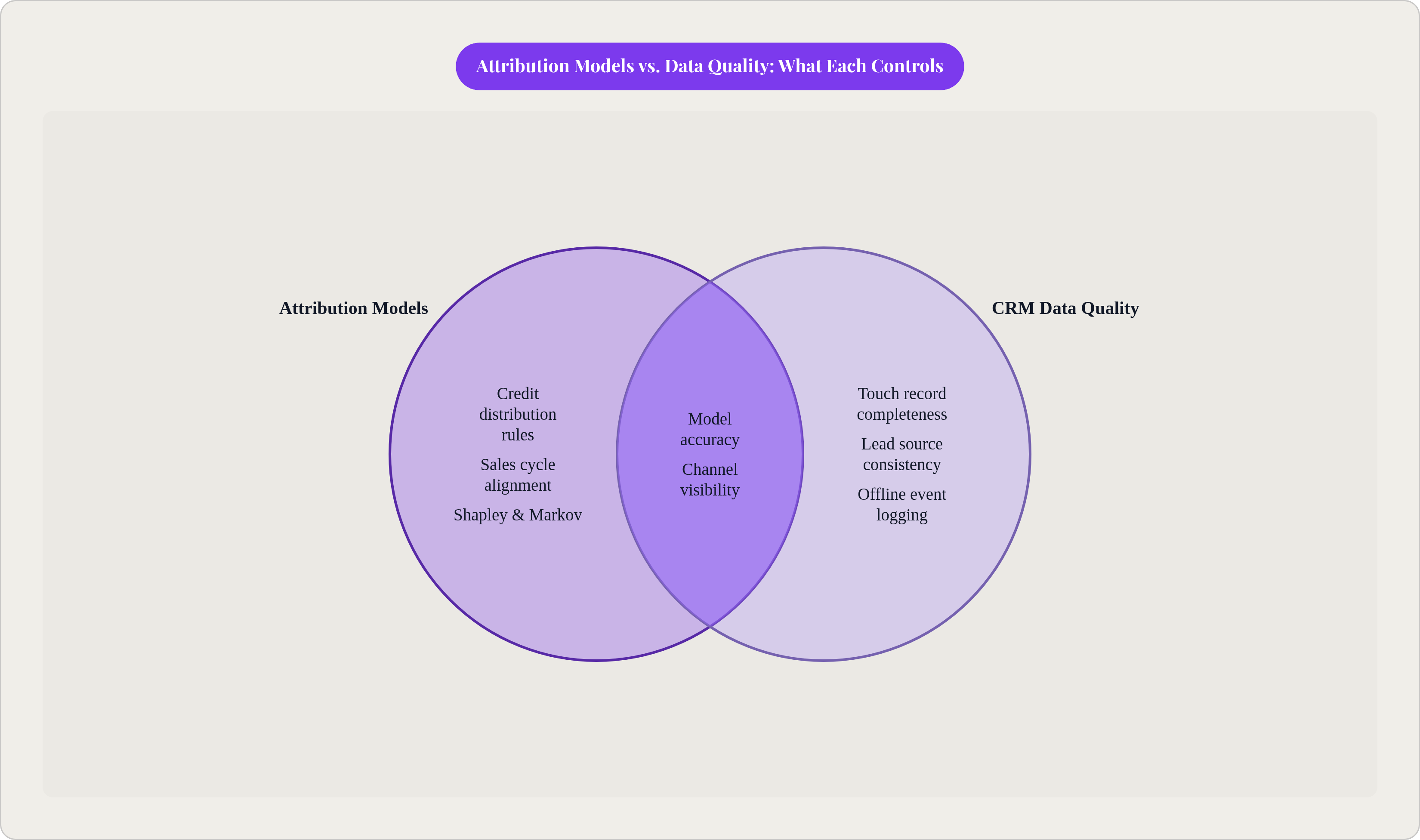
Attribution quality is directly capped by the quality of the underlying data. This is the single most underappreciated constraint in attribution, and it is where most implementations founder before a model is ever chosen.
The failure modes are structural, not exotic: (i) duplicate contact records cause the same buyer to appear as multiple distinct profiles, splitting or multiplying credited touches in ways that corrupt every downstream output; (ii) touchpoints that occurred but were never linked to a campaign record become invisible to the model entirely; (iii) inconsistent lead source tagging treats "Paid Search," "Google Ads," and "PPC" as three separate acquisition channels when they are the same one; and (iv) offline touchpoints, field events, phone calls, in-person demos, frequently never make it into the CRM timeline at all.
This is not a data team problem. It is a strategic liability that degrades every model the organization runs, and the cost compounds quietly over time as budget decisions calcify around outputs that were never accurate to begin with.
Cookie deprecation has sharpened this problem considerably. As cross-channel tracking fidelity degrades, first-party CRM data becomes the attribution anchor, which means the stakes for CRM hygiene have risen in direct proportion to the erosion of third-party signal.
The practical consequence is straightforward: audit whether your CRM actually records the touchpoints you believe it does before selecting a model. Choosing between W-shaped and algorithmic attribution when your offline touchpoints are unlogged and your lead source tags are inconsistent is equivalent to selecting a map projection before the territory has been surveyed.
The Blind Spots No CRM Attribution Model Fully Captures
Every attribution model can only credit what the CRM can see. In B2B, a meaningful share of buyer activity leaves no trackable footprint.
Community forums, peer review sites like G2 and Capterra, podcasts, word-of-mouth recommendations, analyst reports: these influence purchase decisions without creating any event the CRM can record. Forrester and 6sense research suggests a majority of the B2B buying journey occurs before a buyer identifies themselves to a vendor in any trackable way. Attribution models, regardless of their sophistication, are blind to this portion of the journey by design. That is not a fixable bug; it is a boundary condition of the methodology.
Multi-device and cross-channel identity gaps compound the problem. B2B buyers switch between personal and work devices across a long sales cycle. Without deterministic identity matching, typically login-based or CRM-matched email, probabilistic matching introduces error that accumulates across every step of a complex journey. By the time you reach a closed-won deal that touched eight channels over nine months, the compounding inaccuracy is not trivial.
Attribution window settings are a structural choice with real consequences, and they get made without explicit deliberation more often than not. Short windows miss the early touches that shape long B2B sales cycles. Long windows dilute signal by crediting interactions that had no meaningful influence on the eventual purchase. The window configuration is one of the most consequential settings in any attribution implementation, and probably the least discussed.
Attribution models distribute credit across what was recorded. They cannot recover what was not. In B2B, a substantial portion was not.
How to Match a Model to Your Sales Cycle, Data Maturity, and Decision Context
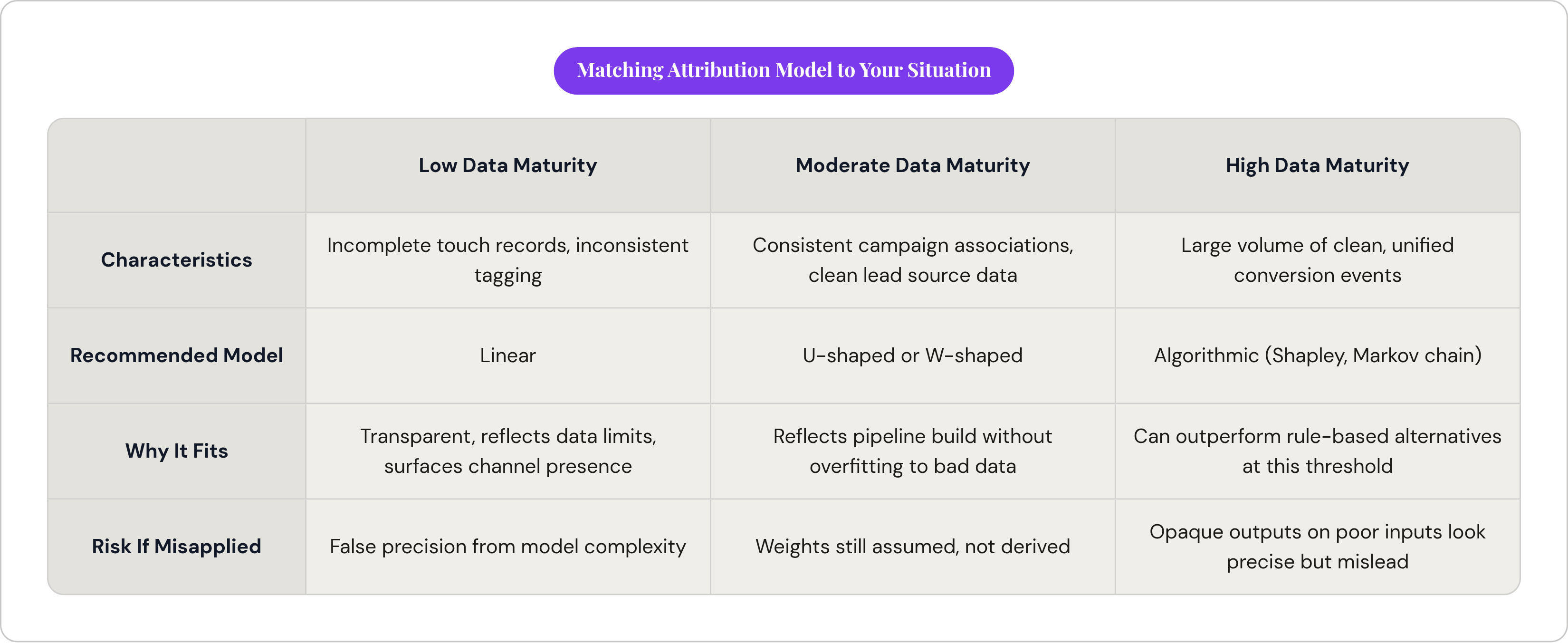
There is no universally correct model. The right choice depends on sales cycle length, data maturity, and what the attribution output needs to drive. Treating any of those as secondary produces a model that is technically implemented and strategically misaligned.
Sales cycle length shapes the choice considerably. Short cycles, measured in days to a few weeks, make time decay a defensible choice because recent touches genuinely are more influential when the window from first contact to conversion is compressed. Long B2B cycles, measured in months or quarters, make time decay actively counterproductive: it punishes the early brand and awareness work that placed you on the consideration set. U-shaped, W-shaped, or full-path models better reflect how pipeline actually builds across a protracted decision process.
Data maturity is where most teams overestimate themselves. Low maturity means incomplete touch records and inconsistent tagging; if that describes your current state, start with linear attribution. It is transparent, it does not pretend to precision the data cannot support, and it surfaces a baseline understanding of which channels are even present in buyer journeys. Moderate maturity, characterized by consistent campaign associations and clean lead source data, makes U-shaped or W-shaped models viable. High maturity, defined by a large volume of clean, unified conversion events, is the threshold at which algorithmic models can be trusted to outperform rule-based alternatives. Below that threshold, running Shapley value attribution is an expensive, opaque way to process bad inputs and call the output insight.
Decision context is the most operationally important consideration, and the most frequently neglected. If the goal is optimizing top-of-funnel budget, first-touch or U-shaped attribution surfaces where new pipeline originates. If the goal is evaluating nurture program performance, linear or W-shaped models give middle-of-funnel touches appropriate credit. If the goal is reporting closed-won revenue to leadership, full-path or algorithmic models provide the most defensible full-journey picture. If the goal is justifying spend to a skeptical CFO, a rule-based model with explainable logic often wins over a black-box algorithmic output, even when the latter is technically more accurate. Accuracy and persuasiveness are not the same thing, and conflating them costs budget.
One dimension that contact-level attribution misses almost entirely in B2B: buying group dynamics. Multiple stakeholders from the same account often interact with campaigns in parallel, across different channels and different content types. Account-level attribution, available in platforms like Demandbase and 6sense and increasingly in Salesforce and other major CRM platforms, reflects how B2B buying actually works: as an organizational decision, not an individual one. Running two attribution models in parallel is a legitimate practice when transparency and accuracy requirements genuinely diverge, one for stakeholder reporting and one for internal optimization, configured with full awareness of why they differ.
Where Attribution Ends and Incrementality Begins
Attribution and incrementality answer fundamentally different questions, and conflating them leads to real budget misallocation. Attribution answers who got credit; it cannot answer whether a touchpoint actually caused the conversion, a distinction most attribution discussions understate.
A channel that appears in every buyer's journey will always receive substantial attributed credit under any multi-touch model. But that ubiquitous presence often reflects buyer intent rather than channel effectiveness. High-intent buyers seek out more information everywhere; crediting every channel they touched with driving that intent is an attribution artifact, not a causal finding.
Incrementality testing, through (i) geo-based holdout tests, (ii) conversion lift studies, and (iii) matched market experiments, is increasingly used alongside attribution to validate model outputs. Marketing scientists at Meta, Google, and Shopify have been reasonably consistent on this point: attribution and incrementality answer different questions, and both are needed to build a defensible picture of what is actually working.
Marketing Mix Modeling adds a third lens, particularly relevant for enterprise B2B programs. MMM captures long-lag and offline effects that multi-touch attribution misses, including brand investment that takes quarters to manifest in pipeline. For organizations running significant brand budgets alongside performance spend, MMM and MTA are complementary instruments, not competing methodologies.
Treat attribution models as navigation instruments, not ground truth. They guide decisions about where to look and what to test; incrementality testing confirms whether the findings hold up. For teams running content as a multi-touch channel, this distinction carries particular weight. Thought leadership, SEO-driven articles, and email nurture sequences are systematically underweighted by last-touch models and frequently invisible in short attribution windows, even when they are the material that shaped the buying decision. The model you choose determines whether that work is measured, funded, and repeated, or quietly defunded because the data never captured it.