Content Feedback Loops from Sales to Marketing Using CRM
Sales data buried in your CRM holds the content insights marketing actually needs.
Most marketing teams have never spent an afternoon inside the CRM their sales colleagues live in every day. That's the core of the problem. Not strategy, not budget, not executive buy-in. Proximity. The CRM contains verbatim objections, the precise language a buyer used to describe their hesitation at the third meeting, and the reasons deals went cold. Marketing built the infrastructure, and then walked away from it.
Salesforce data suggests 91% of companies with ten or more employees use a CRM. So the tool exists. What doesn't exist, in most organizations, is a marketing team with meaningful access to what's inside it and any habit of doing something with what they find.
Here is what actually lives in there. Call notes from reps who just finished a hard conversation. Deal dispositions that say, in plain language, why an opportunity was won or lost, which competitors surfaced, and which objections never resolved. Pipeline stage data that shows exactly where prospects stall and what content was shared in the week before a deal went quiet. Intent signals. Lead scoring inputs. Engagement history before a prospect ever spoke to a rep.
Every one of those data categories has direct content implications. A prospect who stalls at stage three after seeing a particular case study is telling you something. A competitor who shows up in notes across fifteen deals in a quarter is telling you something more urgent. Teams that read this data regularly stop building content for hypothetical buyer questions and start building for the ones that actually killed deals last month.
The structural reason marketing doesn't read this data is mundane. Sales and marketing often operate in separate platforms with limited shared access. When systems don't share data, people don't either. It's a motivation problem only on the surface. It's really plumbing.
How a Closed-Loop Feedback System Actually Works Mechanically
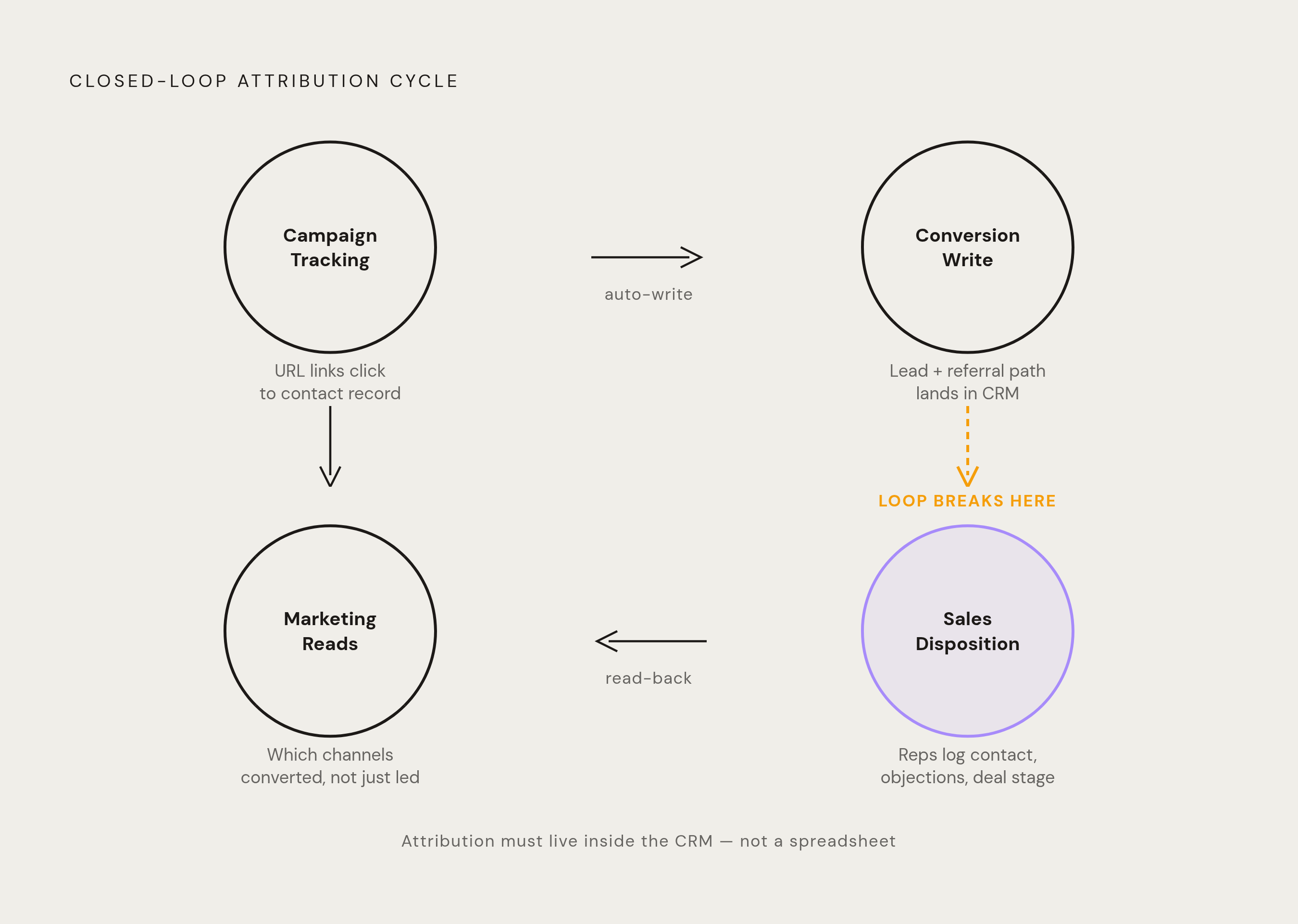
Closed-loop marketing, in the simplest possible terms, means tracking what happens after the lead leaves marketing's hands and routing that outcome back to the team that generated it. The concept is not controversial. The execution is where things fall apart.
Every campaign needs a tracking URL, so the traffic source connects to a contact record from the first click. Lead conversion data, including referral path and content consumed before conversion, writes automatically to the CRM. Sales then dispositions the lead: whether contact was made, what objections came up, and which stage the deal reached. Marketing reads those dispositions to evaluate which channels and content types produced leads that converted, not just leads that entered the funnel and disappeared.
The absolute non-negotiable: attribution has to live inside the CRM. Not in a spreadsheet someone updates when they remember. Not in a slide deck that gets shared at the quarterly review. If it isn't in the system, it effectively didn't happen.
The most consistent failure point is the hand-off itself. Marketing generates a lead, sales sees a name with no context, follow-up is delayed or generic, and the opportunity quietly dies. No one can diagnose why because disposition data never flowed back. That failure cascade is entirely predictable when systems aren't integrated and the hand-off protocol isn't formalized. I've watched it happen in organizations that had every tool they needed and just hadn't wired them together properly. The leads were real. The pipeline was real. The feedback was missing, so the whole machine kept spinning without learning anything.
Turning CRM Notes and Objection Data into a Content Signal
Rep notes are the closest thing to unfiltered buyer voice that marketing has access to. Not the language the campaign used, but the language the prospect used when they were describing their actual problem to another human being. That distinction is worth pausing on. There is a substantial difference between content that reflects how a company talks about itself and content that reflects how buyers describe the problem they need solved. The CRM is where the second version lives.
Getting usable signal out of those notes requires some discipline on the sales side. Objections should be categorized by deal stage because early-stage skepticism is a fundamentally different content problem than a late-stage stall or a loss reason. Notes should be tagged by persona or industry so patterns become segmentable rather than anecdotal. And teams should agree on shared terminology, applied consistently, so notes are searchable across the whole team over time. When multiple reps across different months all flag "security review" as an objection, that's not a one-off concern. That's a content gap, and it's been invisible because no one was reading the notes together.
The objection heatmap is a useful framing for this. When objections are logged at scale over time, the data reveals which concerns appear most frequently at which stages. That maps directly to where content is missing or failing to convince. It also surfaces something more granular: the difference between an objection that gets resolved and closes, versus one that consistently kills deals. Those require very different content responses, and most teams are building the wrong one because they're guessing.
A quarterly win/loss review where sales walks marketing through deal outcomes, structured around note data rather than rep impressions, is a lightweight starting point. It's not a substitute for a real system, but it's how most teams build the muscle before they formalize anything.
The Structural Conditions That Make Feedback Loops Sustainable
Most organizations attempt an informal version of this. A few motivated people on each side trade information when they think of it. It works until those people get busy, change roles, or simply stop thinking of it. The loop collapses and no one notices immediately because there's no system to produce an alert when it breaks.
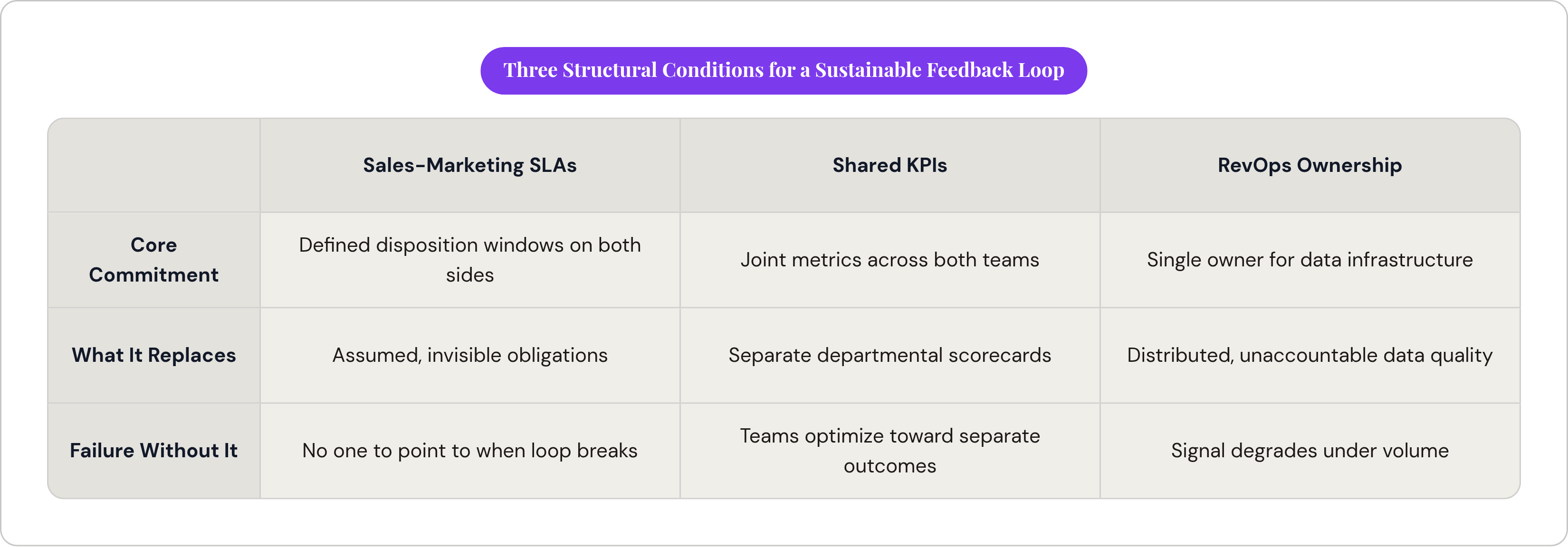
Three structural conditions prevent that collapse. First, service-level agreements between sales and marketing. Sales commits to returning disposition data within a defined window; marketing commits to acting on it within a defined window. The obligation is explicit and documented, not assumed and invisible. When the SLA exists, both sides have something to point to when it breaks down.
Second, shared KPIs. This is the one that most organizations resist longest because it requires relinquishing departmental scorecards that feel comfortable. If sales is measured on closed revenue and marketing is measured on lead volume, they will optimize toward those separate outcomes regardless of how many alignment meetings they attend. Conversion rates, pipeline contribution, and speed-to-lead need to be metrics both teams own, not metrics each team watches the other team miss.
Third, a RevOps function with real accountability. Someone has to own the data infrastructure that makes the loop auditable and consistent. Without that ownership, the system degrades under volume. Gartner has projected that by 2025, the majority of highest-growth companies will have deployed a RevOps model. The reason is straightforward: distributed accountability for data integrity produces distributed data quality, and distributed data quality produces an unreliable signal.
Shared dashboards inside the CRM, surfacing lead quality by source, content engagement across the pipeline, stage-by-stage drop-off, and objection frequency by segment, address this more durably than any weekly meeting cadence. Meetings end. Dashboards stay.
How AI Is Changing the Speed and Scale of Signal Capture
AI is solving the biggest bottleneck in the feedback loop: the inconsistency of manual note-taking at scale. When the loop's quality depends on a rep logging detailed, consistent notes after every call, under time pressure, across a full pipeline, data quality degrades predictably. That's not a character failing. It's a throughput problem.
AI-native call analysis platforms like Gong, Chorus, and Clari process call recordings at scale and surface cross-deal patterns without depending on rep memory or post-call discipline. They identify competitor mentions, pricing objections, and feature concerns across hundreds of conversations simultaneously. Some flag signals during the call rather than requiring post-call synthesis. Most route summaries to reps, managers, and marketing via existing integrations, getting content-relevant intelligence in front of the right people within hours of a conversation instead of weeks later, when the context has faded.
What this enables downstream is a dynamic sales playbook rather than a static document that grows obsolete between updates. AI-informed systems recommend content based on deal stage, buyer behavior, and competitive context. A rep working a late-stage deal where pricing just surfaced as a concern gets pointed toward a specific ROI one-pager, not the generic deck that was accurate eighteen months ago.
One thing worth stating plainly: AI in CRM performs exactly as well as the data it learns from. Poorly structured records and inconsistent note conventions produce noisy outputs. The structural discipline described in the previous section is a prerequisite for AI-augmented signal capture. These are not parallel tracks; one enables the other. Platforms built to automate the full content lifecycle, like Letterstory, depend on that same clean upstream signal to route objection data through drafting and publishing without losing fidelity.
Content operations platforms that integrate with CRM data can close the final mile by converting objection patterns and surfaced content gaps into briefs, drafts, and on-brand assets. The signal doesn't have to stop at insight. It can go all the way through to production.
What the Feedback Loop Produces When It Runs Consistently
When the feedback loop runs consistently, it fundamentally changes what marketing produces and how closely it matches what sales actually needs. Content stops being built around assumed buyer questions and starts being built around documented ones. Objection-specific assets, the one-pager addressing the security review concern and the email sequence for a late-stage pricing stall, reflect what actually came up in conversations, not what someone in a conference room predicted would come up. Stage-mapped content aligns to where buyers demonstrably are, based on pipeline data. Competitive positioning responds to what competitors are actually saying in deals, because reps are logging it and marketing is reading it.
The more meaningful change is in messaging recalibration. When a value proposition lands differently in real conversations than it does on the website, the loop surfaces that gap early. Without the loop, that misalignment compounds quietly for months. Marketing keeps amplifying language that buyers are privately pushing back on, and no one knows until someone asks why conversion rates drifted.
The compounding effect is what makes this worth the structural investment. The longer the loop runs, the more specific and calibrated the signal becomes. Content decisions that were once intuitive become grounded in what real buyers said last quarter, then last month, then last week. The distance between what marketing produces and what sales reaches for in a live deal narrows to something that, eventually, starts to feel like the same thing.
That outcome is achievable with the infrastructure your organization likely already has. The CRM is sitting there. The data is accumulating. The question is whether you have built a reason to read it together.