CRM Software for Healthcare Patient Relationship Management
Healthcare CRM tracks patient engagement separately from medical records.

What does healthcare CRM software manage?
Healthcare CRM keeps a clinic connected with the people it treats, which is separate from their medical chart. A patient's chart can be flawless, yet she can spend eighteen months with no checkup, since nobody's software was ever built to catch that she quit booking. Many people believe EHR has this already. That's wrong, and the biggest error happens when any practice buys software while acting like those two systems are interchangeable.
A health file shows the appointment: signs, conditions, drugs, test results, and care details a doctor uses later. Reaching out isn't part of its job. EHRs skip reminders, referrals go unmonitored once they exit, patients without post-discharge follow-ups stay invisible, and flu-shot rosters never get built. The software isn't at fault; this just isn't its work. In practice, this gap shows up all the time: a flawless chart beside a patient who slips away and doesn't return.
Healthcare CRM steps into that space. Instead of living within the EHR system, it sits beside it and handles engagement tasks: scheduling, communication, outreach, tracking referrals, plus an ongoing log showing where a patient sits during their care. EngageBay's rundown uses Wikipedia's CRM framing, which splits the tasks into several domains. That CRM arm handles referrals, clinical pipelines, plus winning new patients. Promotional CRM handles ads, SMS and inbox alerts, health bulletins, plus winning back people who stopped coming. CRM covers booking, patient onboarding, virtual care alignment, prioritization, and everything that follows a consultation.
A CRM entry and a chart hold very different things. Appointment history, referral progress, communication logs, care pathway position, segmentation tags: this is CRM ground. Clinical records and drug lists don't appear. WebMD Ignite frames a broader take on this as one combined information base, bringing age, mindset, community, behavior, medical, financial, and engagement details together into a single view of how a person behaves. That payoff shows up in daily work: care staff quit relying on recall to spot patients who are overdue on their mammogram or behind on a post-op check, since the software flags it rather than a staffer keeping track.
In 2025, patient care made up the biggest segment of revenue at 44.6%, according to DataBridge Market Research, which also showed software platforms alone earned 47.8% instead of services built around them. Customers are investing in platform features that work independently.
Clinicians almost never handle the software in their routine work. Reception teams use it alongside marketing coordinators and care coordinators, with practice leads, making clear this tool is: a work and communication setup with a healthcare name, built to serve people managing patient contact, not clinical decisions.
When implementations work well, those two systems share information. FHIR APIs plus HL7 feeds surface useful clinical details, such as a patient needing a routine test, right in the CRM instead of duplicating the chart. If that link fails, a practice ends with two systems that can't see one another, and this recreates the same gap that CRM meant to fix.
Where AI is changing what these platforms can do
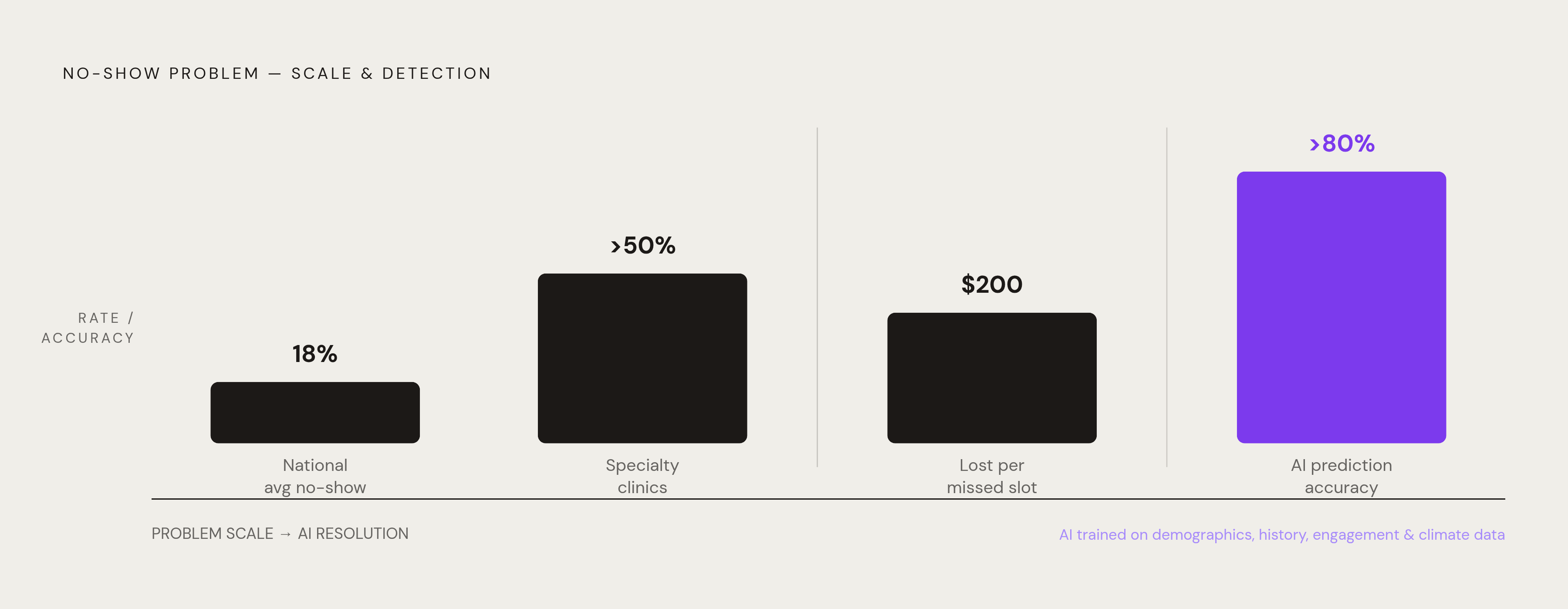
AI earns a place on no-shows, and the point is plain. About 18% is the typical figure across the country, specialty clinics watch it cross 50%, and each unfilled appointment runs a doctor close to $200 in missed income, per a GroovyWeb breakdown. That compounds into serious cash weekly for any mid-size practice.
That GroovyWeb piece says learning systems using demographics, appointment history, past communication engagement, and climate data spot no-shows over 80% of the time. What changed is when it acts. Rather than blasting each patient with a 24-hour-before text that's identical, the software contacts each high-risk patient sooner, or by another route, and ignores the steady ones.
Tools for more than no-shows have expanded quickly, arguably more quickly than certain practices might absorb. Before people lapse, Predictive analytics flags those drifting toward disengagement. Natural-language software changes words to match how each patient prefers being contacted. It spots dissatisfaction in post-visit feedback a staff reviewer might skim over. Autonomous tools, including Salesforce's Agentforce in Health, rolled out during 2025, now do benefits verification, clinical trial recruitment, and disease surveillance tracking without an employee doing each part.
GroovyWeb's report says AI-powered CRMs reduce office work 30 to 40%, and both retention plus care-quality go up together instead of competing.
It all falls apart when data is poor, though, and that's where many rollouts go wrong. Predictive systems learning from fragmented, incomplete patient data will yield predictions that are fragmented, incomplete. Data hygiene is what the AI rollout needs first. That's what determines if the rollout works or not.
What makes the market's expand
Numbers for the market shift a lot based on who measures it and how. Grand View Research puts the market at a substantial figure for 2025, rising toward a much larger sum come 2033, with growth of 6.2% compounded each year. Mordor Intelligence gives a smaller starting point for 2025, though it sees a much steeper rise, roughly doubling by 2031, and 12.34% CAGR. Precedence Research begins even smaller for 2025, then forecasts more than double that figure come 2034, rising 9.76% a year.
The range reflects what gets included rather than market disagreement, since certain groups add related health-IT areas while a few track just standalone CRM platforms alone, and no one has yet smoothed the gap to form a single tidy figure for trusting.
No matter which figures you check, North America is out in front. Precedence Research puts this region's 2025 number at a level less than half of what it forecasts for 2034 on roughly 9.94% CAGR growth, while Grand View Research puts North America's worldwide slice near 53.0% for 2025. Asia Pacific climbs more quickly from a lower starting point, per Mordor Intelligence's 13.62% CAGR, and that's the figure revealing where the coming ten years of expansion play out.
The reasons behind this expansion are clear. Care keeps moving toward patient-centered approaches, pushing practices to communicate differently after leaving the exam room. Cloud platforms lowered costs so mid-size practices can use this software now, unlike ten years back. People today want the instant, personal service online finance already gives them, but the healthcare field is behind that standard instead of leading it. Big care groups doing revenue-cycle and population-health work require coordinated engagement data for many people at once, while telehealth brings new touchpoints, online calls, check-ins, beyond an EHR for tracking.
HIPAA compliance as a non-negotiable design constraint, not a feature add-on
A vendor must have a Business Associate Agreement in place before their CRM handles health data. This is the minimum bar, not something up for discussion.
Below that floor sit the technical controls that make compliance real instead of nominal: encryption of data in transit and at rest, role-based access so staff only see what their job requires, and audit logs that record who touched a record and when.
Vendors throw around the phrase "HIPAA certified" loosely, but it carries no legal weight. No software gets certified under HIPAA. Compliance is either self-declared or checked against an outside standard such as HITRUST, per industry sources. A logo on the vendor's homepage means little; what counts are BAA details and real technical controls, so people must review those themselves rather than trusting marketing.
CRMs such as Zoho plus Salesforce can be made HIPAA ready, but the customer must do the heavy lifting. Purpose-built platforms usually come with those rules pre-configured, so that fact should drive a buying choice well before a famous name does.
That tradeoff may imply a sacrifice in writing, but compliance leaves a practice's marketing sophistication in place. The right CRM can sort patients better and shape messages more closely than mass-market software, while blocking the data risks tied to that choice. In busy healthcare markets, an audited CRM under a BAA reads as proof patients can count on, which can lead to better patient retention, referral pipelines, and payer partnerships.
Deployment choices count here as well. Cloud continues to lead in sales, while DataBridge Market Research's numbers point to the on-premises segment expanding at 19.8% CAGR from 2026 to 2033. A practice's compliance stance ought to drive how it picks deployment.
What these platforms are built to do
Epic Systems anchors this market by default: approximately 428 systems with 22.4% of hospital CRM installations, per EngageBay. Built EHR-adjacent, Epic's CRM works closely with the clinical data its ecosystem already holds. This health-system tool serves big networks, so treating any small practice like a sensible starting point wastes cash and setup hours that a basic platform could handle more easily.
CRM.org's assessment states that Salesforce Health Cloud is constructed for top-tier care coordination. It then builds the 360-degree patient view, a term from Smartbridge's analysis, unifying clinical data, care plans, determinants, plus engagement history; it connects into EHR systems using FHIR APIs with HL7 feeds, per Melonleaf Consulting's findings. This AI works in two ways: Einstein AI covers predictive analytics plus embedded guidance, while the Health Agentforce, launched during 2025, supports autonomous benefits verification and disease surveillance, plus clinical trial recruitment. Avenga's report counts more than 140 customers on Agentforce Life Sciences, double the count from less than a year prior, with Pfizer, AstraZeneca, Moderna, Takeda, and Novartis named among them. Salesforce's EU documentation confirms Health Cloud is GDPR compliant and meets HIPAA from the start.
CRM.org says NexHealth was built for appointment scheduling plus automated reminders, with pricing on request. Tebra is positioned to manage the patient lifecycle in one place, priced on request. Built for dental care teams, the tool has cost details from CRM if asked; Neklo's 2025 figures say plans begin from $99 monthly, meet HIPAA-compliant rules, and are hard to learn, Neklo says.
Write-ups from CRM.org plus Neklo's reviews say LeadSquared collects prospects, sends replies by itself, and instantly looks at health records. CRM.org gives costs on inquiry, whereas Neklo shows a base rate of $25 a seat monthly with made-to-order options above it, and checks HIPAA adherence.
For $15 per user, CRM.org says HubSpot for Healthcare is built around engagement and patient outreach efforts. Making this general-purpose platform HIPAA-ready demands precise configuration, since compliance features aren't built into the software by default. EngageBay's 2025 data shows it offers segmentation through mail, natural discovery, and engagement.
For the Healthcare plan, Zendesk is mainly built around service desk ticketing, with CRM.org pricing it $19 for each user. Neklo's 2025 figures list a healthcare rate of $189 for each person monthly, distinct from the standard Zendesk cost that CRM reported, so don't mix them up. Neklo says it can become HIPAA compliant, but the needed customization can get hard quickly.
Zoho CRM stays general-purpose while being positioned around patient data for small practices and mid-sized ones. Under 2026 pricing, it runs between $14 per seat each month for Standard and $52 under Ultimate, paid annually, with HIPAA controls requiring configuration. Making this general-purpose platform HIPAA-ready demands precise configuration, similar to HubSpot.
Keap, once known as Infusionsoft, puts patient care first and offers practices like these an affordable way to use compliant CRM, per Neklo reviews. Its entry package costs $159 per month, with BAAs available on every tier, making it one of the easier compliant picks for a micro-sized practice.
Dynamics 365 aims at tailored treatment programs for bigger practices, from $95 per seat monthly, per Neklo's figures. It meets HIPAA rules and leans on the backing of a big-name vendor, yet Neklo's 2025 figures point out a steep learning curve for groups newer to it, the same caution tied to Epic. Sophistication costs money; one small practice ends up buying features it won’t use.