Revenue Operations as the Bridge Between CRM and GTM Strategy
When pipeline grows but revenue goals don't, RevOps fixes the leaking funnel.

Revenue Operations is needed because most GTM plans break down before they ever reach the CRM. That gap shows up in the numbers. Fullcast's Benchmarks Report showed businesses reduced sales quotas by an average of 13.3%, but nearly 77% of sellers still missed them, proof the strategy couldn't work. It is not a talent issue. When quotas land 13% too big while three-quarters of sales reps still miss, the plan was never executable.
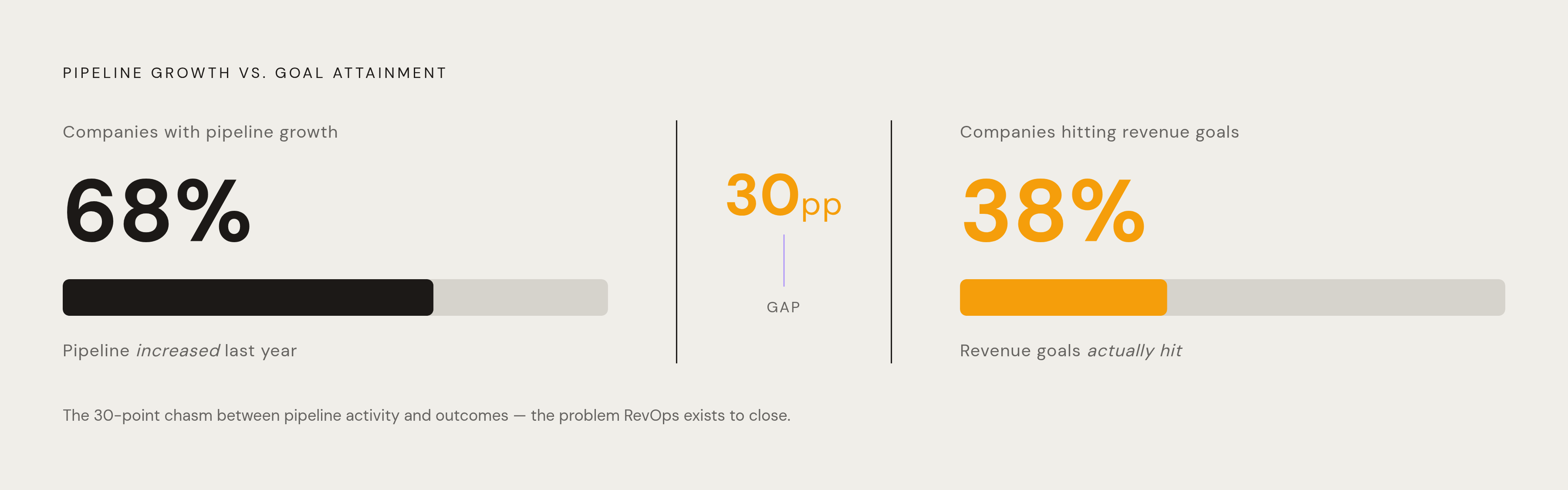
That report found deals closing 8.3% less often, with sales cycles stretching nearly 7% longer. Meanwhile, a separate finding puts real numbers on the disconnect between activity and outcome: 68% of companies saw pipeline increase over the past year, yet only 38% actually hit their revenue goals. Pipeline isn't the bottleneck. The problem sits downstream of pipeline, where prospects are routed, forecasts take shape, and handoffs between marketing, sales, and customer success are leaking revenue already in the funnel. RevOps exists to spot and stop that drain.
The Definition of RevOps
A few misreadings are circulating, and they all undersell the function. RevOps only sounds like rebranded sales ops; it is a function that covers more. It is not something you purchase from a vendor's site. And it is not just an org chart move that puts several ops groups under one boss while they keep doing the same things.
RevOps is a way of running things. It's the backbone spanning people, data, process, and tools that lets marketing, customer success, and sales execute a GTM approach together in real time, without competing interpretations of "closed" or "qualified". Leaders like Tessa Whittaker, VP of Revenue Operations at ZoomInfo, and Theisen Chang, Senior RevOps Manager there, illustrate the distinction: GTM strategy defines how an organization finds buyers and presents its product, while RevOps strategy is the system that lets the work get done. Leaders mix them up regularly, thinking a strategy document just runs itself.
Comparing it to sales ops makes the point clear. Sales ops scopes its work around sales execution, takes direction from the VP of Sales, and gets measured by quota attainment, closed deals, plus ramp time. RevOps scopes across the revenue lifecycle, sits under the CEO or the CRO, and uses pipeline velocity, CAC payback, and net revenue retention. Framing RevOps as just sales ops with extra layers lets the silos it was meant to kill set in: territory plans run on sales-only data slices that drop attribution tied to marketing and customer success health metrics altogether, which is how unfair territory maps and morale issues get locked into the setup from the start.
How far RevOps adoption has come
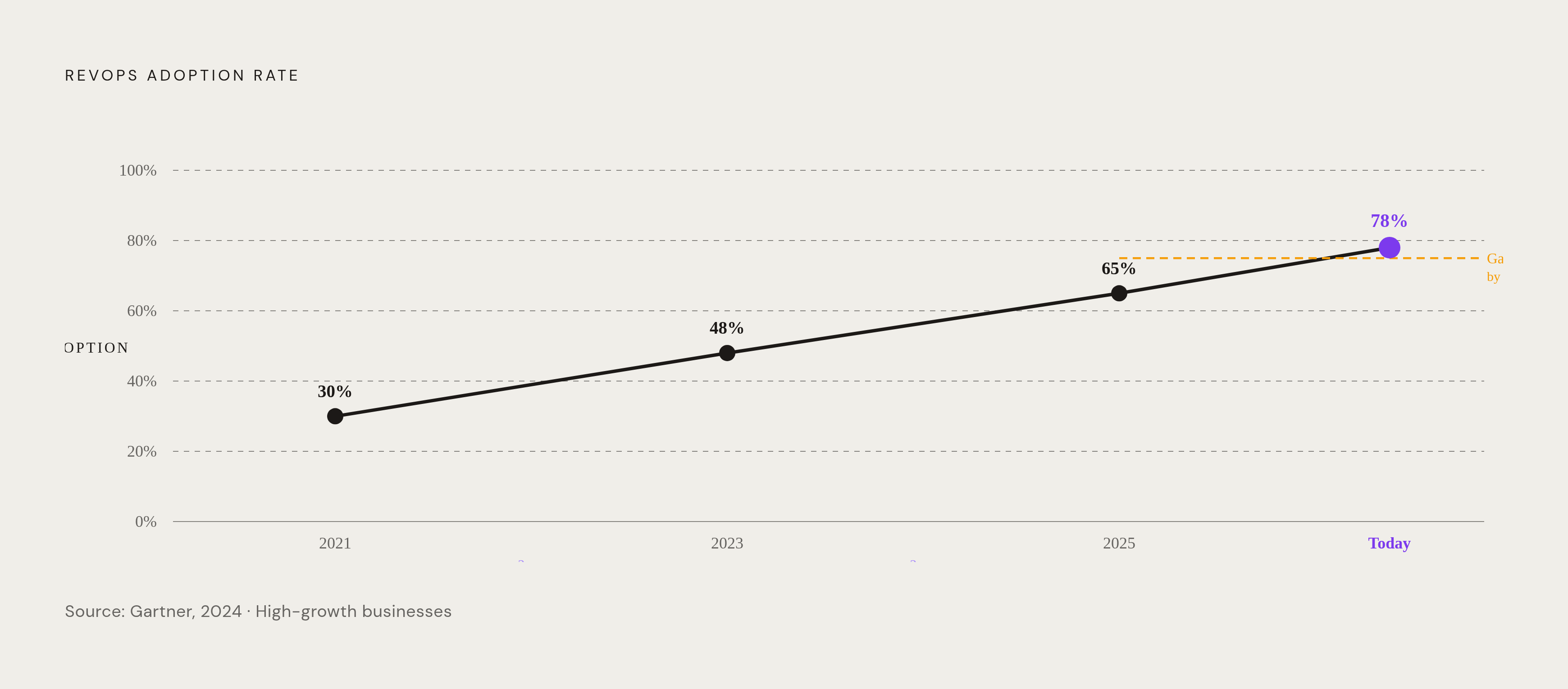
Gartner's projection says adoption will reach 75% among high-growth businesses with RevOps by 2026, after being below 30% only recently. That's hardly incremental growth. That is a function jumping from niche to default across one planning cycle for most firms.
The 2026 RevOps Report polled B2B companies and shows steady growth: 30% adoption back in 2021, then 48% by 2023, rising to 65% during 2025, hitting 78% today. The 22% lacking a function are mostly early-stage firms under a set ARR point, with operations handled by separate leaders instead of being centralized. That's a stage-appropriate setup, not a flaw, but the function usually formalizes once a firm crosses the revenue and headcount point where informal coordination can't keep scaling.
Hiring data backs the same trend. "VP of Revenue Operations" openings climbed 300% across eighteen recent months, while ZipRecruiter shows over 174,000 active RevOps postings. Pay matches the seniority commands: entry-level RevOps jobs bring in between $100,000 and $160,000, while veteran leaders earn $273,000 in comp. Firms fund these positions to get results. Results are what they're buying.
Why the CRM is the foundation, not just a tool in the stack
One expert puts it bluntly: a business's CRM shapes how its RevOps runs. Any automation, AI tool, or dashboard the revenue group uses reads from that system and updates it. If the data is bad, what runs on it is bad, just more sure of itself.
A RevOps strategy playbook is explicit: RevOps controls the systems, and the CRM, be it Salesforce, Dynamics, or HubSpot, functions as the one record everyone trusts. Every other tool either feeds the CRM or pulls from it. No exceptions, because once one exists, another place for truth appears, and each group acts on its own view of that pipeline.
The data issue runs deeper than a simple nuisance. For 38% in RevOps, bad data is a main work problem, and for 60% in revenue, data silos get in the way of forecasting. Clean data foundations lift sales efficiency by 40% and cut slippage by 22%, the same RevOps work found, with deals finishing on time rather than pushing into the next quarter. That’s a real result. Deals close on time rather than sliding a quarter when the data behind projections is trustworthy.
This goes beyond getting the reports right. Nearly two-thirds of CROs have little confidence in their Ideal Customer Profile definition when data is scattered across silos. If marketing, sales, and CS can't see eye to eye on who the customer is, the GTM strategy is misaligned before any rep makes a call.
The four functions RevOps performs to make GTM strategy executable
RevOps proves why it belongs through its four connected jobs, and each one needs the earlier CRM information base. Take that layer away and each function degrades to guesswork.
Bring RevOps into Proactive planning. The pattern shows up at every January kickoff: executives give RevOps final targets for Q4, with the work behind them, routing, territory carving, and comp, unable to be ready before January 1. What helps is jumping in sooner, not pushing harder. What's needed is earlier involvement. Planning works when the Q3 kickoff includes shared OKRs shaped by real constraints and RevOps workload, not hoped-for quota growth that assumes better routing is already done.
Shared metrics belong to every revenue group. Departmental KPIs such as MQL totals, NPS, and quota attainment have value in their respective functions, yet they won't reveal if the revenue engine runs properly. It calls for shared measures: revenue kept, pipeline speed, time until revenue, CAC recovery. Pipeline velocity, how quickly deals progress and close, is now the top RevOps measure. A drop in velocity flags trouble in the process or data layer, usually ahead of the revenue figure turning.
Territory plus enrichment: a layer linking CRM-to-GTM. CRM data gets out of date quickly. Enriching records with firmographic and technographic data plus intent signals surfaces growth potential and keeps TAM models accurate. Mixing third-party signals and first-party data holds territory models steady across planning cycles instead of watching them degrade right after the planning offsite. Territory models that exclude marketing attribution alongside CS health signals create inequity plus the rep morale problems Fullcast's work found, echoing earlier concerns about sales-centric cuts of data.
Cross-functional handoff process. The connective link among all those functions is the literal handoff, when a prospect or customer shifts from one group to another's. Each metric, each enrichment, each planning cycle either reinforces that handoff or erodes it.
What the financial case for RevOps looks like
This function pays off in clear numbers, not reputational gains. Forrester's study of revenue engine alignment found that firms aligning people, tools, and process down the funnel gain 36% extra revenue growth plus up to 28% added profitability over others who don't. On paper this looks like a routine ops task, yet it carries enterprise-scale impact.
Organizations with an established RevOps setup report 19% faster revenue expansion and 15% greater profitability than those without one. The data shows what a setup buys: companies with formal RevOps functions are 1.4x more likely to exceed their revenue targets by 10% or more, and 2.4x more effective at automating customer follow-ups.
Year-over-year figures settle the argument on spend, not only growth. Well-run RevOps teams cut GTM spending by 30% and drive 10% to 20% higher sales output per person, counting new pipeline and won contracts. When growth and cost savings rise in step instead of one coming at the other's expense, that's the mark of a revenue engine doing what it should.
Where AI fits into a RevOps function built on clean CRM data
AI adoption in RevOps has grown quickly, but not as quickly as the marketing makes it seem. A 2026 report says 61% of RevOps shops have AI in at least one workflow, up from 34% in 2025. Yet only a small fraction have autonomous workflow execution fully operational. The gap between AI adoption for forecasting and fully autonomous execution remains wide, far from the hands-off operation vendors push in a demo.
Where AI is earning its keep today is narrower and more specific than "AI-powered everything." Predictive lead scoring built on behavioral and firmographic signals is replacing gut-feel prioritization. AI now projects revenue from data, not from the rep-level gut checks that once anchored every call. With Conversational analytics, a RevOps analyst can put a plain-language request to the revenue data instead of making a report. Third-party intent data flows into CRM and sales systems automatically, so reps get a real-time read instead of waiting for a quarterly estimate.
AI tools now handle sales cadences, CRM cleanup, pipeline predictions, and region assignments that once kept a RevOps specialist busy all day. They handle every handoff from marketing to sales the same way and tell the owner right away when the deal goes off course.
It all depends on the groundwork described earlier here. RevOps AI only matches the CRM data it reads, and Skaled nails the issue: the data is there, but the answer sits underneath it. The prerequisite the AI conversation depends on is Clean CRM data, not a side issue. Every part of this conversation depends on that prerequisite.
What it takes to build the bridge: the RevOps flywheel in practice
Pulling it all together, a clear framework takes shape: planning, KPIs, territory work and lead data, and smooth handoffs, all running on one CRM source of truth, with AI added on top to speed up whatever parts of it already rest on reliable data. Practitioners call it a flywheel where planning, process, data, tech, people, and metrics are interconnected so they reinforce one another once aligned.
The framing shapes how it gets interpreted and put to work. A flywheel builds speed only when each part feeds the one after it. When no shared metrics back the planning, targets become unmeasurable. Shared metrics minus clean CRM data mean dashboards no one trusts. Without enrichment, territory models go stale inside a quarter. And layering AI there before the data is right only automates the same wrong calls faster.
That's the real case for treating RevOps as a connector, not a silo. GTM strategy proposes the direction an organization hopes to take. The CRM, clean and trusted as the real source of truth, is the road ambition travels to turn into a signed contract. RevOps, as a function, builds and maintains that path through every data point, handoff, and shared metric over time.
Sources
- Revenue Operations Strategy: A 2026 Framework for GTM Teams
- Blueprint for GTM and RevOps Alignment for A Predictable Growth - Fullcast
- RevOps Trends 2026: Top 4 Shifts in People, Process, and Tech
- How to build a winning revenue operations strategy
- The Future of Revenue Operations (RevOps) in 2026
- Revenue Operations: The What, Best Practices & RevOps Guide
- 2026 RevOps Report: Key Trends Reshaping Revenue Operations
- RevOps Framework: How B2B Companies Unify GTM in 2026